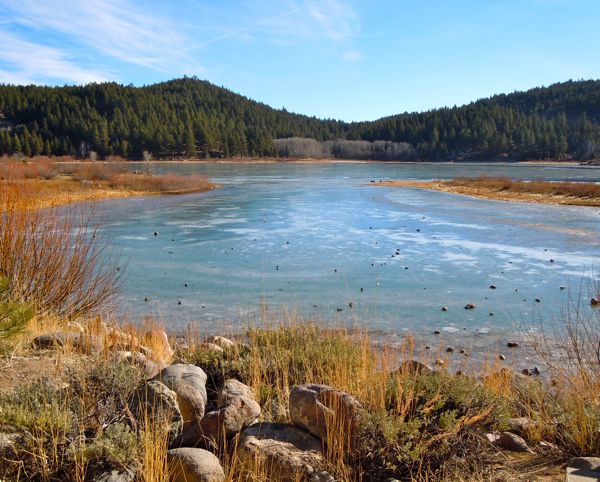
End of bear hunting season does not make controversy go away

By Jeff Delong, Reno Gazette-Journal

The new year ended Nevada’s first black bear hunt with 14 bears killed and no sign that controversy over the hunt is near an end.

Nine male and five female bears were killed since the hunt’s Aug. 20 start, six bears shy of the maximum that could have been taken by Dec. 31.

The hunt was approved by the Nevada Wildlife Commission after a series of crowded public hearings and protests and vigils conducted by organized critics. A lawsuit was filed to block the hunt but was rejected by a district court judge in Carson City shortly before the hunt began.

“I think it was very successful,” Carl Lackey, a biologist and bear expert with the Nevada Department of Wildlife, said of the state’s inaugural bear hunting season.

Lackey said a few more bears were killed than he expected and that he was somewhat surprised only two of them were taken in the Carson Range. None was killed in the Lake Tahoe Basin.

Of the 14 bears killed, half were taken in the Pine Nut Mountains east of Minden. Two were taken in the Stillwater Mountains near Wellington and three in the Pine Grove Hills in Lyon County.

Read the whole story


10 tips for how to exercise while at work

By Nathan Henley

Many of us spend our workdays sitting at a desk or a computer. Our shoulders get tense, our backs slouch over, and our fingers and hands are the only parts of our body that move for most of the day. With the new year here, many of us made resolutions to be healthier. Why not resolve to try some of these exercises while at work?

1. Leave the car at home. If possible, consider walking or riding a bike to work. If you use public transportation, you could start getting off a few stops ahead of time and walk the remaining distance. Even if you have to drive, you could park farther away. Also, skip the elevator and take the stairs.

2. Stand up. We burn more calories standing up than we do sitting down. Stand and walk around your office while on the phone. You might also consider getting a high table to work at for a few hours during the day. If you need to talk to a colleague, walk to their office rather than relying on texts and instant messaging.

3. Take a break. When you need to take a break, take a quick walk or do some stretches. Turn your head side to side, roll your shoulders forward and backward, and stretch your arms and legs.

4. Sit on a fitness ball. Get rid of your office chair and trade it for an inflated fitness ball (as long as you can safely balance on it). Sitting on one of these will improve your balance and your core muscles. You can also use the ball for exercise during breaks.

5. Turn your cubicle into a gym. Keep light hand weights or resistance bands in your office. You can easily do some arm curls in those five minutes before a meeting when you normally have nothing to do.

6. Start a fitness club. Find some co-workers who are interested in working out and organize a lunchtime fitness club. You can walk or jog around the block. This will improve workplace camaraderie and help you keep each other accountable for exercising.

7. Make meetings active. For informal meetings with one or two people, consider walking and talking. You can walk around the building while talking or even go outside if the weather is nice.

8. Speed up. If your job involves walking in some way, try walking faster. You may need to switch your high heels for flats, but the quicker you walk, the more calories you’ll burn.

9. Plan your travel. If you have to travel on the job, don’t forget about exercise. If you’re waiting around in an airport, you can take a walk around the terminal. Some equipment like tennis shoes, resistance bands, and jump ropes are easy to pack. Reserve a hotel with a fitness room. You could even bring a workout DVD with you and do it in your hotel room.

10. Do two things at once. If you truly want to work and exercise at the same time, consider turning a treadmill into a desk. James Levine of the Mayo Clinic came up with a desk that can be installed onto a treadmill so that it’s possible to walk and work at the same time. Studies have shown that the average person can burn an extra 100 calories an hour while walking less than 1 mile/hour on the treadmill. Sound crazy? See it for yourself.

Nathan Henley is a sports psychologist who specializes in performance improvement and injury rehabilitation. He also owns the site Sports Psychology Degree for students interested in getting a degree in sports psychology.


Water content in Sierra dismal, record low set for January

By Kathryn Reed

PHILLIPS STATION – Scanning the field at the base of Sierra-at-Tahoe, Frank Gehrke wonders if he needs to bring his equipment out of the vehicle.

It turns out he does need the tools. But he didn’t need them to tell the story. The dry, not even muddy field spoke volumes. The Sierra has no snow.

Frank Gehrke barely found any snow to measure Jan. 3 near Echo Summit. Photo/Kathryn Reed

No snow has many ramifications for a state that depends on its mountains to fill its reservoirs, irrigate its fields, provide winter recreation that translates into tax dollars and keeps people out of the unemployment line, and lowers the threat of fire.

The one measurement Gehrke took Jan. 3 showed a snow depth of 4 inches. But it’s the water content that matters. It came in at 0.14 inches – a record low.

Gehrke has been taking snow samples near the top of Echo Summit for the California Department of Water Resources since 1987. That was the year the previous low water content record was set at 0.9 inches.

1987 was also the start of a five-year drought.

While no one wants to use the “D” word this early in the season, the lack of precipitation throughout California and Nevada last month had it going down as one of the driest Decembers on record. What Northern California has been experiencing is typical in a La Nina year.

Liquid Precipitation

Location         Dec. 2011    Dec. 2010  

S. Lake Tahoe  trace            6.43 inches

Tahoe City       trace          11.40 inches

    Reno                 zero             1.39 inches

Carson City      zero             3.39 inches

Bridgeport       zero             4.52 inches

Mammoth        zero           13.17 inches

Driest Decembers on record

Location           Precip Total/Years

S. Lake Tahoe               trace (2011)

Reno     zero (2011,1883,1882,

1877, 1876,1874)

Carson City      zero (2011,2000,1989)

Mammoth        zero (2011)

2011 Oct.-Dec. Precipitation Totals and Rank

Location           Precip Total/Rank

Tahoe City         3.72 inches (8th driest)

Reno                   0.30 inches (5th driest)

Carson City        0.45 inches (3rd driest)

Source: National Weather Service

The irony is arid Southern California has received more moisture. Some areas are having an above average rainy season.

The smell of dry grass lingers in the air where the snowpack is being measured. No snowcapped peaks are evident. Mountain bikes on cars go by on Highway 50, while a few die-hard skiers turn in to take some runs at Sierra.

“We just don’t know what the future weather will be,” Gehrke said. “Last year was unexpected. It was supposed to be relatively dry.”

Instead, the winter of 2010-11 set records for snowfall in the Sierra. That’s a good thing because it filled California’s reservoirs to the point that they are higher than they were this time last year.

But Gehrke is realistic. He doesn’t believe the water content can catch up if things remain dry through February.

The National Weather Service in Reno does not see any storms on the horizon for at least the next 10 days. That means going into the next holiday weekend – Martin Luther King Jr. – it will be more manmade snow for skiers to schuss on. While resorts keep making snow, bike rental places are getting back into the business, too, in Tahoe.

After all, it’s been darn right hot out – at least for January. South Lake Tahoe hit record highs on Jan. 2 and Jan. 3. On Monday it was 59 degrees in South Tahoe, breaking the 1997 record of 50 degrees. On Tuesday the mercury crept to 58 degrees, one degree higher than the record from 1996.

The entire region is warm. Reno also hit records for the past two days. On Tuesday the high was 66, breaking the 1927 record of 57 degrees. While on Monday the high in Reno was 69, smashing the 58-degree record set in 1939.

While the moisture is nowhere in sight, the cold is returning. Expect highs to be in the 40s in the Lake Tahoe Basin by the end of the weekend with overnight lows in the teens for the weekend.

Phillips Station:

Dec. 30, 2009

  • Snow Depth: 38.5 inches
  • Water Content: 9 inches
  • Percent of Long Term Average: 75 percent

Dec. 27, 2010

  • Snow Depth: 55. 9 inches
  • Water Content: 19 inches
  • Percent of Long Term Average: 158

Jan. 3, 2012

  • Snow Depth: 4 inches
  • Water Content: 0.14 inches
  • Percent of Long Term Average: 1

Source: Department of Water Resources


Vail Resorts renewing its focus on guest safety on the slopes

By Kathryn Reed

No sport is without risk of injury or death. While common sense can play a roll in staying out of the hospital or morgue, sometimes it’s the other “players” who are the problem.

Skiing and snowboarding are two sports where participants don’t often have control over whether they will be hurt. Out of control riders are par for the slopes. Hardpack terrain is unforgiving. Safety bars on chairlifts don’t have to be used.

According to a study by the Centers for Disease Control and Prevention, of the 213,000 people who were treated in emergency rooms between 2004-05 for outdoor recreational injuries, snowboarding (25.5 percent), sledding (10.8 percent), and hiking (6.3 percent) accounted for the highest percentage of injuries. Fractures (27.4 percent) were the most common injuries.

Those taking lessons at Heavenly must wear a helmet. Photo/LTN

Injuries are so prevalent that most ski resorts have an onsite clinic to treat injured riders before assessing if they should be taken to a hospital by ambulance or helicopter.

While it would be impossible to prevent all injuries, Vail Resorts is raising the safety bar in terms of trying to make its six resorts safer than they have ever been. The Play It Safe, Play All Season campaign rolled out last month, after having been in the works since last spring.

Pete Sonntag, general manager of Heavenly Mountain Resort, said weekly surveys of guests keep indicating the resort could improve in the safety department. He said slope density, people skiing faster than they should, and where trails merge near lifts are three of the biggest problems people cite at the South Shore resort.

Sonntag would not say how many people are dedicated to the safety program, but said the numbers have increased substantially. He, along with other upper management, is taking turns joining the Yellow Jacket team. These employees work in slow zones and elsewhere on the mountain to ensure people are riding responsibly.

 Skier-Snowboarder Responsibility Code                 • Safety on the slopes is everyone’s responsibility. Ski safely-not only for yourself, but for others as well. • Always stay in control and be able to stop or avoid objects. • People ahead of you have the right of way. It is your responsibility to avoid them. • Do not stop where you obstruct the trail or are not visible from above. • Whenever starting downhill or merging into a trail, yield to others. • Always use devices to help prevent runaway equipment. • Observe all posted signs and warnings. • Keep off closed trails and out of closed areas. • Prior to using any lift, you must know how to load, ride, and unload safely.

Some people receive warnings, with their pass or day ticket marked, while others are done skiing for the day or even the season.

Through December, one person had their pass yanked for the season, with about 60 being revoked for the day.

Those who have their passes confiscated are able to go to a safety training at any of the Vail properties and get their pass back if they pass a quiz.

Mike Allen, director of snow surfaces, said the people being talked to run the gamut. It’s not a particular demographic that is more prone to violating the Skiers’ Responsibility Code.

“While everyone is ultimately responsible for their own behavior on the slopes, we can absolutely do our part in encouraging and enforcing responsible behavior and are committed to doing that,” Blaise Carrig, co-president of Vail Resorts’ mountain division, said in a statement.

Vail officials would not point to anything in particular for the amped up safety campaign. The announcement coming in the same week Heavenly was sued by a skier who was allegedly hurt last season by a snowboarding employee was coincidental, according to spokesman Russ Pecoraro.

He also said Vail Resorts does not release stats about injuries at any of its resorts because it is a publicly traded company.

According to the National Ski Areas Association, in the last 10 years nearly 41 people on average died each year from skiing or snowboarding.

This season to date, the lone death at a Tahoe area resort came after a 7-year-old boy fell from a chairlift at Sugar Bowl.

According to the California Ski and Snowboarding Safety Association, coming into this season, “Twelve chairlift deaths have occurred since 1973, the latest at Heavenly Valley Ski Resort [in 2007] where 19-year-old Ryan Moore died when he leaned forward on the Dipper Express chair because of a leg cramp and fell nearly 20 feet into rocks below. California law does not require ski resorts to use restraining bars on chairlifts and no resort mandates it.”

However, Heavenly does mandate the bar be used for all ski school participants.

Teaching kids is one way Vail Resorts is getting its message out. Kids must wear helmets during lessons, and the safety bar comes down almost immediately and is not raised until just before disembarking.

Bars are on every lift at Heavenly, but they don’t have to be used by anyone except those riding with an employee.

While the technology exists to have bars operate automatically, Heavenly doesn’t foresee putting in those devices any time soon.

National Safety Week, which is embraced by most resorts, is Jan. 14-22. This is a time when ski areas put an emphasis on alerting skiers-boarders about etiquette on the mountain and other rules that make it safer for everyone.



Protect your toys from the wrath of winter

By Roger Phillips, McClatchy Newspapers

Winter weather is bound to be just around the corner, and many of your favorite toys will be sitting idle for months. You want to protect and repair your gear so it will be ready to go next spring.

Things with wheels and engines typically require the most attention because they can sustain serious and expensive damage during winter. We talked to experts and got some good advice on how to winterize your gear. Water is a major culprit for RV problems, and if you haven’t drained and added RV antifreeze already, the damage could already be done.

“It only takes a teaspoon of water to break a water line,” said Susan Hammill, service advisor for Dennis Dillon RV and Marine Center in Caldwell, Idaho.

But it may not be too late. The company does a while-you-wait winterizing service that takes about half an hour and starts at $70, depending on what extra services you want. Whether you take it to a dealer or do it yourself, winterizing an RV’s water/sewer system is critical to avoid costly water damage, but it’s not the only thing you should take care of.

Batteries should be fully charged and removed from the RV, Hammill said. Motorhome owners should add a fuel stabilizer and start up the engine and generator once a month.

Read the whole story


Measure R recreation committees in need of applicants

The South Lake Tahoe Recreation Facilities Joint Powers Authority is seeking applicants to the Bicycle Trail and Fields advisory committees.

The committees, part of Measure R, will each consist of seven members.

The deadline to apply is 5pm Jan. 13. Appointments are likely to be made at the Jan. 20 JPA board meeting at 9am at Lake Tahoe Airport. Applicants are encouraged to attend the meeting. If unable to attend, contact John Upton at (530) 541.0525 or rkupton@aol.com.

Application may be obtained from:

1. South Lake Tahoe city clerk, 1901 Airport Road, (530) 542.6004 or eapalazzo@cityofslt.us.

2. John Upton, (530) 541.0525, or rkupton@aol.com.

3. El Dorado County Board of Supervisors office, (530) 621.6577, or bosfive@edcgov.us.


Owl found near S. Tahoe has new home in Carmichael nature center

By Hudson Sangree, Sacramento Bee

Folks at the Effie Yeaw Nature Center introduced their new great horned owl, Echo, to the public Saturday, in a presentation that delighted adults and children.

The event had a special meaning for the center’s staff, who grieved in November 2010 when their beloved great horned owl and star attraction, Virginia, died after an extraordinarily long life of more than 40 years.

That was just months after the nonprofit American River Natural History Association took over the center from fiscally troubled Sacramento County in July 2010. Naturalist Shawna Protze led Saturday’s nature camp program. She said introducing Echo, who is about 9 months old, marked a new beginning for the popular nature center in Carmichael.

“Having Echo is kind of like a rebirth,” Protze said. “It’s a new young energy for our new nonprofit.

“Unlike Virginia, Echo won’t be on regular display in the lobby near the center’s other raptors – a kestrel and a Northern saw-whet owl. Virginia had only one wing and could stand the confines of her glass enclosure, Protze said. Echo needs more room, but she will be a regular at events like Saturday’s program.

The owl was found by a volunteer near South Lake Tahoe after she cried out in the night and took food from the person. It showed she had likely been raised by a human and had been released or escaped. She had imprinted on people as a food source and didn’t know how to hunt.

Read the whole story


Spooner Lake’s beauty captivates on First Day Hike

By Kathryn Reed

LAKE TAHOE NEVADA STATE PARK – Tromping along the dirt under sunny skies, the only indication this is not a fall day in the Sierra is the fact the lake is nearly completely frozen.

What was supposed to be a snowshoe at Spooner Lake turned into a trail walk with a few patches of ice on the north side. The dozen people – a mix of locals and out-of-towners – who showed up at 10am New Year’s Day didn’t seem to mind.

Rocky and Shilpa Shah are on the walk with their son and daughter, and two friends. Lack of snow is keeping them from spending all their time on the slopes. While they’ve been to Tahoe several times to ski, this is their first time to venture to this part of the basin.

Spooner Lake, except for the ice, has the look and feel of fall Jan. 1. Photos/Kathryn Reed

One of the things Rocky Shah likes is learning about the terrain and history from the park supervisors who are leading the hike. For those who don’t have a guide, plenty of interpretive signs dot the landscape as well as benches to take a rest to take it all in.

“Native Americans did a lot for us. They discovered medicinal uses in plants and food uses,” Bill Champion, supervisor of Spooner-Cave Rock units of the state park, told the group along the 2.1-mile trek.

Stopped at one of the grinding rocks not far from the lake, Champion explains how the Washoe Indians would use the willows that grow along the shore to make baskets and for pain medication, much like people today take aspirin.

Shilpa Shah holds a large pine cone in her hand – though smaller than a sugar pine.

Jay Howard, supervisor of Lake Tahoe Nevada State Park, uses a catchy phrase to distinguish between the cones – “gentle Jeffery, prickly ponderosa”.

This is the first year Nevada has taken part in First Day Hikes and it’s the first year all 50 states have participated. It started 20 years ago in Massachusetts as way to get the year off on a healthy note. More information about First Day Hikes may be found online.

Spooner Lake – off Highway 28 near the junction of Highway 50 – got its name from Michel Spooner, a French-Canadian who with partner Simon Dubois acquired 640 acres for a ranch in the 1860s. During the Comstock the land included a hotel, blacksmith shop and way station.

Facts about U.S. state parks:

Source: America’s State Parks

Total Park Visits: More than 740 million per year
Number of state park units: 7,810
Total economic impact on communities: More than $20 billion
Percent of visitors with children: 64%
Miles of trails:

44,219

Number of campsites: 220,329
Number of cabins and lodges: 7,954

While the state of Nevada acquired the land in the 1960s, Spooner did not become part of the state park until 1981. About 12,500 acres are in the backcountry, while about 1,500 acres are what most people visit at Spooner, Cave Rock or Sand Harbor. All three of these locations are part of Lake Tahoe Nevada State Park.

Spooner Lake, which is mostly fed by natural springs and snowmelt, is nearly 20 feet at its deepest. With a Nevada fishing license, people try to hook rainbow trout and other fish the lake is stocked with.

Today, it’s mountain bikers who dominate the trails. About 75 percent of trail users are on two-wheels, while hikers and equestrians are the other main users. In the winter, Spooner has cross country trails.

Spooner has a year-round concessionaire that ferries cyclists using the Flume Trail from the end back to the parking lot and cuts the ski trails. Three seasonal concessionaires operate at Sand Harbor – Shakespeare Festival, food, and boat rentals. The latter started this past summer and brought in $30,000 to Nevada State Parks. In all, the four concessionaires added $80,000 to the state coffers for 2011.

Champion said public-private partnerships are the way to go, especially as money becomes scarcer out of Carson City.

Still, more people are visiting the state park at Lake Tahoe – especially as the economy tanked.

“People can’t afford to travel,” Howard said. “Our visitors are up.”

Getting to Spooner Lake:

From South Lake Tahoe, take Highway 50 east. At the summit, turn left onto Highway 28. The entrance to the state park is quickly on the right. Parking is $7 or $8 depending on the season.

ngg_shortcode_0_placeholder  (Click on photos to enlarge.)


Pesticide use in California on the increase

By Western Farm Press

Pesticide use in California rose in 2010 after declining for four consecutive years, according to data released by the Department of Pesticide Regulation (DPR). More than 173 million pounds of pesticides were reported applied statewide, an increase of nearly 15 million pounds – or 9.5 percent – from 2009.

The increase reflected a 15 percent jump in acres treated with pesticides – up 9.7 million acres to a total of 75 million acres in 2010. The Summary of Pesticide Use Report Data 2010 is online.

As in previous years, sulfur was the most highly used pesticide in both pounds applied and acres treated. By pounds, sulfur accounted for 27 percent of all reported pesticide use. Its use grew by 4.4 million pounds, or 10 percent, and 141,826 acres, or 9 percent.

Sulfur is a natural fungicide favored by both conventional and organic farmers mostly to control powdery mildew on grapes and processing tomatoes. Other pesticides with high use in 2010 treated a variety of diseases and pests that affected rice, walnuts, oranges, almonds, grapes and strawberries.

“The winter and spring of 2009 and 2010 were relatively cool and wet, which probably resulted in greater fungicide use to control mildew and other diseases,” DPR Chief Deputy Director Chris Reardon explained.

“Summer and fall temperatures were also below average, which led to late harvests, more insect damage to some crops and additional treatments.”

Read the whole story


X Games medalist returns to slopes after near-fatal accident

By Austin Murphy, Sports Illustrated

No one was sure what to expect—least of all Kevin Pearce himself. But two years after suffering a traumatic brain injury on a halfpipe training run in Park City, Utah, the 24-year-old snowboarder decided he was again ready to take a ride down the mountain.

Until that afternoon in December 2009, Pearce was a medal contender for the ’10 Vancouver Olympics. In the aftermath of his accident, in which he hit his head on the edge of a halfpipe, it wasn’t clear, however, whether he would again be able to walk or speak, let alone snowboard. “I’ve had to relearn everything from ground zero,” he says. But on Dec. 13 at Breckenridge in Colorado, Pearce—accompanied by several hundred well-wishers—went snowboarding for the first time since his accident. “I was hoping it would be like [riding a bike],” he said the next day. “But I didn’t really know how it [would] go.”

Read the whole story