Nuances of forest come alive in guided Tahoe trail hike

By Kathryn Reed

STATELINE – Someplace National Winter Trails Day lived up to its purpose – a free, guided snowshoe or cross country trek, with introductions to the sports for those who are unfamiliar with them.

In Tahoe, the North Shore event was canceled because of lack of snow and the South Shore event turned into a hike.

No snow didn’t matter Saturday for those who bundled up to experience Van Sickle Bi-state Park – the only park in the country that crosses into two states.
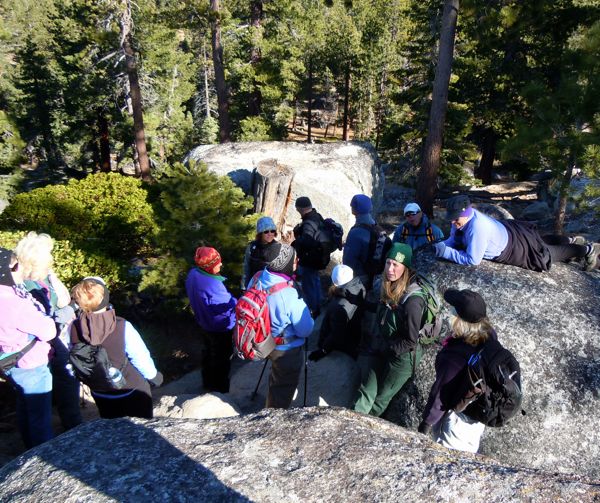
Lindsay Gusses with the USFS, in green, leads an interpretive hike Jan. 3 through Van Sickle Bi-state Park. Photos/Kathryn Reed

The 120 people who preregistered and the nearly two dozen who signed up at the event that launched from the parking lot at Harrah’s Lake Tahoe were divided into seven groups before they headed uphill.

Holding up a three-pronged pine needle, Lindsay Gusses bends one needle down to make a Y as a way to get her group to remember the Jeffery pine is a yellow pine.

It was these little tidbits of information delivered in a fun way that kept the chilly two-mile trek entertaining.

The beauty, well, that needs no explanation. But sometimes it’s nice to know what you are looking at or how something came to be.

Gusses works for the U.S. Forest Service. Her job on Jan. 7 during this Tahoe Rim Trail Association sponsored event is to tell her charges about various aspects of the forest.

“A good reminder as we are walking through the forest is to use all of your senses,” Gusses says.

People are walking up to a Jeffery pine, putting their noses in the crooks. Butterscotch and vanilla fill their nostrils.

On a warmer day, with several of these trees near one another the aroma can permeate the air.

“Gentle Jeffery” is often the nickname for these conifers because their cones are gentle to the touch.

Some conifers – which are any cone-bearing tree – are prickly, even painful if grabbed tightly.

A short history lesson about the Comstock era explains why so many fir trees dot the landscape. They are drought resistant and shade tolerant, allowing them to propagate after the forest was clearcut to build the silver mines in Nevada.

White pines are more often found closer to Lake Tahoe, while red fir are farther up ski slopes.

“One way to tell the difference is the spacing of the needles,” Gusses says. White fir needles curve a bit, while red look more like a hockey stick.

Part way up the trail a cluster of South Tahoe High School students is ready to educate each group that comes by about using avalanche beacons and how to find someone who may be trapped. Leave No Trace is a component of the hike, with Plan and Prepare being one of the seven principles.

These students are part of the Generation Green Club, a collaboration between the school and  U.S. Forest Service.

Tyler Myers, a junior at STHS, uses his beacon to find a transmitter that has been stuffed in a football and hidden behind a tree. The beeping gets louder as he gets closer. How far he is from the “victim” shows up on the device – though 20 meters is the farthest it reads.

“It doesn’t give a depth, that’s why we bring a probe,” Myers explains.

Moving on, the group goes through part of the forest that was charred in summer 2002 during the Gondola Fire.

Gusses talks about the importance of fire when it comes to having a healthy forest. But she also imparts how it’s incumbent upon everyone to prevent wildfires. After all, it was a smoker who tossed a cigarette butt out the Heavenly gondola that started that fire. Heavenly has since made it impossible for that to happen again.

“It doesn’t take much to completely change the ecosystem,” Gusses says.

——–

The Tahoe Rim Trail Association has free Trail Talks scheduled through May. For more information, go online.

ngg_shortcode_0_placeholder (Click on photos to enlarge.)


Mancuso places second in downhill

By USSA

BAD KLEINKIRCHHEIM, Austria — Julia Mancuso of Squaw Valley stormed to second and led three Americans into the top 10 at the Audi FIS Alpine World Cup downhill in Bad Kleinkirchheim on Saturday.

World Cup overall and downhill leader Lindsey Vonn of Vail survived a big mistake right out of the starting gate to finish fourth, missing the podium by a mere five hundredths. Reigning downhill World Champion Austrian Elisabeth Goergl of Austria won for her first World Cup downhill victory.

Mancuso scored her best downhill finish since winning World Cup Finals last March finishing second. She has now been on the World Cup podium for downhill, super G and giant slalom this season.

“It was very difficult and I was hoping for the win, but you had to hold on and fight. It was set pretty straight at the bottom, so you can go really fast, but you pay for it if you can’t hold the line,” Mancuso said. “The light and conditions were really tough. You have to make a lot of direction before the hill just drops away. You’re fighting it the whole way.”

Vonn also continues to lead the World Cup downhill standings.

Stacey Cook of Truckee was eighth, Julia Ford 22, Laurenne Ross 23 and Alice McKennis 26, for six Americans in the top 30.


Vegans muscle their way into bodybuilding

By Mary Pilon, New York Times

HUNTSVILLE, Ala. — Jimi Sitko gets up at 4 most mornings, works out two to four hours a day and can bench-press nearly twice his weight. He has a shaved head and a brightly colored tattoo on his left arm, and he can easily be mistaken for a Marine separated from his platoon.

His apartment is filled with medals and trophies from bodybuilding competitions, snapshots of his tanned, rippled physique in full flex. His uniform is an assortment of sweat pants and hoodies, which he occasionally lifts when his abs look particularly fierce.

But most surprising is what is inside Sitko’s stomach: tofu, fresh greens and plant-based protein powder.

Sitko is among a niche community of vegan bodybuilders.

As the popularity of veganism has spread in recent years — fueled in part by a flurry of food-focused documentaries like “Super Size Me,” “Food, Inc.” and “Forks Over Knives” — its imprint can be seen in industries like publishing (VegNews) and fashion (hemp tote bags).

It has even entered bodybuilding, perceived by many as a population of vein-popping men and women thriving off meat and artificial enhancements. Competitors like Sitko are forging a distinctive subculture of antibeef beefcakes who hope to change more of their competitors’ eating habits.

As a vegan, Sitko, 29, does not eat meat, dairy or, he said, “anything else that comes from an animal.” As a bodybuilder, he spends hours at the gym lifting barbells, running on a treadmill and sculpturing his 5-foot-11, 180-pound body. Then he spray-tans and parades before a panel of judges in a posing suit, known in the sport as a mankini. He is preparing for a competition in March.

Read the whole story


USFS working on improving aspen grove near Camp Rich

On Jan. 9, the U.S. Forest Service Lake Tahoe Basin Management Unit will begin aspen restoration work near the Pope/Baldwin Bike Path adjacent to Highway 89.

A Forest Service contractor will use mechanical equipment to remove pine and fir trees from aspen stands. Most material will be hauled away. Some limbs may be piled outside the aspen stands and burned at a later date.

The project area is 4.6 acres between Taylor Creek and Spring Creek Road.

Work in two locations across the highway from Spring Creek Road is expected to last through Jan. 11.

Operations will then move to the area west of Taylor Creek near the pump house. The entire project is expected to last approximately 10 days.

Because the project involves use of heavy equipment and the felling of trees, access to the bike path on Highway 89 may temporarily be restricted. The area where the contractor is actively working will be clearly marked.

Removing the encroaching conifers will improve aspen stand health, which will provide important habitat for plants and wildlife. Once treated, aspen stands often act as natural firebreaks.

For a complete project description, go online.


Fluctuating currencies impacting European ski destinations

By Jennifer M. Freedman, Bloomberg News

Four years after Bruno Prior paid less than a dollar for an unprofitable ski resort in the Swiss Alps, the strength of the country’s currency has quashed the British entrepreneur’s dream of turning it around.

The Swiss franc has risen 70 percent against the pound since August 2007, when Erner Galen’s community backed Prior’s plan to resuscitate 12 miles (19 kilometers) of pistes over bids to build holiday chalets. After investing more than 500,000 francs ($533,000) in the resort east of Zermatt, he’s dropped a plan to raise another 100 million francs and is instead seeking a buyer.

“The funds we’d set aside for it were worthless,” said Prior, 45, a director of U.K.-based Summerleaze Ltd., a firm that specializes in renewable energy and waste disposal. “The strength of the franc is a problem for the country long term.”

The franc’s gain, coming after a season when snowfall was less than two-thirds of the long-term average, is putting pressure on a ski industry worth 1.5 billion francs a year to the Swiss economy. Resorts from St. Moritz to Verbier are cutting prices for hotels and ski passes to lure foreign visitors and deter locals from crossing the border into France or Austria.

A combination of the strong franc and Europe’s debt crisis is weighing on this season’s bookings with some hotels only half full, said Guy Chanel, marketing director for tourism in Villars, a ski resort 123 kilometers (76 miles) east of Geneva.

Read the whole story


Building a business of no-frills bikes

By Andrew Zaleski, Grist

Two days before New Year’s Eve, Jimmy Standley was in Lake Tahoe getting ready for the inaugural SnowGlobe Music Festival, three days of tunes, parties, afterparties — oh, and he had to sell some bikes, too.

As head of business development for Solé Bicycles, Standley is one part of a five-man team bent on bringing fixed-gear bicycles to the masses. Fixies, as they’re affectionately known, are bicycles at their most basic: frame, wheels, pedals, seat, and handlebars. Whereas most bikes have a “freewheel” system that allows the wheels to spin independently of the pedals, on a fixie, if the bike is moving, your feet are too. This makes for bikes that are simple, lightweight, and low maintenance, although they’re not well suited for tackling hilly terrain Tour de France-style.

“Fixies were big in the ’80s and kind of died out. Now it’s sort of this trendy thing that’s starting to come back,” Standley says.

Indeed. In Seattle, there’s a dude who peddles pies from one. Credit bike messengers in New York City for the resurgence. A fixie’s ideal for shuttling a parcel through traffic-clogged city streets or jetting across campus.

It was the appearance of fixies around the University of Southern California alongside skateboards and beach cruisers that inspired Jake Medwell and Jonathan Shriftman to found Solé Bicycles two years ago, when they were still students. At that time, it was more common to either purchase a custom fixed-gear bike — which could be costly — or rig together your own fixie by stripping down a standard road bike. Over lunch one afternoon, Medwell and Shriftman decided they wanted to build fixies and sell them at prices the typical college student could afford.

A $15,000 grant won through a competition sponsored by Inc. magazine allowed the duo to get the company up and running. They traveled to China to meet with a manufacturer and design the Solé fixie prototype, and placed an initial order for 200 bikes. The first bikes, which they sold for $80 apiece, quickly evaporated.

Read the whole story


South Lake Tahoe pool closed

The swimming pool at the South Lake Tahoe Recreation Center is closed because of mechanical malfunction.

It is not known when it will reopen.

Call (530) 542.6056 for more information.


Lake Tahoe not the only region in search of snow

By Marnie Hunter, CNN

Lane Kommer should be skiing this week. Instead he postponed a trip to Colorado because the snow situation just isn’t looking good.

“We’ve been keeping a close eye on the weather the last few weeks and keeping our fingers crossed, hoping for some good snow and it just got to the point where we decided it’s better to reschedule and pay to change our plans than to go out there and be disappointed,” said Kommer, who was planning to fly from Dallas to meet up with friends at Beaver Creek Resort. Now they’re planning to go in February.

Heavenly has concentrated its snowmaking efforts farther up the mountain. Photo/LTN

It is a decision faced by skiers and snowboarders across the United States as ski resorts scramble to make the snow that Mother Nature isn’t providing. December 2011 yielded the 11th least extensive snow cover in the United States in the past 46 years, according to climatologist David Robinson, a professor in the geography department at Rutgers University.

Weather patterns are moving in and out too quickly and nothing is locking in to produce significant snowfall, he said.

“It doesn’t look like there’s going to be huge improvement the next two weeks and we’re getting halfway through winter by then. But still, hope springs eternal for late January into early March. One would expect that we’re going to see at least some interruption in this progressive fast-moving pattern,” Robinson said.

Any snow would be a welcome change for the Lake Tahoe area straddling California and Nevada, where odd spring-like weather has plagued snow seekers. Base snow averaged about 14 inches at seven area resorts on Thursday, with summit averages of a little more than 19 inches. The annual average summit snowfall at one of the resorts is 350 inches.

Revenue at Lake Tahoe resorts over the peak week between Christmas and New Year’s was down 20 percent to 30 percent after a tremendous ski season across the United States last year, according to estimates from the National Ski Areas Association.

Read the whole story


Ski resorts, USFS battling over water rights

By Jason Blevins, ESPN.com

Ski resorts are feuding with their Forest Service landlord over a water rights clause in updated ski area permitting regulations that keeps water rights tied to the land, not the resort operator.

Snowmaking is what's allowing resorts in the Lake Tahoe area to be open this season. Photo/LTN

After intense lobbying — which included stern letters from a host of congressman and senators — last week the Forest Service rebuffed the calls for a moratorium and issued the new rule as an 18-month moratorium. The resort industry, led by the 121-resort National Ski Areas Association, answered with a promise to sue the agency, which hosts nearly 90 percent of all U.S. ski areas.

“This has to do with water rights in general and how water rights are treated,” said Michael Berry, president of the NSAA. “We believe they have crossed the rubicon and this has the potential to be very, very impactful. We have no guarantee that they will continue to use the water for purposes of ski area business.”

Since 2004, the Forest Service has co-owned water rights secured by ski areas operating on federal land. Before that, under the 1986 National Forest Ski Area Permit Act, ski area water rights on public land were owned by the federal government. So really, said Jim Pena, acting chief of the Forest Service, “this isn’t new.”

Read the whole story


Lack of snow not stopping Olympic Heritage week on West Shore

By Barbara Barte Osborn, Sacramento Bee

In 1960, with the sports world poised to show up on their doorstep, organizers of the Winter Olympics in Squaw Valley grew increasingly nervous through an unusually dry January.

“There was virtually no snow at Squaw Valley, and they brought in tribal snow-dancers and cloud-seeders,” said Mark McLaughlin, a noted Tahoe historian.

But the weather changed in early February, bathing the area in snow, and then brilliant sunshine, to reveal a stunningly beautiful winter landscape. Organizers of Olympic Heritage Week – a series of skiing events that commemorate the games 52 years ago – aren’t likely to be so lucky.

With events beginning Saturday and running through Jan. 15, there is no snow on the ground and none is forecast.

Read the whole story