Lack of snow alters boarder-skier cross competitions in Tahoe

The USASA boardercross/skiercross competition scheduled for Sierra-at-Tahoe for Jan. 22 has been canceled even though snow is in the forecast.

There are three more BX/SX events scheduled for season, with the best two results counting for nationals. On Jan. 27 is a combo slalom/GS at Heavenly, followed by slopestyle at Sierra on Jan. 28 and boardercross/skiercross at Kirkwood Jan. 29.

For more information, go online or email ca@usasa.org.


High school sports realignment won’t change postseason

By Chris Gabel, Reno Gazette-Journal

Discussions of fairly radical changes to postseason tournament formats were brief and, in the end, an NIAA subcommittee elected to recommend the status quo going forward.

With next year’s realignment dramatically altering the landscape, reassessing the structure of region and state tournaments and meets had to happen. The committee, which gathered at the NIAA offices in Reno on Wednesday, discussed awarding first-round byes in region tournaments to league champions.

“It would be a reward for winning your league,” said Ron McNutt, Northern 4A commissioner.

But the committee chose to remain consistent, and recommended future tournaments continue to be structured in multiples of four teams.

“The committee did its homework,” said Donnie Nelson, NIAA assistant director. “They listened to athletic directors and administrators but also to coaches. And these recommendations reflect those comments.”

Read the whole story


Cal student dies in climbing accident at Cascade Falls

By Steven Bell, Westmorland Gazette

A former mountain rescue volunteer plunged 150 feet to his death Saturday at one of the world’s most popular climbing destinations in Lake Tahoe.

Outdoor loving Michael Machell, 23, fell at Cascade Falls after slipping while preparing for an ice-climbing trip with friends.

Greg Almos, El Dorado County deputy sheriff, said: “The way it was described to us, he was at the top preparing to set some anchors and slipped on ice.”

A spokesman for El Dorado County Search and Rescue said although there had not been significant snowfall in the region, there had been a lot of ice in rural areas like Cascade Falls.

Machell was an experienced climber who had helped save lives in the Lake District of England, completing 170 rescues with the Langdale and Ambleside Mountain Rescue Team (LAMRT).

He graduated from the University of Cumbria last year with a first class honors degree in outdoor professional practice and was in the U.S. to study for a year at UC Berkeley.

LAMRT team leader and friend Nick Owen said Machell “absolutely lived for the mountains”.

Read the whole story


Scientists to study climate change and the Truckee River

By Jeff Delong, Reno Gazette-Journal

Scientists are beginning new research into how a warming climate could affect water supplies and flooding along the Truckee River, the waterway that serves as one of the region’s central natural features and the source of most of its water.

The $1.7 million study by the U.S. Bureau of Reclamation is part of a larger effort examining eight rivers across the West, with California’s Sacramento and San Joaquin rivers among them.

The goal is to get an early idea of what costly changes might be associated with climate change when it comes to the vital issue of water supplies and flooding along major river basins in the western United States, officials said.

“The goal is to look into the future so we can be prepared for it,” said Mary Johannis, deputy planning officer for the Bureau of Reclamation in Sacramento.

Authorized by Congress in 2009 under the Secure Water Act, the study would build on information collected through a risk assessment released last year that examined potential impacts from climate change.

Read the whole story


South Tahoe man to compete in MMA fight in Reno

Ryan McCarthy of South Lake Tahoe will be participating in Fight Republic III in Reno on Jan. 20.

The mixed martial arts fights are at Harrah’s Reno convention center starting at 6:30pm.

Confirmed bouts include:

Matt Lively of Susanville vs. Memo Vazquez of Reno; Steven Livel of Susanville vs. Joey Angelo of Las Vegas; Shawn Goode of Reno vs. Daniel Reese of Reno; McCarthy vs. Adam Hill of Reno; Matt McCrary of Reno vs. Chris Halloway of Reno; Phillip Wilson of Reno vs. Richard Vanderploeg of Bridgeport; Danielle Mack of Los Angeles vs. Veronica Rothenhausler of Reno.

Tickets are $25 for general admission, $50 for cageside and $100 for VIP. Tickets available online and at the door.


A fresh heir to Muir country

By Louis Sahagun, Los Angeles Times

LEE VINING — Gale-force winds were whipping whitecaps and spray across Mono Lake when Robert Hanna spotted a distant hiker.

It was a crummy day to chat up a stranger in a state park, but Hanna was upbeat, as usual.

He stepped hurriedly along a trail to introduce himself. “Hello there!” Hanna said, flashing a toothy smile. “Do you know that California wants to shut this place down? Would you like to sign our petition to keep it open?”

“Yeah, I guess so,” the man said.

“Wow! That’s great,” Hanna said, reaching to shake his hand. “Every signature counts.”

The hiker signed and traipsed off, not realizing he’d just shaken hands with the great-great-grandson of John Muir.

Read the whole story


Incline adaptive skier reaches South Pole

By Reno Gazette-Journal

Incline Village resident Grant Korgan — paralyzed since 2010 after a snowmobiling accident — has reached the South Pole.

The 33-year-old, who is using a device called a sit-ski, hoped to reach the South Pole on the 100-year anniversary of the Terra Nova Expedition, which arrived at the South Pole on Jan. 17, 1912.

Read the whole story


Davis, Hight, Teter test out White’s superpipe at Northstar

By Seth Lightcap, ESPN Action Sports

The largest amount snow in Lake Tahoe right now is without a doubt all packed into the walls of the new Shaun White Signature Superpipe at Northstar. After nearly 700 hours of work done by Snow Park Technologies and Northstar, the 22-foot superpipe opened to the public on Dec. 31.

The 500-foot long pipe is notable for several reasons. Not only was it the first halfpipe to open in Tahoe this winter, it is the first-ever 22-foot Tahoe superpipe that will remain open to the public. The massive terrain feature marks the landmark deal Shaun White signed with Vail Resorts last August that made Northstar his home mountain and primary training ground.

White has shown no interest in riding his namesake superpipe yet, however. Rumors flew that he would be at Northstar during the first week of January for a private training session, but for reasons yet to be uncovered, he never showed. Instead it was Burton teammate Danny Davis, who lives less than ten minutes from Northstar, who became the first to score a private session on the new pipe when he took over the two-day training window that White passed up.

“I guess I kinda bit on his session,” laughed Davis, when asked about the opportunity he was given to break in the new pipe. “I called SPT and asked if Shaun was coming and they said ‘No, you want it?’ I was like, ‘Hell yeah!’ We always seem to be poaching his sessions. Thanks for this one Shaun!”

Davis landed tricks during the session that he hadn’t put down since his Olympic-dream-killing back injury two years ago.

Read the whole story


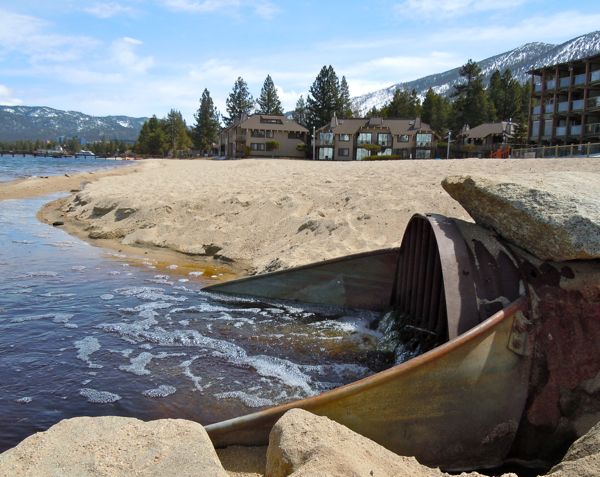
With 38 pipes draining into Lake Tahoe, are lake clarity efforts worth a billion bucks?

By Anne Knowles

Current efforts to improve the clarity of Lake Tahoe are not only a waste of time and money, they are a fraud.

That’s the claim made in the inaugural newsletter of the Tahoe Pipe Club, a secretive coalition of “citizen, business owners, scientists and engineers,” according to its website, who are fed up with what it says is more than a billion dollars squandered on misguided scientific techniques which have failed to reduce lake turbidity.
One of 13 drains in South Lake Tahoe that reach Lake Tahoe. Photo/LTN file

In its newsletter and on its website, the group points to “ineffective watershed management practices,” consisting of mechanisms such as road gutters and storm drain systems, often installed in flood-prone areas that do not impact the lake.

“As justification to use lake clarity funds, the public was told that these erosion control and BMP (best management practices) retrofit projects would clean the water which they do not, and these public relations campaigns were the genesis of the hoax which persists still today,” reads the newsletter entitled “Turning Tahoe Black?”

The club advocates using infiltration methods in which stormwater is absorbed into the ground via swales and basins rather than filtered and conveyed back into the lake, and to focus on only those watersheds that have a direct link to the lake in order to best utilize dwindling lake clarity funds.

The newsletter also grades eight clarity projects based on six categories. Only the Montgomery Estates project in South Lake Tahoe received a passing grade and was judged to provide a benefit. The Luther Pass to Meyers project, for example, got an A for urban restoration, a C for hydrologic connectivity, and an F for the remaining criteria.

“The declining water quality and clarity of Lake Tahoe after spending a billion dollars and having ignored what matters most, the urban runoff from highways, streets, roads, and drainage and its discharge directly into Lake Tahoe through culverts and pipes, which account for an estimated 75 percent of the TMDL (total daily maximum load)” spurred members to form the club in 2010, John Runnels, a club member, said in an email to Lake Tahoe News.

The club won’t release member names or numbers. One member using the pseudonym Tyler Durden, from the book and film “Fight Club,” posts to the website and sends out the group’s newsletter. In an email to Lake Tahoe News, he says the focus should be on the club’s ideas, not its adherents.

“Pipe club is about the idea of sustainable effective urban actions to get to predevelopment clarity,” Durden said in an email to Lake Tahoe News. “Nothing will please us more than disbanding. We agree to dissolve when our goals are met.”

Those goals, as outlined at the website, include replacing conveyance-based approaches to water quality with infiltration methods, stopping unnecessary river realignment, no more land coverage tracking for water quality purposes, and an end to road sweeping and the paving of the Lake Tahoe Basin.

The club gets its name from the hundreds of drain pipes that feed into the lake, which the group is documenting in photos and videos at its website and in annual calendars.

“This 2012 Lake Tahoe Storm Drain Calendar is dedicated to the hundreds of urban outfall pipes which chronically discharge toxic storm water directly into the perennial streams of Lake Tahoe and Lake Tahoe itself every time it rains or snows,” reads the website.

The group has identified 38 pipes it says are a priority: 13 in South Lake Tahoe, including the three El Dorado pipes; 10 in McKinney Bay; four in Tahoe Pines; three in Kings Beach; two in Incline Village; and one each in Carnelian Bay, Marla Bay, Meeks Bay, Sunnyside, Tahoe Vista and Tahoma.

“The pipe club is compiling all this evidence of pipes putting dirty water into the lake,” said Dylan Eichenberg, a senior at UC Berkeley who is studying conservation and resource management, grew up in Tahoma and supports the pipe club’s goals. “The pipes are by far one of the most significant impacts on the lake.”

Eichenberg is not a member of the club, but knows some of its members, has followed its work and supports it, and studied the same issues for his term paper entitled “Urban Impacts on Lake Tahoe”. He would like to see what he calls “rain gardens” installed at the lake, which stormwater would flow into instead of storm drains.

“There could be trenches or basins every couple blocks as needed,” Eichenberg said.

Tahoe Pipe Club is also routinely taking Secchi depth measurements and posting the results to Twitter and Facebook. Secchi depth measurements gauge water clarity using a dinner-dish sized-disk lowered into the water. Clarity is measured at the depth at which the disk is last visible to the naked eye.

The club hopes by posting the data and other related science it can raise public consciousness on the issue and influence lake clarity work and the resources supporting it. The group has no plans to raise money or initiate projects, and it does not attend public meetings such as the Tahoe Regional Planning Agency, although it keeps the TRPA informed of its work.

For its part, the TRPA says it is aware of the group but defends its focus on water quality treatment based on the existing conveyance approach.

“TRPA appreciates Tahoe Pipe Club’s dedication to the water quality of Lake Tahoe,” the TRPA said in a statement provided to Lake Tahoe News. “The problem is not what comes out of the pipes, but what goes in. That is why TRPA is committed to supporting environmental redevelopment projects that include erosion control efforts for treating stormwater runoff in our built environment, from which science tells us is where 72 percent of the pollution entering Lake Tahoe comes. As water quality science evolves, TRPA will continue to support the most effective techniques for treating storm water on both public and private property.”


Next Nevada bear hunt may not include Lake Tahoe

By Jeff Delong, Reno Gazette-Journal

Nevada’s second bear-hunting season would be shorter and no hunting allowed within the Lake Tahoe Basin under new regulations proposed by Nevada wildlife officials.

The proposal will be considered early next month in Las Vegas as the Nevada Wildlife Commission reviews hunting season regulations proposed for black bears and all other big-game animals. Discussions come a month after the state ended its inaugural bear season amid widespread controversy that shows little sign of dissipating.

One significant change would prohibit bear hunting west of the Tahoe Rim Trail, effectively barring all hunting within the Tahoe Basin, said Chris Healy, spokesman for the Nevada Department of Wildlife. The season’s opening would come be Sept. 15 rather than Aug. 20, a change Healy said was requested by hunters to avoid summer heat hard on both them and their dogs.

Prohibiting hunting in Tahoe came in response to both the hunt’s controversy there as well as enforcement difficulty associated with a checkerboard pattern of land where hunting was allowed in some places but prohibited in others, Healy said.

Read the whole story