Sierra sending 3 athletes to X Games

Turn on ESPN this weekend and chances are good an athlete from Sierra-at-Tahoe will be on the slopes competing at the Winter X Games in Aspen.

Riders looking to podium at Winter X are:

Jamie Anderson – Widely considered the best female slopestyle snowboarder in the world, she has won slopestyle gold at Winter X Games twice and was the youngest Winter X gold medalist ever in 2007. She earned a bronze in 2011.

Hannah Teter – An Olympic gold and silver medalist and five-time Winter X medalist, including one gold, Teter has her sights set on the podium in the women’s snowboarding superpipe event.

Maddie Bowman – Coming off a first place at Dew Tour in Killington, Vt., this month, Bowman is quickly becoming recognized as one of the top female superpipe skiers in the world. An alternate last season, this will mark her second appearance at Winter X Games.


Wandering wolf tracked to same area as California’s last wild wolf

By Matt Weiser, Sacramento Bee

California’s new wild wolf resident generally has been on the move since arriving one month ago. But the wolf known as OR7 has spent a lot of time lately in the same region where the state’s last known wild wolf was killed in 1924.

That would be an area north of Honey Lake in southeastern Lassen County. A trapper killed what is thought to be the state’s last known wild wolf in that area, near the town of Litchfield, in 1924.

That wolf was emaciated. At 56 pounds, it was half a normal wolf’s weight. It was also missing part of a hind leg, likely from escaping a prior trapping attempt.

OR7’s lingering in the area is likely coincidence, experts said, though it may point to something in a wolf’s habitat preferences.

Read the whole story


N. Nevada developing plan to promote sports-recreation

By Anne Knowles

CARSON CITY – Northern Nevada is looking at sports and recreation from every angle to boost its economy.

The bid for the 2022 Winter Olympics, the Reno Bighorns minor league basketball team, the UNR Wolf Pack athletic program, even makers of outdoor gear, all figure into plans to capitalize on sports.

Nevada Lt. Gov. Brian Krolicki and Jon Killoran, the chairman and CEO, respectively, of the Reno Tahoe Winter Games Coalition, and others talked about the various efforts during a breakfast meeting at the governor’s mansion Wednesday hosted by the Northern Nevada Development Authority.

Northern Nevada officials want people to think of the area for sports that go way beyond betting on games at a casino.

“We’re here to talk about sports and the passion of athleticism, but also about business,” Krolicki said.

Krolicki said the coalition of California and Nevada interests are in “hot pursuit” of the 2022 Winter Olympics. He said bids to bring the games to Lake Tahoe are due next summer to the International Olympic Committee, which will decide on the location in 2015, giving the winner seven years to build up the needed infrastructure to host the two-week event.

Killoran said the 2002 Winter Games had a $100 million economic impact on Salt Lake City, which expanded its airport and overhauled Interstate 80 in preparation, and raised the city’s profile internationally.

In the Lake Tahoe Basin, he said, public transportation would be expanded to include high-speed water ferries and to reduce personal vehicle traffic. Krolicki promised the Olympics would be a boon, not a burden, to the basin environment. Money generated by the event, for example, could help fund efforts to improve lake clarity.

Lisa Granahan, Douglas County’s economic vitality manager, said the county has identified suppliers of outdoor gear, particularly soft goods like tents and backpacks, as an industry to attract to the region.

She said the county is already home to four such businesses: North Sails, Aviso Surfboards, Sierra 4×4 Trailers and TechSpec.

“Our goal is to have 700 new jobs by 2022 in new businesses and to develop the services to attract them,” she said.

To that end, the county is planning a cut-and-sew center to make soft goods. Granahan said suppliers are interested in relocating manufacturing to the United States from China, where costs are now rising. A $70,000 grant from the U.S. Department of Agriculture funded start up of the center, which is being housed in space at the Carson Valley Business Park donated for a year rent-free by its owner, Bill Miles, owner of Miles Construction.

Granahan said she would be presenting an update on the county’s economic vitality plan, which comprises 12 areas, including Tahoe revitalization and the South Shore Vision Plan, and trails development, to the Douglas County Board of Commissioners at the commission’s Feb. 10 meeting.

Mike Samuels, assistant athletic director of Nevada Wolf Pack Athletics, described the economic impact of the Wolf Pack moving from the Western Athletic Conference to the Mountain West Conference, which is expected to happen this summer. He said the UNR program, which now receives $500,000 annually from the WAC, will get $2.1 million from the Mountain West. He said the program is working with the Reno Sparks Convention and Visitors Authority to develop tourism packages around the program’s football and basketball schedules.

John Kinkella, director of the Reno Bighorns, talked about the team’s place in the D League, which acts as a minor league to the National Basketball Association, and the money it brings to the region, including 1,200 room nights during this month’s weeklong D League Showcase at the Reno Events Center. The team is now locally owned after being purchased in August 2011 by Reno attorney Herb Santos, and Stephen and Jeffrey Adams.

While no one from the Reno Aces was at the Jan. 25 event, the minor league baseball team will bring money to the area when it hosts the Triple-A All-Star Game in 2013.



California rethinking how it manages bear population

By Matt Weiser, Sacramento Bee

The life of a Lake Tahoe bear is a continual dance with death. Not because of the extreme climate and struggle to find food, but because their lives are so closely intertwined with those of humans.

A world-reknowned tourist destination, Tahoe is strewn with vacation cabins, year-round resorts and busy roads. In other words: many potential death traps for the region’s native black bears.

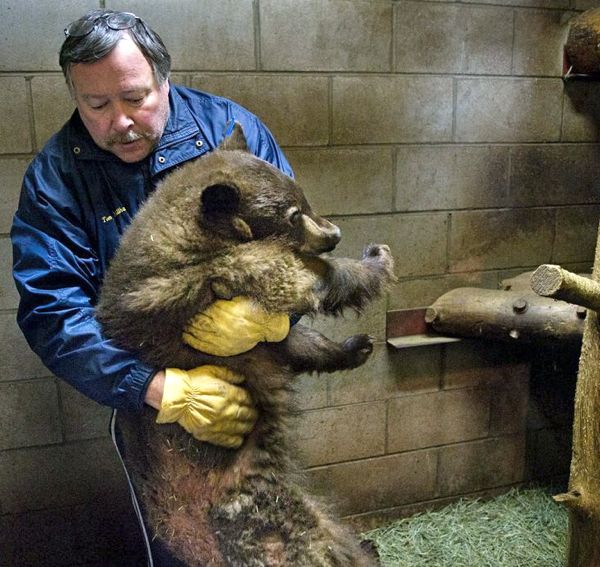
Tom Millham of Lake Tahoe Wildlife Care readies a bear to return to the wild. Photo/Randy Pench/Sacramento Bee

Last Wednesday, two yearling male bears got a second chance after being found last spring, injured and emaciated, in South Lake Tahoe.

The cubs are not siblings. One was probably hit by a car, left for dead by its mother, but revived enough to stagger into a neighborhood, wildlife officials said. The other likely was orphaned, and began visiting Sierra House Elementary School in South Lake Tahoe, drawn by the daily smell of lunch cooking.

The cubs were nursed back to health over six months by Lake Tahoe Wildlife Care, a nonprofit that treats injured and orphaned wildlife.

On Wednesday they were on their own again after biologists from the state Department of Fish and Game moved them into a den in the wilds of Alpine County. The irony: These two bears owe their lives to people, but their continued survival largely hinges on their avoiding human contact.

“All it takes is one person causing a problem, and these bears can become a nuisance,” Marc Kenyon, a Fish and Game wildlife biologist in charge of the department’s bear program, said shortly after tucking the sedated cubs into their new den, a roomy niche in a boulder pile.

“What we hope is they don’t find anything better, and stay here and set this up as their home.”

Though Tahoe is the epicenter, conflicts with bears have become a statewide concern as rural areas have become more suburbanized over the past two decades. Bears getting into people’s garbage and food has become a more common complaint.

One effort by Fish and Game to manage the conflict involved a proposal to expand bear hunting, which is legal in specified seasons and areas in California.

In 2010 it proposed new hunting regulations to allow 2,000 black bears to be killed annually, an increase from 1,700. After months of controversy, it withdrew the proposal amid strong opposition from wildlife advocates.

Now it is trying a new approach.

The department is preparing a new statewide bear management plan, one that will approach the species less as a hunting opportunity and more as a wildlife conundrum of statewide importance.

Read the whole story


Full moon snowshoe near Ehrman Mansion

California State Park rangers will be leading a full moon snowshoe hike along the West Shore at Ed Z’berg Sugar Pine Point State Park on Feb. 4.

The tour begins on the day use (lake side) of the park and explores the natural and cultural history around the Hellman-Ehrman estate.

For those new to snowshoeing, there will be a beginner’s clinic at 6:30pm sponsored by West Shore Sports. The full moon hike starts promptly at 7pm in the day use side of the park.

The programs last approximately 1½ hours and costs $20 for adults and $5 for children under 12. The cost includes event parking and snowshoe rentals, if needed. All proceeds from the tours support the Sierra State Parks Foundation.

Wear warm, layered clothing, waterproof shoes and bring a flashlight.

Space is limited and reservations are required through West Shore Sports at (530) 525.9920.


Most schools in Lake Tahoe closed because of snow

If you see more young people than usual out and about today in the Lake Tahoe Basin, they are not skipping school. Many schools are closed because of the heavy, wet snow that has fallen and is creating hazardous driving conditions.

Lake Tahoe Unified is closed; Lake Tahoe Community College will have classes starting after noon, however, the Child Development Center is open; Douglas County schools already had the day off; Tahoe Truckee Unified is closed; Incline Schools are closed, however, all other Washoe County schools are on a two-hour delay; Sierra Nevada College is closed; and Truckee Meadows Community College in Reno is on a two-hour delay.

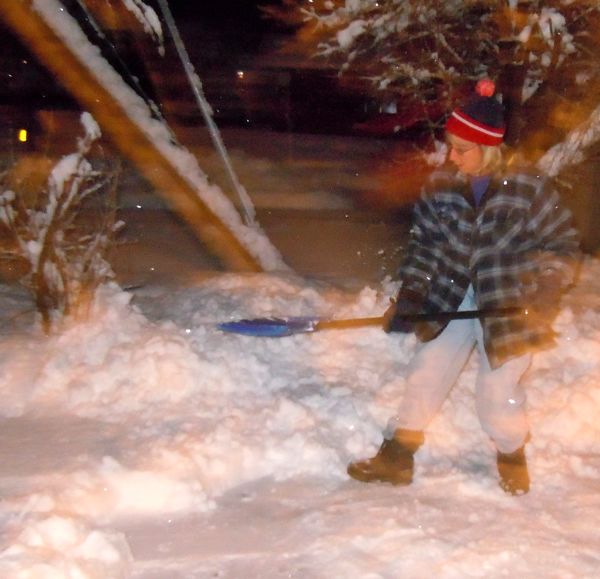
Snow too heavy for the blower Jan. 23. Photo/Kathryn Reed

A winter storm warning remains in effect until 4 this afternoon. The heaviest snow is expected to last until 10 Monday morning. However, in South Lake Tahoe at 6:30am the white stuff had become a slight rain. About 4 inches of snow accumulated overnight in South Tahoe.

The sun is expected to return Tuesday, with a high of 55 forecast for Thursday on the South Shore.

Ski resorts are able to open more terrain with this gift from Mother Nature. Despite a weekend worth of snow, tree skiing is still not advised until another layer covers all those rocks.

The Sierra Avalanche Center says the danger in the backcountry is at high.

Roads are slick and mucky, with chain requirements on most highways in and out of the Tahoe basin. For all the road conditions, click on the state icons at the top of Lake Tahoe News’ home page.

 — Kathryn Reed


Misuse of snowblower could mean fewer fingers to operate it

By Jana Mortellaro

According to the U.S. Consumer Product Safety Commission, it’s estimated that more than 5,700 emergency department visits stem from snowblower accidents each year. More than 550 of those cases have required finger amputations. Some accidents have resulted in death.

Most snowblower accident cases sustain deep cuts, crushed and broken bones, joint, tendon and soft tissue injuries. And 90 percent of the time, the injury is to the dominant hand, according to the American Society for Surgery of the Hand. This typically involves loss of fingertips, most commonly the middle finger.

Jana Mortellaro

Domestic danger

We may have a healthy respect for our lawn mowers and weed-whackers and their ability to cause harm, but we have to remember a snowblower is not any less dangerous just because it throws the ¬white stuff around instead of slicing plants away from the earth. So, before you put your snowblower into action, make sure you take the time to use it properly and safely. Most snowblower injuries are preventable if you concentrate on the task at hand and use common sense.

“A severe hand-finger injury can be excruciatingly painful and affects all aspects of daily life – bathing, dressing, cooking, eating, writing, using the computer, driving, riding a bike, etc. Having access to hand therapy after my traumatic injury [from a snowblower] was critical. Therapy was my barometer during the healing process, and helped me to adjust, so I could attempt these daily tasks successfully,” said J. G., snowblower accident survivor and Barton Rehabilitation patient.

Here are tips to keep you safe while clearing snow:

• Read the instruction manual prior to using the snowblower.

• Never use your hands to unclog a snowblower.

• Wear protective clothing.

• Do not drink alcohol or use prescription narcotics before using your snowblower.

• Be sure the kids and animals are safely in the house.

• Add fuel to the tank outdoors before starting the machine.

• Watch where you’re aiming the snow.

• Don’t add gasoline to a running or hot engine.

• If you have an electric powered snowblower, be aware of where the power cord is at all times.

• Don’t remove safety devices.

• Keep hands and feet away from all moving parts.

• Don’t leave a snowblower unattended when it is running.

• Turn the engine off if you need to walk away.

• Never leave the machine running in an enclosed area.

In case of clogs:

• Never put your hands down the chute or near the blades.

• Turn it o¬ff.

• Disengage the clutch.

• Delay/wait after turning off the engine to allow impeller blades time to stop rotating.

For more information about South Lake Tahoe’s only certified hand therapy program, located at Barton Rehabilitation, call (530) 543.5896.

Jana Mortellaro is a licensed occupational therapist and certified hand therapist for Barton Health.


First Tahoe storm tests snowshoe agility during cocktail races

By Dan Tirabasso

CAMP RICHARDSON – The snow has fallen and Lake Tahoe is officially open for business, but snowsports are not confined to the ski slopes. This was evident during the Snowshoe Cocktail Races at the Beacon restaurant Saturday night.

The lolling barroom chatter flourished into a clamor of snow boots and laughter as the young crowd trickled in, sporting everything from bright red ski masks to robes.

Gina Craig, right, and Stephanie Meyers at the Jan. 21 cocktail snowshoe cocktail races at the Beacon. Photo/Geno Fonderoli

Lack of snow forced the cancellation of the December race, but Mother Nature came through for the Jan. 21 event.

There were mens and women’s competitions that consisted of obstacle and sprint races; with seven men and six women competing. The four-man relay race was canceled due to a low turnout.

The rules were simple, strap on snowshoes, balance a tray of drinks in one hand, and make it to the finish line without spilling all the drinks.

“It’s a great atmosphere,” Tahoe local Amber Pass said. “A great event with good prizes and good cocktails.”

Boisterous observers lined the deck overlooking the snow-covered beach, so brightly lighted the calm lake and the cloudy night sky seemed to merge into solid black.

The crowd cheered as contestants attempted to shuffle and gallop their way through the races.

In the first round, a woman hit by a snowball missed an obstacle, and in the disorientation that ensued she turned tail and began to traverse through the obstacle course backward. The officials declared a redo.

The rest of the competition went smoothly thanks to enthusiastic mediation of snowboard emcee and self-proclaimed hype man David Hunt who kept the contest rolling and the crowd smiling.

Prizes ranging from new snowboards to ski passes were awarded for first, second, and third place. But given the lack of contestants it seemed more like a giveaway than a prize.

The Beacon’s next Snowshoe Cocktail Races are Feb. 18 and March 10, 7pm.


Americans dominate World Cup snowboardcross

By U.S. Snowboarding News Bureau

VEYSONNAZ, Switzerland – It was a sweep for U.S. Snowboarding Sunday with Lindsey Jacobellis of Stratton Mountain, Vt., and teammate Nate Holland of Squaw Valley winning at the Veysonnaz World Cup.

Jacobellis continued on a roll with her third straight win of the season to remain undefeated starting with her victory in the USANA Snowboardcross Cup at Telluride last month. The tour now swings back to the United States for next weekend’s X Games in Aspen.

Holland now leads the pack in the World Cup snowboardcross rankings; his first win since last season’s event in Lech. He took the win in a photo finish – a mere half board length ahead of Swiss Markus Schairer.

“I knew I was riding well on this course. I love this course, like I said I love the speed,” Holland said.


Network of trails provides hours of cycling in North State

By Kathryn Reed

REDDING – Nearly 10 miles of paved trails without ever getting onto a city street. Clearly, I must not be in Tahoe anymore.

This spectacular ride was in Redding.

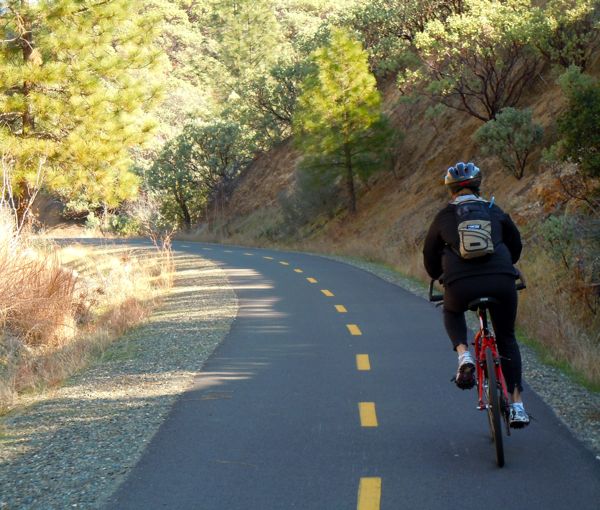
Pam Valentine rides one of the many paved trails in Redding. Photos/Kathryn Reed

More than 80 miles of paved and natural surface bike-pedestrian paths are scattered throughout Redding. But they are also linked so it makes for a harmonious experience instead of some disjointed, annoying ride.

Cyclists can go from the Sundial Bridge to Shasta Dam on a paved route — 17.5 miles one-way.

I was glad we didn’t park where we had intended to because it meant not going up what the bike shop guys called Cardiac Hill. Instead, my sister, Pam, led Sue and me on a 19-mile round-trip ride through some spectacular scenery before the dam stopped us.

The Keswick Reservoir is to our right as we start our ride. On the north end is the Shasta Dam, to the south is the Keswick Dam. This reservoir is part of the Central Valley Project – one of the main water systems running through California that provides water to farmers and municipalities downstream.

Below the Keswick Dam is the Sacramento River.

A few fishermen are on the Keswick Reservoir in hopes of catching wild trout like German browns and rainbow.

As pretty as the ride is, I know the landscape should be much greener. No moisture until this weekend has left the entire state parched. Still, the austere winter beauty is captivating.

The water is glass-like, providing reflections of the hillside as though it’s a mirror.

Rocks protrude from some locations, reminding me of the tufas that dot Mono Lake.

Where the water is shallow it’s most obvious how fast the current is as mini rapids are created as the water skips over the rocks.

This is part of the Sacramento River Rail Trail that follows the historic rail alignment. One spot has us passing through a tunnel built in the 1920s.

The trail ends at Shasta Dam where there is a dirt park for all terrain vehicles. Just before we get there a Bureau of Land Management employee (and this was a Saturday) is sweeping some debris from the trail. It’s maintained that well.

Redding’s trails are a collaborative project, just like they are in the Lake Tahoe Basin. Where we were last weekend was on Bureau of Land Management property. The McConnell Foundation (founded by the largest shareholders of Farmers Insurance) has contributed significantly to that city’s trails.

The first segment of the Sacramento River Trail opened in 1983. And the network keeps growing.

More information about the Redding Trail System is online. And the trails are accessible year-round.

ngg_shortcode_0_placeholder (Click on photos to enlarge.)