Olympic medal the 1 trophy Holland is missing

Publisher’s note: This is one of a series of stories about Lake Tahoe area athletes who hope to compete in the 2018 Olympics in South Korea. 

By Susan Wood

PARK CITY, Utah – With 16 medals under his belt, it’s difficult to imagine this self-assured family man who snowboards for a living insisting on needing to fill a void in his life.

But Nate Holland isn’t your ordinary athlete.

The Truckee snowboarder wants an Olympic medal – sooner than later. He will be 39 on Nov. 8. So, as he prepares to work toward the PyeongChang Games in South Korea in February, he’ll aim for the podium when he roars full-throttle down the snowboard cross track for the one thing that’s eluded him.
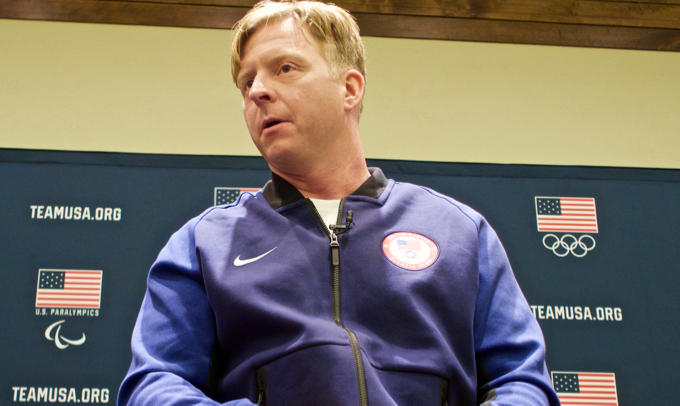
Truckee’s Nate Holland is eager to add Olympic medalist to his resume. Photo/Kathryn Reed

Even with eight X Games gold medals and three Winter Olympics appearances behind him, he came up empty-handed in 2006, 2010 and 2014. In Vancouver, he even came in fourth, with toes almost reaching the bronze podium. To this day, he laments about having control in the first three turns, then missing the notorious Turn 4.

This time, the steely look in his eyes matches his good health. And if a sense of humor contributed to the medal criteria, he’d win gold hands down.

He pokes fun at his youthful competitors’ ages, believing being the elder statesman is actually an advantage despite the sport attracting more and more young bucks.

When they’re staring at their Fitbits and describing their intakes and outtakes with energy concoctions that sound like something out of a sci-fi movie, he shrugs it off.

“I just have Advil, coffee, a hot tub and a good breakfast, man,” he quipped. Of course, a workout that inflicts some pain is incorporated in that routine. The fierce athlete knows he’s of a certain age to where he can’t “roll off the coach” and tax his body without solid conditioning.

But what his competitors may not know is the competition for Holland can be waged in a verbal exchange to psyche them out.

“One of my strengths is my mental warfare. They know that when I was competing, they were eating popsicles,” he joked during an Olympic media summit roundtable discussion earlier this fall. 

He gains insight from other older athletes.

“Look at Tom Brady, Aaron Rodgers,” he listed the New England Patriots and Green Bay Packers quarterbacks as examples.

The athlete who traded in a freestyle career for snowboard cross in 2006 is banking on his “closure” ability. This is huge based on the physics of his sport. A handful of snowboarders race alongside one another on a track with jumps and banks. Collisions and mishaps are frequent. And like a bike race, successful riders will draft on each other until they make their move like a slingshot around the competitors.

Besides the strategy, there’s the sheer thrill of it all.

“When you’re going 60-plus miles per hour, there’s nothing better than big air,” he said. It’s also a risky time to land wrong and blow half a year’s or half a lifetime’s training. 

But that’s Holland – all or nothing.

Nate Holland, center, is the senior snowboarder for the U.S., with Alex Deilbold, left, eight years younger and Ryan Stassel 15 years his junior. Photo/Kathryn Reed

This may be it for the longtime rider from Idaho, who grew up practicing then honing his craft on a small hill near Sandpoint with his buddies.

From there, Holland said their mothers got tired of “driving us around” and hired a ski coach “as a chaperone.” The rest is history.

He moved to Squaw Valley in 1999 to pursue his snowboarding career, and has called Truckee home ever since.

“I’m taking it one day at a time, one year at a time,” he said.

So far, he likes what he sees in his chances in South Korea. The track is big to his liking, as witnessed with his test run there last year with other Olympic athletes.  

“My biggest challenge is getting there and making the team,” he said. “Once I’m there, I know that track suits me.”

Plus, some could argue the adrenaline may build off the course as well.

Given the tensions with the United States between South and North Korea, he wonders whether the Games will be secure. During the test run, F16 military jets were “flying over every 15 minutes.” He made light of the spectacle then by telling his teammate: “Dude, I love you man – if it’s all over.”

These days, he questions whether his daughter should be there at the grand global event. His wife, Christen, insists their daughter see her dad compete.

“Then, I thought if we’re going down, we’re going down together,” he said. Holland was sarcastic, but honestly blunt.

He’s also sentimental when it comes to his family.

“Fatherhood is the coolest thing I’ve ever done,” he said of his 2-year-old daughter, Lux.

Still, despite the bout of parental responsibility, Holland has shown he knows how to have fun.

He not only looks forward to his time on the course. He is eager to immerse himself in the culture, informing Lake Tahoe News at a press conference that he plans to “brush up on a few more songs” for the local karaoke bar.

Holland thoroughly relishes his time with the South Korean people.

“There’s no other place like it. Every time I get on a (chair) lift, they give me a double hand wave and a big smile,” he told LTN.

More than half in U.S. no longer can see Milky Way

By Bruce Finley, Denver Post

People escaping light pollution where they live have forded an icy creek and are rediscovering the night, wandering around on mystical moist sand in the near-total darkness of this wilderness.

They covet silence and stars — splayed across a moonless sky revealing the Milky Way Galaxy —  increasingly popular assets at national parks nationwide.

Darkness is increasingly rare. And land managers at U.S. national parks — joined by more and more towns — are trying to set themselves up as preserves by obtaining official “dark sky” designations. They’re hoping these will serve as protection against an onslaught of light pollution.

Read the whole story


Mountain lions killed in Calif. despite hunting ban

By Ryan Sabalow and Phillip Reese, Sacramento Bee

Victoria Vaughn doesn’t have a killer’s heart.

The 59-year-old artist and former substitute teacher, whose eyes well with tears when she gets upset, loves animals. It’s why she started raising alpacas for wool for her weaving projects in the first place.

She certainly never thought she’d want to kill one of California’s most charismatic mammals.

That changed last year when a mountain lion started coming around at night, savaging her alpacas. Vaughn and her neighbors in the rugged mountains behind Malibu’s beaches blame this single lion for wiping out more than 100 goats, alpacas, sheep and other animals, sometimes dozens at a time. He rarely ate anything from their corpses, instead leaving them to rot in their pens.

Vaughn had had enough. She obtained a permit from the state of California allowing her to kill the lion. Hers was one of about 218 such “depredation permits” issued in California every year, though typically less than half result in a kill.

Last year, livestock owners and professional trappers, houndsmen and sharpshooters killed 120 mountain lions, including five each in El Dorado and Placer counties.

Read the whole story


Western guvs want federal help in invasive species fight

By Associated Press
 
Governors of 19 Western states are pressing the federal government to do more to prevent the spread of damage-causing invasive mussels from infected federally managed waterways.

The Western Governors’ Association last week sent a letter urging Interior Secretary Ryan Zinke to put in place by spring 2018 controls to prevent the spread of zebra and quagga mussels.

The governors are also asking that federal agencies conduct mandatory inspections and decontamination of boats leaving infected water bodies. The mussels can attach to boats and trailers and travel long distances, clogging water pipes, damaging boat motors and affecting other aquatic life.

Read the whole story


Olympic bike with Truckee ties keeps on giving

By Ally Gravina, Moonshine Ink

It’s no secret that mountain bikes are expensive, especially for a teenage boy who grows like a weed. For Luca Robillard, 14, and his mom Annie, who live in Truckee, a June trip to Coffeebar turned into the opportunity of a lifetime when the single mom and her son ran into professional mountain biker Katerina Nash.

Annie had worked on the Mountain Bike World Cup Tour for more than 10 years, so she and Nash had mutual friends. At Coffeebar in Truckee, the three got to talking about, what else, mountain biking. Luca, who was riding his mom’s old bike at the time, had been bit by the biking bug last year when he first started competing in the National Interscholastic Cycling Association (NICA) mountain bike league for Truckee. Like teenage boys do, Luca grew out of his bike in just one season and was in desperate need for a new one as he was already signed up for the 2017 season. Nash, a decorated athlete who has competed in the Olympics five times, twice as a Nordic skier and three times as a mountain biker, had a solution — the $10,000 Orbea Oiz she raced on in the 2016 Rio Olympics, on which she placed fifth.

“I wanted this super fancy bike to be used and not sit in the garage or hang in a bike shop,” Nash said of the bicycle collecting dust in her Truckee garage. “I had a great ride on that bike in Rio and wanted to hold on to it. Since I’m still a sponsored athlete and under contract, I wasn’t really able to ride my Olympic bike due to some new sponsorship. So my Olympic bike was sadly sitting in the garage and not being used.”

Read the whole story


Burn ban lifted in El Dorado County

Effective today the burn permit suspension in Amador, El Dorado, Sacramento and Alpine counties has been lifted.

Those possessing current and valid agriculture and residential burn permits can now resume burning on permissible burn days. Agriculture burns must be inspected by CalFire prior to burning until the end of the peak fire season. Inspections may be required for burns other than agriculture burns.

Residents wishing to burn must verify it is a permissive burn day prior to burning.

Pile burning requirements:

·       Only dry, natural vegetative material such as leaves, pine needles and tree trimmings may be burned.

·       The burning of trash, painted wood or other debris is not allowed.

·       Do not burn on windy days.

·       Piles should be no larger than 4 feet in diameter and in height. You can add to pile as it burns down.

·       Clear a 10 foot diameter down to bare soil around your piles.

·       Have a shovel and a water source nearby.

·       An adult is required to be in attendance of the fire at all times.


Basinwide ski marketing group disbands

By Kathryn Reed

Ski Lake Tahoe has long been a behind the scenes group of Tahoe area resorts that collectively promoted their industry.

After 20 years the group has dissolved and will no longer be that one voice this winter or beyond.

“Ski Lake Tahoe certainly was a brand platform for the regional ski product, but the individual marketing efforts of the resorts may end up being equally powerful. In other words, whether we’re sending a single message ‘Ski Lake Tahoe,’ or several messages, we’re marketing the destination,” Carol Chaplin, executive director of Lake Tahoe Visitors Authority, told Lake Tahoe News.

It’s still possible resorts will partner, but the ownership landscape has changed since Ski Lake Tahoe first formed. At the time owners were all different for Sierra-at-Tahoe, Heavenly, Kirkwood, Northstar, Squaw Valley, Alpine Meadows and Mount Rose. In many ways this made for a more level playing field no matter the size of the resort.

Today, Heavenly-Northstar-Kirkwood have the same parent company, while Squaw-Alpine are united.

Sierra-at-Tahoe has new plans for attracting skiers this season. Photo Copyright 2017 Carolyn E. Wright

“Sierra-at-Tahoe originally joined to have one common voice amongst seven different major resorts around the lake. To promote the destination as a whole and educate people on all the amazing options when it came to winter recreation in Lake Tahoe,” Steve Hemphill with Sierra told Lake Tahoe News. “Fast forward to today, while there are still seven ‘separate’ resorts, we really only have four sitting at the table. With two of those, owning five out of the seven mountains.”

Sierra realized last spring it wanted out. The board agreed to disband in the summer. Letters were sent to destination marketing organizations and lodging partners.

In part it said, “As the competitive landscape continues to change, Ski Lake Tahoe resorts will refocus their efforts and resources. The resorts will continue to play an integral part in the Reno-Tahoe tourism industry and continue to promote the region and look forward to working with you in those efforts.”

Ski Lake Tahoe had offered an ultimate pass for the seven resorts. Those no longer exist.

“We continue to work closely and collaboratively with other partners including Visit California and (North Lake Tahoe Resort Association),” Liesl Hepburn with Squaw-Alpine told Lake Tahoe News.

Reps from Heavenly, Northstar, Kirkwood and Mt. Rose did not respond to an inquiry.

The resorts have long worked with the visitors bureau in its region. Other partnerships are part of the mix, too. Each benefits from the other’s marketing because so many tourists just think of skiing Lake Tahoe, without realizing the choices they have that even go beyond the seven resorts that were in this select group.

“I believe the resorts are still having conversations about where they still collaborate, so while the actual organization goes away, the shared goals don’t,” Chaplin said. “Finally, if we are to stay current with our customers/visitors, we constantly have to look at what’s the best and highest use of funds. It’s not a bad thing to look at different ways to market, particularly since technology causes us to do so frequently these days.”

Hemphill at Sierra echoed that sentiment.

“Each resort will continue to move forward with their individual campaigns and marketing efforts. Sierra and the other resorts remain committed to marketing the destination as a whole and will look for opportunities to collaborate when they’re presented,” Hemphill said.


5 Lakes Trail in Squaw-Alpine ski gondola battle zone

The gondola’s impacts to the adjacent wilderness area are being questioned. Photo/LTN file

By Tom Stienstra, San Francisco Chronicle

From a Sierra crag at north Tahoe, with one sweep of the eye you can look across towering peaks and down into a valley — and take in a landscape shaping up as the next big turf battleground in California.

On one side are the world-renowned Squaw Valley and Alpine Meadows ski areas and their lodging, restaurants and shops. On the other side is the Granite Chief Wilderness, which abuts land where a contested 13,000-foot gondola is proposed to rise up to the ridge and link the ski areas.

In the middle, the Five Lakes Trail rises through a section of Alpine Meadows, including one stretch in which hikers walk beneath a ski lift trolley line and base. The trail then tops the ridge at 7,400 feet, passes the wilderness boundary and feeds hikers to a mosaic of five lakes, small and jeweled. It is one of the best short hikes in the High Sierra. For extended trips, the trail then connects a few miles beyond to the Pacific Crest Trail.

Read the whole story


Wilderness waterfall worth the walk

Galena Creek falls in September. Photo/Kathryn Reed

By Kathryn Reed

INCLINE VILLAGE – Waterfall season is usually a late spring ritual. Not this year.

With the abundance of snowfall last winter in the Sierra, it meant water flowing long past when it normally would be a trickle.

Taking advantage of a Sierra Club hike, I ventured with a group to the Galena Creek waterfall in the Mount Rose Wilderness several weeks ago. What a treat. I didn’t even know this 60-foot high waterfall existed until then.

In mid-September it was more like summer hiking. With this weekend’s storm, it’s hard to know what the access will be like or if snowshoes would be the better choice of footwear.

Part of the hike is along the Tahoe Rim Trail. From here it’s also possible to get to the summit of Mt. Rose.

Lake Tahoe is visible near the start of the hike. Photo/Kathryn Reed

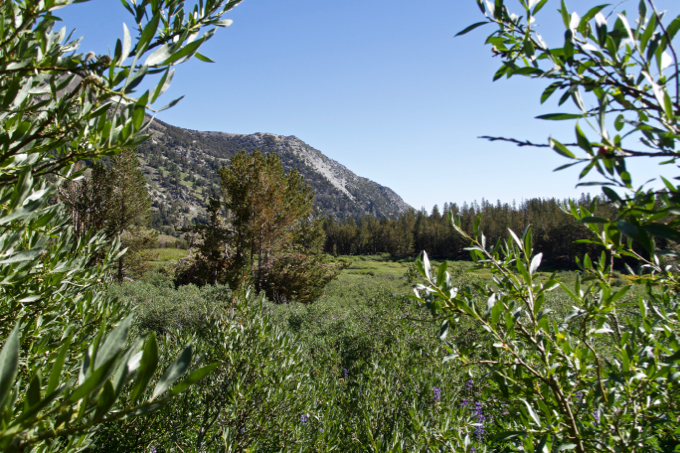
It didn’t take long for expansive views of Lake Tahoe to come into view, along with the meadow that spans both sides of the highway. Winding around, the south part of Reno then comes into view.

The guide points out Tamarack Lake to our right, which through the trees could easily be missed. Tamarack Peak (9,897 feet) is nearby, though Mt. Rose (10,776 feet) is the most dominate feature as it looms large for much of the walk.

It’s a single-track trail that at times is wide-open and other times is closed in by the forest.

While beauty is everywhere, the waterfall really is what makes this hike so outstanding. Looking at the rocks, it’s easy to imagine how thundering the water must have been in the summer. It makes me want to return next year, closer to peak flow.

Looking in the other direction is a lush, verdant meadow fed by these waters.

To the waterfall it was 2.4 miles, a 557-foot elevation gain, and 328-foot elevation loss. Our guides took us a bit farther, through the meadow with its gentle creek and wildflowers still vibrant. This added about another mile to our trek.

It had been a while since I had hiked with a group of mostly strangers. On the one hand it’s nice to meet others and be led, on the other hand the pace is inevitably slower and dogs are less likely to be allowed off leash. Still, the Sierra Club is to be commended for offering these free hikes and allowing non-members like myself to participate. All that’s asked is a $1 donation that goes for the guides to get first aid training without out-of-pocket costs.

A lush meadow is fed by Galena Creek. Photo/Kathryn Reed

—–

Getting there:

From South Lake Tahoe, go east on Highway 50. Go left onto Highway 28 at the top of Spooner Summit. At the roundabout in Incline, go right onto the Mount Rose Highway. Park at the summit on the left. The trail starts to the left. The starting elevation is 8,911 feet – the highest year-round pass in the Sierra.


Vail infusing cash into Whistler ski resort

By Natalie Obiko Pearson, Bloomberg

Last fall, in a record-setting deal, Vail Resorts paid $1 billion to acquire Whistler Blackcomb, betting it could improve upon the resort’s already abundant selling points.

 “It’s a game changer for our company. We’ve just added, arguably, the crown jewel of the ski industry,” says Pete Sonntag, Whistler’s new chief operating officer, who previously ran Vail’s Lake Tahoe operations.

In the next seven years, Vail will invest $276 million in capital improvements at Whistler, on and off the mountain. This season, Vail’s EpicMix app will allow skiers to compare lift lines in real time—minimizing concerns about Whistler’s increasingly large crowds. Vail is also opening a new après-ski spot at the renovated Roundhouse Lodge, that has a heated, open-deck bar with views across the valley.

Read the whole story