Wise snags second consecutive halfpipe victory

By USSA

SNOWBASIN, Utah — David Wise of Reno continued his winning streak at Dew Tour in Snowbasin, Utah, winning his second straight halfpipe event Saturday.

Wise’s first run won the evening for him as his did his first ever 1440 in the halfpipe in his second run and couldn’t get to his feet.

“I’m on a hot streak for sure. It’s fun to be out here enjoying the sport. Landing runs,” Wise said. “I’ve been around in the scene for a long time and did a lot of finals where I just didn’t quite get the run the way I wanted to. So just being able to land runs and just enjoy doing what I do has been awesome. And that’s honestly what’s made the difference for me.”

France’s Kevin Rolland came in second place and won the Dew Tour Cup while 16-year-old Torin Yater-Wallace of Basalt, Colo., landed on his third straight podium. His perfectly executed double cork 1260 in his second run landed him in third.

Next up the halfpipe athletes head to Mammoth Mountain for the Sprint U.S. Grand Prix taking place Feb. 29-March 3.


Fabulous views unveiled after steady climb on snowshoes

By Kathryn Reed

I have to catch my breath at one point as I feel the pull in my legs and lungs at the same time. “That’s why it’s called High Meadow,” Rosemary says.

I don’t have my snowshoe legs. That’s my excuse. It’s February and this was the first time to strap on the devices this winter. Usually by this phase of winter I’ve blazed trails throughout the basin.

Although there is exposed dirt on part of the the route most exposed to the sun, it still seems easier to hike with the snowshoes than boots. As we keep climbing, the snow just gets better for this winter activity.
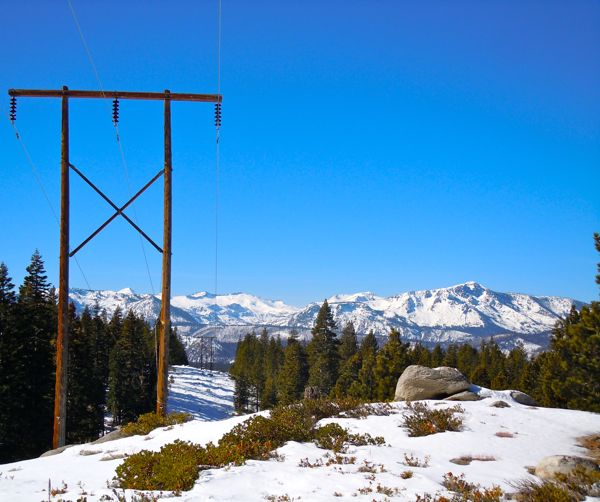
Power lines and Mount Tallac demonstrate modern conveniences and the power of nature. Photos/Kathryn Reed

Oddly, neither Sue nor I had snowshoed here before. Different off-spurs could have us exploring the High Meadow trail system for days. We’ve biked parts of Power Line, but had done zero winter outings until last weekend.

Already on the to-do list for the three of us is going farther than we did this particular day. Next time the end point will be Star Lake. That is about six miles one-way. High Meadow is about one mile below the lake. (Distances are according to the U.S. Forest Service.)

In summer 2010, the Forest Service turned the meadow into a construction zone in order to restore Cold Creek.

On our trek we make it to an earlier manmade disturbance – power lines. Power Line trail gets its name from all those overhead wires that run through the forest.

The clearing we use as a turn-around location provides spectacular views looking west to Mount Tallac, Pyramid Peak and other ridgetops in Desolation Wilderness.

Although signs are clearly posted that no snowmobiles are allowed where we are, the tracks prove the sleds have been out.

With the trail wide enough for a vehicle in places, it allows us to walk at least two across. It makes it easier to chat over the crunching of the snow.

Large conifers loom overhead, casting shadows on this gloriously sunny day. While the temperature was chilly to begin with, the exertion has us losing layers.

A vista of sorts beckons us before we reach our end point. The knoll provides panoramic views in all directions. Lake Tahoe almost looks small below the forest.

I’m ready to explore some more.

Getting to the High Meadow trailhead:

• From South Lake Tahoe, turn east onto Al Tahoe Boulevard.

• Turn right on Pioneer Trail.

• Turn left on Remington Trail. (Sierra House Elementary School is on the corner.)

• Follow signs to the end and park.

• On the trail, we veered up and to the right at times, but signs could be better.

ngg_shortcode_0_placeholder (Click on photos to enlarge.)


Future U.S. Olympic bid in limbo

By Reno Gazette-Journal

A decade has passed since Apolo Anton Ohno, Derek Parra and Sarah Hughes took their golden turns on the Salt Lake City Olympic ice; since U.S. men swept snowboard medals in a Utah halfpipe; since Vonetta Flowers rode a Park City bobsled run to history, becoming the first black Winter Games champion.

In those 10 years, the U.S. Olympic Committee has tried twice to bring another Olympics to U.S. soil.

And failed miserably.

As Salt Lake City marks the 10th anniversary of its Games — the opening ceremony was on Feb. 8, 2002 — U.S. Olympic bid ambitions are on hold while the USOC and the International Olympic Committee jockey over revenue sharing.

The earliest the USA could host another Olympics is 2022, when a Winter Games will be held. It could be much later.

“We’re not considering a winter or a summer bid right now,” says Scott Blackmun, the USOC’s chief executive officer.

That’s nothing to panic over, says Jon Killoran, CEO of the Reno-Tahoe Winter Games Coalition, which hopes to make a bid to bring the Winter Games to Reno-Tahoe in 2022. It’s part of the Olympic process, which often takes time.

“We’ve stated all along that the USOC has been very succinct in what they need to accomplish with the IOC in terms of a revenue-sharing agreement,” Killoran said. “We support and understand that process, and we continue to prepare ourselves so that at the appropriate time, when the USOC wants to move forward with the bid process, we can be ready to do that.”

Killoran said it was in 2009 when the IOC and USOC first began to negotiate the revenue-sharing agreement, and at that time they set 2013, prior to when the host of the 2020 Games will be announced (on Sept. 7, 2013) as a guideline to have an agreement in place.

Not having a home Games on the horizon, Blackmun says, affects Olympic awareness among fans and impacts to some extent how much sponsor and donor money the USOC raises to train Olympians. Over time, it could diminish how well U.S. athletes perform.

“When we have a Games in the United States, it really connects us to the American public in a way that’s good for us and for our athletes long-term,” Blackmun says.

Read the whole story


Superpass Series coming to Sierra-at-Tahoe

The Superpass Series is a five-stop national slopestyle tour open to any amateur riders who thinks he or she has what it takes to win an invitation to SuperPark 16.

Sierra-at-Tahoe is the third stop on the tour — Feb. 12. Sierra is the only Tahoe stop for this rider-judged contest.

Get that perfect shot and it could end up in Snowboarder magazine.

For more information, go online or call (530) 659.7453.


Rahlves’ Banzai Tour begins at Kirkwood

The Rahlves’ Banzai Tour returns to Lake Tahoe ski resorts with competitions in February and March. The event is considered the world’s premier big mountain freeskiing meets skier/boarder-cross experience and is becoming one of the region’s most popular spectator events.

Kicking off at Kirkwood Ski Resort the weekend of Feb. 11-12, participants (18 years and older) will go head-to-head four at a time, top-to-bottom, down a wide-open course over natural terrain and snow conditions. The four-stop event hits North Lake Tahoe Feb. 23-24 at Alpine Meadows.

A solo-qualifying run on Saturday ranks the top 32 men from ski and board and the top 16 women from ski and board to Sunday’s finals and a shot at the title. The top two in each round advance through the brackets until the remaining final four battle it out for the podium and title of Banzai Champ.

The Silver Belt Banzai race first took place in the 1940s at Sugar Bowl. In 2009 and 2010, one banzai race was held each year at Sugar Bowl. In 2011, the Rahlves’ Banzai Tour was created. Rahlves is at each event to open up the qualifying runs and assist competitors with tactics.

After the Alpine Meadows race (called the Beaver Bowl Banzai), the tour continues at Squaw Valley for the KT-22 Banzai (March 3-4) and concludes at Sugar Bowl with the Silver Belt Banzai (March 10-11) when Rahlves will compete in the “Super Final” taking on the men ski winners from each stop. The Rahlves’ Banzai Tour purse prizes total $80,000.

Warren Miller Entertainment showcased the 2011 Rahlves’ Banzai Tour in the recent film “Like There’s No Tomorrow”. For 2012, the event will be covered by NBC Red Bull Signature Series, airing nationally March 27.


Junior freeride competition at Sugar Bowl

The Tahoe Junior Freeride Series makes its first stop at Sugar Bowl on Feb. 11-12.

The region’s best junior big mountain skiers will test their skills each day in a two-run cumulative score format. Age groups of 10-14 and 15-18 for boys and girls. Points count toward national ranking.

The Tahoe Junior Freeride Series began as a friendly competition between Sugar Bowl and Squaw Valley’s Freeride teams and has since become a structured regional event that boasts some of the best junior talent in the country, with teams representing Squaw Free, Auburn Ski Club, Kirkwood Freeride team, Squaw Valley Freeride team, Alpine Meadows Freeride team and the Sugar Bowl Freeride team. Contestants are judged on their line choice, control, fluidity, technique and overall impression.

Competition begins at 10am each day.


Snowshoe event benefits Eric Nageotte-Lowe Scholarship Fund

The Tahoe Mountain Milers Running Club is hosting the Fresh Tracks 5K Snowshoe Walk and Race on Feb. 26 at 10am at Camp Richardson Resort.

The beneficiary is the Eric Nageotte-Lowe Scholarship Fund for the Heavenly Freestyle Team.

Check out the website for complete information and a mail-in registration form.

Register by Feb. 15 and the fee is $30, which includes a sweat shirt, snowshoe rental, post-race refreshments, and continued day use of groomed Camp Richardson trails.

Sweat shirts are for the first 50 registrants.

Online registration is available.

Entry forms are available at Kahle Community Center, South Lake Tahoe Recreation Center, Lake Tahoe Community College, Eclipse Running in Reno, CV Sports in Carson City, and the Douglas County Public Libraries in Minden and Lake Tahoe.

Day of race registration is $40.

For those who like to compete, unique handmade age-group awards are three deep.

There will be barbecued sausages and hot dogs along with other post-race refreshments.

For more information, call (775) 588.2864 or email tahoecarol@charter.net.


Pet owners support changing trap regulations

By Mark Robison, Reno Gazette-Journal

Jason Ruckman took his two German wire-haired pointers named Gauge and Gretchen for a run in the ravine next to the South Valley Sports Complex last month.

The puppies ran a little ahead out of sight — they were being trained to be hunting dogs — so he whistled to call them back. Only Gauge returned. That’s when Ruckman heard a whimper.

He followed the sound and found Gretchen caught in a live box trap baited with a few meats. The trap also contained snare traps, one of which got around Gretchen’s neck.

“She started struggling against it immediately and she started choking,” said Jason’s wife, Amie. “Jason was trying to help her and she was freaking out and completely panicking because her air supply was being cut off.”

He ran to his truck, got lineman’s pliers to cut her free and ran back, she said.

“By now she was not moving, she was passed out,” Amie Ruckman said, her voice cracking. “Sorry, it makes me choke up every time I think of it. He had to give her mouth-to-snout resuscitation.”

The trap was set by David Steven Fulton of Reno. The Nevada Department of Wildlife cited Fulton for having a trap within 200 feet of a roadway and for the way it was baited. The law restricts usage of game species as bait, including trout.

NDOW is helping the state Wildlife Commission develop rules regarding trapping near congested areas. The Wildlife Commission unveiled a draft trapping proposal last week that would make the use of traps illegal on public property within 1,000 yards of a residence.


Truckee River Winery looking for ice carvers

As part of the 2012 Snowfest, Truckee River Winery is teaming up with High Fives to bring you the inaugural ice carving contest – Wine n’ Ice on March 7 from 1-5pm.

For those interested in competing, entry packets are available at the tasting room. The $100 registration fee covers the cost of a block of ice. The top three contestants will receive an assortment of wine and other gifts, plus win back their entry fee. Entry forms are due back to Truckee River Winery by Feb. 17.

Spectators are welcome. Cover is $20, which includes soup, chili, appetizers and dessert as well as one glass of TRW wine, and a souvenir wine glass. Part of proceeds raised will go to High Fives Foundation.

In addition to the competition, there will be barrel roll races, live music and other outdoor games and entertainment. Guests are encouraged to sport their favorite, most colorful spandex, with prizes awarded to Best Dressed Male, Female, Tandem and Group. All ages welcome..

For questions about registration or information about the event, call (530) 587.4626 or email info@truckeeriverwinery.com.


Simple device makes walking on ice less precarious

By Kathryn Reed

Ice under tennis shoes and a dog at the end of a leash. And I didn’t fall. I didn’t even slip. Not once.

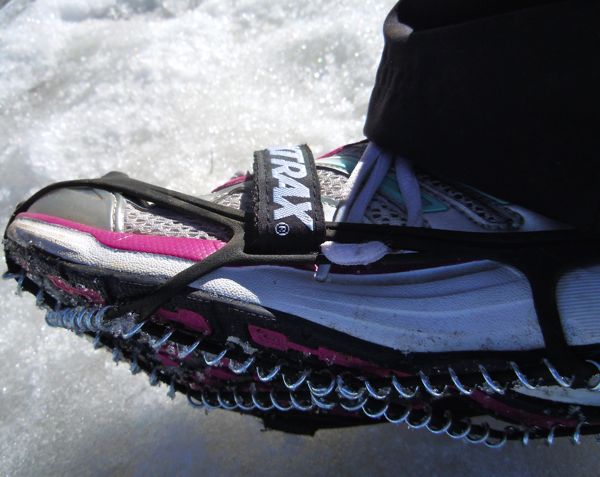
This is because I had a pair of Yaktrax on. I’ve owned a pair of the Walkers for a while, but seem to forget I have them until I’m sliding. Last week a pair of the Pro model arrived in the mail.

I’m keeping these in my car so I have them with me in case I’m in an icy parking lot or I’m off to walk my friend’s dog, AJ.

Yaktrax make walking on ice less scary. Photo/Kathryn Reed

These simple-to-use devices allowed me to walk my normal pace and normal gait. I walked on ice, hard pack and a mix of white stuff. The surface was level. I didn’t run, but the manufacturer says these are good for runners.

Abrasion-resistant steel coils are wrapped around heavy-duty natural rubber that slips over the bottom of shoes. One obvious difference between the Pro model and my old ones is the nylon hook and loop strap that fits around the top of the shoe for a more secure feeling.

The Yaktrax website says, “The easiest way for most people to install Yaktrax on their shoes is to sit down, cross your legs, pull your foot up near your other knee and slip them over your shoe.”

They also say not to wear them inside — which in my mind is the easiest place to sit.

I was outside putting them on because I didn’t need them on the street. I needed them to walk along the path in the Upper Truckee Marsh. Sitting was not an option if I wanted to stay dry.

Had it been colder, it would have annoyed me that I needed to take my gloves off to get them on and off. Part of that has to do with the strap, and part is these are tighter than my other pair.

But that was the only issue I had with these winter walking aids that are named after the Tibetan yaks that roam the Himalayas.

After my one test walk of the Yaktrax Pro, I know in the future I will not hesitate to wander into icy areas that normally I would avoid.