Tahoe woman survives avalanche, 3 others die

By Mike Dunham, Anchorage Daily News

Elyse Saugstad of Squaw Valley was taking a break with several fellow skiers Sunday in the Washington state backcountry when the shouting began. “Elyse! Avalanche!”

The 33-year-old turned to see tons of snow boiling toward her.

“I pulled the trigger,” she said, inflating two air bags attached to her backpack. The device is meant to keep skiers and adventurers from disappearing beneath waves of snow in an avalanche.

It likely saved her life, said Saugstad, who was hurled half a mile down the slope.

“(It was) like being in a washing machine,” she said.

Saugstad came to a stop buried in densely packed snow. Only her face and hands were free.

“The snow was like cement,” said Saugstad, who worried a second avalanche might follow. Only later did she learn that the body of one her companions was buried a few away.

In all, the avalanche had swallowed three other skiers. Saugstad, a professional downhill skier who grew up in Girdwood, was the only one of the four wearing the air bag backpack — and the only one to emerge alive.

On Monday, the Dimond High graduate and prize-winning freestyle skier told the Daily News that she was in a group of eight experienced skiers who opted to descend through a backcountry section near the boundary of the Stevens Pass ski area northeast of Seattle. Another group of five followed them.

“We weren’t being idiots,” she said. “We understood the dangers and followed all the safety protocols. We went one at a time, moving section to section, ping-ponging our way down the hill.

“Several of us had stopped in a safety zone among some old growth trees,” she said.

Hundred-year-old trees are usually a good indicator that the area is avalanche-free.

“Unfortunately, the freak accident happened,” she said. “One of the skiers (above me) set off the avalanche.”

Saugstad managed to pull the lever to deploy the air bags as the snow hit. The ABS TwinBag backpack, made by a German company and available in Europe for the past 15 years, has two bags on either side connected to canisters of compressed nitrogen. In an emergency, the gas fills the pillow-shaped bags, which act somewhat like water wings.

“The idea is that it’s keeping you up on the top of the avalanche,” Saugstad said.

She didn’t feel the bags inflate as the avalanche caught her, she said. “I wasn’t even sure they were deployed.”

She estimated that it was a Class 3 avalanche, which the Avalanche Center website says can destroy a small building and snap trees. Saugstad called it “huge.”

She came to a stop an estimated 2,000 feet or more from where she was first caught in the slide. Her face and her hands, wrapped in pink mittens, poked above the packed snow. The air bags formed a “cocoon” around her head and neck. Her feet were about five feet below the surface and she was unable to move.

“It’s very frightening,” she said. “I was trying to remain calm, but after a while I thought: ‘Hmm. Maybe I should scream for help.'”

Ten minutes after being swept away in the snow, the first rescuer reached her. At that point Saugstad wasn’t worried, except for the fear that a secondary avalanche — or even a third — might follow.

As the rescue continued, she realized how close she was to death. Literally.

“One victim was buried three feet to my left,” she said. “Another was 30 feet above me.”

The Seattle Times identified the dead skiers as Stevens Pass marketing director Chris Rudolph, Jim Jack, head judge for the Freeskiing World Tour, and John Brenan, a Leavenworth contractor.



Tahoe-Reno athletes on podium in slopestyle

By USSA

OSLO, Norway – Chas Guldemond of Reno won men’s slopestyle finals and the overall Ticket To Ride World Champion title on Sunday. Guldemond’s run was smooth and had a huge backside 1080 to an even bugger cab 1260.

Jamie Anderson of South Lake Tahoe took second place for the women, while Canadian Spencer O’Brien took the top spot.

Guldemond’s final run gave him the win with an 87.9 and it was a nail biter that put Quebec’s Sebastien Toutant in second place with a final score of 86.8.

Eric Beauchemin of Lake Winola, Pa., came in fourth place and Tyler Flanagan of Mammoth Lakes ended up in seventh.

In women’s competition, Jordie Karlinski of Snowmass Village, Colo., came in seventh and Ty Walker of Stowe, Vt., was ninth.

The weather improved from Saturday’s pipe finals, but temperatures dropped making the course slick.


What do you have to say about the Tahoe Rim Trail?

Stories about the Tahoe Rim Trail are being sought by Bona Fide Books for a future book.

Hikers, backpackers, cyclists, equestrians, trail builders and anyone else with an experience from the 165-mile trail that wraps around Lake Tahoe is invited to submit a story. It may be humorous, about natural history, epiphanies, trials and tribulations, wildlife, weather or anything else.

The deadline is Dec. 1. Stories should not exceed 5,000 words. Send them to submissions@bonafidebooks.com.

A portion of the proceeds will go to the Tahoe Rim Trail Association.

For more information, go online.


Grooming goes high-tech with a beastly fleet at Heavenly

By Susan Wood

She may be cold sometimes, but she’ll warm up fast – then take you for a real ride.

If you push her buttons just right, she’ll raise her big blade – then cover her tracks behind her.

She’ll light up your night man. And to the one who knows her best, she is an animal that often lives up to her name – The Beast.

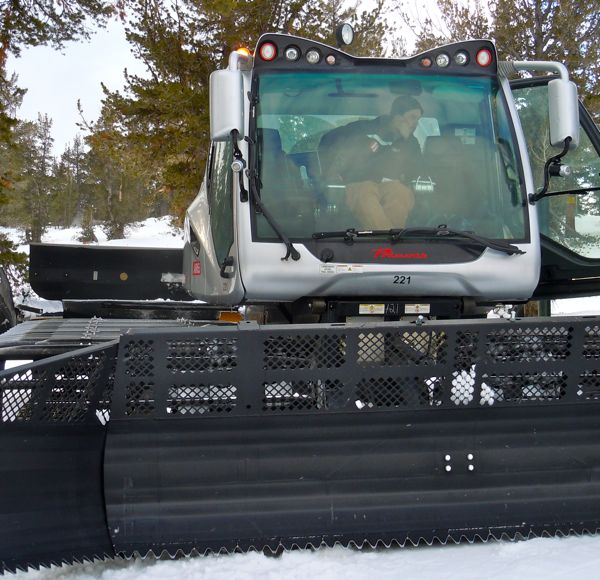
The Beast is able cover more terrain than smaller snowcats and do high-angle grooming. Photo/Kathryn Reed

Heavenly Mountain Resort’s latest fleet of four grooming snowcats is aptly named for being the best at moving snow, carving corduroy and covering ground.

With a 500 horsepower engine, she can put her mark on 9.5 acres per hour. Her predecessor the Bison is a smaller version in the 13-machine fleet that grooms 6.5 acres an hour with 350hp under the hood.

“The whole reason we bought The Beast is it can do more acres per hour. It has its place. It can push (snow) uphill. It’s aggressive. We need to cover as much ground as we can in the time we have,” Casey Blann, chief of Heavenly’s mountain operations, told Lake Tahoe News. “In their second year, we think it’s the way to go.”

This year, covering enough ground and spreading the snow can be more of a challenge with the lack of it – especially compared to what Lake Tahoe Basin experienced last season.

“Usually we have Mother Nature covering holes and rocks. Now it’s all us,” said swing shift groomer Daniel Huizar, who waited patiently for clearance to drive his rig up the mountain from the Tamarack Lodge at the end of the day. It’s Huizar’s fourth season as a groomer – a big step up in his eyes from sitting inside auditing tills at Mount Hood Meadows. Now he usually works at Heavenly from 4pm to midnight.

Heavenly employs 35 groomers who collectively have logged at least 230 years of experience.

Huizar’s first glance at a grooming machine was love at first sight.

“I want to be in one of those,” he recalled with the glee of a teenage boy. The 28-year-old is spending his fourth season at Heavenly. He sought change, and change is what he got with the opportunity to drive The Beast.

This beauty’s tiller in back and blade up front measure 23 feet across at full wing span. That’s a good 4 feet more than the Bison. Both are made by Prinoth, an Italian corporation that took over the former Bombardier company.

Parent company Vail Resorts spared no expense with purchasing the first Beast at Northstar then adding four more at Heavenly at about $500,000 each – substantially more than what the Bison models cost. With the buttons, joystick, levers and stereo with an iPod hookup, she’s a little bit of a cross between an airplane and video game inside. There’s even a knob for defrosting a very large windshield that runs coolant through the blades. (Tahoe residents would likely line up for that feature on their trucks and cars in the winter.)

Outside, she resembles a bulldozer on snow. She can push snow up the mountain like no other machine – even at a 16-degree angle most cats would have to use a winch for what’s called “high-angle grooming.” It can be nerve-wracking to drive it at first because unlike smaller cats she can easily clip a fence with her size. If you were to equate different models with paintbrushes, The Beast would cover the wall. The Bison would touch the corners.

Although Huizar appreciates the workhorse nature of The Beast, he waxes poetic when talking about her ability and where she takes him on the hill.

There’s a certain rhythm to watching The Beast’s giant blade push snow. It reminds Huizar of an ocean wave forming over the shoreline.

It was hard to imagine the run off the Tamarack chairlift was so tracked up when The Beast went for a spin last weekend. She placed perfect corduroy behind her. This is why some riders and skiers hang behind the machines – to “poach” the tracks, as Huizar put it.

Apparently, they’re not the only ones. Huizar often sees coyotes. One ran off with a whole bottle of Gatorade near the Beach Hut at Patsy’s chairlift. Most sniff the tracks to see if food has been churned up.

“Some places are thin, so you don’t want to do too much,” he said of this year’s slim natural snow. The groomer pointed to the top of the ridge that takes skiers and riders to the Nevada side of the resort and indicated how the area can be more challenging to groom with rocks just underneath the surface. Though conditions have improved substantially in the week Lake Tahoe News took a ride in The Beast.

“You tend to feel rocks more on these machines than skis,” Huziar said a week ago.

(Note to my skiself: These guys have saved the ski season.) But a modest Huizar turned the credit over to the snowmakers who manage the gun operations.

Suddenly, a beautiful rosy sunset lay over Mount Tallac to the west.

“Oh, I love this,” he said, stopping the machine on the Tamarack ridge and pulling out his camera. This is where Huizar takes lucky, ride-along buddies at the end of the ski day. They’re picked by ski patrol from the lodge. Many are so appreciative, they try to tip him, but to no avail.

To the east, overlooking the Carson Valley, the groomers have even coined a name for the view from where the Big Dipper meets Orion – “Operation Elevation.”

A fleet may follow each other’s fall line from the ridge like a pack of dogs. The camaraderie is enhanced by the chatter on the radio. For that reason alone, Huizar doesn’t get lonely – even on occasions when he works the graveyard shift. He recalled how interesting the nights were at Mount Hood when groomers at Meadows would flash their lights at the Timberline resort drivers and vice versa.

Night operations is a world all its own.

“I don’t think people realize how a lot goes on at a ski resort at night,” Huizar said.

Sometimes he sees the groomers at Homewood across Lake Tahoe.

“The views up here are awesome,” he said as the sun was setting in the real High Sierra.

ngg_shortcode_0_placeholder


Hight takes 6th in halfpipe event in Norway

By USSA

OSLO, Norway – Kelly Clark of West Dover, Vt., earned her 15th straight win taking the Ticket To Ride title at the World Snowboarding Championships halfpipe finals on Saturday.

Matt Ladley of Chicago had a huge frontside 1260 and a great run that scored him second place in the men’s competition, while Iouri Podlatchikov of Switzerland took the win.

Louie Vito of Sandy, Utah, took third for the men with a big frontside double 1080, while Gretchen Bleiler of Aspen was third for the women.

Elena Hight of South Lake Tahoe came in sixth place.

Foggy weather and humidity made for tricky conditions in the halfpipe and it took great skill for the athletes to gauge their speed.

Next up check out the Sprint U.S. Grand Prix at Mammoth Mountain Feb. 29–March 3.


U.S. women dominate World Cup downhill

By USSA

SOCHI, Russia – U.S. women rewrote the record books Saturday as Lindsey Vonn of Vail finished third, Julia Mancuso of Squaw Valley sixth, Stacey Cook of Mammoth Mountain ninth and Alice McKennis of Glenwood Springs, Colo., 10th to place four American women in the Audi FIS Alpine World Cup downhill top 10 for the first time in history.

The record setting team performance, which included all Americans finishing in the top 30, happened at Rosa Khutor Resort – alpine host of the 2014 Olympic Winter Games. The last time U.S. women place four in a World Cup top 10 was March 17, 1985, during a giant slalom in Waterville Valley, N.H.

“Any one of the girls on our team could have won this race. Our speed group is incredibly strong and we have been the past few years,” Vonn said. “It says a lot about how hard we work and how much we love ski racing.”

Mancuso said, “I like to dream big, ski fast and dream about all of those powder days at Squaw Valley that helped me to get to this place that I am now. Being a professtonal skier and being able to ski in the Olympics is a pretty big honor, so I’m hoping to be back here in 2014.”


Bahrke wins his first World Cup in freestyle aerials

By USSA

Scotty Bahrke of Squaw Valley won his first FIS Freestyle Aerials World Cup on Friday in Kreischberg, Austria.

This was Bahrke’s first podium of the season and the second of his World Cup career.

Dylan Ferguson of Amesbury, Mass., finished third, earning his second podium of the season. Laura Peel of Australia was the women’s winner.

Bahrke’s winning jump was a back full double full full (quad twisting triple flip).

Bahrke is the first U.S. mens aerialist to win a World Cup since Ryan St. Onge in February 2009 in Moscow.

No U.S. women competed in Austria.


Truckee resident competing in World SUP Championships

Truckee’s Jay Wild is serving double duty for Team USA, racing in the technical and distance divisions at the ISA World SUP Championships.

This is Surfing America’s first time to participate in the PacSun USA Stand Up/Prone Paddle Team competition. The event in Miraflores, Peru, runs Feb. 19-25.

Wild is considered one of the best racers in the nation and is highly regarded and feared by fellow competitors for his speed, endurance and technical skills that he honed in the tricky waters of Lake Tahoe.


GOP candidates talk about feds releasing control of Western lands

By Rocky Barker and Dan Popkey, Idaho Statesman

GOP presidential candidate Rick Santorum’s call to sell or transfer federally owned public lands Tuesday night in Boise earned him several rounds of applause.

But Idaho Gov. Butch Otter found in 2005 that while Idahoans don’t like how federal lands are managed, they don’t want to lose access to the places they hunt, fish and camp.

President Herbert Hoover and former Interior Secretary James Watt learned similar lessons in their times.

But Santorum’s detailed proposal on an issue close to the heart of Westerners may help set him apart from Republican Mitt Romney in the March 6 Republican caucus, which is expected to attract the most devoted party members.

“We need to get it back into the hands of the states and even to the private sector,” Santorum told an overflow crowd at Boise’s Capital High School. “And we can make money doing it.”

Santorum said national parks like Yellowstone and Grand Canyon should remain under federal management. But based on the poor management he has seen in the federal lands in his home state of Pennsylvania, he said he believes Westerners could do better.

“We do not need this huge amount of federal land under federal purview and I would be happy to work with your senators and congressmen out here in the West to put a plan together that’s going to have a much more responsible management of land in the West than we’ve had in the last many years, OK?”

Santorum isn’t the only Republican in the race urging the federal government to transfer public land.

Rep. Ron Paul has called for eliminating the Department of Interior, which manages more than 500 million acres of public land and a big chunk of Idaho, almost two-thirds of which is owned by the federal government.

Read the whole story


Adaptive wrestling champion switching to snowsports

Born with one leg, 23-year-old Anthony Robles, 23, went on to win the 2010-11 NCAA individual wrestling championship (against all able-bodied competitors) in the 125-pound weight class. He is a two time ESPY award winner, an inductee to the National Wrestling Hall of Fame, and the exclusive motivational speaker for the Washington Speakers Bureau.

This weekend will mark the first time he has been on snow.

MakeAHero.org and Northstar are partnering to have Robles, who will be with his family, have the opportunity to learn to ski from local adaptive sports instructor Bill Bowness.

“Anthony has never let anything slow him down, so when he expressed interest in learning to ski, we wanted to help him achieve his next goal,” Kurt Miller of MakeAHero.org said in a statement.

Bowness, also an adaptive skier, was awarded the first adaptive slot on the PSIA Alpine Team in 2004, promptly earning the respect of fellow team members for his ability to instruct able-bodied alpine skiers of all levels just as well as adaptive skiers.

MakeAHero.org crews will document Robles’ experience on snow this weekend, creating a web video to share with people around the world. Raising awareness and funds in support of sports opportunities for people with disabilities is at the heart of MakeAHero.org’s mission.