Mancuso 9th in GS; one spot ahead of Vonn

By USSA

OFTERSCHWANG, Germany — Torino Olympic gold medalist Julia Mancuso of Squaw Valley was ninth and Lindsey Vonn of Vail 10th Friday at an Audi FIS Alpine World Cup giant slalom held on incredibly soft snow conditions in bluebird southern Bavaria.

Temperatures soared into the high 40s as local Viktoria Rebensburg clocked the wire-to-wire victory and reclaimed the World Cup giant slalom points lead.

Vonn’s overall lead slipped slightly from 528 to 474 as Slovenia’s Tina Maze, her closest competitor for the highest World Cup honor, finished second.


North Shore man dies from injuries sustained in avalanche

A 29-year-old Olympic Valley man caught in an avalanche Thursday near Alpine Meadows has died from his injuries at Tahoe Forest Hospital in Truckee.

Benjamin Brackett was skiing with two friends March 1 when they triggered the slide. They were climbing with skins on their skis about 500 vertical feet below Stanford Rock when the avalanche occurred.

This video from KTVU Channel 2 explains the difficulty rescue teams have in getting people out of the backcountry in a timely manner.

The area the trio was skiing in is considered extremely rugged. It is on the backside of Alpine, but not in the ski resort’s boundaries.

The Sierra Avalanche Center on March 1 called the avalanche danger “considerable”.

— Kathryn Reed


Buoy battle at Tahoe escalates despite TRPA court victory

By Kathryn Reed

The Tahoe Regional Planning Agency must use better science and environmental analysis to prove increasing the number of buoys and piers in Lake Tahoe will not harm the alpine waters.

Although it was the TRPA that essentially was on the winning side of a decision that came out of the Ninth Circuit Court of Appeals on Feb. 29, it is not a clear-cut victory.

Some believe more buoys on Lake Tahoe will bring more boats and more pollution. Photo/LTN file

In some ways, the League to Save Lake Tahoe won, too.

It was the League that filed the original lawsuit. The conservation group took issue with TRPA’s plan that would have allowed an additional 128 private piers and 1,822 buoys to the already existing 768 piers and nearly 4,500 buoys.

It is estimated this would create an additional 62,000 boat trips each year on Lake Tahoe.

“The amount of pollution you get out of a boat is dramatically more than you get out of a car,” Carl Young, program manager for the League, told Lake Tahoe News. “The reality of it is when you put a buoy on the lake, it’s not just a buoy. It’s the boat connected to it. When boats are used on the lake, they have certain impacts.”

TRPA is tasked with improving lake clarity. The irony is this court decision came out the same day the lake clarity report was released. While a dinner plate of sorts can be seen to a greater depth than in 2010, the clarity has stayed essentially the same in the last decade despite more than $1.5 billion being spent on clarity efforts.

While Tahoe led the charge a decade ago in banning the old polluting two-stroke engines, TRPA staff and board members don’t routinely talk about how boats pollute Lake Tahoe. But the League contends boats pollute the lake more dramatically than cars do through air pollution. Car emissions, what comes out of woodstoves — those are topics TRPA is vocal about.

The shorezone issue has been contentious for nearly 24 years and became even more so after the Governing Board of the TRPA adopted a shorezone plan in October 2008. That month the League and Sierra Club filed suit in U.S. District Court in Sacramento.

The bi-state regulatory agency appealed the September 2010 decision by U.S. District Judge Lawrence Karlton that struck down the TRPA’s shorezone ordinance.

The San Francisco-based appellate court on Wednesday did not overturn the entire District Court decision, but instead ruled on a segment of it.

TRPA must provide better, thorough environmental documentation as to why illegal buoys should be allowed in the baseline analysis.

“What we have with this ruling is a process for moving a shorezone policy forward with a more thorough analysis and we will be reviewing our options,” Kristi Boosman, spokeswoman for TRPA, told Lake Tahoe News.

But with the focus of the agency being on the Regional Plan update, in particular the draft environmental impact statement coming out at the end of the month, it’s not likely the TRPA will address the shorezone in the immediate future.

The League will wait to see what the TRPA comes up with before it makes a move. According to Young, his group from the get-go wanted better analysis and is happy the court is mandating TRPA provide it.

“What the Ninth Circuit did was overturn that portion of Judge Karlton’s ruling saying the agency basically could use potentially illegal buoys, but it needs to justify why it would be included and analyze the impacts,” Young said.


3 skiers survive avalanche near Alpine Meadows

Updated: March 1 7:25pm

By Kathryn Reed

Three skiers in the backcountry near Alpine Meadows triggered an avalanche Thursday that caused one man to be brought out in a basket by a rescue team.

The names of the three have not been released.

They were climbing with skins on their skis about 500 vertical feet below Stanford Rock when the slide occurred.

Dena Erwin, spokeswoman for Placer County Sheriff’s Office, told Lake Tahoe News that officers at the rescue site said the skiers believe they caused the avalanche. But she did not know how wide the slide was.

This area is considered extremely rugged. It is on the backside of Alpine, but not in the ski resort’s boundaries.

The Sierra Avalanche Center on March 1 rated this a “considerable” avalanche danger day. This is typical after a substantial snowfall on a slick surface.

One of the three men was able to ski out to call for help, while the other skier stayed with their injured friend.

The call came into the sheriff’s department about 2pm. The skier was  hauled out of the backcountry close to 5pm. Erwin said he  was in critical condition when he was taken to Tahoe Forest Hospital in Truckee

Also assisting with the rescue were members of Tahoe Nordic Search and Rescue.


Tahoe’s clarity — a billion dollar scientific experiment

By Kathryn Reed

Stabilized is the word being used to describe what is going on with the clarity of Lake Tahoe. It took $1.5 billion to get to that point.

That is the amount of money spent, according to the Tahoe Regional Planning Agency, on environmental improvement projects between the inception of the program in 1997 and 2010. In 1997, the depth the Secchi dish, which looks like a white dinner plate, could be seen was 64.1 feet. In 2010 the depth was 64.4 feet.

On Feb. 29 the 2011 clarity data was released, showing a clarity depth of 68.9 feet – or an improvement of 4.5 feet in one year. 2010, though, was the second worst reading since records began to be kept in the late 1960s, having decreased by 3.7 feet from 2009.
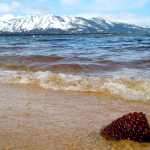
It has taken $1.5 billion to stabilize Lake Tahoe's clarity. Photo/LTN file

The back-and-forth nature of the readings amounts to little change in the last decade. In 2000, the disk could be seen at a depth of 67.3 inches.

“We feel it’s positive news because we’re at the point of stabilizing,” Kristi Boosman, TRPA spokeswoman, told Lake Tahoe News. “It would have been a whole lot worse had we not made the investment we did.”

But there is no proof that statement is true.

That money – mostly from the feds through the Southern Nevada Public Lands Management Act – is about to run out. That means another funding source needs to be found. Public-private partnerships are touted as the answer, but what exactly that looks like and who will be in either category remains to be seen.

Lake Tahoe clarity readings: 2011: 68.9 feet (21 meters) 2010: 64.4 feet (19.6 meters) 2009: 68.1 feet (20.8 meters) 2008: 69.6 feet (21.2 meters) 2007: 70.1 feet (21.4 meters) 2006: 67.7 feet (20.6 meters) 2005: 72.4 feet (22.1 meters) 2004: 73.6 feet (22.4 meters) 2003: 71 feet (21.6 meters) 2002: 78 feet (23.8 meters) 2001: 73.6 meters (22.4 meters) 2000: 67.3 feet (20.5 meters) Source: TRPA

“We always have to ask ourselves if we are getting results from the dollars because they are public dollars,” Harold Singer, executive director of Lahontan Regional Water Quality Control Board said. His agency is tasked with managing water issues on the California side of the basin, though Lahontan’s jurisdiction is much greater than Tahoe.

“You can’t tie year-to-year clarity readings to the landscape. You have to look at long-term trends,” Singer told Lake Tahoe News. Otherwise it’s just looking at what was going on that one year instead of at the big picture, he said.

The surprise with the year-over-year improvement was 2011 was a heavy snow year, which in turn created a ton of runoff. This usually means more sediment reaches the lake to cloud the water, with an expected outcome of diminished clarity.

Geoffrey Schladow, director of the UC Davis Tahoe Environmental Research Center, in a statement said, “The factors that contribute to lake clarity are complex, and are not necessarily linked to factors occurring in the current year. Understanding what controls the long-term trends is at the heart of what we are attempting to do.”

TERC along with TRPA released the report.

But one of the problems is no one is sure what is working and what isn’t. For years nutrients like nitrogen and phosphorous were seen as the big bugaboos. Now it’s fine sediment.

While TRPA has come up with a top 10 list of what individuals can do to help with lake clarity, there is no overall top 10 list of projects that could or should be implemented.

No one has identified the top areas contributing to the degradation of lake clarity. The mantra is “urban upland” – or the old developed areas in the basin.

This means that instead of taking a concerted approach to fixing the biggest polluters, the powers that be have cast a broad net to fix the problem. So, the next billion dollars that is spent on lake clarity may not be spent in the most efficient manner because after all of these years no one has prioritized what needs to be fixed to get the best return on investment.

Goals from 2008-18 are outlined on Page 14 of this document. But they are neither specific nor detailed.

TRPA also supplied this information with accomplishments through 2006. It says how the money was spent, not whether it did any good in terms of lake clarity.

Even though the goal of TRPA and the states is to have Lake Tahoe’s clarity be 97 feet by 2076, no detailed plan to reach that goal has been put in place by now. TRPA was created more than 40 years ago with the main emphasis to protect the waters of Lake Tahoe.


In search of disappearing vernal pools

By Stephanie Taylor, Sacramento Bee

A vanishing and mysterious phenomenon, concentrated on the western alluvial slopes of the Sierra, spans much of California’s Great Valley. Vernal pools. We most often hear about vernal pools in relation to the “endangered” fairy shrimp, and I was always slightly annoyed that such a big deal is made over something we can barely see.

In winter, rain collects in shallow depressions of hardpan earth so dense that water can’t drain. Every freshwater pool is as unique as a fingerprint, with hundreds of species adapting to precise conditions of its specific environment. An integral element in California’s freshwater system, each vernal habitat is like an island, a microcosm that represents our wider ecosystem of interdependence, including specialists and generalists, each with a talent or trick for survival.

Fleeting vernal habitats are easiest to see in the spring. Flowering plants proliferate in concentric rings in a seemingly impossible array of color and pattern. When John Muir walked this valley, he wrote, “Sauntering in any direction my feet would brush about a hundred flowers with every step, as if I were wading in liquid gold.”

With summer, the bounty fades in the desiccating heat, and in fall the magic is covered with a sheltering layer of dying matter.

Winter hides what I think are the most fascinating secrets of vernal pools. The land looks barren but softly golden as we drive by. Stop, and an undulating countryside transforms into a surreal fantasy-scape.

At the top of a gentle hill at Rancho Seco Recreation Area, hundreds of fuzzy mounds descend in all directions. These are mima mounds, covered with dead grasses highlighted white in the late afternoon sun. Each casts a shadow over slightly greener, flatter areas that should be filled with water reflecting a huge sky. But most pools are dry now. There’s been so little rain.

Read the whole story


Snow cancels classes; roads a mess in Lake Tahoe Basin

Blizzard conditions this morning have forced schools in the Lake Tahoe Basin to call a snow day.

Closed for the day are:

• Lake Tahoe Unified School District

• Lake Tahoe Community College, including Child Development Center

• Douglas County schools at the lake

• Tahoe Truckee Unified School District

• Incline Village schools

• Sierra Nevada College.

Walking along Highway 50 will continue to be dangerous today -- and chains are needed. Photo/Kathryn Reed

Washoe County schools outside the basin are on a two-hour delay.

The heaviest snow on this Leap Day is expected through 10am. But another storm is on the heels of this one, so snow is likely to be falling through Thursday.

A winter storm warning remains in effect through noon March 1. Because strong winds are part of this system it will make driving hazardous. Expect whiteout conditions over mountain passes.

For road information, click on the state icons at the top of Lake Tahoe News’ home page. Highway 89 around Emerald Bay is closed.

According to the Sierra Avalanche Center, “A trend of increasing avalanche danger is expected to occur this afternoon through (Thursday).”

— Kathryn Reed


Sugar Bowl event raises money for Boarding for Breast Cancer

Sugar Bowl Resort is teaming up with Boarding for Breast Cancer for the fourth annual Shred the Love benefit March 3.

The resort will have a rail jam contest in the Switching Yard Terrain Park, with all entry fees from the event benefiting B4BC and their mission to provide breast cancer education, prevention and support programs for young people and the action sports community at large.

Adding awareness to the cause and contributing additional funds, pink Sugar Bowl pass lanyards will be on sale for $4, and $1 from every Coors Light poured that day will go to benefit B4BC’s efforts. The resort will also host a silent auction from 10am-2pm.

Entry is $25 and registration is from 8:30-10am for the boarding contest. Competition is form 11am-1pm in Coldstream Terrain Park.

For more information, call (530) 426.9000.


Continuous snow reminds people it’s winter in Tahoe

By Kathryn Reed

What was supposed to be a minor storm as a prelude to what is going to arrive Tuesday night turned out to be a rather significant event by 2011-12 winter standards.

South Lake Tahoe officially received 5 inches of snow by 3:30pm Monday, according to the National Weather Service. By 6:41pm Mount Rose had recorded 17 inches of snow.

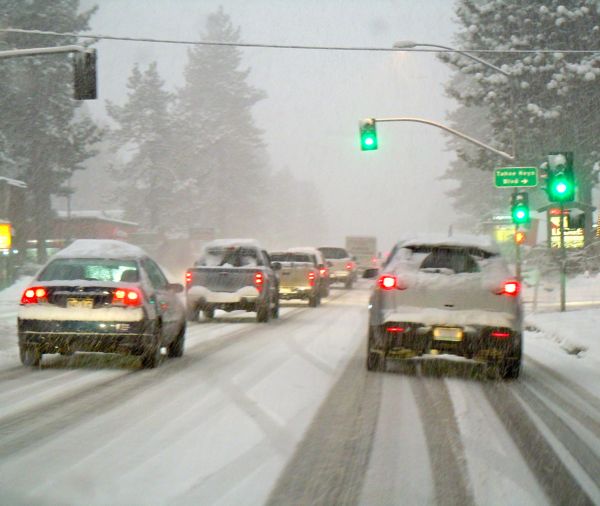
It's bumper-to-bumper traffic through South Lake Tahoe on Monday night. Photo/Kathryn Reed

Both those amounts keep increasing as the white stuff continues falling. While the snow is expected to taper off Monday night into Tuesday, there is a 90 percent chance of snow Tuesday night and 100 percent likelihood Wednesday.

The Weather Service has issued a winter storm warning from 1am-7pm Wednesday.

Weather gurus say between 10 and 20 inches could fall above 7,000 feet, with 5 to 10 inches below that level.

Winds will be picking up as the next storm moves in, with steady winds of 25 to 35 mph and gusts of 50 mph. The ridge tops could experience gusts of 100 mph.

Driving over mountain passes will be less than pleasant, just like the Monday commute over Spooner Summit. Snow was falling so fast Nevada Department of Transportation crews were not keeping up with the accumulating snow. Visibility was also a factor and will likely continue to be.

“Strong winds and heavy snow Wednesday will result in dangerous driving conditions on area roads and near zero visibility over the higher passes late Tuesday night and Wednesday,” the Weather Service warns.

To know about road conditions, click on the state icons on the home page of Lake Tahoe News.


Backcountry splitboarder to be at showing of film in Truckee

Follow Northwest splitboard mountaineer Kyle Miller deep into the Cascades on his epic hunt for good snow in the short documentary “FreeRider”.

The film chronicles Miller’s passion for his sport, his ski bum lifestyle, his love of the mountains, his triumphs and disappointments, his pain and his joys, and his unyielding dedication toward fulfilling his riding dreams. Each season Miller sets a high bar for himself. In 2010, he became the first documented splitboarder to climb and ride all 25 volcanoes in the Western United States. Last year he completed Washington’s 10 highest peaks.

He has made numerous first descents on splits and covered hundreds of miles and thousands of vertical feet on multiday haute route traverses throughout the Cascade Range.

Miller will be attending the screening and also presenting a slideshow covering some of his most challenging backcountry trips, as well as sharing some insight on setting and accomplishing goals, overcoming adversity, and just riding for the pure adventure of it.

The presentation is being hosted at the Back Country on March 3 at 8pm, 11400 Donner Pass Road, Truckee.

For more information, call (530) 582.0909.