Don’t depend on a doctor being at sporting events

By Erin Beresini, Outside

Peter Hass had been running for about two hours when he collapsed at the finish line of San Francisco’s Kaiser Permanente Half Marathon last February. The race’s only medical team, which included chiropractors but no M.D.’s, had been called away to deal with another emergency, so a doctor who happened to be running the race performed CPR. Meanwhile, the race announcer issued calls for help over the loudspeaker. The nearest city paramedics arrived 22 minutes later. By the time they reached the 36-year-old Hass, it was too late.

Last year, 13 Americans died during running races, and another eight while competing in triathlons. While those numbers might seem troubling, the deaths are attributable mostly to the booming popularity of endurance sports—13 million Americans enter running races each year, and 2.3 million compete in triathlons. But the rising participation and the proportional death toll—especially in cases like Hass’s—highlight the need for quality medical care at these events. And usually that care comes from volunteer doctors.

At least it used to. More and more doctors are refusing to donate their services, and it’s for one frustrating reason: they can’t get medical-malpractice insurance. Most doctors’ insurers typically won’t issue one-day policy riders for sporting events, and race organizers haven’t stepped up to offer alternative coverage. After the 2008 Ironman World Championships, volunteer medical director Franklin Marcus famously resigned because race organizers had refused to offer coverage.

While some doctors are still willing to volunteer, many events have been dangerously understaffed. Kathy Matejka, event-services director for USA Triathlon (USAT), the official governing body of the sport in the U.S., acknowledged that doctors have been unable or unwilling to take on the risk of volunteer service absent the umbrella of malpractice coverage. The result “was compromised medical support in some instances.”

The truth is, individual physicians may not have much to fear. Outside was unable to find any American doctor who’d been named in an event-related lawsuit. This is because plaintiffs typically go after race organizers, who have deeper pockets.

But while the risk of lawsuits may be overblown, the threat of not having enough qualified doctors on hand is very real. One man attempting to fix the problem is George Chiampas, president of the World Road Race Medical Society and medical director for the Chicago Marathon since 2007. Chiampas, who notes that Good Samaritan laws cover doctors only if they’re bystanding fans and not official event volunteers, teamed with USA Track and Field and sports insurance company ESIX to create policies specifically for volunteer medical teams. Beginning in 2009, all five major U.S. marathons — Chicago, New York, Twin Cities, Boston, and Houston—bought the plan, at a cost of $50 to $60 per doctor. USAT began offering the program last year.
Read the whole story


Helmet technology advances worth new purchase

By Kelly Kaoudis, SKI magazine

Last season, 1.3 million snow sports helmets were sold in the U.S., up three percent from the year before and 25 percent from the 2008–’09 season. Even in one of the toughest snow and retail years in recent decades, helmet sales continue to rise.

The consistent upward trend can partially be attributed to innovations in comfort, fit, and protection, according to Kelly Davis, the director of research at Snowsports Industries America (SIA). While safety experts agree widespread helmet use has reduced the frequency of serious head injuries, today’s lids don’t eliminate all the risks. In fact, in some cases, relatively low-impact falls and collisions can be just as dangerous as plowing into a blue spruce or landing a cliff-drop on your cranium.

A typical helmet disperses about 75 percent of the force of a direct blow to the head, though the impact may still be fatal, according to Dr. Jasper Shealy, a professor specializing in human factors engineering at the Rochester Institute of Technology and a helmet expert.

“Research shows that a [traditional] helmet can reduce brain injury if an incident involves a direct impact with a fixed object like a wooden post [or a tree],” said Shealy.

Read the whole story


Tahoe cyclists ready to set a record

South Lake Tahoe cycling enthusiasts are going after the world record for the largest bicycle parade.

Slow Rollers bike club is sponsoring the May 17 event at 4pm. Riders will go from the Y in South Lake Tahoe to MontBleu in Stateline.

Preregister at Sports Ltd. in the Village Center or call (530) 544.3979.

Come in costume for a chance be named Best of Show.

A party after the ride will be at Mo’s Place on Highway 50.


Reno River Festival moves to mid-June, adds dog event

The 9-year-old Reno River Festival is changing dates – June 15-17.

Former Freestyle World Champion Ruth Gordon-Ebens has taken over as festival director.

The event includes freestyle, boatercross, and slalom kayaking competitions, as well as the Run Amuck fun run. Live music takes the stage throughout the weekend, along with Yoga in the Park and enough food and drink to satisfy most tastes.

This is the first year dogs will be part of the festival as competitors – with Splash Dogs and the Biggest Little Dog Jog.

For more details about the 9th annual Reno River Festival or the Run Amuck, including registration, vendor, volunteer and sponsorship information, go online or call (775) 784.9400, ext. 119.

The festival is at the Truckee River Whitewater Park at Wingfield located in the heart of downtown Reno.


Pacing yourself on your next ski trip

By Jess Higgins Kelley, MNT, SKI magazine

Don't overdo on your ski vacation.

Sometimes, the anticipation surrounding a ski trip creates a type of pressure that detonates the first night of vacation. Here’s what happens: arrival in a ski town, off the plane and direct to the slope side hotel. This is immediately followed by an indecent amount of cocktailing and pizza eating with old pals in effort to blow off steam accumulated by wrapping up work projects needed to get away. The next morning – well, ouch. But you drag yourself out of bed, get an extra shot in your coffee, hit the slopes with half-drunk vigor, and chase it all with a couple beers. The following morning, with sore muscles, slight nausea, and a black diamond headache, you successfully talk yourself out of skiing – it’s a little cold and icy anyway. Vacation is ruined, you feel sick the rest of the week.

The good news is this scenario doesn’t have to be reality. Let’s look at some easy strategies you can implement in order to ensure your next ski trip is spent actually skiing, and not throwing up and watching TV in a dark hotel room.

Read the whole story


Recruiting the next generation of park rangers

By Kurt Repanshek, National Parks Traveler

Who will be the next stewards and advocates of the national parks? In a society where Baby Boomers are graying steadily if not quickly, and where the “face” of the National Park Service is decidedly male and Caucasian, it’s not an unreasonable question to ask.

The question was raised at America’s Summit on the National Parks, a conference that drew nearly 400 to Washington, D.C., in mid-January to explore the future of the National Park System as the National Park Service heads towards its centennial in 2016. Concern over that question stems from the relative lack of diversity in the faces of the nearly 279 million visitors to the parks last year, a similar lack of diversity in the workforce of the Park Service, and a nagging concern that today’s youth are not drawn to the parks.

But the concern is not newfound, and there are groups across the country that are working to answer that question by enticing youth of all races into not just the national parks specifically, but the outdoors in general.

For more than 50 years the Student Conservation Association, an idea a college student at Vassar College outlined in her senior thesis, has been connecting youth with the outdoors. It was launched in the mid-1950s when Elizabeth Cushman, shocked by a magazine article suggesting national parks should be shuttered because they were being overwhelmed by visitors, was searching for a way that students could help the National Park Service with trail work and other conservation projects.

Her proposal: a student organization fashioned after the Civilian Conservation Corps of the 1930s.

Read the whole story


Students to get hands-on education in Tahoe forest

By Kathryn Reed

Joy Barney is doing her part to make sure students on the South Shore are getting outdoors.

The conservation education coordinator for the Lake Tahoe Basin Management Unit of the U.S. Forest Service was shocked when she moved here five years ago and some high school students looked at her funny when she asked if they had ever hiked in the surrounding forest. She presumably had a look of disbelief when they said no.

“A lot of students who grow up here don’t have the same access as tourists who come play here,” Barney said.

Students will be learning about life in the outdoors of Lake Tahoe through Children's Forest. Photo/LTN

Through the Children’s Forest program third- through fifth-grade students will explore the area from the Tallac Site to Taylor Creek Visitors Center along Highway 89 on the South Shore. It’s officially known as the Pope-Baldwin Recreation Area.

Barney said the goal is to link the two areas historically, culturally and environmentally, and then explore how to improve what’s there. Youngsters will be given opportunities to have a voice and be leaders in forest management.

Children’s Forest is an expansion of the Forest Service’s More Kids in the Woods program that started in 2007. The new program is site specific, whereas the older initiative is more programs driven.

This is the second year the USFS has handed out Children’s Forest grants, with it the first time for LTBMU to receive a grant. The amount allocated is $40,000. Another $50,000 in in-kind contributions has come from LTBMU, South Tahoe Environmental Education Coalition and Tahoe Heritage Fund. The Washoe Tribe is also an integral partner.

The bulk of the costs are to start the program, with the goal being it will be in existence for years. The funding provides age-appropriate curriculum.

The big launch will be June 2-3 during the Wild Tahoe Weekend, which is now in its second year. Fourth- and fifth-graders will initiate the Children’s Forest, with third-graders becoming part of the program in the fall during their annual kokanee salmon field trips.

Besides Lake Tahoe Unified students, Incline Elementary, Lake Tahoe School and Tahoe Expedition Academy students will be part of the outdoor program. About 1,700 students are expected to go through Children’s Forest this summer and fall.

The Native Species Festival on June 3 is when the Children’s Forest will be in the forefront. While it is geared toward adults and kids, it will be students who lead most of the programs that day, including a play put on by fifth-graders. Everyone may dress as a native species for the parade.

The Forest Service is talking with Washoe Tribe members to see if they would do seed collection earlier than normal so plantings could occur during the festival at the Washoe Tending and Gathering Garden at the Tallac Site.

The plan is once the garden is finished, it will provide students an opportunity to learn about native plant species and develop a relationship with the Washoe Tribe.

From June 4-13 field trips to the site for fourth- and fifth-graders are slated. This is when the pilot curriculum for Children’s Forest will be introduced to the students.

Learning materials include fourth-graders tackling forest ecology and land management, and fifth-graders watershed restoration, hazardous fuels reduction, and human impacts on the environment.

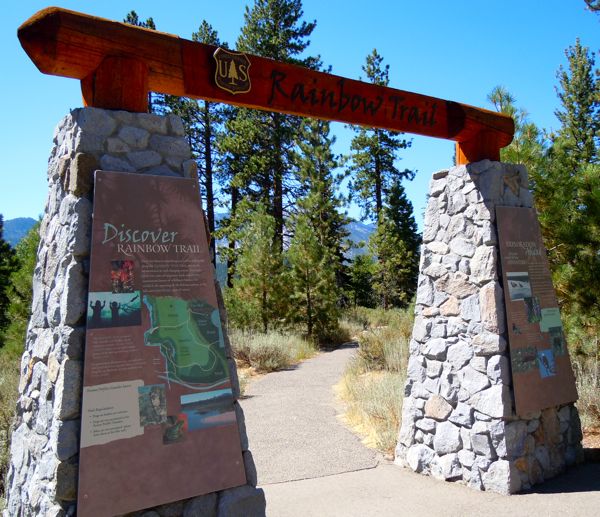
During the summer, expect to see high school students who are part of the 4-year-old Generation Green program leading tours from the Rainbow Trail to the Tallac Site, talking about trees, forest ecology, history and cultures of the area.

In a separate program, K-2 students get outside each year in what’s called Outdoor Explore where they follow the Lam Watah trail in Stateline to Nevada Beach. This group may eventually be incorporated into Children’s Forest.


Winter skipped much of North America

By Wynne Parry, LiveScience

For parts of North America, this winter was the winter that nearly wasn’t.

January ranked as the fourth-warmest for the 48 U.S. states on record since 1895. December, too, was above average, although not as significantly. Weather watchers expect last month to rank above average temperature-wise as well.

Not much snow has falle in Lake Tahoe, but cold temps have created ice formations. Photo/LTN

Of course, this year hasn’t brought early beach weather for everyone; just ask residents of Alaska and Europe, where a frigid cold snap is blamed for hundreds of deaths. And the warmth has been blamed for contributing to the slew of devastating tornadoes that hit the Midwest and southern U.S. on March 2.

While scientists have said that global warming will cause an uptick in extreme weather, they are hesitant to link any one event or even an unusual season to climate change. Even so, they say, global warming may play a role in the weird winter weather.

Read the whole story


3-day event trains TRTA trail and crew leaders

The Tahoe Rim Trail Association’s 7th annual Trail Construction and Crew Leader Workshop will be at Washoe County’s Galena Creek Regional Park in May 18-20.

Participants may choose from the following courses: Trail Design and Layout (Friday), Fundamentals of Trail Construction (Saturday and Sunday), Crew Leadership (Saturday and Sunday) and Advanced Trail Theory (Saturday and Sunday).

This training is partially grant funded by the Nevada Recreational Trails Program and the Humboldt Toiyabe National Forest and supported by Washoe County Regional Parks and Open Space.

Participants pay a fee of $150 (for three days), $100 (weekend) or $50 (Friday) to cover instruction, park lodging, food, training materials and transportation to class sites. Discounts are available for TRTA members and volunteers.

For more information and registration materials, go online or contact visit or contact Teresa Crimmens at (775) 298.0232 or teresac@tahoerimtrail.org.


Vonn wins 4th Alpine overall crystal globe

By USSA

SCHLADMING, Austria — Lindsey Vonn of Vail hoisted her fourth Audi FIS Alpine overall crystal globe in five seasons Sunday to close the 2012 World Cup Finals in Schladming.

Vonn, who was three points short of the overall in 2011, also won the downhill, super G and combined titles for a historic 16 career globes and celebrated the all-time highest women’s point total with 1,980. Her American high 12 World Cup wins on the season pushed her career total to 53, putting her in the elite company with all-time record holder Annemarie Moser-Proell with 62 and Vreni Schneider’s 55.

“I am really happy with the season and it has gone incredibly well. If you had told me at the beginning of the season that I would be second in the giant slalom standings and would win the overall title before the finals, I would have said that is awesome, but not possible,” Vonn said. “It is definitely more than I expected. This year I have had a lot of fun. I have tried to enjoy every day that I am out on the hill and it’s wonderful to have my family and friends around to share this.”