Sugar pines need assistance to thrive in Sierra Nevada

By Maria Mircheva

As you may know, sugar pines and other white pines are plagued by a nonnative invasive pathogen. White pine blister rust kills about 90 percent of sugar pines it infects. Scientists and restoration managers have agreed that the only effective restoration strategy is to identify seed trees resistant to the rust and plant their progeny.

That is exactly what the Sugar Pine Foundation does and you can help too. Last fall, a volunteer described planting sugar pines as “creating life in our neck of the woods”.

For all of you that have been inspired by the recent release of Dr. Seuss “The Lorax,” this will be the perfect opportunity to turn that inspiration into action and do you part in bringing back the Sugar Pines. The Sugar Pine Foundation has 4,000 young sugar pines to plant in Tahoe this spring.

On the South Shore, there will be two community plantings. The first one is April 28 at Bijou Community Park. There will be a morning group starting at 11:30 and an afternoon group about 2. The second planting is May 5 at 10am in Glenbrook.

May 5 is also Climate Impact Day, so the planting will be a part of Connect the Dots campaign. You can also buy a sugar pine to plant in your yard at one of the SPF events or on our website.

There will be another planting May 12 from 10am-1pm at Waddle Ranch in Truckee. Meet at the Truckee Airport parking lot. Bring a 4WD vehicle or ride in the airport van to the planting site.

The SPF’s spring planting blitz begins in late April goes into mid-May. During this time of the year, the soil is naturally moistened from snowmelt and conditions are ideal for giving young seedlings a good start. However, this year our snowpack is below average, which means it will be harder for the seedlings to survive.

If you can’t make it to a planting, maybe you can volunteer as a caregiver to one of the restoration sites and bring the trees some much needed water in the dry summer months.

The goal of the SPF is to help save Tahoe’s glorious sugar pines by planting blister rust-resistant seedlings throughout the Tahoe area.

We like to involve local students and community members in our restoration work and teach them about forest health. We aim to inspire them to become forest stewards.

This spring, 20 Lake Tahoe Community College and 50 Sierra Nevada College students will be planting with the Sugar Pine Foundation as well.

Since 2008, the foundation has planted more than 700 acres with more than 42,000 sugar pines and other native trees to maintain Tahoe’s legacy of beautiful, healthy forests. We need your help to reach our goal of planting 50,000 sugar pines in five years!

For more information, call me at (650) 814.9565 or email admin@sugarpinefoundation.org.

Maria Mircheva is executive director of the Sugar Pine Foundation.


Bike friendly — in what way, South Lake Tahoe?

Bike friendly wasn’t the phrase that came to mind while riding the South Lake Tahoe bike trail (on Earth Day of all days) that goes behind Meeks Lumber, by the Upper Truckee Marsh, through neighborhoods and farther west paralleling Highway 50.

Definitely take a mountain bike. The cracks are so wide it is like riding on one of the many streets in the city.

Sue Wood is stopped April 22 by the debris along a bike trail in South Tahoe. Photo/Kathryn Reed

And crossing the wood bridge over Trout Creek is a bit scary. The boards bounce. I saw them as I watched a couple cyclists in front of me. I don’t remember this happening last year.

As you head east, slow down as you come to Sussex Avenue. A mound of snow is there blocking the bike path, along with chunks of asphalt and other debris and muck. Sussex is off Rubicon Trail, which is a block off Highway 50.

And to think South Lake Tahoe has the designation of being a bike friendly town. It must be in sign only.

May is national bike month. Does South Lake Tahoe realize this, or even care?

— Kathryn Reed


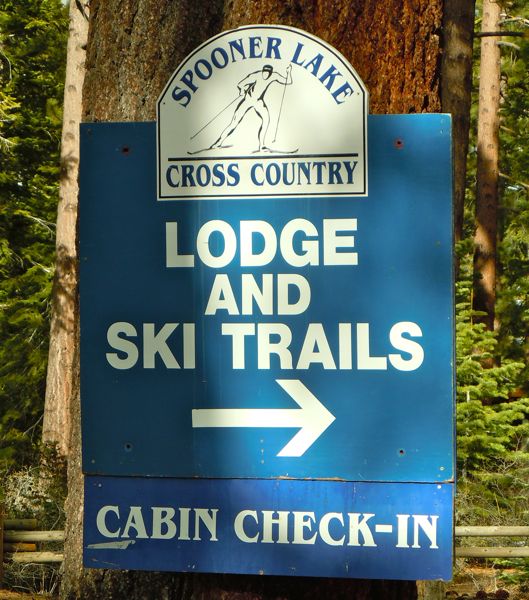
Spooner Lake operator ends ski business, moving bikes

By Kathryn Reed

Gliding along the perfectly groomed trails at Spooner Lake is no longer an option – and not because the seasons at Lake Tahoe are changing.

For 27 years, Max Jones has run the cross country ski center as concessionaire for the Nevada Division of State Parks. And for a dozen years he has operated the summer mountain biking operation out of the park that is at the junction of highway 28 and 50. That, too, is leaving the park.

Groomed trails at Spooner Lake may not be available next winter. Photo/LTN

While Jones, who was in the 1986 Olympic trials for cross country ski racing, is giving up the snow side of his business, he is keeping the biking component. After all, he is a two-time national mountain bike champion and in the Mountain Bike Hall of Fame.

“My wife (Patti McMullen) and I have not had a paycheck since October,” Jones told Lake Tahoe News. “This was the winter that never snowed on this side of the lake.”

It was so bad Jan. 1 when the parks department wanted to lead a snowshoe it turned into a walk in hiking boots around Spooner Lake.

The couple is tired of fluctuating winters – the feast or famine way of doing business in the winter at Lake Tahoe.

Their focus, though, will still be split. Now it will be between mountain biking and a café that is slated to open in July.

The cycling business will operate out of Incline Village starting next year on property once home to the Bonanza television set and later theme park-like attraction. Tunnel Creek Café will be open year-round, serving sandwiches, coffee, beer and other items. It will be in the building that sits on the mountain side of Highway 28 that says Tunnel Creek Station.

This biking season Jones’ operation will be the same as it always has been at Spooner – with rentals as well as a shuttle bringing people who are finishing the Flume Trail back to Spooner.

Starting in summer 2013 the shuttle will take people to Spooner, drop them off, and then let them ride the Flume Trail, which will end where the café is.

Rentals will still be part of the mix. The primary focus will be the Flume Trail, then the shuttle on even days up to Tahoe Meadows for riders to pedal on the Tahoe Rim Trail.

Expanding beyond that is possible – maybe even into Genoa.

Jones says he likes how in the last handful of years the mountain bike trails in the basin have improved, in large because of the U.S. Forest Service. He said the expansion of trails is good so riders are spread out.

What happens next winter at Spooner remains to be seen.

“What we want to do is spend some time to evaluate what the public wants us to do up there,” Dave Morrow, administrator of Nevada State Parks, told Lake Tahoe News. “There is certainly a dedicated group of cross country skiers who would like to see the trails groomed. There are others who may like to see additional or other activities.”

Ice fishing and more access to snowshoe trails are options. Parks staff may use a snowmobile as a groomer for cross country skiing next winter until a more permanent solution is settled on.

Morrow said not to expect the level of grooming that Jones did.

The lease between Jones and the state was up, so it was a natural time for a change. Jones didn’t want to pay more, and the state wanted to increase its take.

“The concessionaire at Spooner was more of a convenience to the park visitor than a source of income for the park,” Morrow said.

Surveying users and conducting public workshops will help determine the future of the park and what type of, if any, concessionaire is brought in after the summer season.

Also, state parks in the process of developing a management plan for Lake Tahoe State Park.

For people who want to suggest what should happen post-Jones at Spooner, they should call (775) 684.2770 and ask to speak to the administrative assistance or email dmorrow@parks.nv.gov.


Female riders to show off during Miss Superpark at Squaw

Starting on Monday, the eighth installment of Miss Superpark is coming to Squaw Valley.

More than 50 of the world’s top female riders are making the trip to North Lake Tahoe. Gretchen Bleiler, Erin Comstock, Jenny Jones, Jamie Anderson, Kimmy Fasani, Enni Rukajärvi, Jess Kimura, Kelly Clark and many more are getting ready to open up a new chapter in women’s snowboarding.

As noted by Grind Networks, “Miss Superpark is dedicated to showcase the world’s best female riders on the world’s best terrain created by the world’s best park building teams.”

The features for Miss Superpark were built by Squaw Valley’s terrain park crew,led by industry veteran Jessica Richitelli – one of the only female terrain park managers in the nation – in conjunction with Snow Park Technologies.

Miss Superpark is the most highly acclaimed women’s specific event in the snowboard industry.

Spectators can check out the action at Squaw April 23-26. The best viewing will be off of Squaw Valley’s Siberia and Gold Coast chairlifts.


Sequoia planting project could create second old-growth

By Jim Gardner, San Francisco Business Times

If a giant coast redwood falls in the forest, there’s a good chance Dave Milarch would hear it.

The beefy, Camel-smoking fourth-generation Michigan tree nurseryman is on a mission to clone the world’s oldest, largest trees. He’s now turned his attention to the gigantic Sequoias that dot northern California and southern Oregon, with hopes of reseeding a new generation of redwood forest.

Collecting tree DNA is not just a science project for Milarch, who has made presentations to a group of NASA scientists and, earlier this month, to opinion leaders at a TEDx event in Mountain View. Although his nonprofit, Archangel Ancient Tree Archive, has cloned 50 other species, the 300-foot-plus, 3,000-year-old coast redwoods are key, he said, to cleaning the air — and thus stopping many human diseases.

“These big trees trump anything, everything,” he said.

Read the whole story


Improvements to Rubicon 4-wheel drive route approved

Improvements to the Rubicon Four-Wheel-Drive Trail in the Eldorado National Forest can move forward now that the U.S. Forest Service has granted an easement to El Dorado County for the Rubicon Trail where it crosses National Forest lands.

The feds also authorized a number of road and recreational opportunity enhancements.

A bridge will be built, along with an elevated rock ford, numerous erosion control features, and five toilets.

“Protecting resources and providing recreational opportunities are high priorities for both the Forest Service and El Dorado County,” Forest Supervisor Kathy Hardy said in a statement.


Reno-area golf course looking parched

By Dan Hixman, Reno Gazette-Journal

Should anyone at the Chamber of Commerce or the RSCVA want to get some nice, color photos of Truckee Meadows golf courses to distribute to travel magazines, this would be a good time to wait.

Reno’s golf courses look like Kansas’ wheat fields, post harvest.

Golfers are no doubt frustrated by the condition of area courses, especially as temperatures finally reach short-sleeves territory, and this might not be all that comforting, but there is nothing that could have been done to stop it.

In match play terms, it’s Mother Nature 10 and 9.

Some golf pros call it “winter kill”; others, “winter desiccation.” It’s the rare combination of little or no precipitation and either really low temperatures or really high winds (or all three). Northern Nevada had one of the driest winters on record this year, and golf courses are feeling the after-effects.

“This is very unique,” said Tom Janning, who has been the superintendent at Rosewood Lakes since the city of Reno-owned course opened in 1991. “Some years we haven’t watered all winter and we came through fine.”

Read the whole story


Quagga mussel laced barges stopped before polluting other lakes

By Rocky Barker, Idaho Statesman

An armada of 41 flexible barges infested with quagga mussels during construction work in Lake Mead were stopped by Idaho’s boat inspection program.

The barges were heading back to Seattle after work on the new Las Vegas water intake tunnel was completed in Lake Mead. Mead has been infested with the quagga mussels that were carried by boat from the Great Lakes.

The mussels reproduce quickly and clog canals, hydroelectric dams, and other structures in the state’s lakes and streams and vast network of waterways. They also take over the ecosystems reducing the number of game fish. State officials predicted an infestation here could cost $91 million.

A week ago one of the barges showed up at an Idaho inspection station at the port of entry on Interstate 84 south of Burley. Idaho Department of Agriculture inspectors stopped the barge and found mussels. They contacted Washington and Nevada officials when they learned that 41 similar barges were heading toward Seattle.

All of the states jumped into action to find, inspect and decontaminate the barges, said Amy Ferriter ISDA invasive species coordinator. Inspectors stopped two barges last Wednesday on Highway 93 north of Jackpot that had been reinspected and decontaminated by Nevada.

“Our inspectors said they were spotless,” Ferriter said

Read the whole story


Firefighters get wet to train for water rescues

By Andrew Adamson, KOLO-TV

“I’ll put it to you like this, the more you play, the more you find out there’s more hazards than fun,” says RFD Suppression Capt. Greg Claiborne.

In his 27 years with the Reno Fire Department, Claiborne has seen just how dangerous the Truckee River can be. Last year was especially memorable for river rescues.

“We had people that wanted to get in that river because they thought ‘ooh it’s neat, it’s fun, it’s fast, this is the way to be’ and we end up swimming down first street grabbing them,” says Claiborne.

Claiborne and the rest of the Wet Team have started gearing up for what they hope will be a safer summer by doing river rescue training near Verdi.

Read the whole story


Sick birds making their way to South Lake Tahoe

By Cheryl Millham

About the third week in March, we started receiving dead adult Pine Siskins at an alarming rate. The first thing we thought about was West Nile virus (WNV), so we started giving out that phone number (877.WNV.BIRD). It is a toll free number and, if the lab is interested, they would give instructions on how to handle the carcass. Remember: Humans cannot contract WNV from the dead bird. The only way to contract WNV is if a mosquito bites the sick or dead bird, then bites you.

At this time of year, mosquitoes are not yet present at our altitude. Walk around your house and empty any containers that are filled with standing melted snow water which mosquitoes will breed in.

Because of this die out of the Pine Siskins, I called our California Fish and Game biologist – who is also in charge of all of the wildlife rehab centers in the state – to report this situation. I was told by her to call Avian Disease Specialist Krysta Rodgers and report the die off to her, which I did.

I found out that some recently deceased Pine Siskin carcasses were sent to the lab and salmonella was the culprit. In my conversation with Rodgers, the Pine Siskins that were tested were from Placerville, which were on their way up to Lake Tahoe for the summer.

I told Rodgers that we are above the 6,000 foot elevation and still have snow with freezing weather, so I didn’t think salmonella was here yet and that Placerville is at about 2,000 feet.

She agreed with me that these birds are exposed at lower elevations where salmonella is present. When the birds arrive at Tahoe, they are met with snow, cold and no food. In that weakened condition, they die.

Krysta asked me to inform the community, especially those who feed the Pine Siskins, do not put out the yellow socks, filled with Nyjer seed, until, at least May 1. This way, the sick birds will not be spreading germs on the yellow socks and, maybe, with some luck, we can stop the Salmonella die out.

As always, should you have any questions on this, or any matter dealing with wildlife, please feel free to contact us at (530) 577.2273.

Have a great summer.

Cheryl Millham is executive director of Lake Tahoe Wildlife Care on the outskirts of South Lake Tahoe.