South Tahoe park begins with pomp and circumstance

By Kathryn Reed

Eighteen-month-old Morrison Scott didn’t care who all those people talking were, why they had funny hats on or that there were super shiny shovels standing in fresh dirt.

Nope. What this little South Lake Tahoe resident cares about is having a place to run around in. She lives about a block and a half away from what will be the Bonanza Park. Right now the closest place for her to go play at is Tahoe Valley Elementary School – and at her age, that’s quite a hike. Plus, during school, she’s not allowed.

Brandon Hill of Edgewood Companies talks about the future Bonanza Park. Photos/Kathryn Reed

Her dad, Creighton, brought Morrison to Monday night’s ground breaking of the park that they are both looking forward to being built.

“It will be somewhere to go to keep her busy,” the elder Scott said.

Of the approximately 60 people at the April 30 event, about half were from the local neighborhood. The rest were people who praised each other for making the park a reality.

With May 1 being the initial day of building per Tahoe Regional Planning Agency rules, it means the heavy lifting can begin.

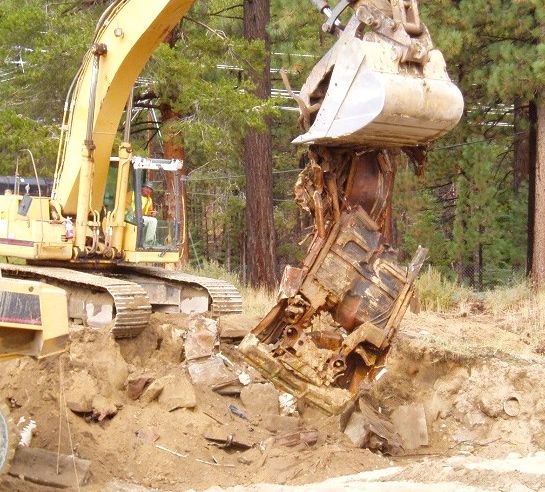
Long gone is the old C&M Lodge, though an old sign rests against a tree not far from a heavy piece of construction equipment.

Edgewood Companies had bought the property so it would have ownership of the tourist accommodations units. The city allowed for those to be transferred to Stateline for the Edgewood Lodge project if the company would build the park. Once it is finished this summer the city will take over ownership.

ngg_shortcode_0_placeholder (Click on photos to enlarge.)


Sage grouse endangered listing moving forward

By Jim Sanford, Reno Gazette-Journal

An Endangered Species Act listing for the sage grouse “would make the spotted owl listing pale in comparison.”

There is a chance Nevada, through a habitat recovery program and other efforts, can prevent Endangered Species Act listings for the state’s two distinct sage grouse population segments.

But should those efforts prove unsuccessful, all Nevadans – including Clark County residents–will be paying for that listing for a long time.

Those were all comments offered last week by Nevada Department of Wildlife Director Ken Mayer in addressing what is becoming a huge concern for Nevada.

Commenting on the pending U.S. Fish and Wildlife Service September 2013 ESA determination date for the Bi-State sage grouse listing and the September 2015 potential listing for the more-prevalent Range wide Greater Sage Grouse species, Mayer said this week, “The listing may affect central and northern Nevada more, but Clark County residents will be paying right along with everybody else.”

“There is a chance we can succeed (in preventing the listing),” Mayer added. “I am convinced there is ample time to address the 2015 Greater sage grouse decision because a hell of a lot of things are being done. With the Bi-State, I think we do have time as well. It is more questionable whether we will make it with the Bi-State or not.”

Read the whole story


The killing agency: Wildlife Services’ brutal methods leave a trail of animal death

By Tom Knudson, Sacramento Bee

The day began with a drive across the desert, checking the snares he had placed in the sagebrush to catch coyotes.

Gary Strader, an employee of the U.S. Department of Agriculture, stepped out of his truck near a ravine in Nevada and found something he hadn’t intended to kill.

There, strangled in a neck snare, was one of the most majestic birds in America, a federally protected golden eagle.

“I called my supervisor and said, ‘I just caught a golden eagle and it’s dead,’ ” said Strader. “He said, ‘Did anybody see it?’ I said, ‘Geez, I don’t think so.’

“He said, ‘If you think nobody saw it, go get a shovel and bury it and don’t say nothing to anybody.’ ”

“That bothered me,” said Strader, whose job was terminated in 2009. “It wasn’t right.”

Strader’s employer, a branch of the federal Department of Agriculture called Wildlife Services, has long specialized in killing animals that are deemed a threat to agriculture, the public and – more recently – the environment.

Since 2000, its employees have killed nearly a million coyotes, mostly in the West. They have destroyed millions of birds, from nonnative starlings to migratory shorebirds, along with a colorful menagerie of more than 300 other species, including black bears, beavers, porcupines, river otters, mountain lions and wolves.

And in most cases, they have officially revealed little or no detail about where the creatures were killed, or why. But a Bee investigation has found the agency’s practices to be indiscriminate, at odds with science, inhumane and sometimes illegal.

Read the whole story


World of concussions impacting potential pro athletes

By Jim Trotter, Sports Illustrated

Stanford wideout/returner Chris Owusu has a sprinter’s speed and a bodybuilder’s physique. He also has a medical report that makes NFL teams wince.

The 6-foot, 196-pound senior had his final season cut short last November, when he sustained his second concussion in three weeks and third in 13 months. He was asymptomatic within days of each concussion, but the Cardinal did not clear him to play in the Fiesta Bowl or the Senior Bowl. Since then he has been medically cleared by two doctors, including at the annual Scouting Combine in February. But that has not allayed concerns among some NFL personnel men.

“He’s off our board,” says one general manager. “He was from the start. It wouldn’t matter if he was RG3, he’d still be off our board. With that kind of history it’s not worth the risk of him being seriously injured, especially with all the attention you’re going to receive. If you draft him you’re going to be under the microscope the whole time. Every time he gets hit it’s going to be magnified tenfold.”

Owusu’s combination of medical risk and athletic talent makes him the most intriguing prospect in this year’s draft. He is entering the league at a time when more than 1,000 former and current players are plaintiffs in 59 lawsuits against the league — including at least 15 class-action suits — that claim the NFL failed to adequately treat and educate players about the possible long-term consequences of brain trauma. Just last week Ray Easterling, a safety with the Falcons in the 1970s, shot himself to death after years of struggling with depression and dementia, his wife said. Fourteen months earlier, former Bears and Giants safety Dave Duerson committed suicide, after which it was learned he was suffering from chronic traumatic encephalopathy (CTE), a degenerative brain disease.

It is against that backdrop that Owusu is entering the NFL. One general manager says he has third-round talent, but gave him a seventh-round grade because of the concussions. Most executives view him as a value pick, meaning he has too much talent to pass on altogether but will only use a late-round selection on him.

Read the whole story


Concerts, kayaks, food — all part of Lakeview Commons

By Kathryn Reed

It will neither be Julie Andrews making the hills come alive with the sound of music nor the bass of bands from SnowGlobe. Instead, a mix of jazz, reggae and blues are expected to resonate from Lakeview Commons this summer.

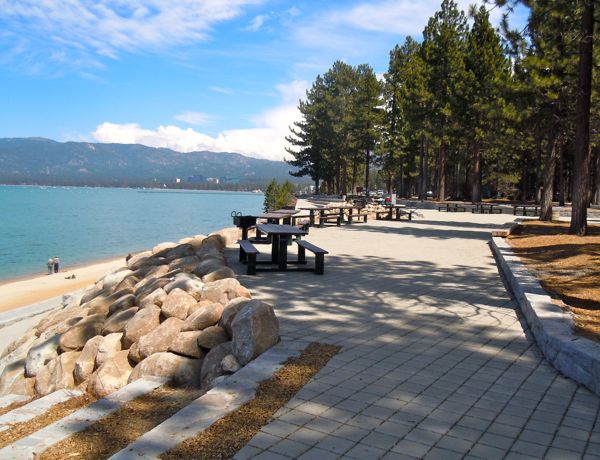
OnCourse Events has been granted a permit to bring music to the South Lake Tahoe venue. Every Thursday starting June 28 through Sept. 6 from 4-8:30pm a different band will perform on a temporary stage that will be built in the sand. Spectators can sit – for free – on the terraced area or up top where there are picnic tables.

“I want to introduce locals to different music,” Rob Giustina, with OnCourse Events, told Lake Tahoe News. He expects most acts will be from out of the area. However, the first band is likely to be Jump Start, though local, they don’t often play in the basin.
Free concerts on Thursdays are coming to Lakeview Commons starting in late June. Photos/Kathryn Reed

Giustina is more often associated with competition event productions. But as someone who was born and raised here, he wants to help the town resurrect itself in terms of fun and economics.

“I wanted to be proactive in saving our community,” Giustina said.

He expects to make money on the summer concert series selling booth space at $75 a pop for a 10-foot-by-10-foot spot. Artists, nonprofits – he will consider them all. Vendors will be at the top of the commons area.

Until the city votes on who will be operating the food part of the Lakeview Commons, Giustina is holding off on deciding what type of food will be sold. He doesn’t want to compete with the concessionaire, but instead complement or have his vendors be completely different. But he also hopes to have a beer garden.

Bids for the food concessionaire closed April 27. It’s possible the City Council could make a decision at its May 17 meeting.

For people wanting to be part of Giustina’s Live at Lakeview Commons Concert Series, email him at rob@oncourseevents.com.

Giustina is encouraging people arrive by bike. A valet will be operating for storage purposes during the concert.

As for what the city plans to do at Lakeview Commons, the rest rooms and drinking fountain should be in operation any day. Bathrooms will always be a seasonal operation based on demand, and the water will operate when the threat of frozen pipes is eliminated.

On the May 1 council agenda is an item to award the nonmotorized concessionaire to Standup Paddle, which has a shop on Harrison Avenue.

“Whoever gets the contract will have to do their own tenant improvements,” Stan Sherer, community services director, told Lake Tahoe News. The city will take a percentage of the gross profits, with it topping out at 12 percent.

In addition to the rental of paddleboards, kayaks and canoes will also be available.

Per the original plans when the $6.5 million Lakeview Commons project was conceived, people will also be able to store their nonmotorized craft at the boathouse for a fee.

Right now garbage cans without lids are scattered about Lakeview Commons. Sherer said those will be converted to bear-proof containers soon. A bid on the project is on Tuesday’s council agenda.

Landscapers will be back out there this week to finish the plantings.

Sherer told Lake Tahoe News his intent is to make the area accessible to dogs – legally. Plenty of people take their dogs to the commons and El Dorado Beach, but that is violating the current law.

Something that perplexes Sherer is why in the original plans there was no place to dump ashes from the barbecues.

“It’s not just having a facility to empty the briquettes, it’s will they use them or will they try to dispose of them someplace else,” Sherer said people who are barbecuing. The fear of someplace is it could cause a fire or contaminate Lake Tahoe.

A solution as of last week had not been found. And they are being used. Smoke has been seen wafting from the grounds on the unseasonably warm days.

While the area has been transformed and looks nothing like it once did, all the boulders on the north end mean beachgoers can no longer walk very far. It used to be people could walk to Ski Run Marina and beyond.

A pipe on El Dorado Beach that used to be ghastly, especially as water drained directly into Lake Tahoe, is still there. Only now sand covers part of the upper part of the metal, and boulders and branches cover the lower section. Gunk, well, it still flows into the lake from Highway 50.

On June 20 at 2pm there will be a grand opening – again – of Lakeview Commons. This time Secretary of Natural Resources John Laird is supposed to attend the dedication, as will members of the California Tahoe Conservancy and its board. It was CTC money that funded the project.

What name it will be dedicated as, well, that remains to be seen.

A beach party will follow at 3pm.

ngg_shortcode_1_placeholder (Click on photos to enlarge.)


Reno River Festival includes boat race for charity

The Charity Raft Race is returning to the Reno River Festival June 15 at 3pm.

The race, which hits the rapids at the Truckee River Whitewater park for the first time since 2007, is a fundraiser for the Truckee River Foundation, a nonprofit organization dedicated to impacting the Truckee River by providing environmental, educational, access, safety and athlete development programs. Cost is $1,000 per team and includes up to six people. Space is available on a first come, first served basis.

The Charity Raft Race is the kick off for the annual Reno River Festival. A professional guide is provided to each raft.

For more details about the 9th annual Reno River Festival or the Run Amuck, call (775) 784.9400, ext. 119.


Fallen Leaf Lake adding boat rentals, making marina repairs

By Kathryn Reed

While the actual road to Fallen Leaf Lake is a rougher ride than it has ever been, the operations of the community service district are smoother.

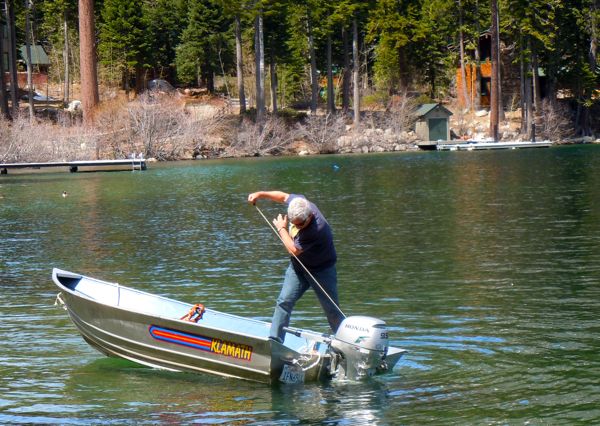
Sid Bazett, who is a part-time resident of the South Shore enclave at the edge of Desolation Wilderness off Highway 89, didn’t let the fact that the docks aren’t in stop him from launching his boat on a sunny Saturday afternoon.

About an hour later on April 28, the board that runs the operations of the lake met at Lake Tahoe Airport.

Sid Bazett gets an early start April 28 to the boating season at Fallen Leaf Lake. Photos/Kathryn Reed

The three board members – Tom Bacchetti, Wanda Knowacki and Stephanie Neidig – agreed to spend the money to repair the breakwater logs and launch dock.

Knowacki described a storm in early December as “unusually violent” which resulted in the damage. Emergency fixes were made to make it safe, but now a more permanent solution is needed prior to the start of the season – which is usually Memorial Day weekend.

California Land Management, the concessionaire for the Fallen Leaf Lake marina and store, is liable for the first $5,000 per the contract. It’s estimated the district will need close to $6,000 to complete the repairs.

John Rich, who for years was the concessionaire at the lake, will do this.

It was mentioned that the district is doing fine financially after a good year with CLM operating the concession. The money for the repairs will come out of the district’s operating budget.

CLM’s contract for another year was approved Saturday. A change is that the operator, which also runs the U.S. Forest Service owned campground at the other end of the lake, will be allowed eight slips instead of six for rental boats.

Larry Chapman, assistant director of operations for CLM, told the board, “We think we can do more business (with rentals). All the slips have not been rented in the past.”

He rents fishing boats and pontoon boats.

The board also agreed to increase the maximum horsepower allowed on the pontoons from 15 to 40. To start with Chapman is going to try using high altitude props to increase power. The reason to do this is for safety concerns because the limited horsepower isn’t enough for a boat full of people to get back to the marina on a windy afternoon.

The Fallen Leaf Protective Association is paying for a Tahoe Resource Conservation District employee to be in charge of boat inspections Thursday-Monday, 8am-5pm from May 24-Sept. 10.

In May, CLM staff will be trained by TRCD and Tahoe Regional Planning Agency employees how to use the hot wash decontamination apparatus that is designed to keep invasive species out of Fallen Leaf Lake. Fallen Leaf, unlike Lake Tahoe, has zero invasives in it.

Chapman said the goal is to have the operations going the weekend or week before Memorial Day so locals can get their boats in the water before the masses descend.

As for the three-member board, they agreed to fill the two vacancies by appointment. They are hoping to be able to do so at the June meeting.

James Kelly, a part-time resident participating by phone, was against doing so by appointment.

“Residents are disenfranchised and we are out of the loop,” Kelly said.

Board President Bacchetti said he believes the whole voting issue at the lake has been clarified, even for people whose property is on U.S. Forest Service land. The whole voting brouhaha at Fallen Leaf Lake has gone from the District Attorney level to the Attorney General’s Office. Allegations of voter fraud have embroiled the district for a couple years.

At issue were people voting at Fallen Leaf Lake who voted elsewhere – which is illegal – or not claiming the lake residence as what it is.

“If you claim your domicile at Fallen Leaf Lake, the district attorney says you are able to vote,” Bacchetti said. “There is a difference between a domicile and permanent residence.”

The board appointments will be until the next election in November 2013.

A key reason to get people on the board soon is that four votes are needed to pass the budget.

ngg_shortcode_2_placeholder (Click on photos to enlarge.)


2 STHS students selected to attend NFL-Wharton workshop

South Tahoe High School juniors John Cefalu and Bailey David are two of 36 student-athletes to be chosen among approximately 2,000 applicants to be part of the NFL-Wharton Prep Leadership Program.

The program is a three-day workshop in June that provides top-notch high school athletes with leadership training and instruction from Wharton professors and NFL executives. The workshop at Wharton School will provide student-athletes with a crash course in business and personal finance, the role of financial advisers, and development of leadership skills.


No reason to fear mama bear with cubs

By Cheryl Millham

It is time to dispel some myths about our black bear families.

Mother bears are not dangerous. Nor, are they more aggressive when they have cubs.

Mother bears will not bring their cubs out of the den until they can climb a tree. If a mom feels her baby is in danger, she will send it up a tree for safety. Sometimes she climbs up after them and sometime, she will sit at the base of the tree.

If it is time to nurse her babies, she will climb the tree and position herself with her back leaning against the trunk and straddle a branch. The baby will come to her and climb onto her lap and nurse.

If a dog is harassing her babies and the tree is far off, she might swat the dog. It is her way of telling the dog to stop.

So, if you see a mom with babies (the babies are about 5 pounds at this time of the year), don’t let your dog chase them.

Tom and I have been between a mom and her babies many times. She is not dangerous to us. She just wants to get her kids back and, as soon as she gets them close to her, she will send them up another tree.

Such is not the same with a mother grizzly bear. She will attack first and ask questions later. Grizzly bears are very dangerous. I am so happy that we have black bears here and not grizzlies.

Here is a little informational tip. There are no more grizzlies living in California, even though you will see a picture of a grizzly on the California state flag.

So, why am I telling you this information? You guessed it. We have just gotten sighting of mother bears with little, tiny cubs, following her.

Keep your eyes open and you might see a little bit of nature right here in your own back yard. So, enjoy the wildlife around you. And remember, when you shoot wildlife, use a camera.

Cheryl Millham is executive director of Lake Tahoe Wildlife Care on the outskirts of South Lake Tahoe.


Meyers Landfill bill doubles to $13 mil.; case back in court

By Kathryn Reed

Cleaning up the old Meyers Landfill is costing more than twice what was expected – for a total of more than $13 million. The doubling of the cost has also created another lawsuit between the U.S. Forest Service and El Dorado County.

El Dorado County Board of Supervisors this month approved taking $6.3 million from the General Fund Contingency to pay for the cost overruns.

The April 17 staff report to the board says, “Failure to pay back this temporary loan will adversely impact other services provided by General Fund appropriations.”

Meyers Landfill cleanup is costing more than $13 million. Photo/USFS

Gerri Silva, director of environmental management for the county, expects the $6,313,156 to cover everything related to the actual work on the project. By the end of the summer the restoration to the site off Pioneer Trail should be complete.

The Meyers Landfill was used from 1947-71. Twenty years later the feds sued a slew of entities for cleanup costs. Vinyl chloride, a carcinogen produced when household waste breaks down, was the main contaminant under the sealed plot, although methane and other gases posed problems.

Those lawsuits lasted for years and cost the various agencies – mostly public, with a few private companies involved – millions of dollars. Those millions aren’t even part of the $13 million to fix the land so it is usable again and deal with the toxins so they don’t threaten people or the environment.

The entire disturbed area is more than 20 acres. Originally, the liner was to cover 7 acres, with what’s called the plateau area encompassing another 4 acres.

Because debris was found in a larger area than expected, the cost to remediate the site grew. But the county does not believe it should have to incur the expense because when the federal court case was settled it was the USFS plan that El Dorado County had to follow, with the Forest Service saying what the cost would be and where the cleanup would take place.

Silva said the original budget was $5.5 million, which the county’s insurance company covered.

“The Forest Service gave us 100 percent of the remedial design. They included what they thought it would cost, but there was a lot more waste there that had to be relocated,” Silva told Lake Tahoe News.

To recoup its expenses, the county took the feds to court. (No matter who wins, all of this is taxpayer money.)

The federal court granted the county’s motion for construction, enforcement, and modification of the partial consent decree. The Forest Service appealed this to the Ninth Circuit Court of Appeals. The next set of court briefs are due May 11.

According to the county, “If affirmed by the Court of Appeals, a hearing will be scheduled to determine the potential amount of the additional construction costs due to the large number of issues, errors, and omissions with the final 100 percent remedial design the county may recover from the U.S Forest Service.”

The Lake Tahoe Forest Service office deferred comment to the U.S. Department of Justice in Washington, D.C. However, because the matter is ongoing litigation, Wyn Hornbuckle declined to answer the following Lake Tahoe News questions:

• The cost of the project is more than twice what the Forest Service said it would cost when the agency came up with the design and told the county what to do. How do you account for this?

• How do you expect another agency to pay this when it’s your plans that seem not to be working?

• What does the USFS attribute the cost overruns to?

The county and USFS agree the land could be open to the public in August.

“Everything is contingent on site conditions and how well the vegetation is growing and how the cover system is settling in,” Cheva Heck, spokeswoman for Lake Tahoe Basin Management Unit, said. “We could reopen Garbage Dump Road as soon as August of this year; once the construction equipment and trailers are off the site. If it takes longer for vegetation to re-establish, the site could remain closed for more than a year. Our intention is to reopen the site to dispersed recreation like biking, hiking, dog-walking and similar activities.”

This will be the third summer contractors have been working on the Meyers Landfill.