North Shore focusing on adventure sports for 10 straight days

North Lake Tahoe will capitalize on its famed natural terrain by hosting the 2nd annual Adventure Sports Week Tahoe June 15-24.

According to event director Todd Jackson, in addition to the sporting events, designed for the beginner to the professional, the 10-day festivities will also include clinics hosted by world-class athletes and Lake Tahoe locals who know area trails firsthand. Each night of Adventure Sports Week Tahoe will wrap up with a variety of activities, including live concerts, outdoor movies and dinner on the lake. There’s even a kid-friendly component with fun and games geared for little ones.

For more information about Adventure Sports Week Tahoe, a complete calendar of events, photos, videos and volunteer opportunities, as well as to register and get connected via social media channels, go online.


Papers filed to protect rare woodpecker living in Angora burn

By Scott Sonner, AP

RENO — Smokey Bear has done such a good job stamping out forest fires the past half-century that a woodpecker that’s survived for millions of years by eating beetle larvae in burned trees is in danger of going extinct in parts of the West, according to conservationists seeking U.S. protection for the bird.

Four conservation groups filed a petition with the U.S. Interior Department on Wednesday to list the black-backed woodpecker under the Endangered Species Act in the Sierra Nevada, Oregon’s Eastern Cascades and the Black Hills of eastern Wyoming and western South Dakota.

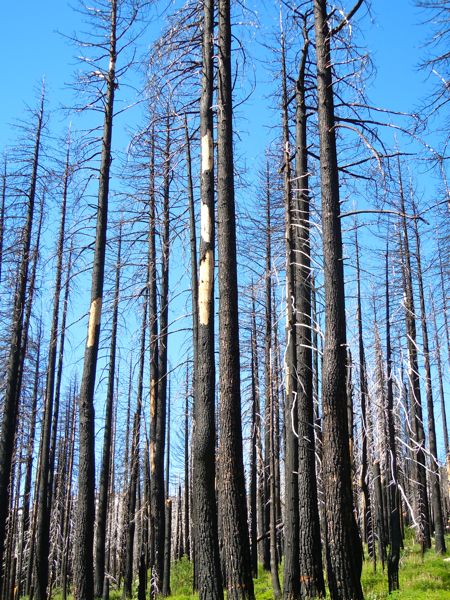
Dead trees like these from the Angora Fire are habitat for a rare woodpecker. Photo/LTN file

It is the first federal petition to recognize the ecological significance and seek protection of post-fire habitat, an expert said.

In addition to fire suppression, the groups contend post-fire salvage logging combined with commercial thinning of green forests is eliminating what little remains of the bird’s habitat, mostly in national forests where it has no legal protection.

“Intensely burned forest habitat not only has no legal protection, but standard practice on private and public lands is to actively eliminate it,” the petition said. “When fire and insect outbreaks create excellent woodpecker habitat, salvage logging promptly destroys it.”

Chad Hanson, executive director the Earth Island’s John Muir Project based in Cedar Ridge, filed the petition Wednesday with the Interior Department’s U.S. Fish and Wildlife Service in Sacramento. Co-petitioners are the

Center for Biological Diversity based in Tucson, Ariz., the Blue Mountains Biodiversity Project in Fossil, Ore., and the Biodiversity Conservation Alliance in Laramie, Wyo.

Hanson, a wildlife ecologist at the University of California, Davis, said the black-backed woodpecker has been eating beetles in fire-killed stands of conifer forests for millions of years and specifically in North American forests for “many thousand years—since the last Ice Age.”

“Now, it’s very rare,” he said.

The best science suggests there are fewer than 1,000 pairs in Oregon and California, and fewer than 500 pairs in the Black Hills, the petition said.

“Such small populations are at significant risk of extinction, especially when their habitat is mostly unprotected and is currently under threat of destruction and degradation,” the document said.

The three-toed, black-backed woodpecker is a specialist at digging out wood-boring insect larvae. The bird’s sooty black dorsal plumage serves to camouflage it against the deeply black, charred bark of burned trees.

Richard Hutto, a biology professor and director of the Avian Science Center at the University of Montana, has been doing post-fire research since the early 1990s. He said it would be difficult to find a forest-bird species more restricted to a single vegetation cover type than the black-backed woodpecker is to early post-fire conditions.

Hanson believes the federal petition is the first to seek protection of post-fire habitat and recognize it as “distinct and ecologically significant.”

“While it may come as a surprise to some, burned forests, and the dead trees associated with them, are essential to the survival of many wildlife species,” said Justin Augustine, a San Francisco-based staff attorney for the Center for Biological Diversity.

Over the past five years, the two have been pressing for protection of the bird through legal challenges to U.S. Forest Service logging projects, primarily in burned forests in the Sierra north and south of Lake Tahoe.

A May 14 hearing is set before the 9th U.S. Circuit Court of Appeals in an ongoing legal battle between the Forest Service and the John Muir Project over salvage logging in woodpecker habitat where 254 homes burned in the 2007 Angora Fire at South Lake Tahoe.

Read the whole story


Sand Harbor bans pedestrian traffic

Starting June 16 people will no longer be allowed to walk into Sand Harbor.

Officials are saying this change is for safety reasons.

People wanting to access the beach can still pay to park there assuming there is room.

The other option is to take the East Shore Express shuttle from Incline Village throughout the day. The transit system will begin operation June 15 daily from 9am to 6pm. The pickup location is at the old elementary school on the corner of Tahoe and Southwood boulevards in Incline Village. The cost is $3 per person and it runs every 20 minutes to Sand Harbor.

In addition, bicycle traffic will only be allowed into the park when the parking lots are not full. During the months of June through August, the parking lots are typically full by 10:30am.

Drop-offs and parking are illegal along the highway at Sand Harbor. The no parking zone covers approximately three-quarters of a mile in both directions from the park’s main entrance. A multi-agency effort to increase enforcement of this no parking zone will be in place to prevent pedestrian injuries.

For further information on the shuttle system, contact the Tahoe Transportation District at (775) 589.5500.


Leg-holds make for gruesome animal deaths

By Tom Knudson, Sacramento Bee

No tool in Wildlife Services’ arsenal kills more nonselectively – or slowly – than the leg-hold trap.

Since 2000, more than 90 species of wildlife have died by mistake in agency traps, including pronghorn antelope, mule deer, river otters, swift foxes, badgers, porcupines and federally protected bald eagles, government records show.

But whether animals are caught accidentally or not, they often struggle for days and die of exposure, injuries and other causes long before a trapper returns to the site.

“They suggest traps be checked once a week, but that’s all it is, a suggestion,” said Gary Strader, a former Wildlife Services trapper in Nevada from 2006 to 2009. “There are traps that are not checked for literally months at a time.”

By then, little is left but steel and bone. “I’ve found traps that were Wildlife Services that were never checked, come across them years later with skeletal remains of skunks or badgers or coyotes,” said Tony Wasley, a mule deer biologist with the Nevada Department of Wildlife.

Leg-hold traps have been banned in more than 80 nations and outlawed or restricted in eight states, including California, where voters in 1998 passed a proposition banning leg-hold traps, but allowing padded traps in some situations.

Read the whole story


Science of river restoration emphasis of weeklong course in Truckee

Geomorphic and Ecological Fundamentals for River and Stream Restoration is a weeklong course at the Sagehen Creek Field Station in Truckee.

The Aug. 13-17 program is an introductory course emphasizing the understanding of geomorphic and ecological process as a sound basis for planning and designing river restoration, covering general principles and case studies from a wide range of environments. Incorporating insights from recent research in fluvial geomorphology and ecology, the course emphasizes developing predictive connections between objectives and actions, learning from built restoration projects, and developing restoration strategies and innovative management approaches to address underlying causes of channel or ecosystem change, rather than prescriptive approaches.

The course integrates perspectives from leading academic researchers to consulting practitioners in river restoration, and across that spectrum it draws on a range of approaches from state-of-the-art hydraulics and sediment transport, historical geomorphic-ecological process analysis, urban-infrastructure-focused approach, to resource-focused approaches.

In addition to field techniques, the course uses spreadsheet models to calculate sediment transport and channel design based on this analysis, map and aerial photo analysis, and sequential problem solving in approaching restoration of fluvial processes. The course includes field trips to the Truckee River and streams in the Lake Tahoe Basin, and workshops on stream restoration problems faced by participants for discussion and ideas on analytical approaches and resources.

This course emphasizes integration of hydrology, hydraulics, sediment transport, geomorphology, aquatic ecology, fisheries, and riparian ecology, and includes field measurements, mapping, and interpretation. An advanced course focuses explicitly on geomorphic, sediment transport, and riparian vegetation principles applied to channel design.

For more information and registration details, go online.


3-day workshop in Leopold’s land ethics

The Northern Sierra Training at Sagehen Creek Field Station is June 1-3.

The Land Ethic Leadership Program embraces the theories conservationist Aldo Leopold embraced.

Participants will be taught how to help their community think about complex and changing environmental issues and have deeper discussion about their collective values and vision. Each Land Ethic Leaders workshop engages participants from across the country in leading reflective discussions designed to help people think about the relationship between human communities and the land. Paired with nature observation and land restoration work, these discussions offer a new way to engage and build the thinking community. The workshop focuses on giving participants the skills, tools, and confidence to help others explore their individual and collective connections to the land.

The workshop fee is $350, including all meals, lodging, program materials, and a public screening license and kit for Green Fire ($150 value).

For more information, click on the flyer.


No snow to measure at Echo Summit; reservoir storage OK

By Kathryn Reed

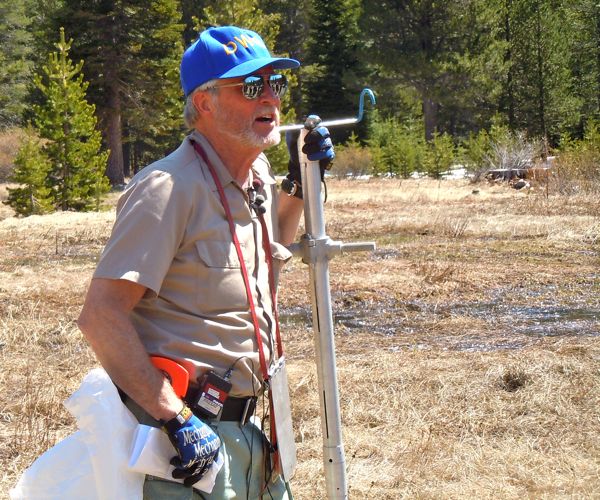
PHILLIPS STATION – Frank Gehrke with the Department of Water Resources did not need his instruments Tuesday as he walked through a barren field. Snowmelt was more in evidence on the final snow survey of the season than the actual white stuff.

“With climate change, we’ll definitely see more of these extremes,” Gehrke said comparing the abundance of snowfall a year ago to the dismal showing this season.

The May 1 reading in 2011 had 5 feet of snow with 3 feet of water content in the open area near the entrance to Sierra-at-Tahoe off Highway 50. This week the evidence of snow was the runoff at the far end of the field that was puddling and the patches on the higher peaks.

No snow for Frank Gehrke of the Department of Water Resources to measure on May 1. Photo/Kathryn Reed

Statewide, the snowpack water content is at 40 percent of average for this time of year.

According to the National Weather Service in Reno, the streams in the Lake Tahoe area have already hit their high water mark.

“Some of the smaller creeks had decent rises this year, but nothing to warrant an advisory or flood warning,” meteorologist Scott McGuire told Lake Tahoe News. He said the minimal snowpack this year meant no flooding, unlike a year ago.

While a small weather system is expected to settle over the basin this week, scattered showers and cooler temps are all that’s expected. No big weather events are on the horizon.

But McGuire did caution that while flooding is not an issue, rivers and creeks are running fast and are extremely cold.

“It doesn’t take a whole lot of water to sweep someone off their feet,” McGuire said.

It’s all that water in California reservoirs that is keeping the nerves of farmers and municipal water purveyors calm. Last year’s deluge and the late storms this season have kept the water levels at serviceable levels.

“Overall, our water supply is OK this year,” Gehrke said.

Lake Oroville is at 97 percent capacity.

Source: Department of Water Resources

Location

Elevation

Snow Depth

Water Content

% of Long Term Average

Alpha

7,600 feet

26.5  inches

12  inches

45

Phillips Station

6,800 feet

0  inches

0  inches

 0

Lyons Creek

6,700 feet

37  inches

15  inches

66


Eager off-roaders being cited by USFS officials in Tahoe basin

U.S. Forest Service law enforcement officers have observed widespread violations of road closures. In particular, officers have issued a number of warnings and citations for driving on Forest Road 1306, which leads to Camp Shelly and Camp Concord, off Highway 89 in the South Shore.

National Forest System roads in the Lake Tahoe Basin remain closed.

The LTBMU’s Motor Vehicle Use Map states the legal opening dates for each road. These dates, ranging from May 10 through June 1, represent the earliest the roads will open. If snowy or wet conditions persist, the Forest Service may extend the closure to protect the environment, as well as public safety.

Road closures help prevent soil erosion and sediment runoff and, in some cases, protect wildlife. They also help protect public safety – roads that are snow-free near the gate may be impassable at higher elevations.

For the most up-to-date information on which roads are open, contact the LTBMU’s front desk at (530) 543.2694.


Deadly force creates unintended consequences in nature

By Tom Knudson, Sacramento Bee

Like the prow of a ship, the Granite Mountains rise sharply from the creamy-white playa of the Black Rock Desert in Nevada.

Here, in rugged terrain owned by the American public, a little-known federal agency called Wildlife Services has waged an eight-year war against predators to try to help an iconic Western big-game species: mule deer.

With rifles, snares and aerial gunning, employees have killed 967 coyotes and 45 mountain lions at a cost of about $550,000. But like a mirage, the dream of protecting deer by killing predators has not materialized.

“It didn’t make a difference,” said Kelley Stewart, a large-mammal ecologist at the University of Nevada, Reno.

For decades, Wildlife Services, part of the U.S. Department of Agriculture, has specialized in trapping, poisoning and shooting predators in large numbers, largely to protect livestock and, more recently, big game.

Now such killing is coming under fire from scientists, former employees and others who say it often doesn’t work and can set off a chain reaction of unintended, often negative consequences.

In biological shorthand: Kill too many coyotes and you open a Pandora’s box of disease-carrying rodents, meadow-munching rabbits, bird-eating feral cats, and, over time, smarter, more abundant coyotes. You also can sentence the deer you are trying to help to slow death by starvation.

“There is a widespread perception that predators are the root of all evil and I’m tired of it,” said Stewart. “More often than not, if you have predation on a mule deer population, you’re going to have a healthier population.”

Agency officials say controlling predators is a must, especially in the West where livestock graze large tracts of unfenced land. “The intent is not to prevent predation,” said William Clay, deputy administrator of Wildlife Services. “All we’re trying to do is remove the problem animals.”

Killing predators is part of Wildlife Services’ DNA, a mission it pursues – along with a wide range of other animal control work – largely outside public view.

Some details, though, can be gleaned from the agency’s Web page, where it posts a sea of data showing – species by species – the millions of birds and mammals its employees kill each year. Sift through the numbers and you find that about 560,000 predators were killed across America from 2006 to 2011, an average of 256 a day.

The body count includes more than 25,000 red and gray foxes, 10,700 bobcats, 2,800 black bears, 2,300 timber wolves and 2,100 mountain lions. But the vast majority – about 512,500 – were coyotes.

“When they see a coyote, all they got is one thing in mind: killing it,” said Gary Strader, a former Wildlife Services hunter in Nevada. “They don’t know if it was a coyote that killed a sheep. It’s just a coyote, and it’s got to be killed.”

While fewer bobcats are killed today, the numbers of three other major predators shot, trapped and snared by the agency have risen. In 1970, agency employees killed 73,100 coyotes, 400 black bears, 120 mountain lions. By 2011, the tally had climbed to 83,200 coyotes (up 14 percent), 565 black bears (up 41 percent) and 400 mountain lions (up 230 percent).

Read the whole story


Law breakers force all dogs from Upper Truckee Marsh

By Kathryn Reed

Poop bags have been replaced with pamphlets about why dogs are no longer allowed in the Upper Truckee Marsh.

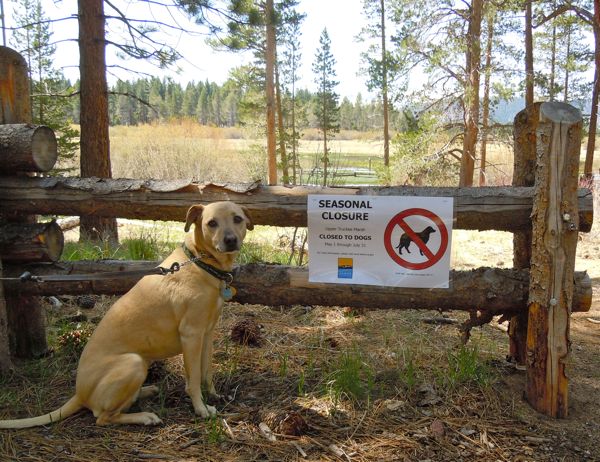
Today begins the second annual three-month ban of canines – even ones on leash – from this popular South Lake Tahoe meadow that leads to Lake Tahoe.

While those who like to take their best friend for a walk in this area won’t be able to until Aug. 1, neighborhood lore has it that this also happened when the land was privately owned.

No more walking in the Upper Truckee Marsh for AJ. Photos/Kathryn Reed

Before the California Tahoe Conservancy took ownership several years ago longtime Tahoe families owned the land. It was known as the Barton Meadow before the CTC called it the Upper Truckee Marsh. On maps, the sandy area is called Hartoonian Beach.

Cattle used to roam this acreage. And when they were being rounded up, even the locals stayed out of the meadow for about three months a year for fear of being trampled in a stampede by the herd. Plus, the cowboys shot dogs caught off leash.

By comparison, the $150 potential fine levied in this modern day era pales by comparison.

The whole point of the CTC closure is to preserve the marsh that provides critical habitat for wildlife – in particular a variety of birds. This marsh is the largest wetland habitat in the Lake Tahoe Basin.

“It’s the public’s responsibility to respond to and honor the objectives by which we are trying to manage that property,” Dana Dapolito, CTC associate environmental planner, told Lake Tahoe News. “We are providing the information. They need to take that step to comply.”

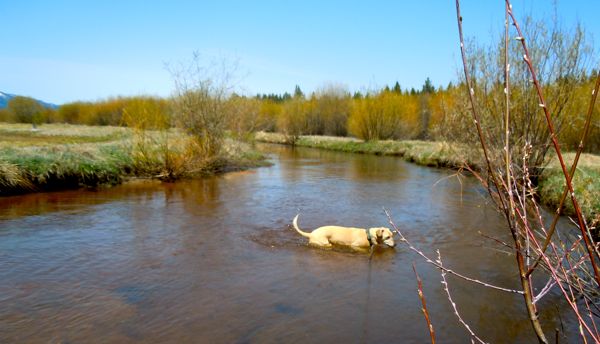
Even on leash, AJ is forbidden from swimming in Trout Creek where it meanders through the Upper Truckee Marsh.

For the first 24 days of April sheriff’s deputies wrote 18 citations. However, the CTC does not know how many of those were people with dogs off leash or people drinking alcohol or campfires or some other unpermitted activity.

What the landowners do know is compliance of the leash law, according to their land steward, is at 65 percent this year. This compares to late last summer-early fall when it was at 80 percent when dogs were let back into the marsh.

With an average of 400 dogs a week being seen by the steward this spring because of the extremely temperate conditions and lack of snow, that equates to 140 dogs running around off leash. They could be trampling on sensitive habitat and scaring wildlife.

Even when the closure is not in effect, the leash law has been – and always has been the rule since the Conservancy has owned the land. And prior to it becoming public property, no one was ever supposed to be in this area without permission by the private landholder.

Had people followed the leash law rule, those who do what they are told would not be punished. Instead, the majority of dog owners are paying the price for the minority — that one-third of dog walkers seen without a leash.

“Our goal is not to levy fines,” CTC Deputy Director Ray Lacey told Lake Tahoe News. “The citations are for flagrant disobedience.”

Of the nearly 5,000 CTC properties in the basin, this is the only one with this type of closure.