Tahoe not among the top bike friendly locations

By Jayne Clark, USA Today

Missoula, Mont., and Durango, Colo., are the latest towns to make “gold” status in the League of American Bicyclists Bicycle Friendly Communities rankings. The group’s annual list comes out today as a kick-off to National Bike to Work Week.

The program annually awards towns and cities with gold, silver or bronze status according to how well they promote cycling, provide infrastructure, enact pro-cycling policies and support related education programs.

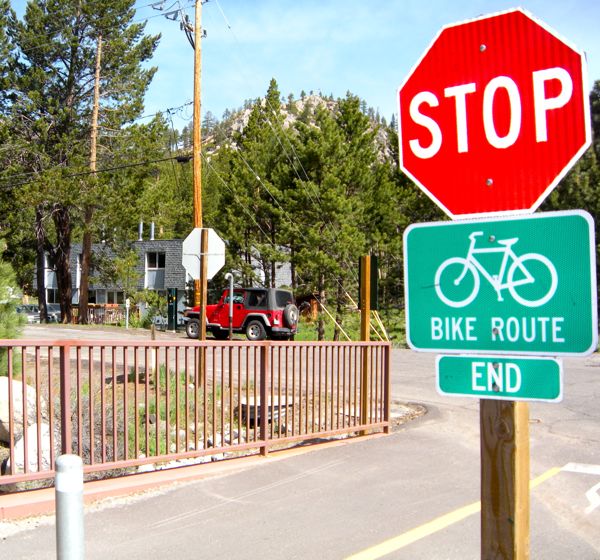
South Lake Tahoe is known for bike routes that abrupty end. Photo/LTN file

With the latest round of entrants, the organization has now certified 214 locales in 47 states as bike-friendly. In general, communities in the Mountain West lead the pack.

In Missoula, protected bike lanes, signage, and new bike parking serve an estimated 7% of residents who commute by bike. Durango boasts 300 miles of mountain bike trails and a growing network of city bike lanes., and cycling is “integral to the town’s culture and identity,” the league said in a statement.

Read the whole story


Meeting set to discuss Truckee trail system

By Barbara Barte Osborn, Sacramento Bee

TRUCKEE — A public meeting is scheduled May 16 on a proposed trail that would link Truckee’s trail system to the Village at Northstar and eventually to the ridge surrounding the Lake Tahoe Basin.

Public comments on a recently released draft environmental impact report for the Martis Valley Trail project are invited at the meeting, which will be at 5:30pm in the Truckee Town Council chambers.

Comments also may be written and mailed through June 11 to Mike Staudenmayer, general manager, Northstar Community Service District, 908 Northstar Drive, Northstar, CA 96161, or emailed to Staudenmayer at mikes@northstarcsd.org.

The draft report and more information on the proposed trail are available online.

According to the report, motorized wheelchairs would be the only motorized vehicle with access to the 10-foot-wide paved trail. It would be available to all pedestrian and non-motorized uses, with the exception of equestrians.

Two alignments are being considered, with one positioned closer to Highway 267 and the other following an existing dirt road farther south through the valley.


TRTA sets dates for trail talks

Tahoe Rim Trail Association this summer has several free trail talks planned in and around the Lake Tahoe Basin.

These one-hour informational talks are designed for trail enthusiasts to meet like-minded users and learn about what the TRTA does from trail improvements, numerous educational opportunities and providing a world class trail experience.

Upcoming Trail Talks:

May 16th – Explore Tahoe, 4114 Lake Tahoe Blvd., South Lake Tahoe, 11:45am-1pm

June 6 – El Dorado County Library, 1000 Rufus Allen Blvd., South Lake Tahoe, 6:30-7:45pm

June 13 -Sundance Books, 121 California Ave., Reno, 5:30-7:00pm

June 26 – Tahoe Meadows Interpretive Loop, 11:30am-1pm

July 12 – 21025 Ames Lane, Reno, 5:30-7pm

July 17 – Incline Village Library, 845 Alder Ave., Incline Village, 1-2:30pm

July 24 – Van Sickle Bi-State Park, South Lake Tahoe, 11:30am-1pm.


Splendor of the falls worth the trek up Hawley Grade

By Kathryn Reed

MEYERS – Express delivery of mail was probably slowed down a bit this time of year as men on horseback crossed the Hawley Grade Falls.

Also called the Upper Truckee Falls, this trek in Meyers used to be part of the Pony Express route. It was used from April-November 1860 after which time the trail was altered to go along Johnson Pass Road.

While no falls in California are raging like they were a year ago, enough thundering water is descending at a rapid pace that Kim and I chose not to cross the falls.

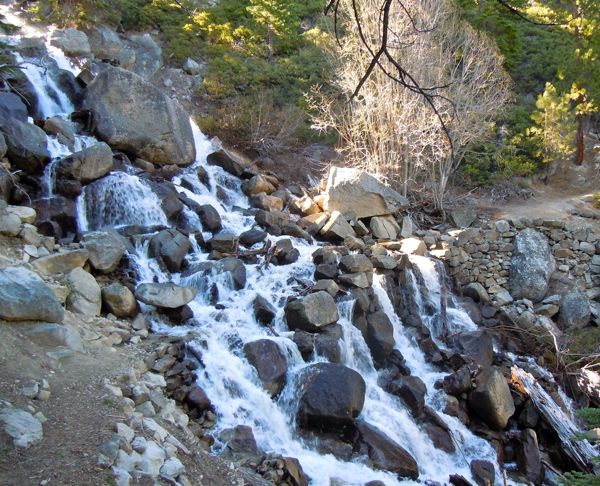
The trail cuts right through the Hawley Grade Falls. Photos/Kathryn Reed

Evidence of the winter’s high winds is in abundance with large trees blocking the trail. We did not let it impede our progress as we scampered over them to keep walking to our destination.

In 2008, a 75-foot section was taken out in a landslide. The U.S. Forest Service stabilized the lower slope, though the upper looks like it could use some attention.

As we keep going, the roar of the falls bounces off the towering pines. Soon the cascading icy water comes into view. It’s like a series of mini waterfalls tumbling over granite boulders to form one long fall that eventually reaches the Upper Truckee River.

Manzanita is just beginning to bloom. Closer to the river the distinctive red willow branches are clustered together.

Much of the trail is dry, though spots are muddy.

An abundance of butterflies flit about near the base of the trail. We hear something scurry in the brush.

Kim’s dog Joe on a previous hike up Hawley Grade ended up at the vet’s office after tangling with a porcupine.

One of the best things about going this time of year is the absence of mountain bikers. They prefer when the water is a trickle or non-existent so they can keep going up to Echo Summit or descend from there into Meyers.

Hawley Grade gets its name from Asa Hawley, a pioneer on the South Shore. This was reportedly the first graded wagon road crossing the Sierra.

Besides being a National Recreation Trail, this route is said to be an area where Snowshoe Thompson saved someone’s life.

It’s a relatively short hike to the falls, with an elevation gain of about 900 feet. Sturdy shoes are recommended. It’s narrow in spots, but most people who live in Tahoe will be able to do this hike.

Getting there:

Go west on Highway 50 to Meyers. Pass through town. Turn left on South Upper Truckee Road. Go almost to the end. On the right, at least last week, the gate is closed. (This is before the bridge.) Park near the gate and start walking. If the gate is open, drive as far as you can go.

ngg_shortcode_0_placeholder (Click on photos to enlarge.)


10-week program offers certification as California naturalist

California naturalist is a new certification program developed by the UC Cooperative Extension to foster a committed corps of volunteer naturalists and citizen scientists trained and ready to take an active role in natural resource conservation, education, and restoration.

From June 8-Aug. 10, UC Berkeley’s Sagehen Creek Field Station near Truckee will be providing one of the first offerings of this  program. The course runs for 10 weeks of Friday evening classes, with three Saturday field trips on subjects like:

• Forest and Woodland Resources

• Wildlife

• Plants

• Geology, Soils and Climate

• Energy and Global Environmental Challenges.

More information and a registration form are online.


USFS offering class for chain saw certification

Lake Tahoe Basin Management Unit is offering a chain saw sawyer course June 16-17.

The course provides introduction to the function, maintenance and safe use of chain saws. The classroom session on Saturday will cover safety standards, appropriate use and function of personal protective equipment, saw maintenance, sharpening, and troubleshooting.

The Sunday field session will be entirely hands-on. Class attendees should be comfortable using power equipment, be physically capable of operating the saws, and be committed to active participation.

Contact Jacob Quinn to sign up or for more information — jmquinn@fs.fed.us or (530) 543.2609.

Current first aid and CPR are required for this certification, or participants must be able to document enrollment in an upcoming first aid/CPR course.


Stuffed animals at El Dorado County bar confiscated by game wardens

By Bill Lindelof, Sacramento Bee

State Fish and Game wardens on Tuesday confiscated a stuffed raptor and a wolverine from a Georgetown bar.

The mounted red-tailed hawk and the wolverine, sporting a hat and clenching a cigarette between its teeth, were on display at the Georgetown Hotel and Bar until wardens got a tip.

Wardens removed the species because having them dead or alive violates state fish and game code.

One code section states that there are nine mammals that are against the law to kill or possess for whatever reason, even if they are stuffed and no matter how old, said Andrew Hughan, Fish and Game spokesman.

Read the whole story


TRTA looking for workers to help at Van Sickle

Tahoe Rim Trail Association is participating in the American Hiking Society’s 20th annual National Trails Day event June 2.

Volunteers are needed to build trail and being part of a guided hike around Van Sickle Bi-State Park.

The event begins at Van Sickle Bi-State Park off Lake Parkway in South Lake Tahoe.

To participate, register online or contact Lindsey at (775) 298.0239 trails@tahoerimtrail.org.

Trail work is from 9am–4pm. Volunteers of all skill levels and physical abilities are welcome and encouraged to participate. No prior experience necessary. Volunteers will receive free lunch provided by REI and the TRTA. The event will conclude at 4pm with a volunteer party at Explore Tahoe, including free food and drink.

This event opens the fourth trail-building season of a multi-year project, which will connect the Tahoe Rim Trail with Van Sickle State Park, re-route the TRT off paved roads, and provide stunning views of Lake Tahoe to more people.

Volunteers must wear long-sleeved shirts, long pants, boots, and work gloves; bring sunscreen, bug spray, water and a backpack. The Tahoe Rim Trail Association will provide hard hats, trail building tools and crew leaders.


Swallows may be messy, but they keep the mosquitoes away

By Cheryl Millham

To some, Cliff Swallows are a blessing. To others, they are a cause.

There are three species of swallows in Tahoe: Cliff, Barn and Tree.

The one swallow I will be talking about is the Cliff Swallow. People have called them the Mud Birds because they build their nest from mud. It is amazing to watch them build the nest with one little ball of mud at a time. They are busy little birds and can have the nest finished on one day.

Once the nest is completed, it is illegal to knock down the nest, either by hand, or by washing it down with water.

In the United States, all swallows are classified under the Migratory Swallow Treaty Act of 1918 s migratory insectivorous birds, which means swallow are federally protected birds.

Swallows eat mosquitoes. Lots of mosquitoes. Mosquitoes are the most disease carrying insect in the world.

Cliff Swallows make their mud nest under eaves of buildings.

I received a call from a young mother complaining about the swallows making a big mess. She said that there were about 16 mud nests on one side of her house and wanted to get rid of them. The swallows were making a big mess on the sidewalk below, because, when the little baby swallows have to “go pooh”, they turn around and stick their bottoms out the opening. This is what keeps their nest clean.
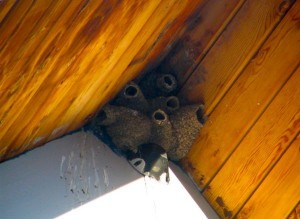
Cliff Swallow nests at the top of the A-frame at Lake Tahoe Airport. Photo/LTWC

I explained to the lady that they are protected under federal law because they are insectivorous. Our tax dollars were used to fund a study to find out that a Cliff Swallow can eat up to 1,000 mosquitoes in a day — per bird. The woman paused and then admitted that she has not had to put on mosquito repellent on her kids. In fact, she said, they hadn’t had any mosquitoes around when they were outside.

I explained the droppings are easy to wash off with a hose and when all the babies leave the nest, then she can knock or hose down the nest.

Her whole attitude changed. She said the Cliff Swallows were welcomed at her home.

Last week, I got a notice from the California Department of Public Health about West Nile Virus, which is carried by mosquitoes which bite a sick bird or animal. (You cannot get virus from the dead bird or animal, but only by the mosquito who bit it.) Since the best mosquito hunters are swallows (during the day) and bats (at night), we all should do what we can to protect both.

April 22-28 was West Nile Virus Awareness Week. To date, there have been 3,146 WNV human cases in California, which led to 110 deaths. Last year, 2,497 birds were tested, of which 28 percent tested positive for WNV. 108 dead tree squirrels were tested with 22 percent positive.

So, now is the time to walk around your house and empty any containers that have filled with melted snow or rain water so you will not be breeding mosquitoes.

The phone number to call for WNV is simple — 877.WNV.BIRD. If you find a dead bird or squirrel, call the WNV hot line. Get a plastic bag, put your hand in the bag, pick up the bird or animal, then pull over the plastic bag and tie it shut. Call the WNV hot line.

Remember, you cannot get WNV from the dead bird. Only from the mosquito.

Cheryl Millham is executive director of Lake Tahoe Wildlife Careon the outskirts of South Lake Tahoe.


Sailors’ Swap Meet at Tahoe Keys Marina

The Lake Tahoe Windjammers Yacht Club is hosting a Sailors’ Swap Meet on May 19 from 11am-2pm.

Sailboat parts and pieces, boat gear, sailing clothing and more will be available.

Do some spring cleaning and bring some stuff to sell or swap. Or come with cash and find deals on all kinds of boating treasures.

The swap will be in the building next to the Fresh Ketch, upstairs from Harbor Master’s Office at the Tahoe Keys Marina.