Search and rescue training turns into recovery of kayaker

By Linda Fine Conaboy

MEYERS — Search and rescue volunteers know when they sign up for the job no two days will be the same, a generalization they discovered to be tragically true on Saturday during what was supposed to be a routine training exercise.

The SAR training cadre, consisting of Marcel Rowley, Terry Carroll, Nathan Smith, Chris Stanton, Bruce Donley, Sten Seeman, Charlie Powers, Brian Tupper, John Nugent, Mike Mullens, Matt Massie and Sienna Smith under the leadership of Scott Gabler and Deputy Greg Almos had finished a water rescue training class on the Upper Truckee River and had just arrived at Camp Richardson to complete their smooth water maneuvers.

According to Almos, suddenly a 911 call went out and the SAR team-in-training made their way to the vicinity of the Valhalla pier where a male had jumped off of a kayak and attempted to swim to shore.

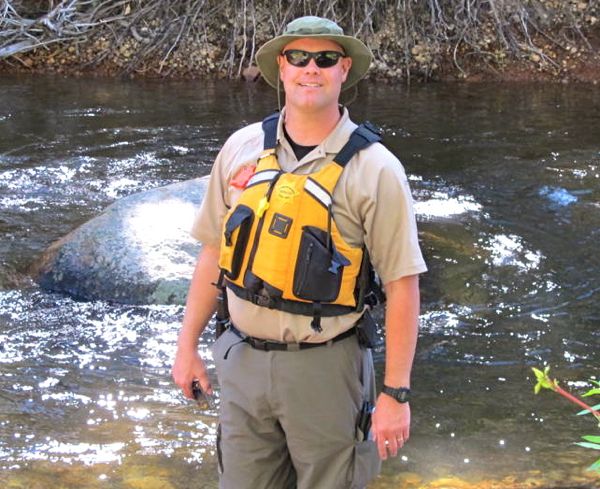
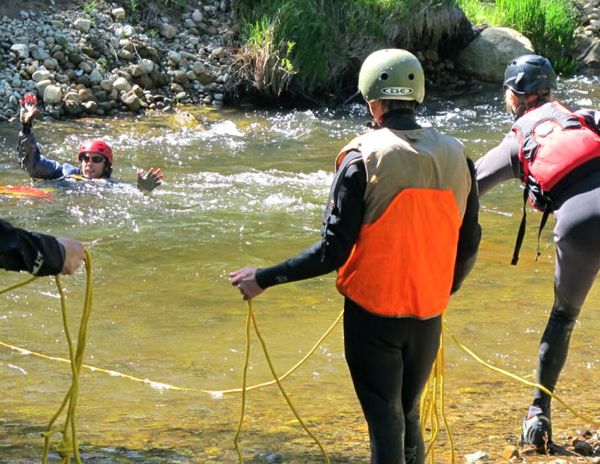
El Dorado County search and rescue volunteers on June 2 train in the Upper Truckee River. Photos/Linda Fine Conaboy

“We had two boats in the water,” Almos, who leads the El Dorado County Sheriff’s Department SAR unit, told Lake Tahoe News. “The SAR volunteers ran to help and with the assistance of Camp Richardson employees, immediately pulled the victim out of the lake and started CPR.”

Almos said the SAR team continued administering CPR even after the medics arrived to start their advanced care procedures. According to Almos, rescuers were able to detect a pulse after performing CPR, but the Bay Area man died the evening of June 2.

The 31-year-old from Antioch has not been identified pending notification of family.

Almos, who is also in charge of the Office of Emergency Services as well as the boating program, said more adults than kids are rescued by the SAR team, mainly because adults are more daring and kids tend to be supervised, a fact that proved true on Saturday.

He said lake rescues happen fairly frequently, but not often in the rivers. “If someone is in distress in swift water, it’s tubists and sometimes it’s kayakers,” he said of river rescues. “This is a mild year because the water [in the rivers] isn’t so high.”

Saturday’s training class started on the Upper Truckee River where it flows through Meyers and passes the banks of the old Sierra Pines Campground. It is designed to give awareness and beginning insight into various types of water — standing or flowing waters, Almos explained.

“People need to understand that cold water can be very dangerous.” — El Dorado County sheriff’s Deputy Greg Almos

During a moving water rescue, ideally, there will be two people downstream to snag a victim who may have slipped by the upstream team. Rescuers communicate by a series of whistles; one blast is an attention getter; two blasts notifies people something is coming and to look upstream; three short sounds means something is happening downstream and three long blasts indicates an emergency, or that a rescue is in progress.

Almos cautioned that it’s important to do what you can do to rescue someone while you’re onshore rather than wading into the water — especially if you’re alone.

“You could attempt to use a throw bag (an inflatable attached to the end of a rope). Going in after somebody has to be well thought out. You need a support team for that,” he said. “Do what you can do from shore.”

The 11 people involved in Saturday’s rescue are all volunteers, ranging in age from 18 to 50 and are part of a larger group totaling 35 within the Lake Tahoe Basin in El Dorado County. There are about 100 volunteers located on the West Slope. They all have pagers and are on call 24/7.

“We run anywhere from 50 to 70 calls annually,” Almos said. “Although most calls are for backcountry rescue, all of the rescues are performed by the team.”

He added that the Placerville team handles between 20 to 40 calls each year.

“People need to understand that cold water can be very dangerous. Plan your recreation. Don’t be impulsive. Always have people with you and always have a life jacket if there is a chance you could be submerged. It’s all about safety and avoiding a problem,” Almos said.

——-

Notes:

• The 2012 National Search and Rescue Conference is June 4-6 at Harvey’s in Stateline. The conference is a combined presentation by the Mountain Rescue Association and the National Association for Search and Rescue and features various exhibitors, speakers and workshops.

• The third annual El Dorado County Search and Rescue Appreciation Day is June 20 at Riva Grill in South Lake Tahoe from 5-9pm. More information is on the flyer.


Bike challenge encourages people to give up car keys

The 7th annual Tahoe Bike Challenge, which promotes bicycling as an alternative transportation choice over the automobile, is June 4-15.

This is not a competition, but rather an invitation to join hundreds of Tahoe bicyclists in riding your bike to work, school or play. The challenge can be personal or a team effort.

For 2012, goals have been set to increase participation and results. They are:

· 1,000 participants

· 100 teams

· 10,000 trips

· 30,000 total miles traveled.

 To register for the challenge, go online.


Summer sports performance camps in Tahoe for youth

Lake Tahoe Community College and Barton’s Tahoe Center for Orthopedics have teamed up to offer the area’s only team sports performance summer camps for ages 8-14.

Seth Martin, physical education specialist with Lake Tahoe Unified School District, will lead other top coaches and Barton’s training staff in the four- and eight-week camps. They will focus on improving children’s overall health and wellness. Kids will learn training skills, team building exercises, sport-specific techniques to enhance overall sports performance and nutrition.

For more information and to register, call (530) 541.4660, ext. 717.


Angora area becomes outdoor classroom

Photo/Lisa Herron, U.S. Forest Service

South Tahoe High School senior Jason Reum plants a yarrow seedling in the Angora Fire area on May 29 as part of a cooperative project that includes the U.S. Forest Service, University of Nevada Cooperative Extension and South Tahoe High School.

The project aims to restore native plants to the burn area while teaching students about native restoration.

“It’s great,” said senior Michael Wood. “We’re doing something that benefits the environment and gets us out of the classroom.”


Community garden sprouts from loss of family home

By Leona Allen

My father was the consummate naturalist and environmentalist. He paid attention to his surroundings, and worked hard to ensure that the native flora and fauna had a place to exist. He strove to educate others on the importance of the smallest plant and the largest mountain. He recycled before it was “cool” to do so. And he spent more time reveling in the beauty of nature than paying attention to things man made.
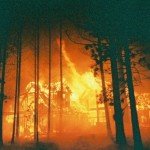
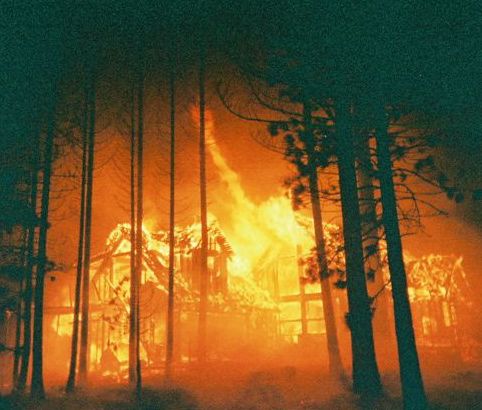
Angora Fire -- 5 years later

He shared this spirit of the outdoors with my mother, and together they always worked hard to surround themselves with gardens that mirrored the native species of the Sierra. It then made sense that after the Angora Fire’s devastation to their home, that dad would decide to not rebuild, but rather to give back to the neighbors he loved so much by creating a garden.

When we sat down to discuss the concept, there were a few things that he was sure about. First, he wanted it to contain flowers, shrubs and trees that are native to Tahoe. Second, he wanted it to be something beautiful. And lastly, he was adamant that his beloved neighbors have access to the property.

Sadly, my father did not last too much past developing his initial idea. He was 90 years old at the time of the fire, and the event had taken its toll. Two years later he succumbed to old age and congestive heart failure. But the idea lived on, and after sharing the idea with the Tahoe Resource Conservation District (TRCD) we started to conceptualize on paper.

My history with the wonderful folks at TRCD had been steeped in education from the beginning. As a defensible space inspector for Lake Valley Fire Protection District, my job was to be a “landscape therapist” of sorts for homeowners whose surroundings put themselves and their neighbors at risk for spread of fire. As has been demonstrated in fire after fire across the nation, defensible space can make the difference between a bit of smoke damage to a house and total loss. I was tasked with showing our constituents how their property can be altered and managed to create a fire-safe environment while being pleasing to the eye.

TRCD was developed to help people protect land, water, forests, wildlife, and related natural resources with backyard conservation programs. They also work with their partner agencies to integrate all aspects of their conservation programs with fire defensible space, water conservation, fertilizer management and wildlife habitat enhancement. They are a non-regulatory, grant-funded, not-for-profit agency.
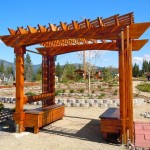
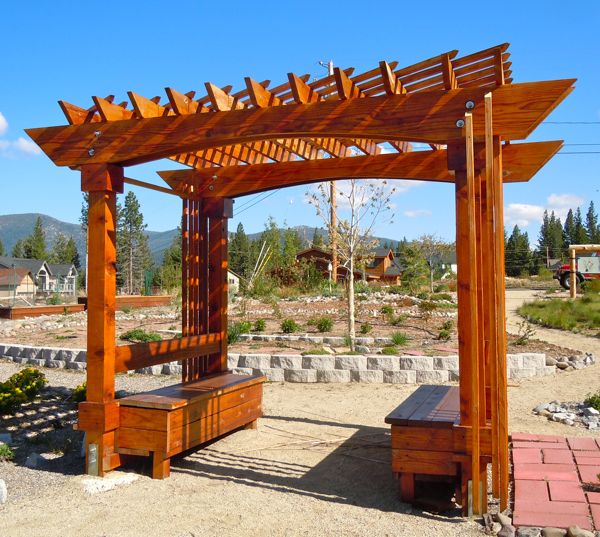
The gazebo beckons people to sit for a bit. Photos/LTN

We all worked together at various public events, and eventually started inspecting properties together so that we weren’t telling the homeowners conflicting procedures and regulations. It was obvious that we all shared a strong sense of our natural environment and appreciated the uniqueness of our surroundings. In sharing my dad’s vision, my enthusiasm for the project caught on and soon we had ideas on paper. Drawings led to gaining support from others. Encouragement led to funding sources. And finally, the first dedication ceremony was June 6, 2009, where our first deciduous tree – a maple – was planted.

During the first year, we overcame a few challenges with the support of neighbors, local garden enthusiasts, Tahoe Regional Planning Agency staff, Lake Valley Fire
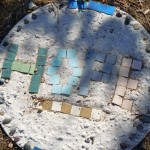
This handmade rock conveys the garden's purpose.

Protection District, South Tahoe Public Utility District, Aspen Hollow Nursery and Tahoe Outdoor Living. A mound of dirt was placed on the property so that we could demonstrate plants and stabilization alternatives appropriate for sloped properties. Three large cedar trees were planted on the mound – compliments of my uncle and aunt, Dan and Sydney Kurtz – which were followed by several other evergreens. Deciduous trees were planted and a riparian area was formed, complete with a conveyance swale lined with rock.

Paths were also designated, and with the hard labor of many volunteers decomposed granite was carefully placed to encourage foot traffic and prevent erosion. Lake Tahoe Community College’s Demonstration Garden donated four fruit trees that had to be removed from their property, and the wildlife garden

The Evans and Allen families demonstrate a sense of community by giving the neighborhood a garden of growth.

started to take shape. Plants and shrubs were carefully placed by members of local garden clubs, and birdhouses were built by the Boys and Girls Club. As winter settled on the property, a real garden had begun to take shape. To my amazement, before the snow fell we were witness to an array of wildflowers blooming – columbine and monkey flower to name a few.

During the first year’s work, we realized that a corner of the garden was starting to sprout on its own without help from anyone. It was decided that this area should be allowed to come back without our intervention to demonstrate how natural recovery from a fire takes place.

In 2010, the snows melted early and we were able to start work in earnest. The first things I noticed upon setting foot on the property that year was that the trees had buds on them – a good sign that they were taking root. Best of all, however, was a mother bird hovering near the birdhouse. Her eggs were inside. Later, we were to find evidence of a robin’s nest in the cedar trees. The local wildlife had found the garden, and approved.

We immediately started working on irrigation issues with a drip system. All of us had taken turns watering the garden as needed, but a drip system would save water and give our volunteers some time to themselves. We also planted more in the riparian area with the assistance of the local Girl Scout Troop and their beautiful hand-made garden tiles. The South Tahoe Rotary Club came for a day of major planting and soil moving.

On Father’s Day of that year, I sat on the garden wall to see the progress that we had made. To my delight, that was the day chosen by the birds to try their first flight. I was able to watch the young birds as they tried out their wings for the first time, looking much like Snoopy’s friend Woodstock. After many “first flight” tries and a few crashes, the youngsters were able to make it around on their own.

The summer saw many volunteers in the garden, including a group of Russian students and an environmental educational program from the American River Conservancy/Sierra Epic Adventures. With their help, many new plants were placed in the garden and a lot of weeding was accomplished.

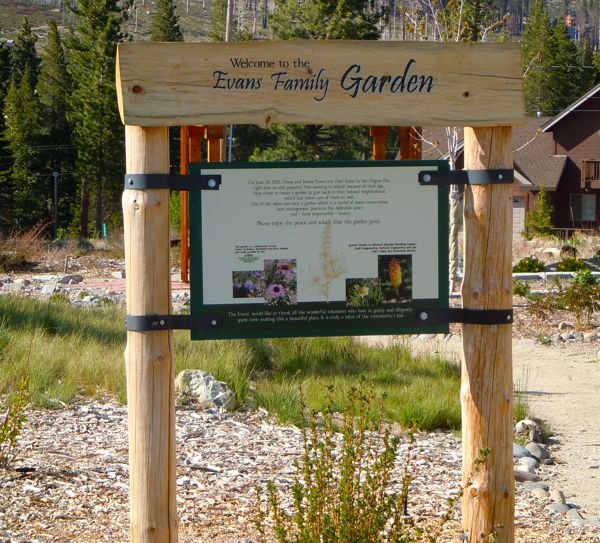
In my hours spent at the garden, I also watched people walking by and talking about the flowers but never setting foot on the property. We realized that a “welcome” sign of sorts was needed, and began the design of our interpretive sign. With the most generous assistance of Angie’s Signs, we created a work of art that explains the garden’s purpose and encourages entrance to the property. From then on, neighbors and visitors alike began to come on to the paths and explore the work being done.

The other planned structure was an arbor, which represented the home in the defensible space equation. My husband, Mark, and our friend, Michael Keiser, were put to work. Both had backgrounds in construction and woodworking, so the task suited them perfectly. Before we knew it, a beautiful redwood arbor had been completed at the rear of the property, complete with benches that could house tools and equipment. The timing was perfect, as winter again ascended on the garden – this time with a blanket approximately 4-feet high.

As we all know, the summer of 2011 got a late start. By the time the snow melted, the flowers were very ready to bloom. All the winter’s moisture proved to do well, and the garden was rife with currant, serviceberries, lilacs, iris, lavender, thyme and daisies. Nature at its best. As well as a cottage garden and some wildflowers, we built two raised beds and a moveable compost box. With several organically grown starts, we planted zucchini, tomatoes, peppers, mint, rosemary, cucumbers and potatoes. Much to my pleasant surprise, the garden exploded with produce — only the cucumbers didn’t succeed. As of the writing of this article, I am still knee-deep in blanched and frozen zucchini (which comes as no shock to those who have grown it, I’m sure!).

We also found ourselves doing a lot of maintenance work on what we had already planted. After all, what is a garden without invasive species, pruning needs, voles, and weeds to keep us busy. But with the generosity of our volunteer gardeners and the TRCD staff, we watched the winter take over feeling satisfied that our garden had taken shape quite beautifully.

So now begins another season of planting, mulching, repairing, digging, volunteering, and generosity. We look forward to this time of growth, and welcome anyone who wishes to help out. You can check out the garden at www.evansfamilygarden.org or contact TRCD at (530) 543.1501 – ask for Jennifer Cressy or Courtney Walker.

And thank you to the folks who have donated so much to our project:

American River Conservancy/Sierra Epic Adventures

Lake Tahoe UCCE Master Gardeners

Local Girl Scouts, Boys and Girls Club and Rotary Club

Lake Valley Fire Protection District

Tahoe Resource Conservation District

Nevada Fire Safe Council

South Tahoe Public Utility District

Tahoe Regional Planning Agency

Aspen Hollow

Tahoe Outdoor Living

Mapes Landscaping and Snow Removal

Earth and Stone Landscapes

Swift General Engineering

Western Nevada Supply

Herback General Engineering.

Leona Allen Evans Family Garden is online.


USFS moves Lake Tahoe logging for woodpecker; still criticized

By Scott Sonner, AP

U.S. Forest Service officials have agreed to move post-Angora Fire logging operations farther away from nests with rare, black-backed woodpecker chicks at the request of conservationists who’ve been fighting the overall project for years.

But John Muir Project members — who have documented one nest in the path of the logging and suspect there are more — say the no-cut buffers the agency is implementing are far too small to protect one of the rarest birds in the Sierra Nevada.

“No credible black-backed woodpecker scientist would say it is enough — not even close,” said Chad Hanson, a wildlife ecologist and executive director of the group who has filed a petition seeking protection of the bird under the U.S. Endangered Species Act.

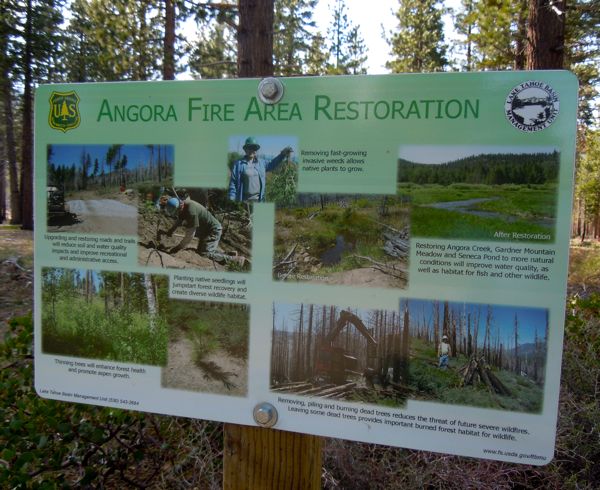
A sign at the end of Seneca Road explains restoration efforts by the U.S. Forest Service in the Angora burn. Photo/LTN

“It will kill them just as surely as logging right up to the nest tree,” he said.

Lawyers for the Forest Service told the group recently its proposed 60-acre buffers around each nest would undermine the 1,400-acre project’s goals of restoring the forest and reducing future catastrophic risks where the Angora Fire destroyed 254 homes in South Lake Tahoe in 2007.

But Deputy Forest Supervisor Jeff Marsolais said Friday the agency and the private logging contractor agreed to move the fuels reduction operations at least 10 acres away from the nesting area until the chicks leave the nest. One acre is a little less than the size of a football field.

“The relocation shows our ongoing commitment to balance ecosystem values and our intent to maintain efficient operations in completing our Angora restoration efforts,” Marsolais said in a statement the agency provided to the Associated Press late Friday.

In addition to no logging within 10 to 12 acres of the identified nest tree, an additional 25 acres of habitat will be preserved within one-quarter mile of the tree, until the chicks “fledge,” USFS spokeswoman Cheva Heck said.

The area includes some of the last of the 156 acres of forest that remains uncut in the overall 1,400-acre project first proposed in early 2009 and under way for more than a year.

A federal judge in Sacramento earlier rejected a request for an injunction to block the logging filed by the John Muir Project and its parent Earth Island Institute.

The 9th U.S. Circuit Court of Appeals currently is considering their appeal claiming the Forest Service’s environmental assessment ignores the agency’s own science suggesting the project will harm the bird without effectively reducing long-term fire threats.

Hanson said the Forest Service’s science consistently shows one pair of black-backed woodpeckers needs 100 to 200 acres of good habitat with a minimum 60-acre core for foraging. He said the latest logging will come so close to the nest tree that the noise alone may cause the adult birds to abandon the nest.

Rachel Fazio, a lawyer for the group who argued its case in the 9th Circuit last month in San Francisco, said it made no sense to rush to log the last remnants of the project area given it was more than 90 percent complete and therefore, based on the agency’s arguments, had already reduced fire threats accordingly.

Fazio said the chicks may “fledge” — or fly for the first time — within about three weeks but would remain dependent on their parents weeks longer and be especially vulnerable to predators.

“It will just be a little island of habitat so that maybe the birds survive for a week or so,” she said.

Hanson said the additional 25 acres of habitat retained within a quarter mile — approximately 400 meters — is too far away for a bird that historically won’t travel more than 150 meters at a time in unsheltered forest for fear of becoming someone else’s dinner.

Hanson said the Forest Service took the same approach — unsuccessfully — with a post-fire logging project in the neighboring Eldorado National Forest, leaving uncut three 40- to 50-acre patches of black-backed woodpecker habitat after the 2004 Freds Fire near Kyburz.

“They tested this exact theory before, and it didn’t work,” he said. “No one has been able to find woodpeckers near any of those patches since then.”

Heck said the agency is leaving intact about 1,168 acres of burned forest for the woodpeckers and other wildlife — approximately 43 percent of the area charred to varying degrees over more than 3,000 acres.

But Fazio said that less than 800 acres of that 1,168 is considered suitable for the black-backed woodpeckers, which are highly dependent on the most intensely burned forest habitat for the beetle larvae they peck from the bark.

Heck said she couldn’t comment directly on that claim because it’s part of the ongoing litigation. She said the district court has denied the group’s request for an injunction blocking the logging “citing the project’s benefits to the public interest.”


Birds change nesting routines as new species arrive in Tahoe

By Cheryl Millham

Living in Lake Tahoe gives us the opportunity to witness the changing bird habitats and to take part in helping the Steller’s Jays, the most dominant songbird in the Sierra.

A gentleman called, totally confused, so I am going to share his story with you.

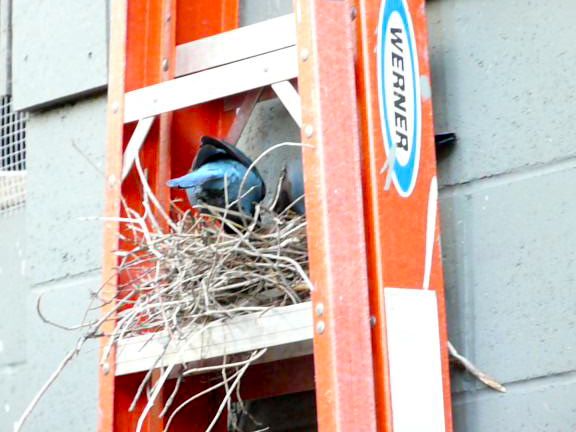
He and his wife keep their garage door open for most of the day. Two jays decided to build a nest in their garage. Well, if you have ever witnessed Steller’s Jays building a nest, they make a big mess before any twigs start to adhere together. The couple kept cleaning up the mess. He finally called Lake Tahoe Wildlife Care to talk about his problem with his jays.

He didn’t mind if the birds nested in his garage. However, they close the garage door every night and were afraid the birds wouldn’t be able to feed their babies.

I explained to him that birds sleep at night (with a few exceptions). If they opened the garage door each morning and closed it each night, the birds would be fine.

Steller's Jays are changing their nesting habits to guard against ravens. Photo/LTWC

Then I explained to him why the jays were building a nest in his garage.

Twenty years ago there were very few – if no – ravens in Tahoe. But with many years of drought and mild winters, the ravens have moved here.

What do the Ravens eat and feed their babies?

You guessed it — newly hatched baby birds. If they are flying over some trees and see a nest with chicks in it, they would swoop down and grab the just hatched babies, then fly off to feed their own babies.

The gentleman on the phone then told me he witnessed this behavior. He told me there are a lot of ravens by his house and he saw a raven fly down and pull a baby robin right out of the nest, even while the mom was screaming.

But there was nothing she could do.

That is why you will see jays making nests where they have never made nests before. It is no longer unusual to see nests under eaves or in garages to hide their nest from the hungry ravens.

I hope the robins also learn to change their nesting habits.

Be patient with nesting birds. They are just trying to raise their babies safely.

But, remember this, in just 23 days after their eggs have hatched, the (songbird) babies will be too big for ravens to eat and will have left the nest.

Cheryl Millham is executive director of Lake Tahoe Wildlife Care on the outskirts of South Lake Tahoe.


Nice weekend on tap, but snow in the forecast

A few record high temperatures were set June 1 in the Tahoe area.

South Lake Tahoe reached 81 degrees – two degrees higher than the record set in 1992. Reno’s 97 was three degrees higher than the 2007 record. Mammoth surpassed the 2002 record of 77 by three degrees.

Markleeville tied the 2001 record of 88 degrees.

The weather is going to change in Tahoe soon. Photo/LTN

“No record high temperatures are expected on Saturday as a weak trough pushes into California and Nevada on Saturday,” the National Weather Service said.

Temps in the Lake Tahoe Basin are expected to be in the 70s this weekend before dramatically dropping on Monday. The high on June 4 in South Lake Tahoe is forecast to be 55 degrees with a 70 percent chance of showers, with the possibility of snow that evening when the low drops to 28 degrees.

— Lake Tahoe News staff report


Workshop all about lavender

Western Nevada College Specialty Crop Institute offers a Lavender Production, Sales & Marketing Workshop on June 18, 9am-4pm at the Carson City campus.

It will include a lavender farm tour.

Cost is $45. Lunch is included. Seating is limited, and registration is required.

The workshop will begin at Campie’s Lavender Patch in Stagecoach where students will learn about harvesting, soils and site selection, the extraction process for essential oils, and best varieties for Nevada. Following the farm tour, a classroom lecture at the WNC Carson Campus will focus on sales and marketing, product development, and online strategies to expand markets.

Featured speakers include farmers Mike and Diane van Camp of Campie’s Lavender Patch in Stagecoach and Susan Harrington of Labyrinth Hill Lavender in Washington. Harrington has been growing and selling lavender for almost a decade. With a background in business management, she teaches workshops across the Northwest and has developed online courses for lavender production and sales.

Mike and Diane van Camp have grown lavender commercially for more than eight years. They produce more than 30 varieties, focusing on propagation and development of varieties favorable to Nevada’s climate. Their nursery plants and retail lavender products are sold at farmers markets and online.

Information/registration, contact Ann Louhela at (775) 351.2551 or louhelaa@wnc.edu.


Non-competitive cycling event for all ages, abilities

As part of this year’s “Alta Alpina Challenge – Riding the Wild Sierra” cycling event, the Alta Alpina Cycling Club is organizing non-competitive ride for people of all ages on June 30.

Designed to accommodate cyclists of all abilities, the course will allow riders to experience the scenic beauty of the Sierra foothills along the popular road riding area of Diamond Valley. Options for the ride range from 15 to 20 miles.

For information and registration, call 877.845.2453.