Invasive weed spreads from Tahoe to Truckee River to Pyramid Lake

By Jeff Delong, Reno Gazette-Journal

A troublesome water weed that has spread through Lake Tahoe for decades is now established along the length of the Truckee River, posing possible problems of unknown scope and scale.

From the outlet of the Tahoe City Dam to where the river flows into Pyramid Lake 116 miles downstream in the desert, anywhere the river’s waters flow slowly enough Eurasian watermilfoil can be found, experts said.

“It goes all the way to the end of the river,” said John Mosely, environmental director of the Pyramid Lake Paiute Tribe. “In every irrigation diversion, in every backwater, we can find it.

“It’s a huge concern,” Mosely said.

An exotic and aggressive invader, Eurasian watermilfoil is trouble. The weed crowds out native plants and takes away oxygen needed by fish. It can ruin boating and clog irrigation ditches, water intakes and pipes.

No one knows for sure when it first showed up in Lake Tahoe.

A good guess is that watermilfoil appeared in South Lake Tahoe’s Tahoe Keys Marina – a place now thoroughly infested – sometime in the mid- to-late-1980s, said Lars Anderson, a scientist with the U.S. Department of Agriculture who has tracked the weed’s spread since 1994.

Spread by boats or as weed fragments carried by currents took root on the lake bottom, Eurasian watermilfoil can now be found in most of Tahoe’s marinas and some other near-shore areas.

Established near the Tahoe City Dam, the weed may have escaped into an overflowing Truckee River during the flood of January 1997.

It was found growing in a quiet part of the river near Verdi a few years later and is now firmly established in the lower river near Pyramid Lake.

The weed has not yet posed any serious problems for the Truckee Meadows Water Authority, which draws the bulk of its drinking water supplies from the river.

The utility’s hydroelectric plants are located in parts of the river that flow too fast for the weed to grow.

Recent multimillion-dollar upgrades to the Highland Canal, which serves the area’s primary drinking water treatment plant, substantially increased water velocity and diminished any threat, said Bill Hauck, water supply coordinator for the authority.A troublesome water weed that has spread through Lake Tahoe for decades is now established along the length of the Truckee River, posing possible problems of unknown scope and scale.

From the outlet of the Tahoe City Dam to where the river flows into Pyramid Lake 116 miles downstream in the desert, anywhere the river’s waters flow slowly enough Eurasian watermilfoil can be found, experts said.

“It goes all the way to the end of the river,” said John Mosely, environmental director of the Pyramid Lake Paiute Tribe. “In every irrigation diversion, in every backwater, we can find it.

“It’s a huge concern,” Mosely said.

An exotic and aggressive invader, Eurasian watermilfoil is trouble. The weed crowds out native plants and takes away oxygen needed by fish. It can ruin boating and clog irrigation ditches, water intakes and pipes.

No one knows for sure when it first showed up in Lake Tahoe.

A good guess is that watermilfoil appeared in South Lake Tahoe’s Tahoe Keys Marina – a place now thoroughly infested – sometime in the mid- to-late-1980s, said Lars Anderson, a scientist with the U.S. Department of Agriculture who has tracked the weed’s spread since 1994.

Spread by boats or as weed fragments carried by currents took root on the lake bottom, Eurasian watermilfoil can now be found in most of Tahoe’s marinas and some other near-shore areas.

Established near the Tahoe City Dam, the weed may have escaped into an overflowing Truckee River during the flood of January 1997.

It was found growing in a quiet part of the river near Verdi a few years later and is now firmly established in the lower river near Pyramid Lake.

The weed has not yet posed any serious problems for the Truckee Meadows Water Authority, which draws the bulk of its drinking water supplies from the river.

The utility’s hydroelectric plants are located in parts of the river that flow too fast for the weed to grow.

Recent multimillion-dollar upgrades to the Highland Canal, which serves the area’s primary drinking water treatment plant, substantially increased water velocity and diminished any threat, said Bill Hauck, water supply coordinator for the authority.


Future of California state parks remains uncertain

By Matt Weiser, Sacramento Bee

Dozens of California state parks struck down by the budget ax are slated to close their doors in three weeks. Yet that process remains so unsettled that even state officials can’t say with certainty how many parks will actually close.

One year ago, the state Department of Parks and Recreation released a list of 70 parks that would be closed to achieve a $22 million savings in operational costs. The closures – unprecedented in the 150-year history of California state parks – are set to occur no later than July 1.

The uncertainty is a silver lining for park lovers. It means far fewer than the original 70 parks will close, because many local groups have raised money and rallied volunteers to rescue a state park in their community.

“If there’s anything positive out of all this, it’s that it’s connecting local communities back with their parks, making people pay attention to them, and realizing they don’t just take care of themselves,” said John Woodbury, general manager of the Napa County Regional Park and Open Space District.

Woodbury’s organization, in partnership with the nonprofit Napa Valley State Parks Association, signed an agreement with the state to operate two parks: Bothe-Napa Valley State Park and Bale Grist Mill State Historic Park.

The groups have an ambitious plan to turn the neighboring parks into a break-even operation after decades as a money loser for the state. Among other changes, they plan to return the campground to year-round operation, install 13 yurts as pricier overnight accommodations, and turn historic buildings into rentals.

Dozens of partnerships across the state are still in the works at this late date, partly because the state has never before handed over an entire park to a nonprofit group. It took months to resolve the legal issues and prepare contracts. And every such agreement is different, so a uniform approach was impossible.

Roy Stearns, a state parks department spokesman, said last week his agency’s best estimate is that 22 parks have operating agreements signed with new partners that will keep them open. Such agreements are pending at 14 other parks.

So the worst case at the moment is that 48 parks would close, not 70. The number may drop to 34 – and possibly lower.

The state also is mulling concession contracts with private companies to operate other parks on the closure list. These numbers are even less certain because the most recent closing date for bids was just five days ago.

“We do not have a listing of what parks will close, as we are still in the process of seeking partners,” Stearns said via email. “We shall not be putting a park on the closed list if there appears to be a deal in the works that is possible soon.”

Read the whole story


Synchronized skating event at South Tahoe rink

More than 300 ice skaters from Northern California and Nevada will be competing at the annual Skate at the Lake Competition this weekend.

The synchronized skating event is at the South Lake Tahoe ice arena on Rufus Allen Boulevard.

Teams of 10 to 20 skaters perform intricate routines to music. Spectators are encouraged to watch. It’s free.

The June 16-17 event begins at 4:55pm and will last until about 7:15pm.


LTUSD not in agreement regarding equality of ball fields

By Kathryn Reed

Lake Tahoe Unified School District is going to come up with a list of priorities for the ball fields it owns to give the committee recommending how to spend $500,000 of taxpayer money.

The district owns all the fields where children and adults play softball-baseball-soccer on the California side of the South Shore except for the one by Lake Tahoe Community College. The city of South Lake Tahoe, though, owns some of the improvements.

At issue Tuesday night at the school board meeting was whether the softball field still under construction at South Tahoe High is of equal caliber to what the boys play baseball on.

Board member Sue Novasel emphatically and repeatedly said they are not equal.

“It should be equal, which would be a fence and lighting,” Novasel told her fellow board members June 12.

Even with the 4-0 approval (Judy Cefalu was absent) to allocate $160,557 from the special reserve fund to pay for improvements, that doesn’t buy a fence or lights for the softball field.

Facilities Director Steve Morales is of the belief that what has been done and the worked slated to be done will comply with the Office of Civil Rights complaint filed in 2010 against the school district.

“It’s not a regulation size softball field and is a regulation baseball field,” Novasel countered.

The Title IX issue was not resolved at the meeting.

Morales and Novasel will make a list of what the district would like improved, with the high school softball field likely to be at the top.

The fields committee of the Measure R joint powers agreement will meet June 25 at 4pm at Lake Tahoe Airport. This group is running out of time to have a plan of action together before the JPA board meets July 27 to hear proposals and possibly vote on how to spend the half million dollars for field upgrades.


Students help environment, learn about yesteryear Tahoe

By Kathryn Reed

CAMP RICHARDSON – Ridding the swales between Tallac and Taylor creeks of invasive species could help reverse the decline of native fish species so in future years third- and fourth-graders might be able to see what the Washoe were accustomed to harvesting from Lake Tahoe.

Back in the day when Washoe summered at the lake and wintered in the Carson Valley, there was a two-week period when they could wade knee-deep into the lake and come out with a basket full of fish.

“There was a seasonal abundance that Lake Tahoe would provide,” Joy Barney, conservation education coordinator with the U.S. Forest Service, explained.

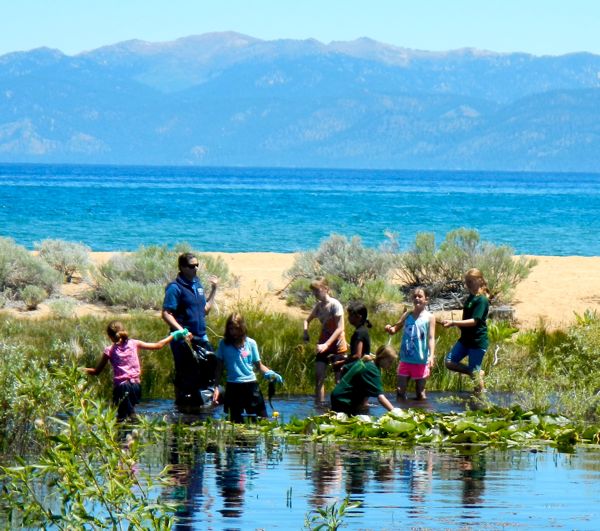
Fifth-graders from the magnet school on June 12 pull milfoil from the swale at Baldwin Beach. Photos/Kathryn Reed

Part of what fourth-graders were learning Tuesday is the historic food web and then comparing it to today.

Speckled dace, tui chub, Lahontan, redsides, Tahoe sucker – while all these fish still exist in Lake Tahoe, their numbers are dwindling because of invasive species.

Meandering through the various old estates that are now owned by the Forest Service, the children are broken into groups to be taught Trees are Terrific, Ways of the Washoe (which has been approved by the tribe) and Founding Families.

For many of the youngsters, this is their first trip to this part of the South Shore. The same could be said for some of the parent chaperones.

Valhalla to Baldwin Beach became an outdoor classroom on June 12 for third-, fourth- and fifth-graders from the environmental magnet school. Third- and fourth-graders in Lake Tahoe Unified and Incline have been spending time at the Tallac Historic Site learning outside the classroom — but using curriculum that meets state requirements.

“The overall theme of the day for the Children’s Forest program is that people and the environment are and always have been intricately connected,” Barney told Lake Tahoe News.

At Baldwin on this particular day are the fifth-graders from the Meyers school. Looking at this small body of water that sits at the edge of the parking lot it seems like a swamp that rational people would not willingly venture into. The beach separates this unattractive wet area from Lake Tahoe.

While the swale is natural in its formation, what isn’t native is what’s living in it – Eurasian milfoil and bullfrogs.

Students are pulling the milfoil out by hand.

“It feels slimy (in the water), but when it comes out, it feels like a leaf plant,” student Summer Furrer says.

She pulled out about 10 handfuls that went into one of the seven garbage bags her class collected.

Part of the class helped put a large black mat that is something like permeable landscaping cloth at the bottom, center part of the swale. This will essentially smother the milfoil, while allowing for oxygen to get to the macro invertebrates that might be under the covering.

What stopping the photosynthesis process does is one of the educational components of the day.

Forrest McCann is articulate beyond his years – clearly demonstrating some adults are not smarter than a fifth-grader.

Part of Barney’s time in the classroom that preceded the field trip was to talk about interpretive signs – what they are good for, how to write one and how to illustrate one.

McCann’s “Save the Swale” sign is so good that it may become the actual sign the Forest Service posts to educate people who come to the area.

This is one of four swales in the area.

Some students are in waders and booties, some are in shorts. All are getting wet to some degree. The deepest part of this particular swale is 3½ feet. Measuring the swale was part of the job for the day – and one way it became a math lesson.

While the students this day are not dealing with the estimated 500,000 bullfrogs that call this area between Tallac and Taylor creek waterways home, they know it would be better if they literally croaked.

“The bullfrogs are bad because they eat native species and make the water dirty,” McCann said.

Sarah Muskopf, aquatics biologist with the Forest Service, is the mastermind behind this particular project. In her waders, she is in the water with the students to help and educate at the same time.

She explains the three treatments going on – hand pulling, the fabric liner and then the jute, which is a rope-like mat that will not have to be removed.

The learning process will continue in the fall when other students will remove the fabric barrier to see if it worked to get rid of the milfoil.

“Even when the whole swale is treated, it will need to be maintained,” Muskopf explained. “It’s like weeds in a yard, it’s never a done deal.”

ngg_shortcode_0_placeholder (Click on photos to enlarge.)


Image caught by camper confirmed to be wolverine

By Bill Lindelof, Sacramento Bee

A Sacramento man believes he has snapped a live picture of what only remote motion-sensitive cameras have captured before: a wolverine in the Sierra Nevada.

David Messa, 51, was on a camping trip in Nevada County on May 19 when around nightfall he took a picture of a creature walking on a thawing lake.

Wildlife biologists working for the U.S. Forest Service and the state Fish and Game Department on Thursday confirmed that the animal is a wolverine.

The rare sighting came at 8:41 p.m. during an all-day hike at Beyers Lake.

“It was fairly dark,” Messa said Thursday. “I hear him come galloping across the lake. I wasn’t sure exactly what it was.”

Read the whole story


Sierra hosting mud obstacle race for all ages, abilities

The Tahoe Tri Club will host its first mud obstacle race at Sierra-at-Tahoe on July 14.

The spectator-friendly course starts at an elevation of 6,800 feet and offers multiple options for distance and age.

Organizers say the race course will be built by a sadistic crew of licensed contractors designed to test people’s strength and fortitude. Three levels of competition will be offered for adults including a Green Route that is four-miles long, a Blue Route that is seven-miles long and a Black Route that is 11-miles long.

Challenging obstacles along the way will include ropes, ice baths, nets, wall climbs, beams, and the ever-popular slip ‘n slide.

Families are also welcomed to participate in the Kiddie Recon, where children ages 7-14 tackle a one-mile course with six to eight obstacles or children ages 6 years old and under conquer a half-mile course with four to six obstacles.

Racers start and end on the Broadway trail.

Music by Lavish Green, and food and beverages will be on on the Tiki Deck.

The awards ceremony will be hosted in Opal Lounge at MontBleu at 5pm where winners will be crowned, and participants can view photos and videos from the race.

Participants may register online or on race day at Sierra-at-Tahoe from 7-10am. The cost per person is $65 for the Green Route, $75 for the Blue Route, and $85 for the Black Route until June 30, when prices will increase. The Kiddie Recon will be $35 in advance and $45 on the day of the race.


Fallen Leaf Lake moving on despite lingering voter issue

By Kathryn Reed

FALLEN LEAF LAKE – Who can vote at Fallen Leaf Lake continues to be a murky issue, but clarity was brought to the boat inspection process.

The board of this community services district met Saturday at this lake that sits on the edge of Desolation Wilderness.

What was learned just this month is that the board missed the deadline to be able to appoint two members to fill out the five-member board. Now it is up to El Dorado County to either appoint two people or call for an election. If the latter were to occur, the vote could be on the November ballot.

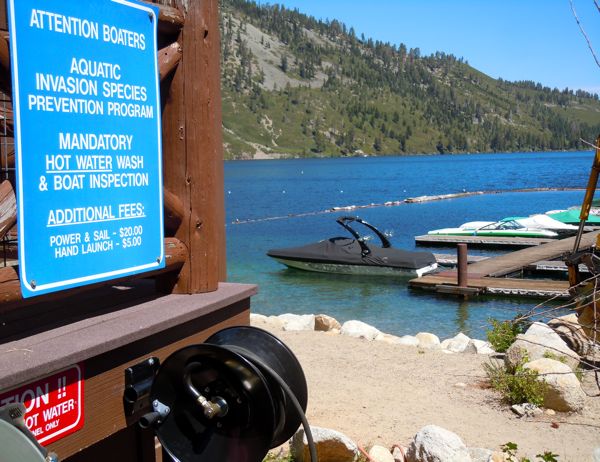
Full decontamination of boats is not offered at Fallen Leaf Lake. Photo/Kathryn Reed

Two people applied for the board – Joan Cathcart and Larry Calof. The board has recommended to the county that these two be appointed.

Mike Cathcart, who is an attorney but was not offering legal advice to anyone at the meeting or to the board, said the main issue with who can vote in the district centers on a local U.S. Forest Service interpretation. Whoever is named as the primary permitee of a USFS parcel is not allowed to vote.

Cathcart said that issue still needs to be resolved, adding that he has calls into Forest Service officials outside the basin.

“We need to make everyone who wants to vote to feel comfortable to do so without the threat of losing their permit,” Cathcart said.

As for the definition of domicile, Cathcart said the district attorney “recognizes that second homes can be domiciles.”

The voting issue has caused much consternation among those who have homes at Fallen Leaf Lake. The differing sides came together last year trying to get Assemblywoman Beth Gaines, R-Roseville, to carry legislation that would determine who had the right to vote. It never came to a vote. And Gaines, after the November election, because of redistricting won’t be the rep in the Assembly for this area even if she wins.

Who can vote also determines who can be on the board. A board members needs to be a registered voter in the Fallen Leaf Lake Community Services District.

While there has been talk of dismantling the CSD and creating a homeowners association, this is easier said than done. Legal settlements from 20 to 30 years ago play a role in what can take place.

But the board is moving forward with the job at hand — to oversee the marina, store and fire department.

Aquatic invasive species

Fallen Leaf Lake will continue to use its apparatus near the boat launch to clean the exterior of all boats. Being able to pump 1 gallon of 140-degree water a minute is sufficient to wash away any potential invasives that are on the watercraft.

However, being able to pump 5 gallons of 140-degree water in a minute is what’s needed to cleanse a motor of any quagga mussels that may have become attached to the vessel.

Because the marina does not have that capability any boat that cannot prove it was last launched at Fallen Leaf or Lake Tahoe will have to be inspected in Meyers – the nearest decontamination station. About 10 boats last season had to make the trip back to Meyers.

Fallen Leaf Lake has zero aquatic invasive species, unlike Lake Tahoe that has Asian clams, milfoil and other undesirables.

In other action:

• Jeanne Lear with South Tahoe Refuse explained how residents can use the blue bag recycling program.

• The preliminary budget for 2012-13 was talked about. Fire Chief Gary Gerren talked about how this fire season is likely to be bad, with conditions much like 2007, so he has requested more funds for more staffing and training. The final budget will need funding for the election if one were to occur.

• The swim platform should be in the water in the next two to three weeks.

• The concessionaire has brought in more than $50,000, with the marina and store open for less than a month. That is $50,000 more than this time last year.


Death Valley road to stay closed to the public

By Louis Sahagun, Los Angeles Times

Inyo County has lost a six-year legal battle for control of “Last Chance Road,” an alleged public highway that starts in a desert wash and peters out at several spots halfway up a small hill on Death Valley National Park’s northern edge.

The county had sought to open the road for public use, but environmentalists had fought to keep it closed.

“This is a great ruling for Death Valley National Park and the wildlife that calls it home,” said Ted Zukoski, an attorney with Earthjustice. “It means that an alleged road through federal wilderness will remain closed to vehicles.”

U.S. District Court Judge Anthony W. Ishii ruled Wednesday that the county failed to prove the half-mile sliver of wilderness terrain was established under a Civil War-era right-of-way law known as R.S. 2477.

Although the law was repealed more than four decades ago, routes established before then were allowed under a grandfather clause.

Read the whole story


Derby Dames ready for home opener

The Tahoe Derby Dames will be hosting the first home bout of the season June 16 at the outdoor flat track at Bijou Community Park.

The home opener will feature a double-header with the Tahoe Derby Dames splitting into two squads. The opening bout pits the Tahoe Derby Dames against the Riverside Roller Belles, followed by the main event with the veteran squad for the Tahoe Derby Dames taking on the Port City Roller Girls from Stockton.

“Meet the Dames” at the after party hosted at Lakeside Inn and Casino.

The Dames have had an exciting 2012 season with many up and coming skaters joining the team. Team training began in January and the Dames have completed their away game travel with the remainder of the scheduled bouts in South Lake Tahoe.

If interested in skating with the Tahoe Derby Dames, all levels of skaters are welcome to attend “Fresh Meat Mondays” at 6pm at Bijou Community Park.

To buy tickets for upcoming bouts contact your favorite derby girl for $10 advanced tickets, or visit the Sea Leagues Skate Co. at 2494 Lake Tahoe Blvd., No. A5 in the Pine Cone Plaza. At the gate tickets are $12.

Gates open at 3pm for the bouts and whistle blows at 4pm for the first bout, main event whistle blows at 6pm.