Cold Creek reroute in High Meadow turns back the clock

By Kathryn Reed

Disturbances are still visible, but High Meadow no longer looks like the construction site it has for the past two summers.

Instead, the meadow is a verdant green that if on this particular Sunday weren’t so chilly, would be inviting to lounge in. It looks ideal for Frisbee. On a hot summer day the creek would beckon to soak ones feet in after the arduous climb. The meadow is at 7,843 feet – a 1,500-foot elevation gain from lake level.

Looming to the left is Monument Peak at 10, 067 feet. This is the mountain on the boundary of Heavenly Mountain Resort.
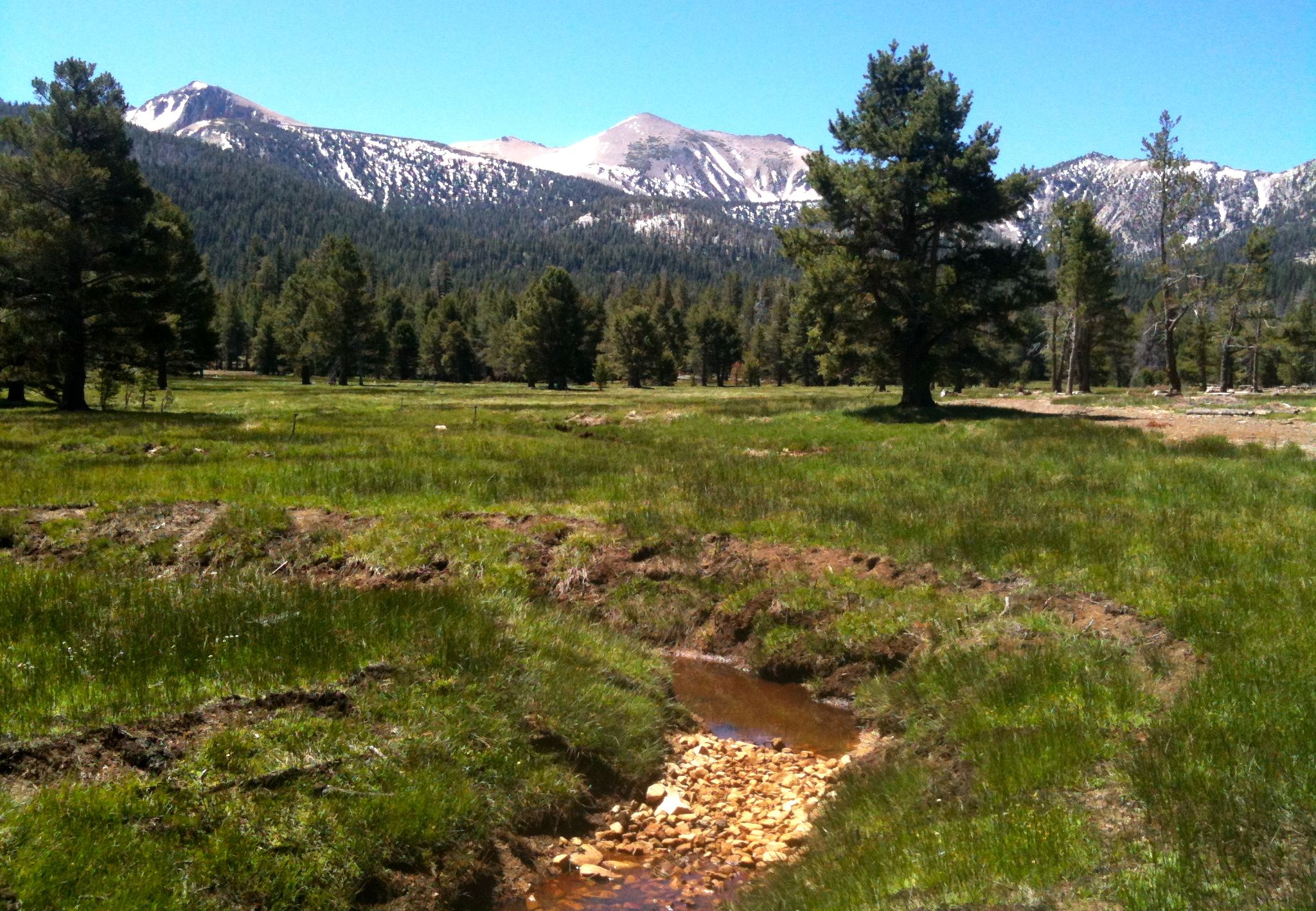
Cold Creek reroute through High Meadow will be done in October. Photo/Kathryn Reed

Looking toward the route for Star Lake are the well-known South Shore icons Jobs, Jobs Sister and Freel peaks. Pockets of snow dot the mountains almost like icing.

At the edge of the meadow is a creek – the realigned portion of Cold Creek. Barely a trickle of water is flowing.

Part of the reason why the meadow is such a lush green in June is because it’s getting a little help beyond what Mother Nature has done.

“The sprinklers we set up to irrigate the constructed channel to help the vegetation along since we’ve had such a dry spring,” explained Stephanie Heller, hydrologist with the Forest Service. “We’ll be introducing flow into the constructed channel in mid-July, after that the irrigation will no longer be needed because we expect groundwater levels to come up very quickly.”

Two years ago the U.S. Forest Service began a major project to reroute Cold Creek to its natural meander. By Oct. 15 it’s expected to be completed.

“We still need to construct the channel and a grade control weir at the downstream end of the project, construct connections of the constructed channels to the existing streams, fill the existing Mainstem channel, and construct in-channel log structures on the East Fork tributary of Cold Creek,” Heller told Lake Tahoe News.

The final touches will include decommissioning all temporary roads and staging areas associated with the project. Water is still flowing through the old channel.

A towering mound of dirt and piles of logs that look big enough to build a cabin make the entrance to the meadow seem less than idyllic. That’s all part of the restoration project. The dirt came from the first year of the project. It will be used to fill in the old channel, according to Heller.

“The logs will be used for a variety of different purposes when we complete construction. For example, logs will be incorporated into the grade control weir at the bottom of the project, logs will be placed in the backfill of the existing Mainstem and in floodplain areas to break up flow paths and created habitat complexity, and logs will be used to construct in-stream debris jam structures in the East Fork Tributary,” Heller said.

Eighty of the 280 acres of this Sierra meadow have been restored.

The $2 million restoration is being paid for with money from the Southern Nevada Public Land Management Act.

The goal of the project is to have Cold Creek meander like it did before cattle grazed in the meadow, willows will sprout from the bank, the dead beetle-infested lodgepoles will be hauled away, and wildlife will return to the area.
South Tahoe offering variety of youth camps

South Lake Tahoe’s Community Service Department is offering summer camps for youth and teens now through Aug. 24.

Camp Tadaka is designed for grades kindergarten to 8th-grade and is operated from 7:30am-6:30pm daily.

Tahoe Outdoor Adventure Camps is designed for ages 12-16. Nine adventure themed camps over the course of the summer include: geocaching, river rafting, backpacking, bicycle skills, stand-up paddling and more.

Call (530) 542.6056 to register or for more details.


BLM fire restrictions in place for the season

By Cathy Locke, Sacramento Bee

The federal Bureau of Land Management announced this week that fire restrictions are in effect for all public lands managed by the bureau’s Mother Lode Field Office.

Included are approximately 230,000 acres of BLM-managed lands in El Dorado, Placer, Nevada, Yuba, Amador, Sacramento, Calaveras, Tuolumne, Stanislaus, Sutter and Mariposa counties. Campers are urged to familiarize themselves with special restrictions before visiting public lands in these counties.

The restrictions prohibit all open fires on public lands because of extremely dry conditions, according to a news release.

A valid California campfire permit is required for all fires. Campfire permits may be obtained free of charge at any BLM, U.S. Forest Service, or California Department of Forestry Office.

Restrictions include:

• No open fires except in designated campgrounds. Lanterns and portable stoves using gas, jellied petroleum or pressurized fuel are permitted.

• No welding or use of any torch with an open flame, except by special permit.

• No operating internal combustion engines, except on a maintained road.

• No firing tracers or incendiary devices capable of starting a fire.

• No fireworks.

Violations are punishable by fines of up to $1,000 and/or imprisonment for up to one year. For additional information, call the BLM’s Mother Lode Field Office at (916) 941.3101.


Baby birds needs help being cared for

By Carlos Alcalá, Sacramento Bee

Volunteers are needed to take care of baby birds at Sierra Wildlife Rescue in Placerville.

The wildlife care center has about 100 birds that were orphaned of injured and are in need of volunteers to handle feeding and care.

Hands-on training is available at Sierra Wildlife Rescue, 3030 Newton Road, every Wednesday at 5pm.

Trained volunteers can sign up for two- or four-hour shifts between 7am and 7pm.

To register for training, call Barbara Barker at (530) 621.2650.

If you find an orphaned or injured baby bird in El Dorado County, call the nursery at (530) 621.2020.


Fair highlights what makes El Dorado County special

By Kathryn Reed

PLACERVILLE – “Look at me as if I’m the judge.”

“You have to look like you want to win.”

“A big point will be how hot it will be. We need to bring squirt bottles.”

All of these words of wisdom are from Marcia Deane, swine project leader.

Do they know what's next after they are judged at the El Dorado County Fair? Photos/Kathryn Reed

Before the El Dorado County Fair opened she and her charges were practicing Wednesday for today’s judging. It’s all about the 4-H kids today, whereas on Thursday the pigs were being judged for their meat.

Deane was trying to instill confidence in these youngsters who range in age from 9 to 19. For most, this fair is the first time they’ve been in an arena with one of their animals under the scrutiny of professional judges.

The swine weigh between 215 and 280 pounds. One of the girls leading around a pig looked like she weighed about 70 pounds.

A sneak preview Wednesday night of this annual event in Placerville showed a different side of the fair than what people will see for the next three days. (The fair is June 14-17.)

Vendors are putting up their displays in the exhibit halls. Boxes full of stuffed animals are being unloaded as rewards in the games of chance. Lights from the midway are twinkling, but the carnival sounds are not on.

But what can’t be turned off is the baying of goats, the oinks of pigs and moos of cows.

It wouldn’t be a county fair without the farm animals. While Tahoe doesn’t have much in the way of farming anymore, cattle rustling and cowboys are a strong part of the basin’s history.

On the other side of the county farm life is thriving. What’s going on is not a throwback to a different era, but instead is a way of life for people on the West Slope.

Shanley Bruscino, 12, is feeding alfalfa to her myriad goats. This makes their milk taste better than if they were to eat grass.

Her mom, Tammy, explains how they raise a variety of goats on their 10 acres in Shingle Springs.

“The goats are not grazers, they are browsers. They don’t like grasses,” Tammy Bruscino said.

All have registered papers, and are tattooed or microchipped to comply with judging regulations.

“It’s just like a dog show. It’s very intense,” Bruscino said.

These year’s theme is The Grapest Show on Earth. A number of wine events are part of the festivities.

“The theme is always to share something special about El Dorado County,” county Supervisor Norma Santiago says while she sits with Lake Tahoe News on preview night. This year it’s the county’s 53 wineries that are being highlighted.

Tom Davis, South Lake Tahoe city councilman and fair board director, is also at the table. He brings a trailer down each year and sleeps nearby the carnies for the four-day event.

One of Davis’ favorite events is the wheelbarrow race. (June 17, 5pm) This is the 68th year for the John M. Studebaker Wheelbarrow Race. After all, Studebaker started in Placerville manufacturing wheelbarrows.

All ages can compete, but it takes some strength to put the wheelbarrow over logs, with what could be 50 pounds of sand, then through neck-high water, in mud – oh, and it’s supposed to be 94 degrees in Placerville on Sunday.

It’s also a spectator sport, so to speak.

“It’s brutal,” Davis said of the course.

—-

Notes:

• El Dorado Transit is offering free shuttle service for the El Dorado County Fair from 11:30am to midnight today, 9:30am to midnight Saturday and 11:30am to 10:30pm Sunday. For detailed information, go online or call (530) 642.5383.

• More information is on the fair’s website.

ngg_shortcode_0_placeholder (Click on photos to enlarge.)


Truckee River rafting season under way

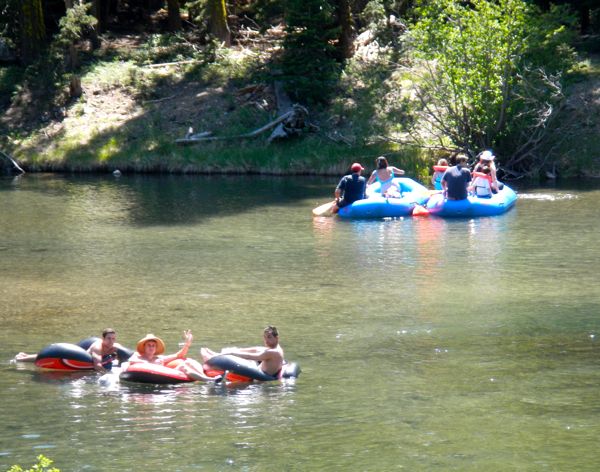
The dam gates are open and the river is flowing, and rafting along North Lake Tahoe’s Truckee River is open.

Tahoe City-based Truckee River Rafting opened June 12. Truckee River Raft Company, also in Tahoe City, opened June 14. The companies offer self-guided, five-mile floats down the Truckee River.

Most trips are leisurely and take two to three hours to complete, with patrons exiting at River Ranch Lodge near Alpine Meadows Road along Highway 89.

People enjoy floating down the Truckee River near Tahoe City on June 14. Photo/LTN

Guests can park in Tahoe City and take free shuttles back to their vehicles after the float anytime before 6pm.


Horse packers relieved to have work this summer

By Marek Warszawski, Fresno Bee

Pack station owners serving Sequoia and Kings Canyon National Parks in California are breathing easier this week after a federal judge allowed the parks to issue permits for commercial stock use effective immediately.

“We’re going full-speed ahead,” said Tim Loverin, owner of the Cedar Grove Pack Station. “It’s going to be an early season because of the low snowpack, so now that we’ve got the permits we can finally get going.”

Presiding over a 3-year-old lawsuit between the High Sierra Hikers Association and the National Park Service, U.S. District Court Judge Richard Seeborg issued a temporary authorization May 23 that set permits for commercial horse packers at 80 percent of use levels from 2007.

A final written ruling will follow as Sequoia and Kings Canyon officials prepare a wilderness stewardship plan that will establish the extent to which commercial services such as pack stock belong in wilderness areas, which make up 97 percent of the jointly managed parks.

Seeborg’s previous ruling on Jan. 24 stated that the NPS violated the federal Wilderness Act because its 2007 general management plan for Sequoia and Kings Canyon fell short of doing so. This, in effect, halted all permits for commercial horse packing, threatening to cripple more than a dozen pack stations as well as other businesses that rely on stock use.

As an example, the Bearpaw High Sierra Camp canceled all guest reservations from June 15-30 due to the uncertainty over permits. The backcountry tent camp, which depends on pack mules to ferry supplies and haul out trash, will open June 29.

Read the whole story


Varied cycling events part of Adventure Sports Week

The 2nd annual Adventure Sports Week Tahoe (June 15-24) includes a series of mountain biking events.

The Lake Tahoe Mountain Bike Race is June 16. It kicks off at 8am and has a 4- and 8-hour race that participants can engage in solo or on a team of two, three or four people. The Tahoe City course is approximately 12 miles and is a mix of single track and fire roads. It is a fast and smooth course with few technical sections. The rider with the most laps wins. Fast laps are estimated to take approximately 51 minutes.

Triathlon competitions all take place June 23 with three races for competitors to choose from. XTERRA Tahoe City, one of the events that make up the XTERRA U.S. Point Series, has outdoor enthusiasts swimming two 750-meter laps in Lake Tahoe with a 50-meter beach run, mountain biking 22 miles and trail running five miles throughout the North Lake Tahoe region.

The XTERRA Tahoe City Sprint offers shorter distances with one 750-meter swim, 13-mile mountain bike ride and a three-mile trail run. The XTERRA Tahoe City Duathlon is a two-mile run, 22-mile ride, followed up by a 6-mile run.

Tahoe Mountain Guides will offer a free Local’s Mountain Bike Tour June 20 at 5:30pm. Participants meet at Blue Agave in Tahoe City and will head up the Tahoe Rim Trail, which offers scenic views of Lake Tahoe and the Truckee River Canyon.

For more information about Adventure Sports Week Tahoe, go online.


Night out teaches the basics of car camping for families

The Tahoe Rim Trail Association and REI in Reno have developed a Family Camping 101 program to teach families the basics of car camping, including: camp cooking, pitching a tent and gear demonstrations.

There will be campfire activities and camping games for the whole family. S’mores, hot chocolate and coffee will be provided by the TRTA.

Family Camping 101 is also made possible by the support of Galilee Episcopal Camp & Conference Center.

The camping trip is June 22 at 4pm to June 23 at 10am at Camp Galilee in Lake Tahoe.

The cost $20 per person; age 3 and under free.

Contact Tom at (775) 298.0238 or programs@tahoerimtrail.org with any questions or to sign up.


Fly fishing is all about the bugs and an accurate cast

By Kathryn Reed

The morning of my lesson there is a Tweet from Tahoe Fly Fishing: “Rainbow, Brown, Brook or Cutthroat.” At least I know these are all kinds of trout. The problem is I think one fish looks like the next. Will it matter?

The day after my lesson the Tweet is: “Dry fly time on the West Carson and the Truckee.”

Are they testing me? Should I respond? Can I explain what that sentence means to someone who doesn’t fly fish?

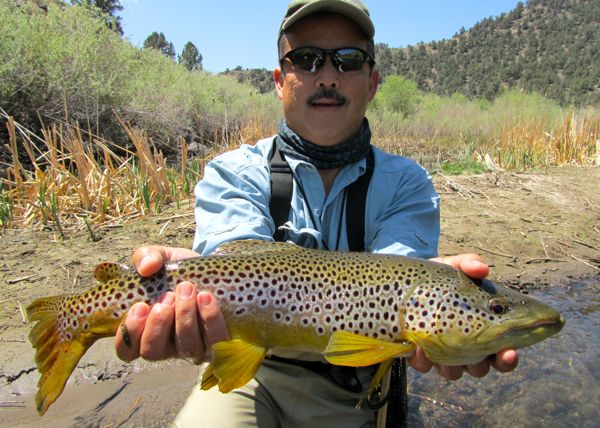
Martin Iyoyo shows off the brown trout before releasing it into the East Walker River near Bridgeport. It was hooked on a size 18 green caddis pupa. Photo/Brendan Burnside

Better get Brendan Burnside to do the talking. The guide for Tahoe Fly Fishing put me through the South Lake Tahoe outfitter’s introductory course this week.

I don’t fish, but I have fished – just never with a fly. Going with dad meant putting the worm on the hook, waiting for hours and wondering why people did this hour after hour.

Something about the beauty of fly fishing has captivated me for years; always wanting to know more about this sport. Watching people cast can be mesmerizing – it looks like art, a dance of sorts. That arc of the line. Fish jumping through the air. The idyllic scenery.

Or maybe it’s like Burnside said, the movie “A River Runs Through It” is still getting people interested in fly fishing. Or maybe Brad Pitt has something to do with the allure. I’m not sure how long I’ve wanted to cast a line – maybe 20 years.

It’s been 20 years since that Robert Redford film came out. And just this week I cast my first line.

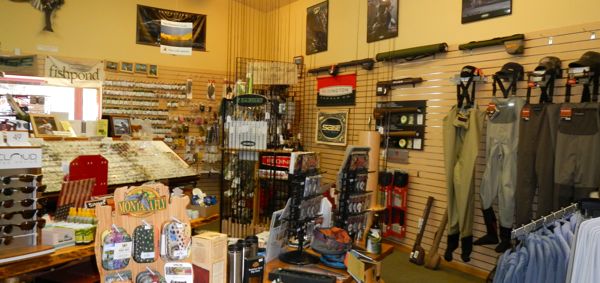
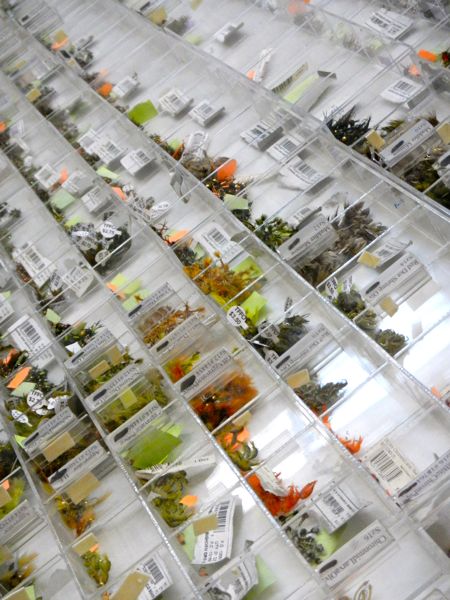
Plenty of bugs to choose from at Tahoe Fly Fishing. Photo/Kathryn Reed

Cast No. 1, was, um, not so great. My natural instinct was to want to stand sideways to the target as though I were throwing a ball or even serving a tennis ball.

Burnside squared me toward the target. Very awkward feeling. But he’s the boss, and considering this 36-year-old has been at this since he was a teenager, I decided I should listen.

He tells me guys tend to want to muscle the line to the fish, while women learn the finesse of the sport fairly quickly. Just a little pressure with that statement. In some ways it’s like golf where technique is more critical than the bicep bulge. It’s also about patience in order to be precise.

A loose grip is needed on the pole. I grab it like it’s a Western grip on a tennis racket.

Soon the end of the line is where the fish would be if there were fish.

See, in this introductory course it’s about getting the rookie to see if she likes the whole idea of the sport before going out to one of the multitude of watering holes in the area.

Then there’s the whole education part – from equipment to attire to flies.

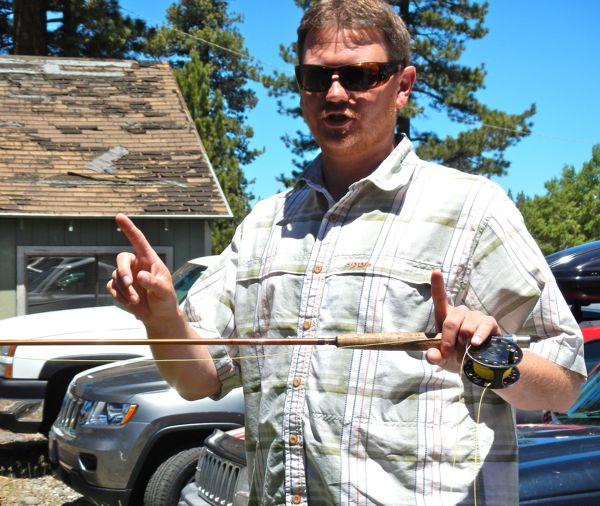
Guide Brendan Burnside explains how to cast. Photo/Kathryn Reed

The latter is what can make or break a fly fishing experience.

“These fish are incredibly fast and smart,” Burnside explains. “If they know it’s not a real bug, they spit it out fast.”

Bugs – that’s what the pros call them. That’s because they look like the bugs the fish would eat in the wild. The size, color and shape are critical in that they mimic as close to possible real bugs.

“They all imitate something that lives in the Sierra. The bugs follow the color of the seasons,” Burnside says as he points to the oodles of “bugs” for fishermen to buy. “We are using green now because it’s still spring.”

Stonefly, caddis, mayfly and midges are the four basic groups.

Burnside brings out a tray that has fermenting bugs to show how the fake bugs resemble what nature creates.

The entomology of fly fishing is what needs to be learned. It won’t matter how good someone casts if what’s on at the other end isn’t something the fish would eat.

“It’s part of the challenge and game we play with trout,” Burnside said.

Dry flies are the adult stage of the bug. They are mayfly, caddis, attractor, hoppers and stonefly. All are used on the surface.

Like most sporting goods stores, Tahoe Fly Fishing has something for all ability levels. Photo/Kathryn Reed

Hoppers – that’s short for grasshopper. They are a huge food source for trout.

“On the East Carson we see blue hoppers,” Burnside said.

The reason the fly needs to get so close to the fish is that trout are known for being lazy. They tread water, so to speak, waiting for the current to bring them food. They see something they like and they go for it. They know what bugs they want – that’s why what’s on the end of the line needs to look like a bug the fish are used to eating and what they want that day or hour.

All trips through Tahoe Fly Fishing are catch and release. Barbs are crimped at the end.

Burnside calls the fish his “business partners” – decimating the fishing holes would put guide service companies out of business.

But one thing that isn’t being done that could be, according to Tahoe Fly Fishing owner Victor Babbitt, is promoting the variety of fishing in Lake Tahoe – not just fly.

“Sixty million Americans fish. It’s the No. 1 recreation activity in the nation,” Babbitt told Lake Tahoe News. “You can hardly find it on the LTVA website.”

Until he started blogging on the visitors’ authority’s website, it was hard to find fly fishing, Babbitt said.

“We have a big, huge lake with fish. Why aren’t we targeting fishermen? It flabbergasts me,” Babbitt said.

While the tourism gurus may not recognize the value of fishing in Tahoe and area lakes and rivers, Babbitt is getting the word out. With a mild winter and spring, his business is doing well. When the water subsides in August, it could be a different story.

But as Burnside told this rookie angler, he would always pick September and October as the best times to fish in the Sierra because the water temp is the most consistent.

It’s back to learning.

Knowing how fish react to water temperatures, light, food sources – it’s what’s needed before the first line is cast for the day.