Mountain bike trail work days on both ends of the lake

TAMBA has two trail building days coming up.

The first is with the U.S. Forest Service and Hilride Progression Development Groups on June 24. They are hosting a work day to train people on building progressive features on the Corral Trail.

Meet at the lower parking area at 8:30am Oneidas Street off Pioneer Trail in South Lake Tahoe. Turn onto Oneidas and proceed for roughly 1.25 miles to the dirt parking area located on the left hand side.

All participants need to have typical personal protective equipment for trail work including: eye protection, gloves, long pants, long sleeves, sturdy shoes. In addition, bring personal items needed to stay safe and comfortable in the field, such as lunch, water, and sunscreen.

The work day activities will focus on building features as shown on the final plan set developed by Hilride. Training will include a discussion on layout of features to ensure proper flow and user speed, risk management, and shaping of jump features to achieve the desired experience. Work will continue through the day, and be finished by 4:30pm.

TAMBA’s trail day in Tahoe City is June 30 where a new connector trail between the Tahoe Rim Trail and Forest Service Road 16N49 near Cedar Flat will be installed.

Meet at 9am that Saturday at Tahoe XC, 925 Country Club Drive, Tahoe City. It’s about a 2-mile bike ride up to the work site. Lunch will be provided and Tahoe XC is hosting a post work BBQ. Bring water and long sleeves, long pants, gloves and helmet.


Report: Replanting in Angora on CTC property a success

By Kathryn Reed

With some areas of the Angora burn having lost 100 percent of its trees, human assistance was needed to restore what a human was ultimately responsible for destroying.

Replanting of mostly Jeffery pines was what the California Tahoe Conservancy chose. The state agency owns about 90 acres of the nearly 3,100 acres that burned in the June 2007 fire. Of those, 40 acres had nothing left.

Mastication of trees like what the USFS did is also the approach the CTC took on some of its land in the Angora burn area. Photo/LTN file

Susie Kocher with the UC Cooperative Extension gave an update June 20 to the California Tahoe Conservancy board about the 40 acres that endured the high intensity fire.

Kocher explained how the loss was much greater than what a natural fire would have left behind. The Angora Fire whipped through the North Upper Truckee area on June 24 five years ago after an illegal campfire was not properly extinguished at Seneca Pond. Ultimately, it destroyed 254 houses.

While the forest is showing resiliency, Kocher informed the board that it would be 60 years before the forest returns to what the average person would call a forest. For now, the seedlings that were planted are just a few inches tall.

About 130 trees have been planted per acre. In addition to the Jeffery, sugar pines are the other primary species. Some incense cedar has been planted, but they are not thriving. This is because they prefer shade and right now it’s direct sunlight in the burn.

Kocher has been studying the recovery process on the CTC acreage since the first analysis of the burn was conducted in July 2007. A report was released this year about the restoration, with Wednesday’s meeting at Inn by the Lake being the first time the board heard the information.

“Where there has not been planting, there are very (few) trees coming back,” Kocher told the board.

Larry Sevison, chairman of the CTC board and Placer County supervisor, questioned whether the 86 tons of fuel load per acre was going to create a fire hazard.

Kocher said even though mulch from the masticated trees along with limbs are on the forest floor, the alternative would be leave the charred trees standing. Those would eventually fall, be in larger pieces and create more of a fire threat.

“Though the fire risk cannot be calculated at this time as computer models do not accurately predict wildfire behavior in masticated fuels, it is generally accepted that masticated fuels burn with lower flame lengths than natural fuels and are more difficult to ignite because compaction impedes the fire’s access to oxygen,” according to the preliminary assessment report of restoring CTC lands post-Angora that was prepared by Kocher and Daylin Wade of the CTC.

Kocher told the board when it comes to leaving the mulch, “It’s a trade off between erosion control and fire risk, but I can’t tell you how much.”

Norma Santiago, CTC board member and El Dorado County supervisor, questioned the threat of the white thorn growing in the burn area.

While Kocher called it a “fire adaptive species”, she said there is less of the prickly bush in the treated areas.

Overall, Kocher said the treatments applied to the Conservancy land have been effective. She said the ultimate goal of creating a healthy forest is on track five years after the flames whipped through the area.




Meeting focuses on Dollar Creek trail

Public and interested parties are invited to comment on the Dollar Creek shared-use trail project until July 6. There is a meeting about the trail on June 28 from 6-8pm at the North Tahoe Event Center, 8318 North Lake Tahoe Blvd., Kings Beach.

The project is located in Placer County, primarily with California Tahoe Conservancy and North Tahoe Public Utility District owned properties, between the intersection of Dollar Drive and Highway 28 and the terminus of Fulton Crescent Drive. This 2.2-mile trail will extend the existing Tahoe City to Dollar Point Trail and connect neighborhoods, schools, shopping and recreation.

For further information, contact Peter Kraatz at (530) 581.6230 or pkraatz@placer.ca.gov.


Coat of pollen mucking up most of Tahoe

The yellow haze blowing through the South Shore is the annual pine pollen.

In addition to kicking up allergies and leaving behind yellow everywhere, the winds are a fire threat. A red flag warning is in effect for the Lake Tahoe Basin and most of northwestern Nevada until 10pm Thursday.

The wind is expected to dissipate on Friday, but the temps will be dropping. The high on June 22 in South Lake Tahoe is expected to be 65, dipping to 61 on Saturday and returning to 65 on Sunday. Lows will be in the 30s.

— Lake Tahoe News staff report

Car washes should be doing good business.

Pollen collects in a swale at the end of a driveway.

Pollen floats on Lake Tahoe. Photos/Kathryn Reed


Western States 100 winner will not defend title

By Sam McManis, Sacramento Bee

Kilian Jornet, the defending Western States 100 Mile Endurance Run champion and widely considered the world’s best ultrarunner, has dropped out of Saturday’s race from Squaw Valley to Auburn following the death of a close friend in a climbing accident in the Alps.

Jornet had been traversing Mount Blanc with three-time world mountaineering champion Stephane Brosse over the weekend when a ridge collapse claimed Brosse’s life. The two apparently were close to completing “La Grande Traversee,” a speed ascent and descent when the ridge gave way, according to a statement issued by the pair’s sponsor, Team Salomon.

“It was on the last part, just before going downhill, that the ridge they were on collapsed, taking Stephane within its spilling,” the statement read. “Kilian remained helpless whilst waiting for the rescue team.”

Read the whole story


Lakeview Commons — a place for people of South Lake

By Kathryn Reed

“A facility like this brings people together.”

Standing at the top of Lakeview Commons, looking down on the stage where moments before the site had been officially dedicated, Ray Lacey was a bit melancholy. As a lifelong resident of South Lake Tahoe, the deputy director of the California Tahoe Conservancy is prideful of what his employer and his town have accomplished.

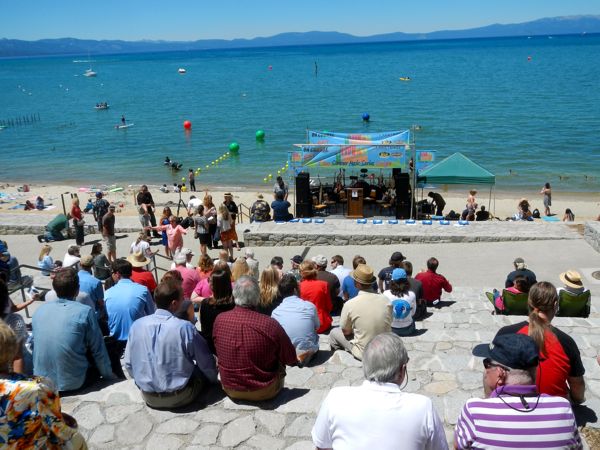
More than 150 people are on hand for the June 20 dedication of Lakeview Commons. Photos/Kathryn Reed

“It’s so personally rewarding to see the South Shore fulfilling its potential,” Lacey told Lake Tahoe News.

On June 20, the $6 million project was introduced to the public in an unveiling of sorts with speeches by political figures and a party afterward.

It was the CTC that paid for the project.

Already it is a gathering place as can be seen by the number of people using it on a daily basis. Even Soroptimist International South Lake Tahoe had its meeting at Lakeview earlier that day.

Many of those who were at the August 2010 groundbreaking returned to see their dream go from idea to a sketch to a functioning park on the edge of Lake Tahoe.

One of those people was Manuela King. As vice president of RHAA – the landscape architects for the project – she was all smiles as she listened to accolades bestowed upon her.

After the ceremony she told Lake Tahoe News she is thrilled with the end result. (So happy is she to work in Tahoe, the Bay Area firm just opened an office in Meyers.)

Her only regret is phase two has not been built.

Non-motorized boats are for rent.

Jim Marino, who has shepherded this project through for the city as capital improvement manager, echoed King’s sentiments.

“I want to do phase 2. The plans are done. We just need to seek funding,” Marino said. The cost is $3 million.

That phase would pick up on the north end of the El Dorado Beach site and continue to the Alta Mira Building. A cantilevered walkway is planned to extend over the water.

Marino reflected on the shaky start the project had with Clark and Sullivan challenging the bid and then ultimately being awarded the project.

In the end, it was only praise for project manager Doris Kelly.

“She was phenomenal on the job,” Marino said.

Hundreds of people were associated with the project – many of them were recognized at Wednesday’s celebration.

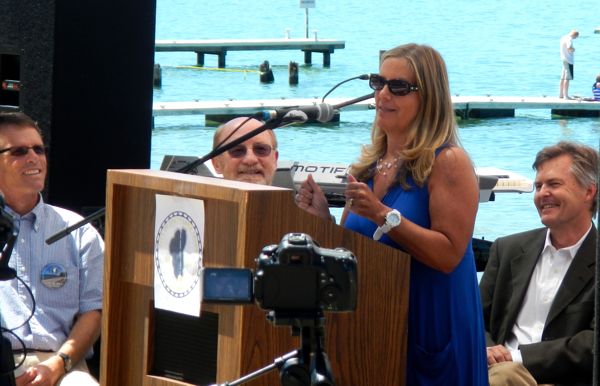
Former Mayor Kathay Lovell tells the history of the project while state Sen. Ted Gaines, state Natural Resources Secretary John Laird and CTC Executive Director Patrick Wright listen.

After all the speeches, the city welcomed all to lunch at Lakeview Café – the name of the eatery at Lakeview Commons. Music and paddleboarding filled out the afternoon and evening.

——


Former South Lake Tahoe Mayor Kathay Lovell speaks June 20 at the dedication of Lakeview Commons:


Shrinking snowpack may impact electric bills

By Craig Miller, KQED

While much is uncertain about California’s warming climate, there is little doubt that it’s already changing the fundamentals of how most of us get our water. In fact, the Bureau of Reclamation has estimated that the Sierra snowpack could be reduced by half as soon as a decade from now.

And that has some far-reaching implications that could even show up on your electric bill.

“When you hear people talk about a depleted snowpack, it’s because of warmer temperatures and the snow just cannot stay in the hills,” says Robert Shibatani, a hydrologist and consultant to numerous government agencies. He says the “hydrograph” for California — the “usual” pattern of precipitation and runoff — is already changing. “There’s no question about it,” he told me in a recent interview. “That’s not an if. It’s not even a when, because I can tell you the when. It’s happening now.”

Shibatani says it’s not that we’ll get less precipitation, necessarily, but warming temperatures will mean more of it falling as rain at higher elevations. And the relatively steady runoff we’ve come to count on to fill the reservoirs and spin the turbines throughout the summer and fall will be compressed into the late winter and early spring.

“What it’s gonna mean is that we’re gonna spill more often,” says Einar Maisch, strategic planning director for the Placer County Water Agency. “And that means we’re gonna lose generation.”

Read the whole story


Living History Day at Ehrman Mansion

The California State Parks and the Sierra State Parks Foundation will be hosting Living History Day at Pine Lodge, a celebration of the anniversary of the lodge also known as the Ehrman Mansion, at Sugar Pine Point State Park on July 28 from 10am to 4pm.

Living history activities will include open house tours, a children’s activity zone, an antique car show and a wooden boats display. Refreshments will be available for purchase. All events are free, though there is a $10 parking fee.

Organizers of the event are looking for members of the community to help put on this annual living history day presentation. People of all ages are needed to wear costumes and play roles of the Ehrman family members, guests and employees. Helpers are also needed for the children’s zone that will include crafts, games, and activities.

Volunteers are needed to serve as greeters, parking attendants, facilities assistants, boathouse docents, crafters and raffle assistants. Volunteers may contact Heidi Doyle at (530) 583.3074 for additional information.


California universities reject proposed ‘Student Athlete Bill of Rights’

By Hannah Madans, Sacramento Bee

Four California universities with big-time sports programs are fighting a legislative effort that could radically change the way schools recruit, educate and retain student athletes.

The schools are opposing the “Student Athlete Bill of Rights,” they say, because it would be too expensive, put their programs at a competitive disadvantage and may go against NCAA rules.

Senate Bill 1525, by Sen. Alex Padilla, D-Los Angeles, would require schools earning more than $10 million a year in media revenue from athletic programs to continue an athlete’s scholarship if he or she is no longer able to participate in athletics, and would allow athletes to switch schools without restriction. The bill also would force schools to provide student athletes with life skills and financial workshops and pay health care premiums for low-income individuals.

“It’s evident to me we’re losing focus on the mission of the university itself,” Padilla said. Student athletes, he added, “should be competing second to getting an education.”

His measure would affect USC, UCLA, UC Berkeley and Stanford University. Other schools would be affected if their media revenue reaches the $10 million threshold.

The bill’s centerpiece provision would require schools to provide scholarships to athletes who become injured or whose scholarships aren’t renewed for nondisciplinary reasons. The impact would be tempered at some schools, however, because this provision would not apply to athletes on teams with a graduation rate greater than 60 percent. At Stanford, for instance, all athletic teams have a graduation rate over 90 percent, said Patrick Dunkley, Stanford’s deputy director of athletics.

Read the whole story


World Tribe Canoe Project descends on Lakeview Commons

On June 20, indigenous carvers from around the world will convene along the shores of Lake Tahoe to create a 70-foot Trimaran by blending ancient art with state of the art.

It will be under the direction of Maori Chief Wikuki Kingi and hosted by the Washoe tribe.

Upon completion, this “floating university” will travel the world sharing indigenous wisdom in service to protecting our world’s water. The goal is to launch at the 2013 America’s Cup in San Francisco.

Traveling 10,000 miles from Aotearoa, New Zealand, Kingi and Tania Wolfgramm (Tonga-Maori) will lead the indigenous protocols and ceremony starting the World Tribe Canoe Project at 3:30pm at Lakeview Commons in South Lake Tahoe.

It will be followed by live music and Liz Brosco leading a drum circle at 5pm featuring Washoe and fire dancers. The California canoe and tule boats demonstrations will be featured with carvings by Wikuki at the 4th annual Lake Tahoe Paddle Festival on June 23-24 from 9am to 5pm.