Strider bike competition at Northstar for youngsters

Northstar is putting on the Lake Tahoe areas first Strider Cup Series.

With a focus on developing balance and coordination, Strider no-pedal balance bikes have proven much easier for children to control when learning to ride a bicycle than those with pedals.

Every Tuesday beginning July 3 from noon-4pm in the village the Strider Adventure Zone will provide children aged 18 months to 5 years the opportunity to test ride a Strider bike while playing, learning, and enjoying a custom designed obstacle course.

Access to the adventure zone is free, and a limited number of bikes will be available for use on a first-come, first-served basis. Guests are encouraged to bring their own bikes.

The Strider Cup Series is a moto-style event offering kids the chance to participate in friendly competition in a fun, safe environment. These events are scheduled to take place July 4, July 21, Aug. 4, Aug. 18 and Sept. 29 from 3:30-4pm in the Village at Northstar. Participation in the Cup Series is free, and each participant will receive an award.

For more information, go online.


Endurance triathlon starts in Zephyr Cove

The inaugural Expedition Man Endurance Festival will be Aug. 25 throughout Northern Nevada.

This is the region’s first ultra distance triathlon.

The course starts swimmers at Zephyr Cove.

The 112-mile bike ride will utilize a variety of Northern Nevada’s scenery, including a 1,400-foot elevation drop into Carson City.

Three fast out-and-back’s around the Sparks Marina will cap off this extraordinary race.

For more information, go online.


Squaw offers fun and serious trail runs

This summer, in conjunction Big Blue Adventure and the Auburn Ski Club, Squaw Valley is introducing a trail running series ranging from easy, light races to more substantial trail runs.

Here are the trail runs:

July 7: Village Run

9:30am start;

Run to Squaw Creek, back over to Red Dog via Western States Trail via a 5K or 10K trail. Race starts at the East end of The Village at Squaw Valley.

Aug. 4: 32nd Annual Mountain Run

9am start

Starting at the base of Squaw Valley (elevation 6,200 feet), runners, walkers and hikers will climb the 3.6 mile mountain run to High Camp (elevation 8,200 feet) where awards, raffle, music, light refreshments and beer are provided. The race is a fundraiser for local cancer programs and the Auburn Ski Club Junior Nordic Program.

Distance: 5.7K

Aug. 25: Mutt Strut Fun Run

11am start

Prior to the kick-off of Squaw’s pet-friendly Peaks and Paws Festival, pet lovers can enjoy a quick 3K around Squaw’s base area with their furry friends, $5 registration. All profits benefit the Truckee Tahoe Humane Society. Dogs welcome.

Sept. 8: Alpine to Squaw Run

9:30am start;

Runners will start at the base of Alpine Meadows, running up the slopes to connect to the Pacific Crest Trail. Following the legendary PCT, participants will run along the mountain ridges to the peak of KT-22, before making their final descent to The Village at Squaw Valley. Transportation to Alpine start line included, $30 pre-registration, $35 day-of registration.

Distance: 12K

Sept. 15: High Camp Run and Pool Party

11:30am start at High Camp,

Run on the High Camp trails at elevation 8,200 feet with incredible views of Lake Tahoe and the surround Sierra Nevada mountains. After the race, participants can enjoy access to Squaw’s High Camp Pool and Hot Tub and poolside Umbrella Bar, both located on the top of the mountain. Click here for details.

Distance: 5k & 10k

Oct. 6: Oktoberfest Run to Squaw

Get your juices flowing before enjoying Oktoberfest by running to Squaw from Tahoe City. This 7.9-mile course travels alongside the Truckee River. Enjoy spectacular views along this stunning scenic corridor, 8am start. Click here for details.

Distance: 7.9 miles.

Details about all the events and how register are online.


Private land near Markleeville bought by Wilderness Land Trust

The Wilderness Land Trust has acquired the last remaining 160-acre private acres that could have blocked access to the Thornburg Canyon Trail near Markleeville.

It covers more than eight miles point-to-point from Blue Lakes Road at 9,000 feet to the quaint mountain town of Markleeville at 5,500 feet.

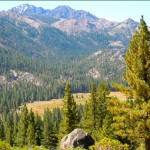
Pleasant Valley from the Markleeville side. Photo/LTN file

The purchase of this property builds on another Wilderness Land Trust purchase in 2009 and protects one of the last private inholdings in the 99,000 acre Mokelumne Wilderness. It helps protect the headwaters of the Carson River, a lifeline for resident wildlife and people.

“The land is one of only two properties within the Humboldt-Toiyabe Forest area of the Mokelumne Wilderness to remain in private ownership,”Aimee Rutledge, the land trust’s California program manager, said in a statement. “Private uses inconsistent with wilderness would have despoiled an unbroken expanse of wilderness and could have blocked public access to the Thornburg Canyon trail.”

The area includes many miles of popular trails including a segment of the Pacific Crest Trail, and offers hiking, horseback riding, backpacking, fishing, birding, snowshoeing and cross country skiing.


40 years later, Title IX still shapes female athletes

By Tom Goldman, NPR

Title IX, which turns 40 on Saturday, has helped reverse years of bias, banning sex discrimination in federally funded schools and colleges.

Its guarantee of equal access to sports was a small part of the original legislation. But it’s become the most recognizable part of Title IX. That guarantee has not always played out, and the law has its critics. For four decades, however, it’s played a huge part in shaping lives.

Even today, when Bernice Sandler beams with pride, watching women athletes walk, as she describes, “with their heads up and feeling like, yeah, I can handle this world,” there’s part of her that laughs, too.

Back in the late 1960s, when Sandler, a career educator, and other Title IX pioneers said enough with sex discrimination in education, she really wasn’t thinking about a sea change in sports.

“I remember saying, ‘Isn’t this great news? On field day [when schools cancel classes and students participate in athletic relays and other outdoor games] … there’s going to be more activities for girls,'” Sandler recalls.

It was a time when sports was still a man’s world, and it was difficult to even imagine the iconic moment of women’s sports that would take place three decades later.

Banning sex discrimination in sports may be one of Title IX’s most notable achievements, but the original federal legislation that President Nixon signed into law as part of the Education Amendments of 1972 actually doesn’t mention sports or athletes.

The first part of the law reads, “No person in the United States shall, on the basis of sex, be excluded from participation in, be denied the benefits of, or be subjected to discrimination under any education program or activity receiving Federal financial assistance.”

In addition to unequal opportunity in student sports, discrimination covered under Title IX includes sexual harassment of students, unequal pay for female teachers, and discrimination against pregnant students. Title IX does not apply to fraternities or sororities, voluntary youth service organizations like the Girl Scouts and Boy Scouts, and “educational institutions of religious organizations with contrary religious tenets.”

On July 10, 1999, as Brandi Chastain prepared to take the last penalty kick of the 1999 Women’s World Cup soccer final, she was not thinking about the moment as a watershed in women’s sports or about the record 90,185 fans at the Rose Bowl in Pasadena, Calif. Like any good athlete, Chastain was focused on the task at hand — make good contact with the ball, don’t let the goalkeeper for China stare you down and psych you out.

“The only thing I could hear, because those 90,000-plus people were so dead silent, was, ‘Don’t look at the goalkeeper. Don’t look at the goalkeeper. Don’t look at the goalkeeper,'” Chastain says.

She didn’t. And the picture of a celebrating Chastain — shirt ripped off, fists clenched, muscles flexed — has become a Title IX touchstone for women and girls — and at least one 6-year-old boy. Chastain’s son Jaden sees the photo every day, hanging in his house.

“He used to sing cute little songs,” Chastain recalls. “You know, ‘Jaden is the silliest’ or ‘Nana is the happiest.’ And I would say, ‘Daddy is the strongiest,’ and he goes, ‘No, Mom. You’re the strongiest.’ ”

It was anything but a straight line from Sandler’s hopes for field day to Chastain’s “strongiest” moment. Along the way, and to the present, there’s been a kaleidoscope of characters and events weaving a Title IX tapestry.

In 1976, four years after Title IX became law, Ginny Gilder and her rowing teammates at Yale University were getting sick. There were no shower facilities available right after practice, and they’d have to get on a bus, cold and wet.

The men had showers. So Gilder and her teammates staged a naked protest in a school administrator’s office. “We all turned around, took off our clothes and stood there naked, with ‘Title IX’ on our backs,” Gilder remembers.

Team Captain Chris Ernst read a statement, as recounted in the documentary film A Hero for Daisy: “These are the bodies Yale is exploiting. On a day like today, the ice freezes on this skin.”

The words and protest were persuasive. The women got their showers, and schools that ignored Title IX got a reminder: don’t. And Gilder got something personal.

“You know, it’s a certain outing of oneself to take a stand,” she says. “And there’s no going back once you do something like that. There’s no place to hide.”

Read the whole story


Trout Creek transports paddlers to oasis by Tahoe

By Kathryn Reed

It’s easy not to want to paddle in Trout Creek. Listening and watching are the preferred activities. If only the binoculars were in the canoe.

A cackle of chirping birds makes it seem like we’ve entered an aviary. Unfamiliar calls fill the air. Flitting about are species we don’t recognize.

Later, Tom Millham from Lake Tahoe Wildlife Care identifies the yellow-headed blackbird.

“We have had them in the past, but not for a very long time. You will see a lot more of them in the Carson Valley,” Millham enlightens me.

Sandy paddles in a field of lilies in Trout Creek. Photos/Kathryn Reed

On this Sunday in June the lilies are starting to bloom a vibrant yellow. The balls on the end of the green stem are like round lemons. Green and red lily pads dot the surface; at times making it so there is more plant life than water visible.

Instead of being in the middle of South Lake Tahoe, not far from a busy neighborhood and state highway, it feels like we are paddling in a remote nature preserve. This feeling, in part, has to do with the dog ban in the Upper Truckee Marsh – allowing for more birds to make their home here.

Five of us started the day at Baldwin Beach after having left a car in the homeowners’ association parking lot at Tahoe Keys. (It costs $7 per vehicle to park at Baldwin.) [Editors update: The Tahoe Keys Property Owners Association’s parking lot is private and not open to the public, according to Greg Feet, general manager of the association.]

Trish, Sandy and Pat are in kayaks, while Sue and I are in a canoe.

We opt to begin by going up Taylor Creek. Several inlets have us guessing which way to head. U-turns in a 17-foot canoe can be interesting.

Up another arm we think will lead to where the salmon spawn in the fall and people see the creek from the Rainbow Trail. We don’t make it. A substantial beaver dam blocks our route.

Knowing our ultimate destination is more than four miles away we choose to make another 180-degree turn.

Back onto Lake Tahoe we head toward Camp Richardson. Wakeboarders are to our left, jumping the boat’s wake in the otherwise tranquil waters. Too early to stop for a Rum Runner at the Beacon.

It’s nice to be on the lake early before the boaters and personal watercraft are creating obnoxious noise pollution and making it a bit scary for human powered watercraft.

We take our time, chatting along the way. Then we hit the Keys and it’s time to gawk at the opulence and varied architecture of the gated Lighthouse Shores area that seldom seems to have people occupying these mini-mansions.

On we go.

Entering Trout Creek we have several choices. The water has a mind of its own and no longer is a single body of water through the Upper Truckee Marsh. We head right, away from the houses.

Mount Tallac is like the alter of the outdoors with the snow cross still visible. We are blessed to live and play in this oasis of Mother Nature’s.

To get there:

From South Lake Tahoe, head north on Highway 89. Go past Camp Richardson. On the right will be a sign for Baldwin Beach. Beyond the payment kiosk park to the left where the road makes a Y.

To leave a vehicle at the Keys, go down Tahoe Keys Boulevard (of Highway 50). Follow this until you see the lake; parking on the left.

Paddling – from the beach, go right. At the Keys, you will pass the channel for the houses, then the channel for the marina. Next right is the Upper Truckee River. Keep going on Lake Tahoe. The next inlet is Trout Creek. The creek goes under Highway 50 and to Lake Tahoe Community College. We stayed in the marsh area.

ngg_shortcode_0_placeholder (Click on photos to enlarge.)


Derby Dame squads split decisions with Stockton

Cryma Passion of Tahoe Derby Dames’s B team was the star jammer for the first home bout of the season on June 16 by helping the team push for a 115-87 victory.

Lake Tahoe’s only women’s flat track roller derby team, Tahoe Derby Dames, hosted the Port City Roller Girls from Stockton at Bijou Community Park.

Pomp Adorable of Port City, right, upends Derby Dame Whiskey Wheels. Photo/Russell Reno Limprecht.

The A teams from each team also squared off. The main event was action packed with a lot of hard hits, speed, and penalties. However, Port City won, 159-113.

The next home bout is July 21.


Driving on Nevada highways is a trip through history

By Marlo Bartlett Pesek, Las Vegas Review Journal

Most of Nevada’s highways began as old trails that were paved over.

Native people first conquered Nevada’s distances on foot, finding routes between water sources. After they acquired horses, they could go farther but still had to utilize available water and find forage.

When Europeans explored the continent, they used the same routes on foot or horseback but had to adapt old trails for wheeled vehicles pulled by horses, mules or oxen. Later, railroads altered routes to meet specific requirements. The automobile eventually dictated that most routes would be paved.

Explore Nevada on any of its major highways for a journey through history. Nevadans vacationing in their own state see unusual places and meet fascinating people. Unfortunately, many Nevadans living in our urban areas seldom venture beyond city streets. They miss what savvy foreign visitors travel thousands of miles to see. Travel websites lead many Europeans to our intriguing rural communities, ghost towns, remote deserts and lofty mountains. These intrepid travelers fly into our cities, rent RVs or motorcycles and set out bravely into our lonely, majestic distances for adventures most Nevadans don’t bother to experience.

Because Nevada is so large and still sparsely populated, road travelers must plan for long distances. For safety’s sake, top off your fuel tank whenever you can, for the next service station might be half a tank away. Check your spare tire and know how to change a flat. Carry sufficient water for your vehicle and a gallon of drinking water for each person. Pack some nutritious snacks. Make sure everyone has a long-sleeved cover-up, for most places in Nevada cool off sharply at night, even in summer. Expect that cellphones will not work in some areas of Nevada. If you break down, stay with your vehicle.

Read the whole story


Volunteers needed to pull invasive weeds in Rabe Meadow

The League to Save Lake Tahoe and U.S. Forest Service are combining forces for a community weed pull on June 28 from 5:30-7:30pm in Rabe Meadow in Stateline.

Volunteers will be helping to remove invasive weeds that are threatening Tahoe’s native plant species, wildlife habitat, and the surrounding watershed. Participants will learn about invasive weeds and how to properly remove them.

Invasive weeds are plants that grow aggressively, spread quickly and choke out native and other desirable plants from the native landscape. They produce enormous amounts of seed, have spreading root systems, and lack natural predators. These traits enable them to dominate entire landscapes. The following are some of the invasive weeds have been found in the Lake Tahoe Basin: bull thistle, oxeye daisy, scotch broom, yellow toadflax, and perennial pepperweed.

For more information on volunteering, call (530) 541.5388 or email events@keeptahoeblue.org.


TRCD educating public about watershed projects

Tahoe Resource Conservation District is putting on conservation events this summer to highlight environmental projects and stewardship opportunities in Tahoe.

Community Watershed Partnership barbecues will be June 27 in South Lake Tahoe and June 28 in Kings Beach. The public is invited to get involved with weed pulls, interpretive hikes and paddles, invasive species projects and backyard forestry. There will also be opportunities to provide input on Lake Tahoe Environmental Improvement Projects coming to a neighborhood near you.

Each CWP Kickoff event is free and open to the public and will include refreshments and kid-friendly activities. The South Lake Tahoe event will take place in the Lake Tahoe Demonstration Garden at Lake Tahoe Community College from 4:30-7:30pm, and the North Tahoe event will occur at the North Tahoe Events Center in Kings Beach from 5:30-7:30pm.

For more information on the Community Watershed Partnership, contact Kim Gorman at kgorman@tahoercd.org or (530) 543.1501, ext. 129.