London — a 3-time Olympic city sparkles in the limelight

By Susan Wood

AMESBURY, England – A flicker of flame carried by four-time gold medalist track star Michael Johnson emerged through a rare, cloudless sunrise at Stonehenge, setting a dramatic stage for the planet’s touchstone for goodwill and humanity – the Olympic Games.

With his signature smile and svelte physique, the 44-year-old American athlete brought the torch on July 12 at 5:09am to the ancient National Heritage Site prior to his official, 300-meter torch-bearing “leg” at the Salisbury Cathedral a few hours later.

The world record-holding sprinter, who took gold in 1996 at Atlanta in the 200- and 400-meter events, made an outrageously slow lap around the spiritual, circular stones as the sun beamed over the “heel stone” and through the structural rock formation. It was a magical moment – one the media from around the world wouldn’t have missed. He repeatedly described the event as “an amazing experience” as reporters held onto every word.

When asked by Lake Tahoe News if the lap was his slowest run, he replied: “Pretty close, but well worth it.”
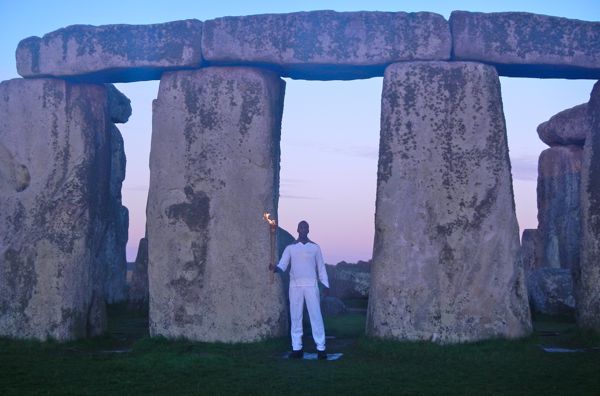
U.S. Olympic track star Michael Johnson with the Olympic torch July 12 at Stonehenge. Photos/Kathryn Reed

Johnson posed with the 31-inch-long, 2-pound torch for the cameras alongside Amelia Clifford, a young Salisbury track star who ran the torch the day before. She was elated, while standing before other gatherers like fellow torchbearer Phil Monk. The local teacher was nominated by his students and colleagues at the Stonehenge School. It was rather appropriate for Monk to be there. He knows the history and magnificence of the Sarsen-stone site built in BC 2400 by hundreds of men over 30 million hours using wooden platforms on rollers and ropes to bury them 6 feet under.

To this day, the burial site that is considered one of the world’s most recognizable attractions makes up a place for reflection and rebirth – including that of the seasons. Thousands of people descend on Stonehenge for the summer solstice each year. The appearance of summer dominated the discussion that morning as much as the arrival of the torch, which is made of gold to represent the qualities of the flame – brightness and the warmth of the light it shines.

“We haven’t had a morning like this in months,” Monk said. England has endured one of its wettest summers in decades.

Spirits were further lifted eight miles away at 7:45am when Johnson arrived to carry the torch in Salisbury in front of thousands lining the streets waving British flags. The town’s celebration the day before brought out 35,000 Olympic fans to witness the spectacle.

The Olympic torch carried by 8,000 people in the relay was designed to touch at least 95 percent of England’s population within a one-hour distance of 1,018 communities on its twisty, 8,000-mile route.

The traditional lighting ceremony took place on May 10 at the Temple of Hera, Olympia, home of the Ancient Olympic Games. The Olympic flame traveled through Greece before a British jet labeled “Firefly” picked it up for its journey through England, which started at Land’s End in Cornwall. The torch also had a one-day appearance in Dublin, Ireland, on June 6. A little more than a month later, it graced the streets of England’s original capital, Winchester – where King Arthur held court with the Knights of the Round Table in the 12th century. The banners were still flying over High Street days later.

Leading up to tonight’s Opening Ceremony, the torch relay will have lasted 70 days and marked 66 evening celebrations, six island visits as well as a variety of types of transports – by foot, plane, train, watercraft and even on a Ferris wheel known as the London Eye.

Each ceremony marked yet another demonstration of rural community pride. In the tiny town of Bowness, more than 10,000 Olympic fans gathered to see the torch transported by a 122-year-old steamboat over Windermere Lake in the Lakes District of northern England, a land of captivating natural beauty.

Jacqui O’Connor, who works for Windermere Lake Cruises, told Lake Tahoe News a regatta of boats flanked the MV Tern steamer with 175 people on board for its journey across the lake which is lined with green meadows, castles and estates. She was among them, along with a group of schoolchildren.

“It was amazing. The kids were so excited,” she said.

Community rural pride represents a common theme on the torch relay route, which culminated with its last stop in Westminster July 26 before making its way the following day into the Olympic Park for the Opening Ceremony.

A record 4 billion viewers are expected to watch a portion of the telecast.

Building a complex Olympic-style cathedral

Signs of London hosting the 2012 Olympic Games blanket one of the world’s most exciting cities.

Posters line the escalators of Underground stations. The London Heathrow Airport has opened a temporary terminal to handle an influx of anticipated passengers descending on the host city. Stands for seating to watch the triathlon and marathon swimming events have been erected at Hyde Park. The park had already staged a number of parties and concerts before the Olympics even started.

The majestic Tower Bridge serves as a backdrop for giant Olympic rings. Inside the tunnel, an educational display highlights other host cities.

London is the only city that has hosted the Summer Games three times – 1908, 1948 and 2012. The vision of this year’s Games is sport, education and culture, a fitting tribute to a city long known for its multi-culturalism. And this year, sports in Britain have captured a world stage – from Bradley Wiggins’ winning the Tour de France to Andy Murray reaching the finals at Wimbledon, where he sent droves of prideful English into the pubs and tea rooms to witness the first British male to make the finals in 76 years.

For the first time, the All England Club at Wimbledon stands ready to host Olympic tennis. The grounds are tastefully immaculate, nearby residents are excited and U.S. tennis greats like the Williams sisters are eager to go for gold in doubles.

The park is the place

Nowhere is the host city more electric than the Stratford neighborhood in East London, an older, industrial area revitalized to become home of Olympic Park.

Helicopters fly overhead as part of the security functions to build the Games’ Olympic Park, which house the stadium, aquatic center, water polo arena, Velodrome and BMX track in eight venues, along with the opening and closing ceremonies. Seating for all the events in just that 500-acre area tops 156,000. A dozen venues have gone up outside the park and 10 outside London.

With the opening, a countryside scene with animals and a Queen Jubilee bell with a quote from the play “Tempest” make up the latest hints to a hush-hush opening put on by Oscar-winning director Danny Boyle, Blue Badge Tour guide Helen Bartolome said, while taking a group of about 30 people around the park’s perimeter. The tour costs 14 pounds and lasts two hours.

The opening will hit a crescendo with the lighting of the Olympic cauldron, following the flame’s 8,000- mile journey. Bartolome said taking the torch all through the country quelled the criticism that the Games were “London centric.” Instead, this was England’s Olympic Games.

On the tour, Sarah Hobbs of Kent County agreed. She not only witnessed the torch relay, she touched it at the McDonald’s after it traveled through her rural homeland.

“It was so inspiring,” Hobbs said, adding she was surprised the torchbearer let her get so close.

With London being awarded the Games in 2005, three components were addressed: The regeneration of the economically depressed end of East London; the making of arguably the “greenest” Games in terms of recycling and reconstruction; and the encouragement of the public to get into sports activities.

“There’s an enormous initiation (for sports) in the schools,” Bartolome said, as wide-eyed tour attendees took in the scenery. Some people have gone on the tour numerous times to see the progress. On this one, the sounds of jackhammers and metal poles hitting the ground marked the ground zero where the Queen Elizabeth Olympic Park now stands.

To pull off such an endeavor, the city had to commit to cleaning up the water and contaminated land, as well as remove 52 electric pylons, bury miles of cable, erect a power station and move companies through the redevelopment process.

To view the area, it’s hard to imagine the place as it was. Now, boats line the canals, ping pong tables stand ready for players, bustling shoppers tour the major Stratford-area complex anchored by the John Lewis department store. The retailer set up a viewing platform so people can see the park being built under their feet.

Some venues like the shopping center represent infrastructure designed to stay long after the Olympics to benefit a host city. Others, such as the water polo arena will come down because as Bartolome put it: “Only two out of 30 people know someone who plays water polo.”

The guide also pointed to the modern architecture from the highway overpass to tell the group how even the stadium – which used only half the steel of Beijing’s Olympic Games to promote energy efficiency — will be scaled down to 25,000 seats.

“We don’t need an 80,000-seat stadium in Stratford,” she said. The group looked out at the skyline in awe of how the construction and deconstruction would come about. Looming overhead was a helter-skelter of a 35-story structure called the Arcelor Mittal Orbit, named after a steel magnate who erected the building with a viewing platform as art meant to enhance the Games.

Nearby, housing for the 13,000 athletes will be transformed into apartments after the Games.

This is one example of London’s venues being designed as sustainable.

With all that is built, whether permanent or temporary, London stands poised to make a difference this year.

Tour attendees stood silently to read the sign outside the gate that is intended to capture the spirit of the grand-scale event and make the monumental effort worthwhile: “There would be no goose bumps, gasps, pounding hearts, tears of joy, records smashed, strangers hugged or whole world together without…”

In two weeks, you finish the thought.

Susan Wood ran the Olympic torch 10 years ago in South Lake Tahoe for the Winter Games staged in Salt Lake City.

ngg_shortcode_0_placeholder (Click on photos to enlarge.)


BMX state qualifier to be staged in South Tahoe

South Lake Tahoe BMX track hosts the USA BMX State Championship Qualifier on July 28.

Sign ups for the event begin at 10am and last one hour. Racing begins at noon.

Race fee is $25 per rider.

Plaques will be awarded to the top three riders in each class.

Spectators are free. The track is located at 1100 Lyons Ave. For more information, call (530) 542.9337.


S. Tahoe dog park to include agility features

Wood chips and a fake fire hydrant are not enough for Tahoe’s dogs.

An infusion of play structures will be arriving at the dog park in South Lake Tahoe.

South Lake Tahoe police Sgt. Josh Adler told the City Council last week to expect things like a tunnel, balance beam, split log and jump.

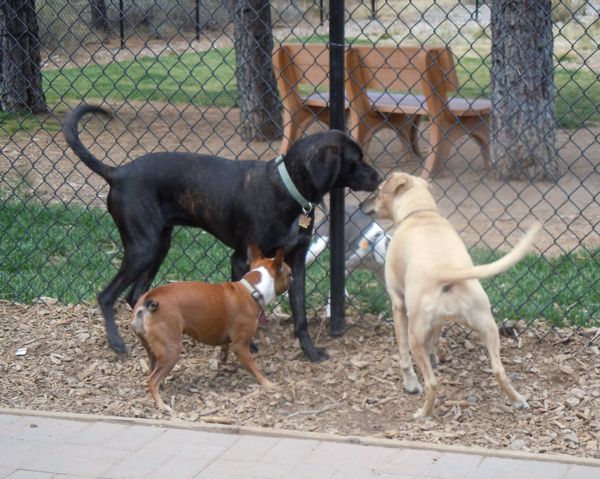
Dogs will soon have more to do than sniff each other at the South Lake Tahoe dog park. Photo/LTN file

The department’s K9 units will be allowed to use the features for training. And they will also be used during the annual K9 trials in September.

When the police dogs are training the big dog area will be off-limits to the public, but the small dog area will always be open. Adler expects the police dogs to be at the park a couple hours a month. The public is welcome to watch this training.

The money for the features – which is not to exceed $20,000 – is being split with the city paying 80 percent and the South lake Tahoe Police Canine Association picking up the remainder.

South Tahoe had been borrowing canine equipment from Douglas County. But those plastic apparatuses are breaking down and need replacing.

The features will be placed in the back of the park, so the bulk of the area is open for the dogs to run around in.

— Kathryn Reed


Washoe Meadows Park may be integral to Meyers’ future

By Kathryn Reed

MEYERS – Meyers is an ideally situated spacious and walkable mountain community that values sustainability, health, wellness, and the natural environment. Uniquely concentrated with year-round outdoor sport and recreational opportunities, the Meyers mountain culture is the hallmark of our thriving local-based economy, boasting a diverse commercial and retail environment, welcoming visitors and providing residents with an extraordinary place to live, work, and play.

That is the recently adopted vision statement for Meyers. Those words lay the framework for this South Shore hamlet as it goes about putting itself on the map in a more definitive manner.

California State Parks may need to do an Historic Structure Report on the Celio barn in Washoe Meadows State Park. Photo/LTN file

Gone is the Meyers Roundtable; with Wednesday night being the last meeting. In its place will be the Meyers Advisory Council. The first meeting will be Aug. 15 at 6pm at Lake Valley firehouse on Highway 89. At that meeting the council will be appointed and work officially begins on developing the Meyers area plan. That will be an official document that will ultimately need approval by the Tahoe Regional Planning Agency.

Part of that plan will include Washoe Meadows State Park and Lake Valley Recreation Area. The latter is better known as the home of Lake Tahoe Golf Course.

“We want to help the community be a recreation hub. Our park is right in the middle of this recreation hub,” Steve Musillami, chief of the State Parks Planning Division, told the more than 30 people at the July 25 meeting.

Most of Wednesday’s meeting was about the future of the state park and golf course.

While a lawsuit regarding the reclassification of the land and CEQA irregularities is still tied up in the legal process, the State Parks people carried on as though that did not matter. When asked about it, they said they were not at liberty to talk about it.

In January, the California State Park and Recreation commissioners upheld their earlier decision to swap land between the adjoining park and recreation area in order to allow for the golf course to remain 18 holes after the Upper Truckee River is restored.

Musillami spoke about how 100 percent of the golf course is now in a stream environmental zone, that 6,200 linear feet of the course are along the river and 850 would be when reconfigured if they do what they want, and that the boundary of the course would shrink. The latter means fewer holes are likely to be on what locals still consider to be State Parks land.

The state has money to design how the Upper Truckee River would meander. (That can’t go forward until the lawsuit is resolved.) Money for the first phase of trail improvements is also in hand.

Parks officials are on a year-to-year agreement with American Golf Corporation to operate the golf course. The concessionaire contract will eventually go out to bid with the presumption whatever company is selected will foot the bill to change the golf course to accommodate the river restoration. The parks department could put all sorts of criteria into the request for proposal – like different winter activities must be offered or the clubhouse could be more than it is today.

This golf course at one time was touted as being the No. 3 money generator for the State Parks system. On Wednesday it was said to be No. 5, making about $600,000 in the last year. The agency’s website shows it at No. 50 with revenue of $503,998 in 2010-11.

“People know the golf course, but not what is behind it,” Musillami said. “We don’t want to have a park out there that no one visits.”

That is why his agency wants to be part of the Meyers plan.

But the state agency has some work to do. In the next month or two folks in Sacramento will decide what level of planning document to create for Washoe Meadows – a general plan would be the most extensive or it could be something much less. Each comes with different levels of environmental review.

No matter what the planning process, plenty of meeting attendees voiced their opinions about what they would like to see the area evolve into.

Daunelle Wulstein and others want to make sure equestrians still have trails to ride on and bridges that are safe for their horses to cross. Norma Santiago spoke for several people in asking for the future concessionaire to offer more than golf – to be a center that involves biking, kayaking and more than snowmobiling when it snows. Some talked about refurbishing the Celio barn; maybe even making it a destination for diners on cross country skis or snowshoes. Lynne Paulson wants biking and hiking trails by the river and not the golf course. Kristi Boosman wants fertilizer use to be reduced. Sue Novasel was not alone in wanting mountain bike trails to be plentiful. Rene Brejc wants the Meyers commercial corridor to link to the park.


Scuba class offered at S. Tahoe Rec Center

The South Lake Tahoe Recreation Center is looking for 12- to 16-year-olds who are interested in becoming lifetime scuba diving certified.

The program is July 30-Aut. 3, 9am-4:30pm. Cost is $395.. Equipment rental included, with minimal personal gear needed.

Preregistration required by July 27 — (530) 542.6099.


Chemicals don’t have to be used for weed removal

By Sunset

Hand pulling or hoeing is your first line of defense against weeds, especially annual and biennial kinds. If you’re diligent for several years about removing these before they set seed, their numbers will decline significantly.

Perennial weeds are harder to manage. Once they’ve passed the seedling stage, they develop rhizomes, bulbs, tubers, or extensive root systems that aid in reproduction. Pulling usually doesn’t remove these underground structures completely, and the weeds can resprout from fragments left behind. It’s best to dig these weeds, removing as much of the root system as you can ― a process you may need to repeat several times.

Don’t leave pulled or hoed-out weeds lying on bare ground, since they may take root again. Leafy annual or biennial types that do not yet have flowers or seeds can safely be relegated to the compost pile, as can the top growth of perennial weeds (before seeding). But roots of perennials (dandelions and quack grass, for example) should be tossed in the trash rather than composted ― as should any weeds that have set seed.

Read the whole story


Hunting with dogs may be banned in California

By Hannah Madans, Sacramento Bee

WILTON – When Josh Brones turned on his pickup truck, Tanner, Sequoia and Dollar began to bark.

The three are treeing walker coonhounds, and these hunting dogs were ready to hunt. As Brones let them out of their kennel one by one, each ran a lap around the truck and then jumped into a crate in back.

“They’re living animals with this overwhelming desire to get out and run and get out and hunt, and it would be tremendously selfish to deny them that opportunity,” Brones said Tuesday. He was about to take them to a Glenn County spot just west of Maxwell where he often hunts.

His canines, and others like them, are central to the controversial practice of using dogs to hunt bears and bobcats. Senate Bill 1221, by Democratic Sen. Ted Lieu of Torrance, would ban their use. The Senate narrowly passed the measure, 22-15, in May. It’s now pending in the Assembly.

“Using dogs to hunt bears and bobcats is cruel to the dogs,” Lieu said in an interview Thursday. “It is cruel to the bears. It is cruel to the surrounding wildlife, and it violates what is known as fair chase.”

It’s a hot-button issue, with Brones and the 5,200-member nonprofit called California Houndsmen for Conservation, of which he’s president, opposing the bill. Joining them are hunting and sportsmen’s groups as well as cattlemen’s associations. Opponents have packed Capitol hallways and legislative committee rooms during hearings.

Just as fervent on the other side are the Humane Society of the United States, which sponsored the measure, and other animal and environmental organizations.

Read the whole story


Helmet cameras protecting cyclists after vehicle conflicts

By Nick Wingfield, New York Times

WASHINGTON — When Evan Wilder went flying onto the pavement during his bicycle commute one morning here, he didn’t have time to notice the license plate of the pickup truck that had sideswiped him after its driver hurled a curse at him. Nor did a witness driving another car.

But the video camera Wilder had strapped to his head caught the whole episode. After watching a recording of the incident later, Wilder gave the license plate number to the police and a suspect was eventually charged with leaving the scene of an accident.

“Without the video, we wouldn’t know who did it,” said Wilder, 33, who was bruised and scraped in the crash.

Cyclists have long had a rocky coexistence with motorists and pedestrians, who often criticize bike riders for a confrontational attitude, and for blowing through stop signs or otherwise exempting themselves from the rules of the road. Now small cameras — the cycling equivalent of the black box on an airplane — are becoming an intermediary in the relationship, providing high-tech evidence in what is sometimes an ugly contest between people who ride the roads on two wheels and those who use four.

Video from these cameras has begun to play an invaluable role in police investigations of a small number of hit-and-runs and other incidents around the country, local authorities say. Lawyers who specialize in representing bicyclists say they expect the use of cameras for this purpose to increase as awareness of the devices goes up and their prices, now starting at around $200, come down.

Some riders even argue that the technology will encourage cyclists to keep themselves in check during dust-ups with drivers.

“I know my actions before and after some event are going to be recorded if I’m the one being a jerk,” Wilder said. “It makes me want to be careful.”

Read the whole story


Study: Gen X not that concerned about climate change

By Eryn Brown Los Angeles Times

According to a survey of more than 4,000 young adults, a large proportion of Generation X isn’t all that concerned about climate change.

Writing in the quarterly Generation X Report — which details findings of the Longitudinal Study of American Youth, a yearly survey of Americans who entered 7th or 10th grade in 50 U.S. public school systems in the fall of 1987 — University of Michigan research scientist Jon D. Miller said that the “surprising” results indicated that “many young adults do not see [climate change] as an immediate problem they need to address … and that many young adults prefer to focus on more immediate issues.”

The survey identified awareness about climate change among interviewees, most of whom are now 36 or 39 years old. In 2008, the research reported, 28% of participants in the Longitudinal Study of American Youth said that they were “very interested” in climate change issues; 55% said they were “moderately interested” and 17% said they were not interested at all. That same year, 57% of respondents said they were “very interested” in the economy and in local school issues.

When asked about their levels of concern about climate change in 2009 and 2011, between a fifth and a quarter of study participants indicated a “high level” of concern, and nearly 60% considered themselves well- or moderately informed on the issue. But Gen Xers reported high levels of uncertainty and ambivalence about a series of statements about climate change included in the 2011 survey, Miller wrote.

Respondents were asked to rate how strongly they agreed, on a scale from 1 to 10, with the statements. Seventy percent “expressed mixed feelings” about the statement “If the present rate of coal and oil use continues, serious long-term environmental damage will occur,” Miller said. More than half of those either had no opinion about the statement or said they didn’t understand the issue well enough to offer an answer.

Analysis of survey responses suggested that nearly a quarter of the Gen Xers interviewed were “alarmed” or “concerned” about climate change and that about a tenth were “doubtful or dismissive” about it, the report said. That leaves two-thirds “disengaged or cautiously on the sideline.”

“The climate issue appears to attract fewer committed activists — on either side — than I would have expected,” Miller said in a statement.

The activists tended to be better educated than the disengaged respondents. People who did not have children were slightly more alarmed about climate change than parents were.

Read the whole story


Youth bike rodeo coming to South Tahoe

The Lake Tahoe Bike Coalition along with the Boys & Girls Club will be producing a Bike Rodeo on Aug. 17 starting at 2pm at the Boys & Girls Club in South Lake Tahoe.

The rodeo will include a bike safety check, proper fitting of helmets, and instruction on safe bicycle handling skills.

South Shore Bikes will be on hand to perform bike safety check and the California Highway Patrol, with the help of the Bike Coalition, will administer the bike safety education.

For those interested in participating as a sponsor, vendor or volunteer, contact Ty Polastri at BikeTahoe@aol.com.