Pull invasive weeds from the Tahoe Keys canals

The League to Save Lake Tahoe, Tahoe Resource Conservation District, and Tahoe Keys Property Owners Association are sponsoring a community weed pull the evening of Aug. 7 in the Tahoe Keys.

Volunteers will be helping to remove invasive weeds that are threatening Tahoe’s native plant species, wildlife habitat, and the surrounding watershed. Participants will learn about invasive weeds, how to properly remove them, and how to plant a Tahoe friendly landscape.

Invasive weeds are plants that grow aggressively, spread quickly and choke out native and other desirable plants from the native landscape. They produce enormous amounts of seed, have spreading root systems, and lack natural predators. These traits enable them to dominate entire landscapes.

The following are some of the invasive weeds have been found in the Lake Tahoe Basin: bull thistle, oxeye daisy, scotch broom, yellow toadflax, and perennial pepperweed.

Volunteers should wear long pants, sturdy shoes, and bring a water bottle. Work gloves will be provided if volunteers do not have a pair. Bring a digging shovel if available, but not required.

If you would like more information on volunteering for this event, call (530) 541.5388, or email events@keeptahoeblue.org.

Meet at the corner of Emerald and Venice Drive next to the tennis courts. The event is from 5:30-7:30pm.


Utah ski resort offering free skiing to California residents

Southern Utah’s Eagle Point Resort near Beaver is offering free skiing and riding to residents of California for the 2012-13 season.

The free skiing declaration was made this month. Every Thursday in January 2013, Eagle Point Resort will offer unlimited free access for skiing and snowboarding to any guest on all 600 acres of its terrain spanning all 1,500 vertical feet. California residents will enjoy free skiing and snowboarding for the entire 2012-13 season. There are no strings attached other than the requirement to provide a name and email address.

“What we have learned overwhelmingly from our guests during the first two seasons since reopening is that we have a truly exceptional mountain that people love to visit. Our goal is to be the premier ski resort in southern Utah,” Shane Gadbaw, CEO and co-owner of the resort, said in a statement. “We have spent millions to make the property and the service first class from the newly renovated Canyonside Lodge down to the friendly greeters in the parking lots.”


Wooden Boat Show returning to North Shore

Lake Tahoe Concours d’Elegance Wooden Boat Show is Aug. 10-11 at the Sierra Boat Co. docks in Carnelian Bay.

The boat show annually features about 100 antique boats and draws more than 5,000 participants. Proceeds raise money to provide educational opportunities in the Lake Tahoe area to enhance expertise or understanding of maritime skills.

Tickets for one day are $25 in advance or $30 the day of the show. Two-day tickets are $35 in advance or $40 when purchased at the show. Children younger than 12 will be admitted free.

To purchase tickets or learn more about the show and the activities surrounding it, call (775) 851.4444.


Farmers alter harvest schedule to save rare birds

By Mark Grossi, Fresno Bee

Shortly before harvest this spring, thousands of rare birds suddenly flocked to a Tulare County wheat field and nested — setting the stage for a vast killing field with baby birds.

But the dairy farmer who was growing the wheat as feed for his cows delayed long enough to save thousands of tricolored blackbirds, averting a wildlife disaster.

He was one of four dairy farmers in the San Joaquin Valley who held off harvests this year to protect more than 20 percent of the tricolored blackbird’s global population. The federal government spent $100,000 helping the farmers replace the feed.

It’s a success story that seems as rare as the tricolored blackbird. In an era when regulation and lawsuits drive environmental reform, this voluntary collaboration saves birds, keeps dairy farms in business and leaves out lawyers.

“Dairy farmers see this as a win-win,” said Michael Marsh, chief executive officer of Western United Dairymen, a Modesto-based industry group representing 900 dairies.

Western United works with Audubon California and government agencies to save the remaining blackbirds, which once numbered in the millions. There are 260,000 left in the world, and more than 95 percent of them are in California.

For dairy owners, the partnership makes sense because it is a major influence in keeping the bird off the protection list for the federal Endangered Species Act, which can be stifling to business and industry.

But nature also plays a part. The tricolored birds gather in huge breeding colonies — they are the most colonial birds in North America. It’s not unusual to see 30,000 in a single farm field.

Decades ago, they nested in the coastal wetlands and inland marshes of Central California. But their historic breeding grounds have disappeared as development and farming spread during the last century.

The birds still nest wherever they can find freshwater marshes among the cattails in the Valley. But the blackbirds will readily settle for alfalfa, hay and wheat fields where they can easily fill their dietary needs.

Read the whole story


Canadians told they must have grass, not a garden

By CBC News

A couple is fighting to keep a vegetable garden they grow on their property in Drummondville, which is northeast of Montreal.

This spring, Michel Beauchamp and his wife, Josée Landry, planted an elaborate vegetable garden on the front lawn of their Richelieu Street home.

They used to have flowers growing, but Beauchamp has high blood pressure and wanted to eat healthier. So they planted cucumbers, tomatoes, zucchinis, beets, onions, and brussels sprouts, among other vegetables.

Landry said the garden has had a big impact on her and her husband’s health. “Michel lost 75 pounds since March, I lost 25 pounds,” she said.

But the couple will face fines if they don’t rip up part of their garden in the next five days.

According to a spokesperson for Drummondville, front lawns in the couple’s St-Charles-de-Drummond neighbourhood must be 30 percent grass.

Read the whole story


12-passenger boat taxi to service North Shore

The North Shore pilot ferry program is going to hit Lake Tahoe on Aug. 3. The service stops at the end of September.

The vessel carries 12 passengers and up to eight bikes.

The pilot program includes a “paperless” reservation program, so book ahead online.

Hours of operation are 8am to 8:19pm through Aug. 26 and then the schedule will run through from 8am to 6:46pm to coincide with daylight changes.

Participating docks are: West Shore Café, Tahoe City Marina, GarWoods Grill & Pier and the Tahoe Vista Recreation Area.

Rates start at $10 for adults, $7 for children up to 12 years old. That’s one way.

Ticket kiosks are available at some of the participating docks.


Lost Lake remains a hidden wonder for at least 2 hikers

By Kathryn Reed

TAHOMA – Lost Lake is appropriately named. We never found it.

Still, the trek along General Creek provided stunning scenery and a chance to explore some terrain that was new to us.

Two winters ago Sue and I cross country skied on the trails at Sugar Pine Point State Park on the West Shore. These trails are where Olympians raced in the 1960 Games hosted by Squaw Valley. We said at the time it would be great to come back to explore the trails on foot.

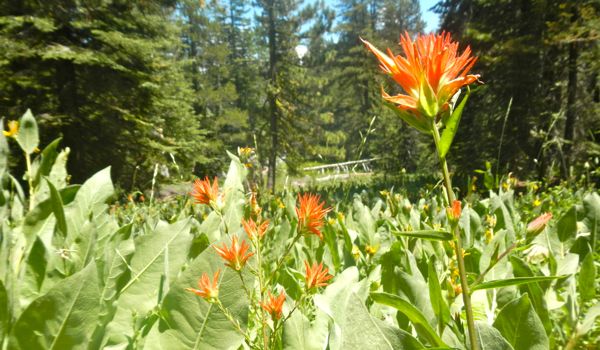
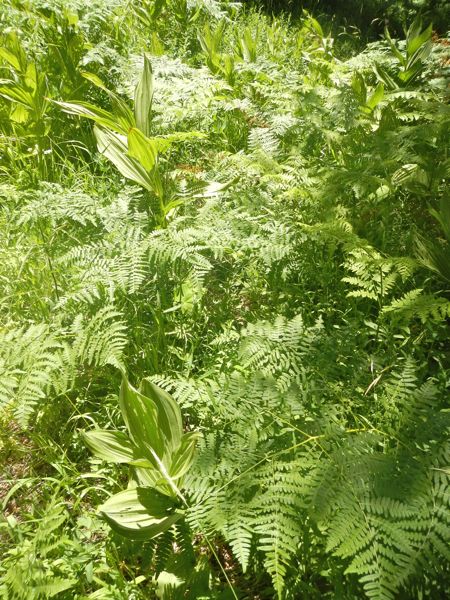
Lush, green foliage is everywhere.
Indian paintbrush fills part of the General Creek trail. Photos/Kathryn Reed

When we went back a little more than a week ago we said it would be great to come back with mountain bikes. Plenty of tracks and a lone cyclist proved our point.

That’s the thing about this state park – it has something for most recreationists. Because where we were playing is also the General Creek Campground most people not staying the night tend to drive by instead of venturing past the attendant at the shack taking money.

Although the park’s employee gave us a map on an 8½ by 11 inch sheet of paper, it is not the most defined trail system. We didn’t let that bother us. We also didn’t let it faze us that another employee was not clear on how to get to Lost Lake and said it had been quite some time since he’d been there.

Maybe some of the $54 million surplus the parks department has could be put into maps and signage.

After parking in the day use lot, we followed the trail that skirts the campground until we hit a trail the width of a road. From there we headed left into Sugar Pine’s network of trails. The red trail is a loop. Going either way gets you to a sign that says Lily Pond. That’s how we went.

Ferns dot the landscape.

For the majority of the 10-mile roundtrip trek we were able to look up because the ground is free of rocks. Oftentimes we were able to walk side-by-side. But off the loop we walk single file.

An abundance of Indian paintbrush covers the landscape in a vibrant glow of red. A field of skunk cabbage is flowering. Lupine adds a shot of purple to the palette. Other wildflowers are out.

But what is most striking is the plethora of ferns. It reminds us both of the Tahoe-Yosemite trail, which as the crow flies, is close by, and runs somewhat parallel to the General Creek trail.

We were on this hike before the recent rains and still some of the terrain was so lush that “tropical” is the word that comes to mind to describe it.

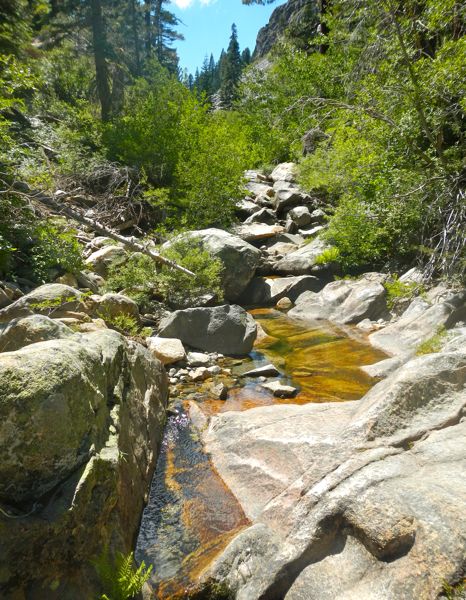
As we start to climb, a wall of granite is to our right and the creek to our left. Eventually we have to cross the creek to stay on the trail, but the water is low and rocks easy to scamper over.

Various pools of water look inviting to swim in – if one likes cold water. Fish dart back and forth – some 6-inches in length.

We get high enough that when we turn around Lake Tahoe is in the distance.

Up we go, hoping around each bend we will find Lost Lake.

General Creek is close by most of the hike.

We hit a marker that says Lost Lake to the left, Rubicon to the right. Right would have us on the Rubicon-McKinney trail. With the Jeep back at the campground lot, it wasn’t going to do us any good to get on a 4-wheel drive trail. We head up a ways toward Lost Lake. It’s not there.

A guy off trail checking out the scenery doesn’t know where it is either.

The heat is getting to me. Sue is struggling with recovering from a cold. We turn around.

Lost Lake remains lost.

—-

Getting there:

From South Lake Tahoe, go north on Highway 89, around Emerald Bay and past Meeks Bay.

Before hitting Tahoma, on the right will be a sign for the Ehrman Mansion.

In less than one mile make the left turn into the Sugar Pine Point Campground.

Parking is $10.

Dogs are not allowed.


Lake Tahoe residents can learn to become master gardeners

The UC Cooperative Extension – Central Sierra in partnership with the Tahoe Resource Conservation District is offering the inaugural Lake Tahoe Master Gardener volunteer training beginning in September in South Lake Tahoe.

Upon completion of the 50-hour training course, certified Lake Tahoe Master Gardeners will provide the community with research-based information about home horticulture and gardening.

The training will consist of core programs in horticulture, native plants, soils, irrigation, pest management, plant nutrition, diseases, forest health, wildfire defensible space considerations plus additional topics specific to the Lake Tahoe Basin.

Once certified, Master Gardeners volunteer 50 hours during their first year of service and 25 hours in subsequent years. Volunteer activities include providing one-on-one consultations, answering questions from phone and email hotlines, offering workshops and classes, writing articles in the local paper or online media, as well as many other outreach and educational opportunities.

If you reside in the Lake Tahoe Basin and are interested in becoming a Master Gardener, go online gardener info or call (530) 621.5528 for more information. Applications for the fall training sessions are due Aug. 7.


Caltrans: Slimy substance in the Sierra no big deal

By Barbara Barte Osborn, Sacramento Bee

On his way to Lake Tahoe earlier this month, Greg Service pulled into an eastbound rest stop along Interstate 80 about 40 miles west of Truckee.

The Santa Rosa resident tossed a ball to his dog at the Gold Run Safety Area, but was soon in for a nasty surprise.

“He came out of the bushes covered with slime,” Service said. “It smelled like sewage.”

Behind the bushes, Service said he saw a stream covered with a foamy, orange, foul-smelling substance.

“It was about 5-feet across in some places and almost 3 feet deep in some places,” he said. “It was full of what appeared to be sewage.”

He cleaned up his dog – “fortunately, I had the truck, so he could ride in back,” he said – and continued on.

But he was so concerned about the incident, he took photos of the stream and called the state Department of Transportation. Dissatisfied with the agency’s response, he checked the westbound Gold Run rest stop on his way home, where he found more of the substance, and later called the Bee.

“It was right after the Fourth of July holiday,” Service said, adding that he suspected that the rest stop’s sewage system had backed up or they flushed it “right into an open trench about 100 feet away.”

Read the whole story


Derby Dames lose double-header; eager for August tournament

The Tahoe Derby Dames lost a double-header at home.

The two July 21 bouts at Bijou Community Park featured different squads.

The first bout featured Tahoe’s Green Team up against the North Bay Bruisers from Sonoma County. Although the Tahoe Green Team battled through the Bruisers’ great defensive plays and scoring jammers, it wasn’t enough as the Bruisers won 213-79.

The main event featured The Tahoe Derby Dames Black Team against the Sacred City Disciples from Sacramento. A tightly contested bout to the end, the visiting team won 118-100.

GiGi Allen, captain for the Dames, in a press release said, “The Black team played well together. There were a lot of good things happening. In the end we did not emerge triumphant, but it was a close one the whole time, and we have a great foundation set for future success.”

The inaugural Tahoe Roller Derby Tournament billed as Deep Blue Derby is Aug. 18 at Bijou Community Park. For more information, click on the flyer.