Lightning does little damage; hot temps for Tahoe to continue

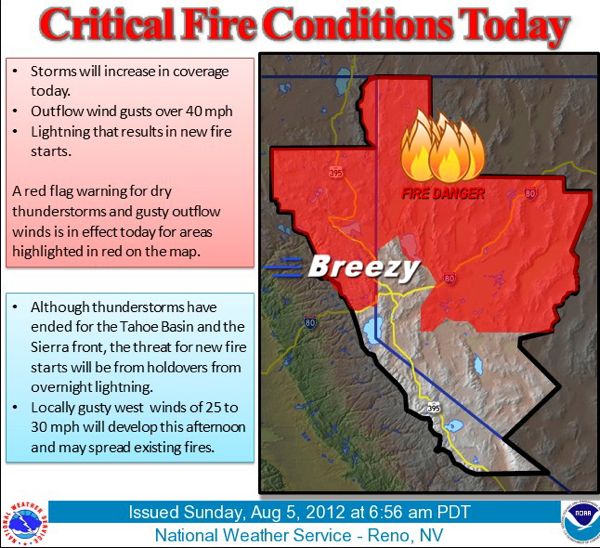
While thunder boomed and lightning filled the night sky in the Lake Tahoe Basin and beyond last night, the fire activity was minimal.

South Shore officials are not reporting any fires from the lightning. There were 34 strikes in the Tahoe National Forest that started two fires, with smoke coming from another area where crews are rushing to.

The first fire burned about 1.5 acres three miles east of Malakoff Diggings State Park in a remote area. Another fire was ignited on Snow Mountain in a remote area overlooking the North Fork American River. Smokejumpers have been requested from Redding. Smoke was seen in the Galloway Ridge area south of Downieville. Firefighters and a helicopter Sunday morning were searching for the exact location.

Three small fires started south of Smith Valley in Nevada from the Aug. 4 storms.

According to U.S. Forest Service officials on the North Shore, “The forecast for today includes continuing potential for scattered thunderstorms primarily west of the Sierra crest. Reconnaissance flights will take place throughout the day with expectations that additional fires will be spotted as the day warms up.”

While lightning is never welcome when terrain is so dry, the rain is a good thing. South Lake Tahoe received 0.41 inches of rain in July – 0.02 inches below normal.

The hottest day of July was the 12th when the National Weather Service recorded 89 degrees for Tahoe. It’s possible that mark will be matched this week.

 — Lake Tahoe News staff report


Reports of ‘swimmer’s itch’ at Pyramid Lake

By Jennifer Hardy, KOLO-TV

The Pyramid Lake Paiute Tribe is warning swimmers about the lake water.

According to the tribe, there have been several recent reports of “swimmer’s itch” from people who either swam or waded in the shallow areas with warm water. North Nets, South Nets and Long Beach were mentioned as places more likely to have water concerns.

This is just an advisory, not a beach closure. All public beaches at the lake will remain open. You will see warning signs at the lake. If you do swim in the water, you are asked to avoid putting your head underwater, or swallowing the water.

According to the Centers for Disease Control and Prevention, Swimmer’s Itch is caused by microscopic parasites. Exposure to these parasites can cause an allergic reaction mostly in the form of a skin rash. The CDC says most times these rashes do not require medical attention, but speak to your doctor if you do become infected to determine any necessary medical care.

If you or someone you know has gotten this rash from swimming in the lake, contact the tribe at 888.225.2668.


Eldorado National Forest imposing fire restrictions

Fire restrictions go into effect in the western half of Eldorado National Forest beginning Aug. 7.

Campfires and charcoal barbecues will be restricted to designated recreation sites and other fire related activities will be prohibited until the end of fire season.

The new Eldorado National Forest fire restriction plan divides the forest into western and eastern zones. The dividing line between the zones is approximately the 6,000 foot elevation. The edge of the restriction zones follows marked roads as much as possible.

A map showing the location of the zones is displayed on the Eldorado National Forest website.


U.S. employees watching Olympics instead of working

By Charles Passy, SmartMoney

Forget the narrow defeat suffered by the U.S. men’s swim team in the 4×100-meter freestyle relay over the weekend. Or that Jordyn Wieber, America’s best hope for all-around gold in female gymnastics, failed to even qualify for the event.

When it comes to this Summer Olympics in London, the real loss may be felt much closer to home.

Productivity experts are predicting that this year’s games could result in a summer slowdown perhaps unlike any other in history, with millions of American workers devoting portions of their day to track and field instead of, say, tracking customer orders. The wasted time could result in a $650 million hit for U.S. companies, according to an estimate by Captivate Network, a digital media company.

Much of that loss will come from employees watching games during work hours on their computers or mobile devices. Some 12 percent of American workers said they plan on viewing the Olympics at the office, according to a survey commissioned by Captivate. A similar survey by Yahoo! Sports showed a figure as high as 43 percent. In addition, Yahoo! Sports found that 25 percent of workers planned to leave early to follow the games.

Read the whole story


View Perseid meteor from 8,200 feet

People can camp under the stars on Aug. 13 and watch the night sky light-up during the Perseid Meteor Shower in Lake Tahoe.

Squaw Valley’s Perseid Meteor Shower Campout will take place at High Camp at elevation 8,200 feet, where guests watch the meteor shower and enjoy amazing views of Lake Tahoe and the surrounding Sierra Nevada.

The Perseids come every year beginning in late July and stretching into August. Among the many nights of the shower, there is always the one night that the viewing of the shower is at its best. This year, that evening falls on Aug. 13.

Perseid Meteor Shower campers can upload Squaw’s Aerial Tram between 4:20pm and 5:20pm. After setting up camp on the mountaintop, there will be an informational briefing on telescopes with meteor shower viewing beginning at 10pm. In the morning campers will have a continental breakfast from 6:45-7:30am before downloading on the Tram.

Reservations can be made by calling 800.403.0206. Prices are $79 for adults and $54 for kids.


Mount Rose wants to infuse $23.5 million into ski area

By Kathryn Reed

With Mt. Rose proposing a $23.5 million expansion to the ski resort over 10 years, it could be in the position to be a player if Lake Tahoe-Reno ever gets the Winter Olympics.

In 1960 the resort was the alternate for the women’s downhill when Squaw Valley hosted the Games. Today, it along with Heavenly Mountain Resort, are the only Tahoe area resorts capable of hosting the men’s downhill, Tahoe-Reno Olympic committee officials have told Lake Tahoe News.

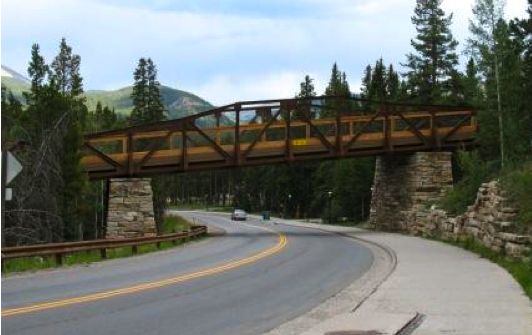
An artist's rendering of what the skier bridge over Mount Rose Highway might look like.

While regional Olympic officials are now eyeing 2026 as the potential year for hosting the Game because the U.S. Olympic Committee won’t go after the 2022 event, Mt. Rose is ready to make improvements that have nothing to do with the Olympics.

The Reno area resort is hoping to start the environmental phase of the process this fall. The U.S. Forest Service will have to sign off on the ski area’s plans. The resort is on the Humboldt-Toiyabe National Forest.

The soonest the plans could be implemented would be next year, though resort officials are saying it could be the following year.

A little work that has nothing to do with the mega plans is going on now.

“Granite Construction is still working on the secondary entrance to the ski area about a half-mile west of the Mt. Rose main lodge. It is being put into place with the future goal of improving circulation into the resort, but entry will not be accessible for the coming season,” Kayla Anderson of Mt. Rose told Lake Tahoe News.

What looks like construction in the main parking lot is actually the staging area for crews working on the erosion control project for highways 28 and 431.

The multimillion-dollar plan includes increasing terrain, more lifts and snowmaking improvements.

Next door, on the north side of Mount Rose Highway is the acreage known as Atoma.

“Mt. Rose looks to expand skiing services onto this 99-acre parcel to complement the beginner terrain on the Mt. Rose side of the mountain. This open, mosaic-glade style skiing would make for a unique lower level snow experience combining open runs with pods of trees intermixed throughout the new area,” the resort said in a statement.

A 3.5-mile run would be created from top to bottom. To make this happen, a bridge for skiers over the highway would be built. This bridge would link Atoma to the existing trails at Mt. Rose. Even the chairlift is proposed to cross the highway.

Ponderosa and Galena chairlifts would be taken out to make way for a high-speed chair going to the top to access runs in the Galena area.

Plans call for lengthening the Lakeview lift, which would provide views of Lake Tahoe as well as easier access to some terrain.

A restaurant near the top of Norwest Magnum 6 is on the books. It would provide 270-degree views of Lake Tahoe and Virginia Peak.


6% drop in snowsports participation in U.S. in 2011-12

By Hugo Martin, Los Angeles Times

Participation in snow sports in the most recent winter season dropped 6 percent, primarily because of a lack of snow and increased work and family obligations for snow sport enthusiasts, according to a study released last week.

The number of Americans who went skiing, snowboarding and snowshoeing, among other snow activities, typically from Thanksgiving to early spring dropped from 21 million to 19.8 million, according to a report by SnowSports Industries America, a nonprofit trade group for snow sports businesses.

The biggest drop in snow sports was among alpine skiers, whose numbers dipped 11% to 10.2 million this winter season, according to the 2012 SIA SnowSport Participation Report. Participation in snowboarding dropped 8 percent to 7.6 million and cross-country skiing declined 5 percent to 4.3 million, the report said.

Among the top reasons snow sport enthusiasts gave for staying off the slopes this winter season were family commitments (33 percent), work obligations (32 percent) and decreased vacation time (20 percent), according to a survey conducted by the trade group.

Poor weather was cited by about 11 percent of snow sports fans as a reason for staying off the mountains, the survey found.

Read the whole story


Tips for keeping critters out of gardens

By Wendy Hanson Mazet

The winter of 2012 went down in the record books for being dry, unseasonably warm and short. But what does last winter have to do with this year’s vegetable and flower gardens? Well, the very mild winter is the reason many gardeners are being inundated by unwanted critters this summer.

By the time gardeners got a jump-start on their gardens, ground squirrels and voles already were enjoying the mild temperatures and mating. Wildlife numbers are up this year with less die-off over the winter months. Our offices have been flooded with calls about cottontail rabbits, ground squirrels, voles and many other pests.

When deciding which mode of protection or control you are going to use, first you must determine what’s causing the problem. Gardeners living in town are most likely to have problems with quail, rats, raccoons, ground squirrels, moles and voles. People living on larger parcels near open space or sources of water have many other pests to add to the list, including cottontails and jackrabbits, chipmunks, skunks, deer, bears and others. Each critter is unique in its habits and the type of damage it can cause.

Once you have identified your pests, it is time to build a strategic plan to manage their impacts. There are seven main options for homeowners to explore: Use repellents, barriers, traps, baits, encourage natural predators, modify the habitat or simply choose to live with the damage.

Liquid repellents may work for short periods, but can become time-consuming and costly. Habitat modification and exclusion are the most effective defenses. A fence reinforced with chicken wire or hardware cloth deters many rodents, particularly when the wire is buried 12 inches in the ground and rise 2 feet above. Small, portable chicken-wire cages help protect seeds, new seedlings and small plants from feathered pests. Once crops grow 6 to 12 inches tall, birds tend to leave them alone and the cages can be moved to protect other crops.

Trapping and baiting work very well once you have properly identified the pest. There are several different types of kill traps and various styles of live traps. Remember, when choosing a live trap, you then must kill the animal humanely. Relocation of most wildlife is illegal and inhumane, as most live in colonies and territories. There are several baits on the market. Read the labels carefully as products are limited to specific pests and uses (indoor or outdoor).

Wendy Hanson Mazet is the Master Gardener coordinator for the Western Area of University of Nevada Cooperative Extension.


Free guided hikes at Squaw

New this summer, Squaw Valley is offering free guided hikes on the upper mountain every Friday, Saturday and Sunday at 12:30pm and 2:30pm.

The guided hikes, which last about one hour, leave from High Camp and travel across Squaw Valley’s mountaintop meadow.

Squaw’s guided hikes are free with the purchase of an Aerial Tram ticket to High Camp. Tram tickets are $29 for adults, $22 for youth and seniors, and $10 for kids 12 and under. The guided hikes leave from the grassy area just outside the High Camp building. For more information or to sign up, call (530) 452.7273. Reservations are not required for the guided hikes.


Upper Truckee Marsh dog ban over; leashes mandatory

By Kathryn Reed

It’s over. That would be the temporary dog ban in the Upper Truckee Marsh.

This popular meadow area that leads to a beach along Lake Tahoe and to the edge of Trout Creek had a three-month (May 1-July 31) dog ban imposed for the last two years. The reason is so many people were allowing their dogs off leash that it was impacting the wildlife in the area.

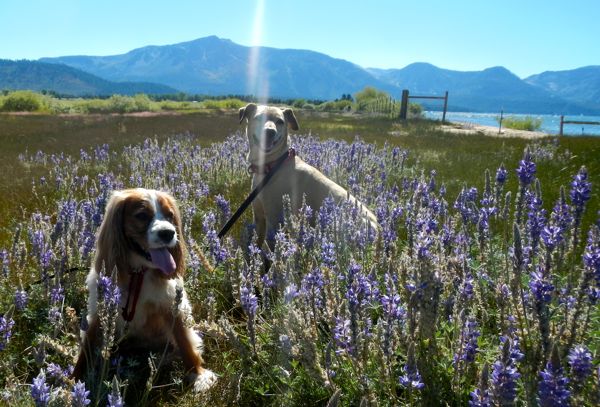
AJ and Rusty romp in the sand after a swim in Lake Tahoe. Photos/Kathryn Reed

This time period was picked because it’s when birds are breeding, with the peak time, at least in 2011, being June 22-July 19. Studies continue to be conducted as to what the effects are on birds, if more are in the area without dogs and how many little ones are born.

Dogs were stressing out birds by chasing them, sniffing at nests – some of which are on ground level in bushes.

While there was a time when cows used this as pasture land, the area has returned to a more natural look with native species calling it home.


A survey in summer 2011 found that two willow flycatchers were in this marsh area as well as neighboring Cove East. This songbird was put on the federal endangered species list in 1997.

AECOM of Sacramento compiled the data for CTC that was presented to the board at its June meeting. Will Richardson with the Tahoe Institute for Natural Sciences based in Truckee collected point count data of avian species.
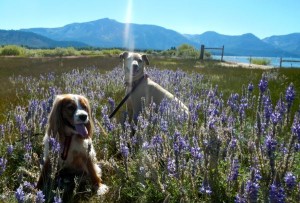
Rusty and AJ are thrilled to be in the Upper Truckee Marsh.

“We believe the very high waters, and perhaps more importantly the late timing of the peak water level, were actually quite problematic for the nesting of many species that do not regularly suspend their nests in emergent vegetation,” Richardson wrote in his report from the 2011 survey. “Among these are the ducks, coots, shorebirds, and terns. We suspect that many species and individuals either nested elsewhere, possibly further (sic) upstream, or simply vacated the area completely in 2011.
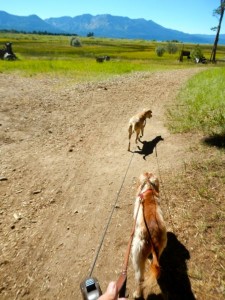
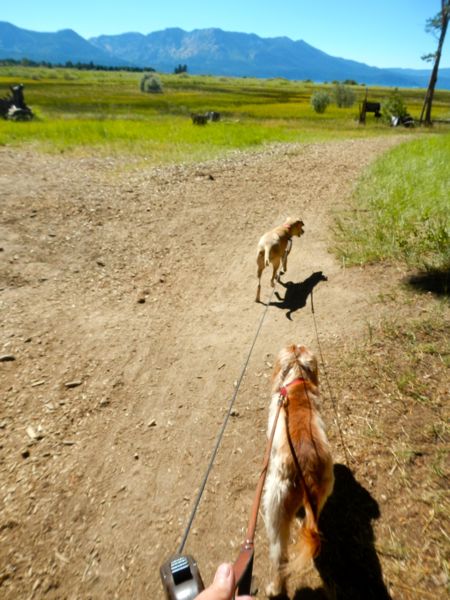
Dogs on leashes are allowed in the Upper Truckee Marsh.

He went on to say the number of shorebirds in the surveys done by AECOM will be below normal because they skipped the beachfront because of how wet everything was and how high the water was a year ago.

“We cannot stress enough that the effects of 2011’s high water on shorebird distribution will completely overshadow any apparent effects of the seasonal dog closure, and thus 2011 will surely be a low outlier with regards to shorebird use at the site,” Richardson wrote.

Data from the most recent closure won’t be available for several months.

A slew of birds call this marsh home – from Canada goose to bald eagles to mourning doves to spotted sandpipers.

It’s possible the seasonal dog ban will be permanent. That’s up to the CTC board. It will occur every year until they vote to do something else.

Several dogs of all sizes and breeds were enjoying the 80-plus degree weather on Aug. 1 – the first day the ban was lifted. Even though dogs are allowed on this acreage owned by the California Tahoe Conservancy, leashes are mandatory.

Of the nearly 5,000 CTC properties in the basin, this South Lake Tahoe parcel is the only one with this type of closure. The 311 acres were purchased about 11 years ago for $10 million. It is considered one of the most sensitive areas in the basin.

“It is the singular and most unique habitat in the Lake Tahoe Basin,” CTC Deputy Director Ray Lacey has told Lake Tahoe News.