LTUSD, South Tahoe solidifying how to manage ball fields

By Kathryn Reed

Lake Tahoe Unified School District officials missed a critical meeting Monday as the fields committee of the recreation joint powers authority centered its discussion on making an area at the old Al Tahoe Elementary School a multiuse field. This would require taking out some of the blacktop and the school board saying OK.

Steve Morales, facilities manager for LTUSD, is a non-voting member of the board. He was not at the Aug. 20 fields committee meeting. But he was at the school board meeting the following night.

At Tuesday’s meeting he advocated for CACC (Community Athletic Coordinating Council) to continue to be a player in the whole process. He is the district’s rep on the CACC board, too.

What was revealed Aug. 21 to the surprise of the school board is the district and CACC have been charging the same people to play on the fields owned by the district. In essence, they were double charged.

LTUSD board member Sue Novasel said that even though in the past her husband was involved with CACC, she is unable able to get any financial statements from this nonprofit. Neither could Lake Tahoe News for its November 2011 story on CACC.

As CFO Deb Yates put it, CACC can charge a membership fee, but won’t be charging to use the field.

Morales was a cheerleader for CACC, saying how much they do and that the city and district won’t be able to handle the fields without CACC’s input.

Superintendent Jim Tarwater, Yates and the board didn’t sound like they agreed with his assessment.

“The city will have to deal with CACC,” Tarwater said.

The school board agreed to spend ($19,800 from special reserves) to pay for scheduling software. LTUSD, in an agreement with South Lake Tahoe, is taking over all scheduling responsibilities for the fields.

Still to be negotiated is the fee structure. The city charges one price and the district another. What the board said, though no vote was taken, is they want CACC out of the business of charging people to use they field.

A formal agreement between the district and city could be on the Sept. 11 LTUSD agenda.

The fields committee at its Sept. 17, 4pm meeting at Lake Tahoe Airport is expected to finalize its priorities. In the meantime, the list of 13 possible places to spend the $500,000 it has in the kitty is being scrutinized to find out actual costs.

South Lake Tahoe, according to Councilwoman Angela Swanson who spoke at the school meeting, is working with El Dorado County on a detailed analysis of field needs in the basin. This will complement what the county has done on the West Slope. However, that analysis is not expected to be done until 2014.


10 new owl species discovered in Philippines

By Jakarata Globe

Scientists and birdwatchers have discovered 10 new owl species in the Philippines, using advanced recording equipment that can distinguish between their hoots, a conservation official said.

Eight of the new species were previously considered sub-species while two are totally new, said Lisa Paguntalan, field director of Philippines Biodiversity Conservation Programme.

“There is no significant variation in their forms. It was the sound difference of their calls that was very significant in distinguishing between species,” she told AFP.

Paguntalan warned that many of these new species were possibly endangered because they were found only in small isolated islands or in tiny pockets of forests.

Ornithologists and birdwatchers from Michigan State University, Birdlife International and other groups used museum samples and high-quality photography and recording systems to show the owls were of different species.

Read the whole story


Nevada secretary of state wins MMA bout at Stateline

By Norm Clarke, Las Vegas Review-Journal

Nevada Secretary of State Ross Miller is retiring from mixed martial arts as an undefeated light heavyweight.

There goes that dream division matchup between Jon “Bones” Jones, the face of the UFC, and Miller, 1-0.

“I’m one and done,” Miller said. “Competing in an MMA event was on my bucket list. Now that I’ve got it done, I’ve got a day job and an important election coming up.”

The 6-foot-4, 205-pound Miller won his MMA debut/swan song, one of 10 amateur fights Saturday held by the World Fighting Championship (WFC) at MontBleu casino in Stateline.

Miller’s fight, the co-main event, was with Jamal Williams, a former high school wrestler and brawler.

Miller’s walkout music was “Fortunate Son” by Creedence Clearwater Revival, a reference to his father, former Nevada Gov. Bob Miller.

Reno Police Chief Steve Pitts, who often trains with Miller, walked the secretary of state into the octagon.

Read the whole story


3-day skiing-wakeboarding clinic for teens

The South Lake Tahoe Rec Center is putting on a three-day water skiing-wakeboarding clinic for ages 12-16.

The classes are Aug. 22-24. Cost is $125.

Register by calling (530) 542.6056.


Run-walk in Truckee benefits humane society

Animal enthusiasts and their dogs of all shapes and sizes are encouraged to take part in the inaugural Humane Society of Truckee-Tahoe’s Tennies & Tails event Sept. 1 at 9am at the Truckee River Regional Park.

Participants and their dogs will park (for free) and register at the Regional Park on Brockway Road in Truckee before going along the Legacy Trail to traverse a course set up along the riverfront trail.

This event is not just limited to dog owners and their furry friends. In fact, the only requirement is support for the Humane Society — animal lovers without their pets, kids, families with strollers, young and old alike are welcome.

Tennies & Tails will be comprised of two races. A three-mile run will commence at 9am and a one-mile walk will follow at 9:10am.

Participants are encouraged to gather sponsors for their run or walk to help increase the total amount of money raised.

For those who preregister, Tennies & Tails registration is $20 for each dog owner plus their leashed dog. Two leashed, well-behaved dogs under control are permitted per owner. All registered dogs must have current vaccinations.

Day-of registration fees increase to $30, and participants can register as early as 7:30am.

Children under 5 years old are free. To preregister or for more info, go online or call (530) 587.5948.

All proceeds from Tennies & Tails will go toward much-needed building funds for the HSTT animal shelter which is currently under construction.


Jet pack launches new beverage at Lake Tahoe

By Chris Buckley, KOLO-TV

SAND HARBOR — Beachgoers at Lake Tahoe’s Sand Harbor got quite a surprise Friday afternoon. It was part of a new business venture that’s making appearances all over the west coast.

A water-powered jet pack that has been hitting oceans, lakes and rivers to promote a new drink called Air is in Tahoe.

“Air is the first ever sparkling water with alcohol,” said marketing rep Jack Cookson. “It tastes exactly like sparkling water but has 4% alcohol and berry and citrus flavors, only 95 calories all natural flavorings.”

The drink hit shelves this summer and a company official says the jet pack is what their product is all about. Pilot Wes Dawson took the jet pack for its first voyage on Lake Tahoe.

“It’s an awesome exhilarating feeling we think our product’s pretty awesome so it tied in pretty good. We feel our product makes water more exciting and we feel this product makes water more exciting also. We thought they went together pretty good,” said Dawson.

It certainly got the crowd’s attention.

“That thing’s pretty cool,” said spectator Jon Debay. “I’ve seen it online but never in person and that thing is literally amazing. I want one.”

You need a special certification to fly it but no one is really sure what kind of certification you need to use it on Lake Tahoe. Park officials cut Friday’s flight short.

“We’ve had some mishaps with rangers and patrols but generally once we talk to them they’re fine with it. They’re just shocked at first.”

Promoters are not not giving up, so keep your eyes open on Tahoe shores this weekend.

The “Air” line has created jobs all over the west coast, and you can find it on the shelves in Reno right now and in the Tahoe area by the end of the month. They’re hoping to fly the jet pack at Zephyr Cove on today.


London Games — a barrier breaker for female athletes

By Bill Saporito, Time

A week after the cinematic opening ceremony on July 27, London’s Olympics were flagging. Of course there were events and medals in the ensuing days, but the showdown between American swimmers Michael Phelps and Ryan Lochte was a bit of a fizzle, and Team Great Britain had been a relative no-show. Sparse crowds at some events in the opening days and breakdowns and delays on the London Underground had the British tabloids in a snarling, told-you-so mood about the nation’s penchant for punching below its weight. Games boss Sebastian Coe wasn’t too happy either. When one reporter offered to show him a digital image of empty seats, Lord Seb sassed back that he would be happy to “look at your holiday snaps later.”

Then, over one stellar weekend, the women of the Olympics changed everything, righting the ship for the Games and sending Team GB toward its best Olympics in 104 years. The signature performance of these Games would come from Jessica Ennis, Britain’s luminous heptathlete and the official face of the Games. On the morning of the hurdles, the heptathlon’s first event, she put a charge into Olympic Stadium with a first-place finish. One night later, that charge became a full-fledged thunderbolt as “our Jess,” as the tabloids then lovingly called her, blazed down the straightaway to claim the 800-m event—and the gold—before a delirious crowd. “She’s an astonishing combination of a great athlete and lovely person,” said David Luard, 31, a small-business owner from London, in the stadium after Ennis took gold. “You know, these Olympics are all about passing a torch to a new generation. She’s a fantastic example for kids.”

She was the brightest star on Britain’s day of glory, when nearly 72,000 spectators swarmed the Olympic Park, filling 92 percent of the available places, with the royal cheerleading couple of Prince William and Kate Middleton first among them.

Ennis’ gold wasn’t the only spectacular moment for female athletes over that weekend. On the water, in the double sculls, Team GB’s Katherine Grainger and Anna Watkins steamed home before 30,000 spectators. Nearby in the velodrome, the Games’ noisiest and sweatiest venue, Team GB’s women vanquished the U.S. in the pursuit race, shattering their own world record. The following Monday, the U.S. women’s soccer team clashed with their Canadian cousins in an epic semifinal, winning 4-3 in the dying seconds of overtime. The match left observers in England, the home of soccer, wondering why they even bothered to watch the men play, since they’ve produced so very little in this tournament. “We never think we’re out of it,” says Megan Rapinoe, the platinum-topped American wing half who scored two goals, the second an absolute screamer. “We’re kind of like, ‘OK, that just means we need to score another one.’ Huge heart, huge fight on this team.” The U.S. men’s team failed to even qualify. The U.S. women went on to play Japan in the gold-medal match, in a repeat of the World Cup final last year.

The color scheme of the London Olympics includes bubble-gum pink, but there’s nothing pink or fluffy about these women’s performances. London has provided a joyous parade of amazons. The first gold went to a female shooter from China, the first gold for Team GB went to rowing duo Helen Glover and Heather Stanning, and some of the most compelling stories were spun by women: for every Michael Phelps, Usain Bolt and Andy Murray, there was Missy Franklin, Jess Ennis and Serena Williams. For nearly half of the 57 nations that earned a medal in the first week, women outnumbered men on the podium.

It only took a century

There were victories for women even before the Games commenced. London distinguished itself as the first Olympics in which all countries sent teams of both genders. (OK, Nauru sent men only, but then again, it sent only two; in 2008 it sent a lone female.) The longest holdouts—Qatar, Brunei and Saudi Arabia—counted seven female athletes among them, competing in sports from swimming to table tennis to judo. At the opening ceremony, International Olympic Committee president Jacques Rogge noted with satisfaction that “for the first time in Olympic history, all the participating teams will have female athletes. This is a major boost for gender equality.”

That only took a century or so. Consider that in 1996, 26 nations declined to send women. Forty years after Title IX changed sports for girls in the U.S. by banning discrimination in federally assisted education programs, the rest of the world, it seems, is still catching up. Now, with the introduction of women’s boxing—hey, knock yourself out, girls—competitors of both sexes can pit themselves against the best in the world in nearly every sport. Synchronized swimming and rhythmic gymnastics alone remain women-only. (Perhaps it’s time that the IOC consider extending those sports to men, in the name of equality.) When women were invited to the Olympics in 1900, they could compete in just three sports: lawn tennis, croquet and golf. The list now includes 34 sports in which both men and women compete. As if to underscore that point, in winning the women’s 400-m individual medley in world-record time, Chinese swimmer Ye Shiwen swam her last 50-m freestyle leg faster than Lochte did in his freestyle leg (a feat so stunning that some accused Ye of doping).

Women have become a competitive advantage if running up the medal count is the goal—and in many countries, it is. China, which claimed the most gold medals of any nation at its home Olympics in 2008, has made women’s sports a keystone of its so-called gold-medal strategy. Figuring that women’s sports are still underfunded in many countries, the Chinese have disproportionately boosted their female athletes. The efforts have paid off. In Beijing, more than half of China’s gold medals came from women. This time around, by Aug. 8, Chinese women had won 42 medals, 55 percent of the nation’s total.

India’s all-time individual-gold-medal count nearly doubled, to two, thanks to its first female boxer, Mary Kom, or to use her formal name, Chungneijang Hmangte. The five-time world champion, who is from an ethnic minority, won a bronze in London in the inaugural sport of women’s boxing. She is a 29-year-old mother of two from the tiny, insurgency-ridden northeastern Indian state of Manipur. She is what is known as a Tribal, similar to being Inuit or native Hawaiian. Kom gets a salary from the Manipuri government as a police officer but spends much of her time running, with her husband, the M.C. Mary Kom Boxing Academy, through which she is determined to give nearly 40 disadvantaged Manipuri youth a fighting chance.

Kom’s medal will easily raise India’s sporting stature. India ranks dead last in medals as weighted by population. The country of more than 1 billion people has captured only one Olympic gold in an individual sport, from Abhinav Bindra, a man who won the 10-m air-rifle event in 2008.

By contrast, the U.S. fielded its first female-majority team—women outnumbered men 268 to 261—and turned that advantage into more medals on the women’s side. (Women also made up the majority on the Russian and Chinese squads.) In swimming, Teri McKeever is the first female head coach for the U.S. women’s team, and her touch made a huge impact, according to the athletes. “It’s so much fun to talk to each other rather than be talked at,” says Rebecca Soni, who won three medals in London, of the atmosphere of openness that McKeever encourages. Says two-time Olympian Dana Vollmer: “These team members were way more open with each other than past ones. All of us want to win, and we know what an honor it is to represent the U.S., but sometimes before a race, that’s not exactly what we need to hear. What we need to hear is that we are ready and we’ve done the work. And that’s what Teri told us.”

McKeever says it’s about understanding that while male and female athletes want the same thing—to win—they use different methods to achieve victory. “As a coach, you want to allow the athlete to be empowered to be their best,” she says. “And men and women typically go about that journey in different ways.” For the female swimmers, making the Olympic rookies and the veterans comfortable enough to share their fears and experiences built bonds that conquered performance anxiety and led to a 14-medal tally.

Which may be why in team play, the American women have been more than equal to their male counterparts. Some of that is expected. In soccer, the U.S. women will have played in four consecutive finals. In basketball, a gold medal seems as likely for the women as it does for the NBA-superstar-studded men. In water polo, the women will again outdo the men in reaching the medal round. In rowing, the U.S. women’s eight, the ranking world champions, claimed gold in that showpiece event, while the men failed to show. And on the faux royal beach at the Horse Guards Parade near Buckingham Palace, the U.S. was guaranteed gold and silver in bikini sports. Misty May-Treanor and Kerri Walsh beat fellow citizens April Ross and Jennifer Kessy in the beach-volleyball championship match.

‘I really inspire them’

It wasn’t just that more women competed—they made history as well. In gymnastics, American Gabrielle Douglas achieved a pioneering twofer, becoming the first African American to win the coveted all-around title and the first U.S. gymnast to flip and tumble her way to gold in both that event and the team competition. Told about her achievement, the excited 16-year-old said, “You learn something new every day!”

Another American woman who appeared in the Olympics set a mark of a different sort. Sarah Attar, 19, a dual American and Saudi citizen who attends college in California, finished last in her 800-m heat while representing the Middle Eastern nation. Although she wore long sleeves, leggings and a head covering in London, she has competed for Pepperdine University in the typical track outfit of a tank top and shorts, without anything obscuring her hair. She was given a warm round of applause as she plodded across the finish line.

Attar is one of two women representing Saudi Arabia at the Games. The other, 16-year-old judoka Wojdan Shaherkani, provoked some controversy when the International Judo Federation initially ruled that she could not compete while wearing a headscarf. No deal, said the Saudi officials whose approval of female athletes at the Games was contingent on headscarves. After last-minute negotiations, the IJF relented a couple of days before Shaherkani’s first bout. She competed with a black head covering that resembled a swimmer’s cap. Shaherkani lost her preliminary-round match in the +78 kg category in 80 seconds, not surprising given that she is only a judo blue belt competing among black belts. Still, she figures she won just by competing. “I am very excited, and it was the opportunity of a lifetime,” she said after her loss. “Hopefully this will be the start of bigger participation for other sports. Hopefully this is the beginning of a new era.”

As if to trumpet its newfound egalitarianism, Brunei designated its first—and only—female participant, 400-m runner Maziah Mahusin, as its flag bearer. “Women in Brunei say that I really inspire them,” she says. “They say they aspire to be like me some day.” Both Brunei and Qatar have unveiled—if that is the appropriate word—programs to encourage girls to participate in sports. Not quite Title IX, but a step forward in two very conservative countries.

It’s tempting to contrast the slow growth in sporting opportunities in the Middle East and elsewhere with those in Britain, where women have had voting rights since 1918. And where funding, some via the national lottery, has not only produced champions in traditional strengths like rowing and cycling but also given women the chance to participate in other sports like water polo. It’s unrealistic to expect Brunei women to be competing in bathing suits anytime soon.

The more pertinent comparison may be with the next Olympic host, Brazil. Like Brunei and Qatar, Brazil is an oil-producing country that is growing rapidly. Unlike in the Muslim countries, the female body in Brazil is a subject of open admiration. But it’s often an idealized, sexualized image of the female body that hasn’t necessarily translated into creating better athletes. Brazil has twice the population of Britain, is home to some of the greatest soccer players ever seen and has claimed less than a fifth of the medals. Only two Brazilian women won medals through the first 12 days of the Games, both in judo, a Brazilian strength. Mayra Aguiar, 21, won bronze in the +78 kg class, while Sarah Menezes, 22, won gold in the –48 kg class.

One lesson from London is that if sports mean anything, putting women on a pedestal, whether religious or hedonistic, won’t put them on the podium. Because of those tendencies in wider society, they need more help, not less, than men to even consider a career in sports and to get the training they need to realize their potential. These Games will have helped, filling stadiums and screens with fantastic female role models. The imagery of strong female bodies of all shapes and sizes provides a brief but powerful corrective to the representations of femininity that usually predominate. London exposed a fallacy: that women’s sports are less gripping, less serious and less entertaining than men’s. The women have made glorious the Summer Olympics. As Shakespeare might have put it: To play is the thing.
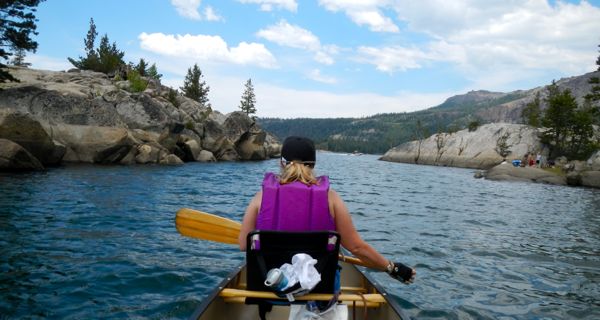



Silver Lake provides ample fun for boaters of all kinds

By Kathryn Reed

PIONEER – It was hard to know where to look while paddling along Silver Lake. The natural scenery was as captivating as the people on their water toys.

At 7,200 feet, this lake in the Eldorado National Forest sits below Carson Peak. Scattered about are smooth granite “beaches” filled with sunbathers. Pockets of sand are interspersed with the rocks.

A few submerged rock islands make it appear as though people and their dogs are walking on water.

Sue Wood glides along Silver Lake. Photos/Kathryn Reed

At times the lake is so smooth, the glassy water looks like one could walk across it. And in some ways one could say the water skiers were doing just that.

A sport I had not witnessed before was a “surfer” being pulled by a ski boat. Sometimes the person held a rope like a skier would, and other times let go to balance like a surfer and ride the wake. The person is just feet from the stern.

Encouragement from observers in the boat had the surfer trying to do a 360 like a wakeboarder would do.

Sitting idle, a couple fishermen had hauled in some trout. Rainbow, browns and Mackinaw call Silver Lake home.

Kayakers dot the water.

Even though motorboats are allowed on this small lake near the Carson Spur, they don’t dominate this body of water. This means being a canoeist or kayaker is a safe endeavor.

Inlets provide pockets of smooth water to explore. Get out early to stake out a spot on shore in one of these sheltered areas.

The only problem was the looming dark clouds moving in from the south. A slight breeze picked up and the water was no longer tranquil. Even Rusty, who was on his first canoe adventure, could tell the ride was becoming a bit more than an E-ticket experience. It was easier to lie down than for him to balance on four legs.

Instead of staying close to shore, as we customarily do, we decided to go across the lake to be close to the ramp before the thunder started booming on this first Saturday of August.

We had the canoe on top of the truck as the rain started to come down and the lightning filled the sky.

This body of water has had plenty of controversy surrounding it. In 2010, the U.S. Forest Service and Eldorado Irrigation District settled on agreements involving land swaps and water rights affecting the campgrounds and lake. Silver Lake was created from flows of the Silver Fork American River.

Getting there:

From South Lake Tahoe, take Highway 50 west. Turn left on Highway 89. Go over Luther Pass. At the T intersection (Pickett’s Junction), go right on Highway 88. You will pass Caples Lake, Kirkwood and the popular Carson Pass hiking-parking area. Turn left on Kays Road to reach the boat launch.

Other things:

• Boat launch is $10.

• Hiking trails skirt the lake.

• Camping is walking distance from the lake.

• Kit Carson Lodge offers real beds.

ngg_shortcode_0_placeholder (Click on photos to enlarge.)


Truckee hotel, TRTA partnering in trail talks

The Cedar House Sport Hotel’s Tahoe Trips and Trails will host a complimentary interactive talk by the Tahoe Rim Trail Association and a variety of guided adventures in Truckee Tahoe and throughout the west.

The Cedar House is the first to join TRTA’s Trailside Inn program. To kick off the partnership, The Cedar House is hosting complimentary refreshments and a virtual hike on the Tahoe Rim Trail presented by TRTA staff members at 5:30pm on Aug. 22.

TRTA’s Mary Bennington and Shannon Skarritt will share stories and information about the Tahoe Rim Trail. In addition to the complimentary trail talk, early this fall author and guide Tim Hauserman will share information from the third edition of his book “Tahoe Rim Trail: The Official Guide for Hikers, Mountain Bikers, and Equestrians.”

For more information, call (530) 548.5010.


TRCD takes the mystery out of gardening in Tahoe

By Courtney Walker

Gardening can be difficult in Tahoe. We have a short growing season, a lot of snow and a lack of water during the summer months. But creating a beautiful garden in Tahoe is possible, and it can help conserve our precious resources.

Many Lake Tahoe residents and second homeowners are confused by all of the environmental restrictions placed on property owners. How can you possibly complete your BMPs, do your defensible space and save money on your water bill, all while having a beautiful garden? You can do all of this and more by using conservation landscaping techniques. Conservation landscaping preserves and protects our natural resources using sustainable gardening and landscaping techniques. It promotes wildlife habitat, erosion control, water conservation, healthy soil, clean air and water – including Lake Tahoe.

Conservation garden tour on Aug. 19 to provide tips for Tahoe residents. Photo/Provided

Choosing conservation landscaping practices will enhance the look and functionality of your property while not taxing our environment. Landscapes that integrate these practices are also typically more cost efficient and require less maintenance and fertilizers.

1. Go native: Native species thrive in Tahoe’s climate. They prefer drier conditions in the summer and being buried in snow during the winter. By using native and Tahoe adapted plants, your landscape will use much less water than other vegetation like turf.

2. Do the drip: Micro-irrigation is water efficient because it delivers water directly to plants’ root zone, minimizing water loss due to runoff, wind, overspray and evaporation.

3. Save your soil: By installing your best management practices (BMPs), you protect your soil from water and wind erosion and keep it out of Lake Tahoe. Up to a ton of soil can be lost in one year on an average Tahoe property without BMPs installed

4. Create space: Creating defensible space around your property will make it more fire resistant. This can be achieved through proper plant selection and creating a mosaic landscape of vegetation, rock and mulch, which breaks up a fire’s ability to move across the landscape.

5. Invite in the wild: Use a variety of native plants and features to attract our local hummingbirds, butterflies and bees.

6. Grow your dinner: Even though not all fruits and vegetables can handle our short growing season, there are plenty of edibles that can — including herbs and cool season vegetables.

The Tahoe RCD provides many grant-funded resources to assist you with your conservation garden through conservation landscaping services available to California Lake Tahoe Basin homeowners. Our staff provides one-one-one, site specific advice to help homeowners meet their individual goals. While landscape design is not included with this service, homeowners will be able to learn about project planning and site analysis, soil preparation, irrigation considerations and proper plant selection and care. For additional resources or to request an on-site visit, please visit our website or call (530) 543.1501, ext. 113.

Want to see some examples in person? Join us for the 5th annual Conservation Landscape Tour on Aug. 19 from 1–5pm. Come enjoy and explore nine beautiful gardens in Tahoma area that highlight Tahoe conservation techniques, from lakefront gardens to beautiful, fire-safe landscapes. The tour highlights native and adapted plant selection, water conservation techniques, defensible space methods, BMP demonstrations, edible gardening and wildlife enhancement features.

As you explore the gardens, feel free to ask garden stewards and homeowners questions related to the conservation landscapes and plant identification.

Last year’s event brought together more than 150 Tahoe residents to enjoy a delightful summer afternoon learning about conservation practices and touring beautiful gardens.

There is no fee for this year’s tour, but donations are graciously accepted. Pick up your tour map between 1–3pm from Marie Sluchack Community Park on the corner of Pine and Wilson in Tahoma. The gardens are nearby and we encourage carpooling and walking. Please leave your pets at home.

For more information, contact me at (530) 543.1501, ext. 118 or go online.

Courtney Walker is the conservation planner for Tahoe Resource Conservation District.