Climate change — a topic at zoos, aquariums

By Leslie Kaufman, New York Times

BOSTON — Sitting on an artificial mangrove island in the middle of the ray and shark “touch tank,” Lindsay Jordan, a staff member at the New England Aquarium, explained the rays’ eating habits as children and their parents trailed fingers through the water. “Does anyone know how we touch these animals when we are not at the aquarium?” she asked.

The children’s faces turned up expectantly.

“The ocean absorbs one-third of the world’s carbon dioxide emissions,” Jordan said, explaining that it upsets the food chain. “When you turn on your car, it affects them.”

Downstairs, next to the jellyfish tanks, a rhyming video told how the jellyfish population was exploding in the wild because they thrive in warmer waters. In the main room, a staff member pointed to a rare blue lobster, saying that some lobsters have been scuttling out of Massachusetts and settling in cooler climes to the north.

With many zoos and aquariums now working with conservation organizations and financed by individuals who feel strongly about threatened habitats and species, managers have been wrestling with how aggressive to be in educating visitors on the perils of climate change.

Surveys show that American zoos and aquariums enjoy a high level of public trust and are ideally positioned to teach.

Yet many managers are fearful of alienating visitors — and denting ticket sales — with tours or wall labels that dwell bleakly on damaged coral reefs, melting ice caps or dying trees.

“You don’t want them walking away saying, ‘I paid to get in, I bought my kid a hot dog, I just want to show my kid a fish — and you are making me feel bad about climate change,’ ” said Paul Boyle, the senior vice president for conservation and education at the Association of Zoos and Aquariums.

Some zoos and aquariums have therefore held back, relegating the theme to, say, a sign about Arctic melting in the polar bear exhibit. But many have headed in the other direction, putting climate change front and center in a way that they hope will inspire a young generation of zoogoers.

Working with cognitive scientists and experts in linguistics and anthropology, a coalition of aquariums set out in 2008 to develop a patter that would intrigue rather than daunt or depress the average visitor. After the group was pleased with the script, it secured a grant of about $1 million last year from the National Science Foundation to train staffs across the nation. This month, the foundation awarded the group an additional $5.5 million for a five-year education effort.

Boyle said that most of the association’s 224 members now have some sort of climate message.

The form varies from subtle to pointed. The zoos in Cincinnati and Toledo, Ohio, for instance, have installed prominent solar arrays over their parking lots to power exhibits and set an example. The San Diego Zoo and the Brookfield Zoo near Chicago have made their exhibits of polar bears and other Arctic species more direct about the threats posed by global warming.

So far the feedback has largely been positive, officials at most zoos say.

Ariella Camera, a counselor with a summer program run by Boston Rising, an antipoverty group, said some of her charges recently took part in a game at the New England Aquarium that taught them what emits carbon dioxide (many factories, most cars) and what absorbs it (trees and the ocean). They were then challenged to balance the two.

Afterward the students struck up a lively conversation about their carbon footprints, Ms. Camera said. “It was a very engaging presentation,” she said.

Such anecdotes gratify Howard Ris, the aquarium’s president. “We would like as many people, if not everyone, to leave encouraged to take action,” he said.

Others are dubious that it will work. “Zoos have been making claims about their educational value for 150 years,” said Jeffrey Hyson, a cultural historian and the director of the American studies program at St. Joseph’s University in Philadelphia. The zoos “say a lot more about what they think they are doing than they can really demonstrate.”

Zoo managers acknowledge that they initially struggled with the challenge of delivering bad news.

In the 1980s and ’90s, Dr. Boyle noted, some zoos and aquariums made a big push to emphasize threats like the depletion of the earth’s ozone layer, the razing of rain forests by loggers and farmers and the overfishing of the Pacific. Electronic boards toted up the numbers of acres being cleared, and enlarged photographs depicted denuded landscapes.

Surveys of visitors showed a backlash. “For lots of reasons, the institutions tended to approach the issues by talking about the huge scale of the problems,” Dr. Boyle said. “They wanted to attract people’s attention, but what we saw happening over time was that everyday people were overwhelmed.” It did not help that a partisan split had opened in the United States over whether global warming was under way, and whether human activity was the leading cause.

At the Georgia Aquarium in Atlanta, Brian Davis, the vice president for education and training, says to this day his institution ensures its guests will not hear the term global warming. Visitors are “very conservative,” he said. “When they hear certain terms, our guests shut down. We’ve seen it happen.”

Such hesitancy inspired the group of leading aquariums to develop, test and refine their model, which comes off as casual and chatty.

Word choices matter, research showed. The FrameWorks Institute, a nonprofit organization that studies how people process abstract concepts, found the phrase “greenhouse gas effect” perplexed people. “They think it is a nice place for plants to grow,” said FrameWorks’ president, Susan Bales. So her group advised substituting “heat-trapping blanket” to describe the accumulation of gases in the atmosphere.

Today’s guides also make a point of encouraging groups to focus first on the animals, leaving any unpleasant message for later.

At the New England Aquarium’s giant reef tank, visitors peered over the side and watched sand tiger sharks, sea turtles and tropical fish swim around a giant coral reef. As a diver entered the tank to feed the fish, a guide explained that the smaller ones tend to hide in coral for safety.

A few minutes passed before she told the crowd that corals around the world are bleaching and dying because of a pronounced rise in ocean temperature and acidity.
Read the whole story


Act fast to ensure having camping spot for Labor Day weekend

By Barbara Barte Osborn, Sacramento Bee

Tahoe National Forest officials are advising visitors to act quickly if they want to secure a campsite for the Labor Day holiday.

“This is one of the big weekends of the summer, and campgrounds, picnic sites and trail systems are expected to be busy,” forest spokeswoman Ann Westling said Monday.

Westling advised making reservations for the most popular campgrounds. Many have some first-come, first-served sites, but it would be best to arrive Thursday or Friday if one is hoping to secure one of those, she said.

Most campsites can be reserved by calling 877.444.6777.

All recreation sites in the forest will be open for the holiday, but the forest is very dry this summer and visitors are urged to be especially careful with fires, Westling said.

Fire restrictions are in effect, limiting campfires to developed campgrounds. In the backcountry, portable propane stoves can be used with a free campfire permit that’s available at all Forest Service offices.

New this year at many campgrounds are bear-resistant food lockers, which have been “very successful – virtually eliminating bear problems,” Forest Supervisor Tom Quinn said in a news release.

Read the whole story


Lab kills trees to learn how to save them

By David Gilkey, NPR

The droughts that have parched big regions of the country are killing forests.

In the arid Southwest, the body count is especially high. Besides trying to keep wildfires from burning up these desiccated forests, there’s not much anyone can do. In fact, scientists are only now figuring out how drought affects trees.

Park Williams studies trees at the Los Alamos National Laboratory in New Mexico, but not the way most scientists do. “We’re interested in trees that die,” he says — specifically, death by heat and drought.

Sure, lack of water kills trees, but which ones die first, how long does it take, how long can they go without water? “That’s a part we don’t understand very well as ecologists,” says Craig Allen, an ecologist with the U.S. Geological Survey. “We don’t know what it takes to kill trees.”

Allen and Williams have tracked droughts through the centuries. They know there’ve been bigger droughts than the one we’re in now, but not many. And Williams says this one is different. “In past droughts, temperatures always rebounded and precipitation rebounded and went to a wet time,” he explains. “What we have now is a gradual trend toward warmer temperatures.”

Climate change is making the region ever hotter. And when you have consistently hotter weather, the atmosphere gets thirsty — it sucks water out of the ground and out of plants. You get more droughts, and deeper droughts. There’s less water for everything.

Computer models of climate change predict that this region will warm by several degrees before the century is out, and Allen says the “new normal” will look like the worst of the past. “So it suggests basically that the main tree populations on our mountains will die,” Allen says. “They will not be able to survive there. It doesn’t mean there won’t be any trees anywhere on these landscapes, but it means the current dominant trees will die.”

Which ones survive, and how many, is the subject of research at the Los Alamos lab.

Read the whole story


Adventure Trail Run at Kirkwood on Labor Day weekend

The 32nd annual Kirkwood 5K/10K Adventure Trail Run is Sept. 1 with a one mile and a half mile fun run for kids at 9am. The 5K and 10K will start after the fun run.

The races are presented by the Tahoe Mountain Milers Running Club and the Kirkwood Volunteer Fire Department.

Race registration forms are available at: CV Sports in Carson City; Kahle Community Park in Stateline; South Lake Tahoe Recreation Center in South Lake Tahoe; and Eclipse Running in Reno; or by calling (775) 588.2864; or online.

Race day registration will be at the Kirkwood Main Lodge beginning at 8am for $40.

Proceeds from the race benefits the Kirkwood Volunteer Fire Department.


‘Miserable Champion’ — the Shaun Palmer story

By Sal Ruibal, Bike

In 1998, I wrote a front-page cover story for USA Today that posed the question: “Is this man the world’s greatest athlete?” That man was mountain bike-snowboard-motocross-punk rocker Shaun Palmer of South Lake Tahoe, and that story shocked the sports world.

The traditional sports establishment wet their seersucker trousers in anger: USA Track and Field cried that only the current world-record holder in the decathlon could wear that crown. Major League sports fans cried in their Lite Beer because Bo Jackson was a pro football-baseball star. The Earth moved.

Fast-forward to 2012 and the idea that an action sports athlete could be the best in the world isn’t shocking, it seems normal. Shaun White, who trains at Northstar in Truckee, lights it up at Winter and Summer X Games while snatching a bunch of Olympic gold medals. He’s looking beyond little wheels and half-pipes these days.

Travis Pastrana? If it has wheels and he has bones, give him something to break. One of the scariest rides I’ve ever been on was in a U-Haul truck with Travis at the wheel.

But neither of those guys were true punk rockers in the heyday of that genre. If the only thing The Palm ever did was scream and shout with Fungus, he would still have a spot in the Crazy MoFo Hall of Fame.

Finally, after many years of frustration and cinematic near death, the Shaun Palmer movie is out there for your viewing pleasure. Brad Holmes’ film, “Shaun Palmer: The Miserable Champion”, is a horror show and a Saturday morning Superman cartoon blended with a Sex Pistols live show and a donkey demolition derby. The flick won Best Biography at the 2012 X-Dance Action Sports Film Festival.

Read the whole story


Mountain lion released near Spooner Summit

By Martin Griffith, AP

A mountain lion that was caught after trying to enter a Reno casino is back in the wild.

The 2-year-old male cougar was released into the Carson Range above Lake Tahoe’s East Shore on Saturday morning, said Chris Healy, spokesman for the Nevada Department of Wildlife.

“He was fully ready to go,” Healy said. “He was feisty in the trap and snarled if you got too close. Once he decided to go, he quickly ran off into the underbrush and was gone.”

Guests at Harrah’s reported seeing the 100-pound cat trying to walk into the casino around dawn Friday morning. When the animal couldn’t negotiate the revolving door, it hid under an outdoor stage where it was tranquilized and captured.

Wildlife officials speculate the cougar was chased out of the nearby Sierra Nevada foothills by the drought or by an adult cat that didn’t want competition for a mate. They believe the cat followed the Truckee River into Reno.

Mountain lion sightings have been reported around Reno in the past, Healy said, but not in the downtown casino area.

Wildlife biologists say the Carson Range is good mountain lion habitat that features an abundance of mule deer and smaller prey in the summer.

“The mountain lion is unlikely to stay in any area until it finds an area of its own,” Healy said.

The cougar was fitted with a collar that will track its movements, and officials hope it stays in the wild.

“The best-case scenario is we never see it or hear from it again,” Healy said, adding the cat probably would be euthanized if it turns up in a city again.

The mountain lion was released a couple miles south of Highway 50 in the Spooner Summit area.


LTWC golden eagle release open to the public

Lake Tahoe Wildlife Care will be releasing the first golden eagle of the season Aug. 26 at Carson Pass.

Everyone is invited to see what exactly the third “R” of wildlife rehabilitation is all about.

Every bird and animal that is received by LTWC has one goal — release.

Meet at LTWC (1485 Cherry Hills Circle off Elks Club Drive in Meyers) at 11am to carpool to Carson Pass. The release should take place about 11:30am.

For further information, call (530) 577.2273.


Private property owner threatens completion of Sawmill bike path

By Kathryn Reed

Sawmill bike path may never be completed.

“They make some offers and some threats, but I’m not interested in them,” Cass Amacker told Lake Tahoe News. “They don’t want to pay me nothing for buildable property.”

Amacker for years has owned a 20-acre parcel off Sawmill Road.

Sawmill bike path goes for seven-tenths of a mile before needing to get on the road. Photos/Kathryn Reed

Part of his property is being sought by El Dorado County so the remaining nearly 1.3 miles of trail can be constructed. Earlier this summer about seven-tenths of a mile was put in which had nothing to do with the Amacker property.

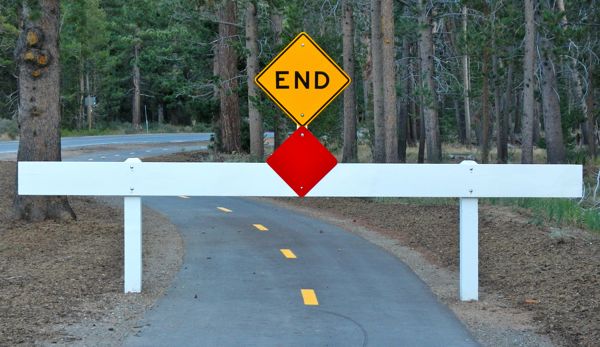
It’s a curvy trail that meanders just off Sawmill, almost into a wooded area. It meets all the current bike requirements of being 10-feet wide, with 2-foot shoulders. But it abruptly stops with a big white fence and yellow sign that says “End”.

County officials don’t want it to end there. The whole idea of the Sawmill path is to have it link up with the bridge on Highway 50 that crosses the Upper Truckee River before the path takes cyclists and walkers to Meyers.

Brendan Ferry, senior planner with El Dorado County, remains optimistic a resolution with Amacker and the other private property owner along that stretch of roadway will be found so that section of bike trail can be finished next summer.

But those agreements will need to be in hand by the end of the year in order to request the Congestion Mitigation and Air Management funds from Caltrans, and have the Board of Supervisors approve a bid package and then award the contract to a company. Plus, with the next portion being longer, it will require more time to build it so everything needs to be in place that much sooner.

Regarding the negotiations with the Amackers, Ferry told Lake Tahoe News, “I can’t speak too much about it because there is a lot of legal stuff. The right-of-way process is very defined and confined, and involves a lot of legalese, money and contracts.”

Amacker said the county wants 3 acres.

Where the trail goes on Amacker land the whole width of the path is on their property. Whereas the adjacent private property next to the California Tahoe Conservancy parcel, which is at the corner of Sawmill and Highway 50, comes with a dedicated right-of-way from Incline Road to the Highway, so less of their land is needed.

“I don’t see any problems (with the other property),” Ferry said in terms of securing right-of-way agreements.

A small drainage easement is being sought on both properties because of an existing pipe.

Plans for the remainder of the Sawmill Trail are 80 percent designed.

Amacker contends the county and agencies, which he did not name, have cost him too much money and land in the past, so he is not willing to give his land away now. And he added that even if a price were settled on, that doesn’t mean he’ll ever sell.

Amacker told Lake Tahoe News his land is zoned for a 40-unit apartment complex, so he wants to be compensated for the land’s potential, not for bare soil and trees.

However, Carl Weiland, El Dorado County assessor, said the Amacker ranch is zoned TR1. That would make it capable of having a single-family residence.

“I don’t see anything saying he can have apartments,” Weiland told Lake Tahoe News.

The ranch falls under Plan Area Statement 119 of the Tahoe Regional Planning Agency. The allowable uses are residential (not multi-family, which is what apartments fall under), recreation, resource management, and public service.

While the county and Amacker keep talking, the county is also working on plans to develop bike paths along Lake Tahoe Boulevard that would connect to the existing Sawmill path.

Ferry would like to do both sections of that route in 2014, though funding could force it to be built in phases. All of that land is publicly owned and deals are in place for it to become a reality.

The trail will require cyclists to come off the Sawmill Path and cross Lake Tahoe Boulevard. Going right, toward South Lake Tahoe, the path will be built on the dirt U.S. Forest Service trail that already exists. To the left, it will be adjacent to the roadway. It will tie into the class 2 bike trail that ends at Clear View Drive.

ngg_shortcode_0_placeholder (Click on photos to enlarge.)


Marmot found in Bay Area on its way back to Tahoe

By KTVU-TV

SAN JOSE — A marmot that found himself far from his natural mountain habitat in a residential San Jose neighborhood Tuesday has been captured and wildlife workers intend to return him to the Sierra Nevada range.

Wild animal expert Rebecca Dmytryk said the marmot was finally captured in San Jose’s Willow Glen neighborhood after it hid in storm drains for hours, coming up only to snack on nearby lawns.

Dmytryk, director of the WildRescue, a Moss Landing-based animal rescue group, had earlier placed apples, carrots and nuts inside “a humane trap” to coax the squirrel-like creature, but the animal preferred to dodge onto front lawns to eat and then run and hide.

The yellow-bellied marmot, so named for its mixture of yellowish and brown fur, was first spotted Monday after it emerged from a storm drain. The animal had been jumping from gutter to gutter since, racing through the drainage pipes beneath the streets, said Dmytryk.

Department of Transportation workers finally helped push it out of a pipe using a Gatorade bottle, Dmytryk said, and scooped the marmot with a net once it was pushed free.

Now the cat-sized mammal is headed to the Wildlife Center of Silicon Valley and on Wednesday traveled to Sacramento en route to Lake Tahoe, where animal care workers will give it a checkup before releasing the animal back into the wild before it needs to hibernate, Dmytryk said. “It’s very important he gets back to his own habitat,” she said.

Read the whole story


Downhill skiing no longer just a winter sport

By Laura Vozzella, Washington Post

LYNCHBURG, Va. — It looks like God’s country from high atop the hill they call Liberty Mountain, with sunbeams slicing through puffy clouds overhead and the school that Jerry Falwell built nestled at its foot.

But the hill itself seems to be more of a deal with the devil. Because it’s August. In Virginia. And despite scorching heat, skiers and snowboarders and tube-riders are swooshing down a white slope like it’s winter in Vail, Colo.

The Liberty snowflex center is one of the few places in the world that you can ski or snowboard year-round. Snow isn’t necessary thanks to an astroturf-like material called “snowflex” that replicates the feel of snow.

The Liberty snowflex center is one of the few places in the world that you can ski or snowboard year-round. Snow isn’t necessary thanks to an astroturf-like material called “snowflex” that replicates the feel of snow.

If there’s anything in Leviticus against planting one foot in summer and the other in winter, the pious souls at Liberty University have turned a blind eye.

“We were water skiing in the morning, and now we’re snow skiing in the afternoon,” marveled Jim Gooding, 43, who works in the District as a government contracts administrator. He had just taken his first few runs down the synthetic ski slope at the Liberty Mountain Snowflex Centre.

Blanketing 1.5 acres of steep hillside above the university is Snowflex, a $150-per-square-foot material that looks like a bristly plastic doormat and mimics the “slip and grip” of snow. Liberty is the only place in this hemisphere to build a ski resort out of the stuff, which was invented in Europe and has caught on more there.

That has made Lynchburg, which at the height of winter averages less than five inches of snow a month, the only place in North America besides Mount Hood where it’s possible to ski in the summer. The town has even become an unlikely stop on one professional skier’s globe-

trotting training itinerary.

“I’ll be honest with you: This is not snow,” said Drew Sherwood, the center’s general manager. It would have been an obvious truth on a hot August afternoon if it weren’t for the skiers rushing past.

“We tell people — we’re honest — it’s never going to be as good as snow,” he said. “And the feeling of snow, when you’re out on a fresh powder day, riding through snow — it’s never going to be like that. But when you’re talking spring, summer and fall, when 99 percent of other ski resorts are closed down, it’s the best feeling you can have.”

Read the whole story