IMBA to teach sustainable trail building class in Incline

The International Mountain Bicycling Association’s Subaru/IMBA Trail Care Crew will be in Incline Village Sept. 7-9 to share sustainable trail building techniques and more with local mountain bikers, land managers and recreation specialists.

The visit, which was requested by the Tahoe Area Mountain Biking Association, is one of about 70 stops on the 2012 schedule. Everyone is invited to attend the weekend’s events. There is no cost, but preregistration is requested.

The Tahoe visit will include the Better Living Through Trails presentation on Friday that focuses on the health, economic, and social benefits of trails to a community. On Saturday, the crew will spend the morning teaching attendees about the proper techniques of trail building with actual hands-on trail work in the afternoon on the U.S. Forest Service’s Tyrolian Trail.

The Trail Care Crews teach “sustainable” trail building, which means building lasting trails that require minimal maintenance. This helps reduce trail damage, protects the environment and enhances visitor enjoyment. The Crews travel in new Subaru Outbacks provided by Subaru of America. The company has been IMBA’s leading sponsor since 1997.

For more information and to register, go online.


California parks to be featured in 2-part TV series

Award-winning production company Backcountry Pictures’ latest project, “California Forever”, will air nationally on PBS stations throughout the fall, beginning in California in September.

“California Forever” is a two-part television special that tells the story of California’s state parks from 1864 until present day. Episode one of “California Forever” highlights the discovery and creation of California’s state parks system, taking viewers on a scenic, cultural and historical tour of California’s state parks. The second episode presents the very real challenges that the state parks are currently facing, including habitat destruction by overuse; protection of native species at the expense of recreation; reclaiming industrial brown fields to create new parks in dense urban areas; and park closures.

“California Forever” was produced over two years, and comprised 70-plus days of shooting at more than 45 state parks, including complex indoor settings such as Hearst Castle and the California Railroad Museum, as well as vast outdoor spaces like Yosemite and the California Coast. From the majesty of Lake Tahoe to the arid inspiration of the Anza Borrego Desert, the filmmakers bring the vibrant California State Parks to life.


X Games eliminating two of the longest running events

By Devon O’Neil, ESPN

Two of the longest-running competitions in X Games history, winter’s Snowboarder X and Skier X, will not be part of the show when the X Games return to Aspen in January 2013. ESPN decided to cut the events, as well as Mono Skier X, and will not build the X Course for the first time in history.

Snowboarder X was one of three events that had taken place every year since the Winter X Games debuted in 1997, along with Snowboard Superpipe and Slopestyle. Skier X had been staged 15 of those 16 years, starting in 1998. Mono Skier X was added to the docket five years ago.

“These decisions are never easy, obviously,” said Tim Reed, senior director of content strategy for ESPN X Games. “We understand the ramifications these things bring. We come up with what we believe are the best events to showcase to our fans on-site and obviously the networks, too.

“There wasn’t one single factor that led to this decision. It just comes down to filling the schedule with how much we believe we need to make the event enjoyable to the fans and deliver on what we need from a product standpoint.”

Meanwhile, two events that were dropped last year, Snowmobile SnoCross and Speed and Style, are returning to the 2013 Aspen schedule. SnoCross had been featured for 14 straight years before it was omitted from X Games Aspen 2012.


Endurance swimmer to take on Lake Tahoe

By Lou Fancher, Contra Costa Times

To kick off his Labor Day weekend, Lafayette’s Jamie Patrick is taking a 360-degree spin around Lake Tahoe, in Lake Tahoe.

Last year, the 41-year-old athlete swept down the Sacramento River on a 111-mile swimming trek. The year before, it was back-and-forth-and-back across Tahoe. And recently, he swam from Spain to Africa, then came home to spend 12-hour overnights, training in Lafayette’s Springbrook pool.

You could call him fond of water.

Which is why he’s pairing up with the Sierra Club’s Water Sentinel Program.

“In the previous swims, I raised money for Buena Vista, a local literacy program,” Patrick said. “For this swim, I wanted to do something for water. It’s so right up my alley; they help people get out, enjoy water, and want to take care of it.”

A graduate of Miramonte High School and an All-American swimmer while at the University of Hawaii, Patrick has an athletic resume as long as his wingspan.

“I do these things to go beyond what I’ve done before,” he says, shrugging off more complicated reasoning.

He and his 15-person crew have already raised $2,000 in four days since the campaign began. One hundred percent of the donations will go to the Sierra Club.

To make it easy to support his cause, he’s partnered with Metabender, an athletic tracking company, to develop a portal through which people can follow his swim in real time GPS, with stats, crew updates, videos and a comment option.

Read the whole story


Sensors for brain injuries may help future athletes

By Anne Eisenberg, New York Times

Football teams of the future — even high school squads on limited budgets — may someday have a new tool to check players for brain injuries. It’s a special form of headgear, packed with sensors that read the brain waves of athletes after they come off the field, thus detecting changes caused by the trauma of hard knocks.

The compact, portable sensors decipher neural activity by measuring changes in the brain’s tiny magnetic field. These small magnetometers — still in the laboratory and in prototype — have yet to be tried on athletes. But their potential is enormous for brain imaging and for inexpensive monitoring of brain diseases, as well as for many other applications like the control of prosthetics, said Dr. José Luis Contreras-Vidal, a professor of electrical and computer engineering at the University of Houston.

Contreras-Vidal’s research includes work on a system that will use brain signals to control prosthetic legs.

“This is a transformative technology” that could make brain interfaces available at a small cost, he said. “We could potentially use these devices to record in real time brain waves that could be analyzed for specific diseases such as Alzheimer’s, or the progression of these diseases.”

The research is occurring at a time of growing concern about collisions and subsequent brain injuries in sports — and the dire effects that may show up only many years later. But an inexpensive system for spotting changes in brain behavior could play an important safety role one day in boxing, football and many other sports.

The magnetic sensors, part of a field called optical or atomic magnetometry, were created at the Commerce Department’s National Institute of Standards and Technology in Boulder, Colo., by Svenja Knappe and colleagues.

Read the whole story


TRTA looking for people for trail camp

Tahoe Rim Trail Association’s final Backcountry Trails Camp is Sept. 15-16.

Camp will be near Barker Pass on the west side of the Lake Tahoe Basin. Volunteers of all ages and skill levels are welcome to attend.

Food will be provided, but in order to offset this cost the camp is $40. Scholarships are available. Families are welcome, and children’s camping equipment is available upon request.

For more information or to register, call Morgan Fessler at (775) 298.0232.

Volunteers must bring their camping equipment, and must wear long-sleeved shirts, long pants, boots and work gloves. The Tahoe Rim Trail Association will provide hard hats, trail tools, volunteer kitchen staff, and crew leaders to guide and support trail work.


Scientists digging around Tahoe to gain info on earthquakes

By Jeff Maher, News 10

TAHOE CITY — Is Lake Tahoe due for a big earthquake? If so, will a large tsunami follow? That’s the question a research team is literally digging to answer.

The team is using advanced technology to collect ancient evidence, including core samples from the Lake’s deepest points.

This is an average geological expedition, then again, Lake Tahoe is not an average place.

“We’re just about to go out and do some water column sampling.” Professor Ross Powell said as the team was getting ready to head out from the shore.

The research team, made up of geologists from the California Geological Survey, Northern Illinois University and the UNR, are on a mission to find out the potential effects of a large-scale earthquake hitting the Lake and what kind of tsunami the lake could produce.

Some of the drilling technology the team will use is being tested at Lake Tahoe for an upcoming expedition in Antarctica, which will investigate how life under the ice is being impacted by global warming.

Read the whole story


History, nature lessons of Squaw unfold on free hikes

By Kathryn Reed

OLYMPIC VALLEY – Three golden eagles soar overhead. But from this vantage point of more than 8,200 feet, it’s already a bit like having a bird’s-eye view.

Dave, our guide on this free hike out of Squaw Valley’s High Camp, has us looking up at the peaks, down at the flowers and out at the vast expanse of granite.

Like many who came for a winter to ski, Dave has been here 23 winters. While his main job is working in mountain operations, including a trip this month to Peru to find employees for the season, on this particular August Saturday he is taking a group on an hour hike.
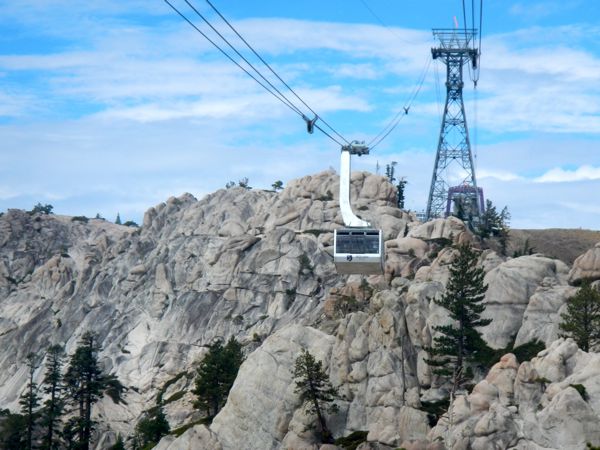
A trip to the top of Squaw opens up miles of hiking trails. Photos/Kathryn Reed

It’s part history lesson as we learn about the humble beginnings of the ski resort that opened Thanksgiving Day 1949 to becoming the unexpected host of the 1960 Winter Olympics to today’s changes as evidenced by lifts being removed and others being installed.

Those Games were the first to be televised.

“It was like a 12-day commercial for Squaw,” Dave tells us.

As Dave put it, this was back in the day when California was thought of as the land of oranges and surfing. It was not a skiing destination. It wasn’t home to multiple winter Olympians.

It was the late Sandy Poulsen who helped name the legendary KT-22. It took her 22 kick turns to get down the mountain.

White pines and mountain hemlock are the predominate trees at this elevation.

With last winter not producing much white stuff, the wildflowers have been less than vibrant. Still, even this month some were dotting the landscape – yarrow, Indian paintbrush, mule’s ear, pennyroyal, and fireweed.

Dave takes off some mountain sage leaves so we can find out it smells just like the spice.

Plenty of hiking opportunities abound. The later guided hike often entails going to Emigrant Peak (8,700 feet), but time does not allow for that on the first excursion. It’s another 30 minutes from our turning around point, which is at the Gold Coast chairlift.

Dave says from Emigrant Peak – if it’s a super clear day – the Bay Area peaks of Mt. Diablo and Mt. Tamalpais are visible.

Plus, the Pacific Crest Trail goes through the area. The Granite Chief Wilderness has numerous trails. Hikers can even reach High Camp from the village area, which would mean an elevation gain of 2,000 feet.

While we didn’t work up much of a sweat on this cool summer day, we still wanted to catch some rays by the pool and listen to the band. A bar at the pool supplies drinks, but just outside the gate is food at the café.

The pool is an ideal setting to relax. For those who want to keep playing, the High Camp area offers roller skating (ice in the winter) and paintball.

Things to know:

• Guided hikes leave from the grassy area just outside the High Camp building. Hikes are at 12:30pm and 2:30pm on weekends through Sept. 23, and on Fridays through Sept. 9.

• Cost for adults to ride the tram is $29, to use the pool-hot tub is $15, and to do both is $41.

• Tram is free for downloading if you’ve hiked up there.

• High Camp Run (5K or 10K) and Pool Party is Sept. 15 beginning at 11:30am at High Camp. Cost is $30 in advance or, $35 that day.

More info is on Squaw’s website.

ngg_shortcode_0_placeholder (Click on photos to enlarge.)


Sawmill Pond ready for weekend anglers

Sawmill Pond was stocked with 650 pound of rainbow trout on Aug. 29.

This fishing spot on the corner of Lake Tahoe Boulevard and Sawmill Road on the South Shore is for youth 14 and younger.

It’s recommended a limit of two fish per child.

For further information, call Tahoe Fly Fishing Outfitters at (530) 541.8208.


Blue moon on the horizon

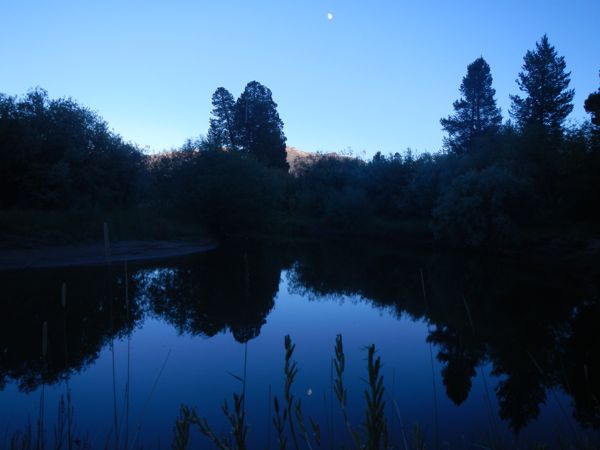
Look for the blue moon on Aug. 31. Photo/Kathryn Reed

Be sure to check out the full moon on Aug. 31. It’s a blue moon.

The moon won’t actually be blue. This moon gets it name from being the second full moon of the month.

The next time this will occur is July 2015.