Study: Dogs help keep microbes from taking over beaches

By Naomi Lubick, Science

If you spent time at the beach this summer, you probably encountered seagulls screeching overhead and eating trash. You probably also encountered their poop.

Seagull droppings can carry disease-causing microbes like Escherichia coli and Enterococcus, which can contaminate beaches and water. Now scientists have found a way to fight back: Release the hounds.

In a new study, researchers show that unleashing dogs keeps the seagulls away—and the water at the beach free of microbes.

Beach managers have been fighting seagulls for decades. The more birds, the more microbes, and the more likely the beach will meet the guidelines for closing, as advised by the Environmental Protection Agency.

In a recent study, researchers from the U.S. Department of Agriculture tried reducing gull populations on Chicago beaches by “oiling” their nests — spraying oil on the eggs to prevent the birds from hatching. That tactic had some short-term success, but its long-term benefits are unclear. Chicago beach managers have also used dogs to chase away gulls, which anecdotal evidence suggests has helped reduce the microbe counts and thus the number of beach closures.

To more definitively connect the gulls’ dog-inspired dispersal to microbe concentrations, a team of researchers led by Reagan Reed Converse, an environmental microbiologist at EPA in Chapel Hill, N.C., examined water quality at North Beach in Racine, Wis.

During the summer, managers regularly “groom” the beach, located on the shores of western Lake Michigan about 100 kilometers north of Chicago, by turning over the sand, which buries any microbes left from bird poop. North Beach’s managers have also worked to remove other sources of pollution, such as sewage runoff, leaving the gulls as the primary source of contaminants in the water.

Read the whole story


2 STHS students to represent U.S. in international forestry competition

South Tahoe High School seniors Emily Barnett and Tyler Myers are going to Russia to present their field research project “The Effects of Fire and Forest Thinning on the Biodiversity of Understory Plants in the Lake Tahoe Basin” at the 9th annual International Junior Foresters’ Competition.

Their project was selected by the U.S. Forest Service International Programs office in Washington, D.C., to represent the United States.

The competition is in Moscow Sept. 12-14.

This annual event brings together youth from nations around the world to promote and reward young scientists for their interest and efforts in the environmental field and encourage international dialogue concerning forestry issues.

This year, 60 students from 32 countries will be competing. An international panel of 15 forestry experts will judge the students’ projects. This is the first time the United States will attend the competition.

Barnett and Myers’ project grew out of their participation in the Generation Green Program, a student club advised by teacher Maria Luquin and the Forest Service’ Lake Tahoe Basin Management Unit’s Conservation Education Specialist, Joy Barney. Through this program, they learned of a summer internship opportunity with the LTBMU, and in 2011 worked as members of the Youth Conservation Corps. The internship motivated them to assume the leadership of the Generation Green Club during the 2011-12 school year.


Forest Service meeting to explain Fallen Leaf Lake trail plans

The U.S. Forest Service Lake Tahoe Basin Management Unit will host a meeting Sept. 19 to explain answer questions about its plan for trails in the Fallen Leaf Lake area.

The Fallen Leaf Lake Access and Travel Management Plan seeks to improve the recreation experience for residents and visitors, while protecting its natural, cultural and historic resources. LTBMU is asking for public input on the plan and alternatives developed in response to public comment.

Under the plan, the LTBMU would expand and improve public parking and access and install water quality best management practices at existing and proposed parking sites. The project would improve the trail system to provide access to popular destinations, while reducing congestion and user conflict.

Many trails would receive BMP upgrades to meet current Forest Service standards, while others are proposed for decommissioning. A primary difference among the six alternatives is how they would address the existing bridge over Fallen Leaf Lake dam and the Taylor Creek stream crossings, the issue that drew the most public comment.

The meeting will be from 6-8pm at the Forest Supervisor’s Office, 35 College Drive, South Lake Tahoe.

The draft environmental assessment is available online or call (530) 543.2694. The Forest Service will accept comments through Oct. 12.


Tahoe Fat Tire Festival lineup solidified

Mountain bikers from all over are expected to be at Squaw Valley Sept. 20-23 for the return of the Tahoe Fat Tire Festival.

The festival is being brought back by the Truckee Trails Foundation and Tahoe Area Mountain Biking Association in an effort to promote the Tahoe area and to create a fundraising event to support trail projects.

Presented by New Belgium Brewing, Barefoot Wines and the North Lake Tahoe Convention and Visitors Bureau, the festival will include five race events, a mountain bike stage race, group mountain bike rides, skill clinics, vendors, movies, trail work classes, and music. Squaw Valley will be opening its bike park and trail network for the four days of the festival.

The festival kicks off that Thursday night with the short track race through the Village at Squaw Valley. Friday brings the hill climb race from the village to High Camp. Saturday will be the Sierra Cup Regional Championship Series Cross Country event and the Nor-Cal State Downhill Championships. The festival wraps up on Sunday with a Super-D race featuring more than 2,000 feet of descending.

During the festival, there also will be group rides on and off-site, beginner and intermediate skill clinics, a mountain bike film festival, and trail work classes.

For more information and to register, go online.


Fishing derby in Tahoe Paradise

The 10th annual South Lake Tahoe Moose Lodge Kids Fishing Derby is Sept. 16 form 7am-2pm.

The event is open to all ages at Tahoe Paradise Park’s Lake Baron.

Donations are gladly accepted and greatly appreciated to assist in providing items such as fish, bait, poles, tackle, prizes, and food for the kids.

For more information call, (530) 541.1632.


Autumn Fest celebrates sustainability in Tahoe

The Tahoe Resource Conservation District will host the 6th annual Autumn Fest at the Lake Tahoe Demonstration Garden, located at Lake Tahoe Community College from 11am-4pm on Sept. 16.

The free festival, run in cooperation with LTCC, includes activities for all ages.

This is a celebration of sustainability, gardening and the seasons in Tahoe.

Autumn Fest will feature live music, a silent auction, a local artisan market and food vendors, crafts and games, pony rides and talks on backyard conservation landscaping and local environmental issues. New this year is the plant swap — donate a plant, swap a plant, or donate for a plant — to highlight native and Tahoe-adapted varieties.

Autumn Fest is a zero-waste event. South Tahoe Refuse Co. and Full Circle Compost of Carson City are donating their recycling and compost services to help keep Autumn Fest environmentally sustainable.


Bike path at Camp Rich to be off-limits for a week

The U.S. Forest Service Lake Tahoe Basin Management Unit will resume work on the Pope-Baldwin Bike Path — also known at the Camp Richardson path — the week of Sept. 17.

The Pope-Baldwin Bike Path is located near the south end of Lake Tahoe and runs along Highway 89 for approximately three miles.

The entire bike path will be seal coated beginning on the west end near Spring Creek.

For safety purposes, sections of the bike path will be closed at times to pedestrian/bike traffic. Work is expected to last approximately one week.

For more information, call (530) 543.2694.


TRTA hike in Van Sickle park

The Tahoe Rim Trail Association is sponsoring a family hike in Van Sickle Bi-State Park on Sept. 14.

Find out about the barn beneath the Heavenly gondola, if the Pony Express rode through the park, and if this area had anything to do with the Gold Rush.

Meet at 10am at the Tahoe Rim Trail kiosk.


Baby bobcat healing with help from LTWC

By Cheryl Millham

On Aug. 25, I received a call from a volunteer about a baby bobcat which was found in the Chips Fire burn area near Lake Almanor.

Ania Wrona, a new LTWC volunteer who lives in the area, took the call and worked with California Fish and Game and the fire crew who found Chips. Ania finally got the OK to go to the fire camp and pick up the bobcat and begin the transportation to LTWC in South Lake Tahoe.

The story of Chips sounds very familiar. Remember four years ago when firefighter Adam Deem picked up a little bear cub – in the Redding area – with four burned paws, all with second and third degree burns from the Moon Fire?
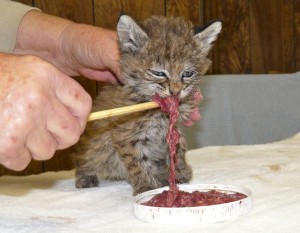
Chips is recovering at Lake Tahoe Wildlife Care so she can be returned to the wild. Photo/LTWC

In this case, a fire crew went back to a burn area and there they saw this baby bobcat going around in circles with its eyes white from ashes from the fire and tears caked. Her little nose was also encrusted with ash.

The fire crew superintendent, Tad Hair, of the Mad River Hand Crew, said they noticed the bobcat was walking in circles.

He said they looked around and did not find any other footprints in the ashes, thinking that a mom would be nearby. The kitten kept following the firefighter and, when they stopped walking, she climbed up on his boot.

The fire crew then took the baby bobcat back to the fire camp. It was then that Fish and Game gave Ania permission to transport the kitten to LTWC.

Ania called and said she would be able to transport the bobcat as far as Sierraville (about 30 minutes north of Truckee). I looked in our transportation book to see who was willing and available to transport this bobcat down to LTWC. I saw a new LTWC volunteer, Sean Bailey, who lives in Truckee and called him to see if he was willing – and able – to help us out. In addition, Sean is a firefighter for Northstar Fire Department.

Sean said he would be happy to meet Ania in Sierraville. I then asked him what a firefighter would do for eyes, heat and ashes. He told me they would irrigate the eyes with sterile water. I asked him to take everything he would need and wash out the kittens eyes as soon as he saw her.

I asked Sean to call Tom when he left Sierraville so he could meet Tom at Spooner Summit for the last leg.

All went well and Tom and the baby kitten arrived at LTWC Saturday night at about 8:30pm. A call was then made to Dr. Kevin Willitts to examine Chips.

Dr. Willitts arrived about 10pm to give a thorough exam and determine what medical procedure we would begin.

The kitten was given subcutaneous fluids and Dr. Willitts cleaned the blistered pads by trimming away all of the burned tissue on all four feet, which had second degree burns. He then medicated her eyes with instructions to continue the ointment three times a day for four days.

Chips had about five burn spots on her fur, but, only one burned through to her skin.

Chips received her name by Tad Hair, so we have kept that same name.

When LTWC received Chips she was about 7 weeks old and weighed just less than 1½ pounds. I would have liked to have given her a bath, but Dr Willitts said he didn’t want her feet to get wet until they have healed.

So, Jolena Hearn, a senior volunteer with LTWC, who was at the center the next day, gave Chips a spit bath that really helped the burn smell on her fur.

Looking at Chips’ teeth, I knew she was able to eat soft food. At this age, her mother would be regurgitating food for her. So, back to what I call Mush Mouse. Chips began eating it with relish.

She has been eating 12 mice a day (three mice per feeding, four times per day). The mice are (are you ready for this) skinned, pounded out and cut up into small bites, after they are chopped up with a cleaver.

Tom has fixed up one side of the aviary with dri-deck, covered with sheets so we can keep her paws dry and clean. This keeps her out of the dirt and on something soft, for her recovering pads. She will be spending a few hours a day outside.

And Chips is now on our webcam (when she is outside, usually in the afternoon).

We expect Chips to fully recover and be released back to the wild.

By the way, she has become quite a celebrity. We have been getting calls from newspapers, radio stations and television stations from as far away as New York City.

Cheryl Millham is executive director of Lake Tahoe Wildlife Care on the outskirts of South Lake Tahoe.


Significant state grant will help S. Tahoe repair bike paths

South Lake Tahoe has been awarded $475,452 in grant funding from Caltrans through the Bicycle Transportation Account.

Several Class 1 bike paths in the city have exceeded their usable life span and are in desperate need of complete reconstruction, which is why the grant was awarded to South Tahoe.

The pathways identified provide key connectivity to various neighborhoods and business districts within the city limits. The rehabilitation project includes full depth reclamation and replacement of approximately 1.97 miles of Class 1 bike trail and will include structural section, paving, striping and signage.

The areas that will receive repairs parallel Highway 50 on the west side from Los Angeles Avenue to Motel 6 and the Upper Truckee River (including bridges); one segment on the east side of Highway 50 from Helen Avenue to the South Y to include Harrison Avenue (Los Angeles to Tulare), Rubicon to Tulare, Eloise to Ponderosa, Silver Dollar to Rubicon, and Helen Avenue to South Avenue and Linear Park.

The total cost of the projects is estimated at $620,452. The city will provide a local match of in-kind engineering services in the amount of $45,000. The South Lake Tahoe Recreation Facilities Joint Powers Authority has pledged a matching contribution of $100,000 through Measure R.