Wildlife officials order 4 mountain lions killed in El Dorado County

By David Bienick, KCRA-TV

RESCUE — Wildlife advocates said Monday that state officials should have considered alternatives after learning they ordered a mother mountain lion and her three offspring to be shot and killed in El Dorado County.

The killings happened last month in the community of Rescue, which is about three miles north of Shingle Springs.

The California Department of Fish and Game said it had received several complaints about the mountain lions and confirmed that at least one domestic goat had been killed by a mountain lion.

Jason Holley, a supervising wildlife biologist for the department, told KCRA 3 it was not clear if all four mountain lions had participated in the kill.

“That may or may not be true, about all four animals killing the animal that was confirmed dead. But what is very likely is that they all fed off of it, and they were all of huntable age, and they could all be killing animals in the area,” Holley said.

Holley said the young mountain lions were about 18 months old — an age at which he said they often leave the protection of their mother.

“Some of these cubs, or sub-adults, looked like they were 60 pounds,” Holley said.

Holley said the department had received a complaint from the owner of a goat herd in the area. He declined to identify the owner.

Holley said the state contacted an agent for the United States Department of Agriculture who confirmed that one of the owner’s goats had been killed by the mountain lions.

Holley said in such cases, state law requires that a permit to kill the animals be issued.

However, the Mountain Lion Foundation, a nonprofit organization based in Sacramento, questioned the decision.

Executive Director Tim Dunbar said the goat owner should have done more to protect his herd.

Dunbar said even if the mother mountain lion had to be killed, the others could have been sent to zoos or wildlife preserves.

“Just off the top of my head, I would say there are 20 or so that are on a waiting list now, that would want to have a cub,” Dunbar said.

He also said in such cases, California should attempt to relocate young mountain lions to other parts of the state.

He said the state of Washington has been successfully doing so for the past two years.

Holley said California officials will attempt to place cubs younger than 4 months.


Tahoe photographer part of expedition using drone in Pakistan

By Rebecca Santana, AP

ISLAMABAD — The use of drones in Pakistan normally brings to mind images of U.S. spy planes attacking tribal areas. But drones now are being used to capture a different kind of picture in the country — showing some of the world’s highest mountains being scaled by world-class climbers through some of Earth’s thinnest air.

Drones, or remote-controlled aircraft, have long been the domain of the American military and are used extensively in Pakistan’s tribal areas near the Afghanistan border to spy on and target militants. Recently, however, civilians have increasingly turned to drones to shoot ground-breaking footage of adventure sports.

This summer a Swiss expedition used remote-controlled helicopters to shoot rare footage of climbers on the Karakoram, one of the world’s most demanding and formidable mountain ranges.

“People are going to see footage from the Karakoram that no human being has ever seen,” said Corey Rich, a photographer and videographer from South Lake Tahoe who was on the expedition.

The expedition was a joint project between outdoor clothing and equipment company Mammut, and Dedicam, a firm that specializes in using remote-controlled helicopters to shoot video. Their goal: to document world-class mountaineer David Lama and his climbing partner Peter Ortner as they climbed Trango Tower. The sheer granite tower in the Baltoro Glacier is more than 6,000 meters (19,685 feet) above sea level and is one of the most technically difficult climbs in the world.

Filmmakers long have used helicopters to capture aerial footage of climbers — as well as other extreme sport athletes like surfers and skiers —that is hard to capture from the ground. But helicopters are costly and can be dangerous if they crash or get too close to the people on the ground. Additionally, their beating rotors often kick up dust, snow and wind — and can push climbers off balance.

Drones, which can weigh just a few kilograms (pounds) and cost between $1,000 and $40,000, are a fraction of the size and cost of the helicopters traditionally used in adventure photography. Newer models tend to have all of their rotors facing into the sky, making them look a bit like a mechanical flying spider or insect.

The main concern for the summertime expedition was how — and if — the drone would perform in Pakistan’s rugged conditions and high altitude.

“The main challenge was that the air is much thinner, and we didn’t know how the flight controls would work with this and the propellers and motors,” said drone operator Remo Masina, from Lucerne, Switzerland. He brought two drones on the Pakistan expedition — one with four propellers and another with six. From the ground, he flew them with a handheld console that resembles a video game console, and wore goggles to let him see the camera’s view.

Another challenge was to find the climbers on the mountain. Tracing the planned trek route, Masina directed the drone up the mountain until he spotted them — more than a mile (roughly 2,000 meters) away.

The result was stunning images of the Karakoram and the climbers making it to the top.

Experienced climbers say the Karakoram puts the rest of the world’s mountain ranges to shame. Neighboring Nepal has Everest, the tallest mountain in the world, but Pakistan has four of the world’s 14 peaks that soar to more than 8,000 meters (26,246 feet) above sea level, including the second highest mountain on earth, K-2.

Lama and Ortner said climbing the legendary Pakistan mountains was an amazing experience.

“Here there are so many mountains, and so many difficult mountains, and mountains that haven’t been climbed,” said Lama. “That’s probably why the Karakoram is known as paradise for us.”

This year has been particularly successful for Pakistan’s climbing industry, which plummeted in the wake of the Sept. 11, 2001, terror attacks in the U.S.

In addition to hosting the renowned Lama for the first time, Nazir Sabir, Pakistan’s elder statesman of climbing who was the country’s first person to scale Everest, said 30 climbers summited K-2 in 2012, the first summits from the Pakistani side of the mountain since 11 people died trying in 2008.

And the drone footage obtained during Lama and Ortner’s climb will expose even more viewers to the legendary Karakoram mountain range.

Drones also increasingly are being used in other adventure sports to push conventional photography boundaries. Cameras on drones have been used to capture video of surfers on Hawaii’s North Shore and to chase mountain bikers speeding down mountain trails.

“I’ve filmed anything from kayaking, rock climbing, mountain biking, to track and field to just casual walking,” said photographer and videographer Mike Hagadorn, who has begun to build his own drones to support his Colorado-based firm, Cloud Level Media. “Anything you can dream of — and as long as you don’t crash — you can make it happen.”

Experts predict drone cameras eventually will become an integral part of every sports shoot. But for now, they’re definitely a novelty. The Swiss team filming Lama said villagers in Pakistan stood in awe, staring at the drones as they buzzed around, whenever he used one on the expedition.

“We were trying to do this shot that showed this quaint village,” Rich said. “But every single person in the shot is standing, stopped in the street, looking up at the helicopter.”


Truckee River Day involves restoration, celebration

Time to grab those gloves, shovels and boots and bring the family and friends out to help restore the Truckee River. The 17th annual Truckee River Day is Oct. 14.

Volunteers will have their choice of half or full day restoration projects with different levels of difficulty. There will be 12 to 15 projects. including re-vegetation at Perazzo Meadows, plantings to help restore areas near the Truckee Legacy Trail, removing aquatic weeds from the Truckee River in Tahoe City, and collecting data for Squaw Creek Restoration.

Projects start at either 9am or 11am and finish between 2 and 3pm.

The River Fair will be from 1-4pm at Granite Flat Campground. This community event is presented by Sierra Watershed Education Partnerships and will feature environmental activities for kids and adults, and the annual fish release at 3pm. There will also be food from Red Truck and live entertainment. Everyone is invited to the fair even if you’re not involved in restoration projects.

To participate in this year’s restoration projects call (530) 550.8760, ext. 1 by Oct. 5.


Kokanee running event targets all abilities

The 23rd annual Kokanee Trail Run is Oct. 7.

Races include 5K, 10K, half marathon, and half-mile kids run.

Run with the salmon at Taylor Creek.

The half marathon begins at 9am sharp, Tadpole Trot kids run begins at 9:30am, and 5K and 10K at 10am.

Register online.

The event is put on by the Tahoe Mountain Milers Running Club in partnership with U.S. Forest Service and Camp Richardson Resort.


Glen Plake roughed up in Nepal avalanche that killed 11

By Steve Casimiro

A massive avalanche struck Manaslu, the world’s eighth-highest mountain, in Nepal shortly before 5am this morning, sweeping through teams of climbers and skiers camped at 7000 meters, including South Shore’s Glen Plake and Greg Hill, both of whom survived. Eleven people have been confirmed dead and as many as six are still missing, among them Plake’s teammates Rémy Lécluse and Greg Costa. Reports that Eric Hjorleifson was on Manaslu were untrue; the skier currently is in Canada.

Hill reported on his Facebook page, “A huge avalanche swept through camp 3 at 4:45am on Manaslu, catching lots of people in their sleeping bags, many dead, and injured. Luckily our team is fine, and helped with the rescue, Glen Plake is also fine but my heart goes out to all the others…”

International Mountain Guides has a crew on the mountain and reported that the slide was caused by a serac fall, which was confirmed by Italian mountaineer Silvio Mondinelli.

“IMG Manaslu leader Mike Hamill reports that about 4:30am (local time) a serac fell triggering a slide that hit Camp 3. The IMG team is at Camp 2 and they are all safe and sound. Mike and several other guides are now responding to Camp 3 to assist. We’ll be waiting for more info.”

Garrett Madison, a guide with Alpine Ascents Internation, told Outside, “We counted 11 total deceased or missing,” wrote Madison. “We were able to assist the French and German survivors some who were in pretty bad shape. We made a heli-pad and coordinated a rescue and evac’d about 15 people, and a few bodies. A lot of gear and a few bodies are still up there as the clouds moved in mid-day.”

Plake was swept nearly a thousand feet in his tent, was banged up and lost teeth, but was otherwise OK.

Read the story


STHS grad expected to start Sunday for Jets

By Mike Vorkunov, Star-Ledger

Aaron Maybin remembers the conversation he had with Garrett McIntyre before the 2011 season began and neither knew their fate — when McIntyre considered this his last chance at the NFL. Both linebackers were with the Jets, having been recycled through the league and hoping to latch on. Maybin had been the No. 11 overall pick just two years earlier so he had tasted glory once, but McIntyre had to pull himself up from the depths.

To understand McIntyre’s path is to know his failures. His lowest moment came the first time he was cut by an NFL team — the Seattle Seahawks let him go in 2006 after bringing him in as an undrafted free agent out of Fresno State. One body blow was followed by others in a span of months.

The South Tahoe High School grad was released twice more that summer, starting a sojourn that took him from the Arena Football League with San Jose to the Canadian Football League with Hamilton.

Maybin remembered his teammate’s situation this week, in the glow of McIntyre’s game last Sunday in Pittsburgh. Starting at outside linebacker for the injured Bryan Thomas, as he likely will again on Sunday against Miami with Thomas listed as doubtful on the injury report, McIntyre sacked Ben Roethlisberger twice.

It was not a surprising performance inside the Jets locker room. McIntyre and Maybin have become close — Maybin credits him with telling him the plays and what to do on the field for his first two months with the Jets — and it was more a reinforcement of how far McIntyre has come.

“The more that you have to fight for, the more you understand and you really appreciate,” Maybin said. “One thing that I know will never be the case with Garrett is him taking a thing for granted, whether that’s a play, whether that’s an opportunity. He is somebody that is always going to make the most of everything he gets because he knows what it’s like to not to be able to live your dream everyday.”

After McIntyre was cut by three teams six years ago, it set him off on a circuitous route. Already a former walk-on who starred at Fresno State, he moved to the Arena Football League, in which he played for the San Jose SaberCats for two years. After knee surgery and the demise of the AFL, he wondered if he should keep playing as a long, painful rehabilitation ensued and then a move to the Canadian Football League followed as he joined the Hamilton Tiger-Cats. In the offseasons, he worked in construction for his father, Bob, in South Lake Tahoe, then became a personal trainer.

“There’s times, like when I was playing Arena Football and the league got shut down, I was like, what do I do?” said McIntyre, who has been with the Jets since 2011. “Do I still want to play? Is it worth beating my brains up every week for okay pay. You’re not going to get rich doing it, but you can make some decent money in those leagues. You can make a decent living but not NFL money. By about Week 15 your body is killing you and you’re like, I’m doing the same thing these guys are doing down here for about one-16th of the pay. There’s times where you question yourself.”

McIntyre will be a key as the Jets look to stop Dolphins running back Reggie Bush on Sunday. Bush ran for 172 yards last week and gave the Jets fits last season — when they had trouble stopping perimeter runs and speedy rushers. Bush had 71 yards on 10 carries against them last season, including a 36-yard run.

“It’s a defensive team effort, it can’t just be one guy or a couple of guys,” McIntyre said. “You have to swarm him constantly, put some helmets on him, make him feel a little bit. For my position we have to set edges, we can’t let him get around that corner.”

Even if McIntyre plays well again, his tireless attitude won’t let him feel satiated. His father said that when he watches Garrett on TV, no matter where the play goes, he always sees him end up around the ball when it ends. That same pursuit won’t let him feel comfortable.

“I don’t,” McIntyre said. “I can’t. I’m not the type of guy that’s ever comfortable.”


Tough Mudder — where adults pay to play in the mud

By Jessie Marchesseau

TRUCKEE – I was more excited than nervous driving up to Northstar on Friday morning to preview this year’s Tough Mudder course and try my hand at some of the obstacles.

Tough Mudder calls their events, not a race, but a challenge, and uses the tagline: Probably the Toughest Event on the Planet.
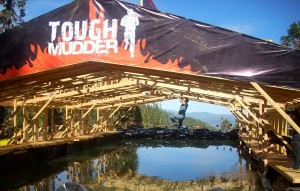
Nolan Kombol, head of course design for Tough Mudder, scales the Funky Monkey without dropping into the water. Photos/Jessie Marchesseau

I had taken their online Are You Tough Enough Quiz the night before and only scored a 75. “Maybe Mudder” it said. Had I chosen the wrong mustache on Question 4? Whatever the reason, I was apparently only questionably prepared.

The 11.3 mile course includes a nearly 2,000 foot elevation gain, 22 manmade obstacles, frigid water, barbed wire and mud, lots of mud.

Participants start their Tough Mudder adventure with the Kiss of Mud: crawling through a mud pit on their bellies underneath barbed wire strung just 8 inches off the ground. They then work their way through a series of other obstacles with names like Arctic Enema, Funky Monkey, Spider’s Web, Electric Eel, Everest and finally, the Electroshock Therapy.

These obstacles take them through icy water, across greasy, muddy monkey bars, over rope nets, into electrified waters, up, down, in and out. And did I mention there’s mud?

For participants starting to feel weary during the event, motivational signs are placed throughout the course with encouraging messages such as “Don’t panic, but if you do, keep running” and “Remember you signed a death waiver.”

If all of this sounds like your cup of tea, then you are not alone. Today’s event sold-out with 15,000 people signed up to participate, and though Sunday still has some openings, organizers are expecting to be close to the 5,000-person limit.

With numbers like that, Nadia Guerriero, general manager of the Village at Northstar, said it would be the biggest single-day event the mountain has ever seen.

With Northern California events held at Squaw Valley last year, and Bear Valley in 2010, Tough Mudder appears to be growing by leaps and bounds. The company started with three events in 2010 and approximately 20,000 participants. This year, they have 35 events scheduled around the globe with nearly half a million people signed up.

This is the first time the event has been at Northstar. Nearly a year of preparation has gone into this weekend, with three weeks of on-mountain construction. This was apparent when stepping off the gondola to find numerous banners, tents, a stage, semi-truck trailers with built-in beer taps, a corral of sani-huts and a 15-foot high quarter pipe named Everest.

Though Everest is actually near the end of the course, it was our first challenge of the day. The object: run up it. I was wearing my hiking shoes, so I was totally prepared for this one. As it turns out, running up a quarter pipe is about as impossible as you would expect it to be. However, sliding back down on your rear is a pretty fun way to fail. I did it several times, not minding the dirt smearing up my back.

We had the advantage of attempting to climb Everest on a dry surface with dry shoes, enabling me and my media cohorts to get within inches of reaching the top. However, by the time participants hit this one, they will likely be wet and muddy, to say the least. The key for this one: teamwork, which is something Tough Mudder encourages. Once they reach the top, people help lift others that last little bit. Some will make human pyramids, climbing over each other to the top.

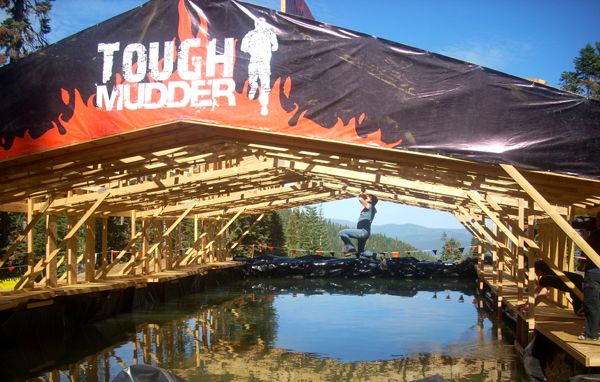
After giving up on summiting Everest for the day, we piled into Rangers which are essentially four-wheelers that seat five people, and headed uphill for a visit to the Funky Monkey. As we rounded the corner, a 2-foot-by-6-foot structure resembling the framing stage of a garage appeared. The orange sign above indicated it was, indeed, the Funky Monkey.

This obstacle gets its name from the monkey bars that span between what would be the roof rafters. I remember being an expert at the monkey bars in elementary school, but am pretty sure I have not laid a hand on one in a couple decades. Like everything in the Tough Mudder, these monkey bars have a twist, quite literally: some of the bars spin. Top it off with a 5-foot-deep pool of chilly water below and now you’ve got a challenge.

Nolan Kombol, head of course design for Tough Mudder, hopped right up and showed us how it’s done. Then he did it again for a photo op. Still no takers from the group. I stepped to the edge and peered down. The water was green and murky, definitely not Lake Tahoe.

“How deep is it?” I asked.

Five feet. Almost as tall as me. Do I really want to get that wet? Maybe if it were 3 feet.

I reminded myself, “I’m here to have fun,” and grabbed hold of the metal bar overhead. I swung my other arm to the next bar and I was committed. The first half of the bars are on an incline as they travel up the roof line. I swung from one to the next, some of them turning slightly as I grabbed on. The group was shouting words of encouragement from the sideline and I kicked my legs as instructed.

Up the roof, then back down. My hands were getting a little tired, but I really did not feel like swimming. As I reached the other side, it took an extra swing to get my feet once again over solid ground, and I was done. Happy to be dry, my heart was beating a little fast, and I felt a definite sense of accomplishment. This could be addicting.

Next up for the challenge was Lindsay “with an A” Romack, the morning show host on 101.5 Truckee Tahoe Radio. She put forth a valiant effort, but did not come out nearly as dry as I did. The gasp she let out as she hit the water indicated that it was surely not a heated pool.

There were no other takers for the Funky Monkey, leaving Romack and me feeling just a touch braver than the boys as we headed back to the gondola.

So what is it about these strange, messy events that is so appealing to thousands of people?

“I think it’s really a way for people to challenge themselves without worrying about winning,” said Kombol. “It’s a way to get out and kind of act like a kid again.”

And plenty of people are willing to pay for the chance to act like a kid again, forking out registration fees of $90-$200 per person, a portion of which Tough Mudder donates to the Wounded Warrior Project.

It may sound like a lot, but after having the chance to play a little on the course, I have a feeling I may find myself joining the masses next year. After all, the quiz did say “maybe Mudder”… next time I will choose a cooler mustache.

—–

Note: More information about the Sept. 22-23 event at Northstar is online.

ngg_shortcode_0_placeholder (Click on photos to enlarge.)


Free rabies shots for El Dorado County dogs and cats

El Dorado County Animal Services is teaming up with area veterinarians and animal welfare agencies to offer free rabies vaccinations for cats and dogs on World Rabies Day — Sept. 29.

The free rabies vaccinations will be offered from 9am to 5pm that Saturday at the El Dorado County Government Center located at 330 Fair Lane in Placerville. Dogs must be on leash; cats must be in pet carriers.

This is only for El Dorado County residents.

In addition to free rabies vaccine, Animal Services will also offer dog licenses for a fee. Unlicensed dogs may receive the rabies vaccine at no cost at the free rabies clinic, but their owners must purchase a dog license within 30 days.

There is currently no requirement to license cats in El Dorado County.


Lake Tahoe Wildlife Care busy with birds, bobcats and bears

By Tom Millham

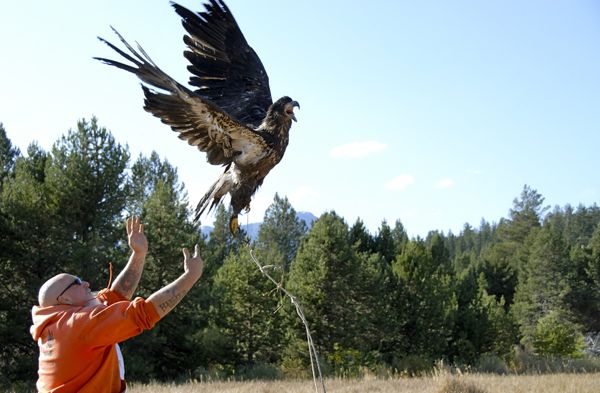
As some of you may be aware, we now have five bobcats in house. We have had a total of six this year, which is the most we have ever had.

The one we got in about a month ago was just with us for about three days after being hit by a car in the Woodfords area. We got her back so she could – hopefully – take care of her babies.

LTWC volunteer Wayne McKnight throws a golden eagle into the air as a way to exercise it. Photo/John Adamski

Of the five we have left, three of them came in on May 20, the second day of our annual training seminar. About three weeks ago, one of those original three was limping in our bobcat cage. As it turned out, she somehow broke her right front leg.

Dr. Kevin Willitts took an X-ray and determined the exact damage, then took her down to Reno for a specialist to perform the surgery, which was successful. However, for the next three weeks, our instructions were to leave her alone as much as possible to allow her to heal.

Willitts took a follow up X-ray Sept. 20 and determined that she has healed about as much as she is going to. So, after she woke up from her sedative, we let her out of her pet carrier to be with her two siblings. The three of them have been getting used to each other and so far no fur is flying.

For more than 25 years, Willitts has been there to volunteer his time for the betterment of the wildlife entrusted to LTWC.

Yes, we still have Chips and, now, Sierra. Chips came to us from the Chips Fire near Lake Almanor about 2½ weeks ago and Sierra came to us from the Sierra Army Depot near Herlong (just south of Susanville) where he got separated from his mother. He is about one week older than Chips.

After we clear up Chips’ problem with Coccidia, we will be able to put the two together. Other than the Coccidia, Chips is doing very well and growing every day. Since we now have two cats, almost the same age, we will most likely raise them here at LTWC and then release them in a suitable environment early in the new year. We will keep you updated on all five bobcats.

On another note, we will be releasing another golden eagle Sept. 23. We plan to meet at LTWC at 10am, then caravan up toward old Highway 40, west of Donner Lake. The exact location will be determined Friday. Anyone who would like to join us is welcome. We anticipate the release to take place at or around 11:30am.

Tom Millham is secretary-treasurer for Lake Tahoe Wildlife Care.

Riley Rettig shot this video of the Lake Tahoe Wildlife Care eagle release earlier this summer near Carson Pass:


Access to trails, parking lots dominate Fallen Leaf talks

By Kathryn Reed

While no decisions have been made as to what the trail system at Fallen Leaf Lake will look like in the future, four additional alternatives have been added to the mix to reflect what the public desires.

Nearly 40 people attended a workshop Wednesday night at the U.S. Forest Service office in South Lake Tahoe to learn about the changes that have been made since the discussions started earlier this year as well as to offer more input. The original preferred alternative – No. 2 – remains on the table. Alternatives 3-6 incorporate the more than 150 responses the feds received. Alternative 1 would be to keep the status quo.

Jacob Quinn of the U.S. Forest Service talks about alternatives to the Fallen Leaf Lake plan. Photo/Kathryn Reed

When the final document comes out in the first quarter of 2013 it’s possible a combo of the alternatives could be selected instead of one as it is written in draft form.

The goal is to address this section of the South Shore that is on the north side of Camp Richardson and captures the entire Fallen Leaf Lake area trail system. Trails, parking and public access are all part of what is being studied.

One person at the Sept. 19 meeting asked if all the improvements would mean more people re-creating in this area.

Jacob Quinn, who led the bulk of the meeting for the Forest Service, said with the increase in use in this area in the last 10 years it has meant overuse of some trails and that people tend to create their own trails when the ones they’ve been on become overcrowded. The idea is even if more people come, the trail system will be better to disperse the various users.

The goal is to decommission most of the user-created trails, while improving others. At the same, trails in the backcountry will remain designed for less use, while trails closer to population bases will be able to handle more people.

Parking is an issue, as was expressed regarding the Glen-Alpine area at the far end of Fallen Leaf Lake. But Quinn pointed out it’s a fine balance between providing enough parking spaces and not wanting to draw the masses to an area than can’t sustain that many people if they were to all arrive.

All of the new alternatives have the bridge at the dam at Fallen Leaf Lake being 4- to 6-feet wide. Originally the Forest Service wanted to widen it up to 14 feet.

Another thing the new alternative has in common is retaining the trail along the west side of Taylor Creek that runs north and south. The Clark and Church trails would also stay.

The polo field parking lot near the entrance to Valhalla has been scrapped and instead will be incorporated into the Tallac Site plans. Improvements to the Pope Baldwin Bike Path, better known as the Camp Richardson paved trail, are out of this study and instead will be part of the Camp Rich plans.

Accessing public lands during the winter and at other times was discussed at the Sept. 19 meeting. Liana Zambresky asked why parking lots need gates.

Garrett Villanueva, trails guru with the Forest Service, said part of the reason is because concessionaires run some Forest Service land and when they are not on site there is no one to monitor activity going on. He said his agency doesn’t have the staff to manage sites in the off-season.

However, he said solutions are being worked on to provide more access. But snow removal and year-round access are not being considered.

Bill Connolly brought up the issue of the gate at the entrance to Valhalla/Tahoe Tallac Site being closed so often which creates an access issue for the handicapped because this is one of the easiest places for the disabled to access Lake Tahoe.

Brenda Knox with the Tallac Association told the group it’s a tricky balance between accommodating the public and needing the spaces for events – whether it’s a show or a wedding. But she added that the gate issue is something her colleagues are working on.

More information about the project is online. The Forest Service will accept comments through Oct. 12.