2-day festival devoted to Kokanee salmon

The Kokanee Salmon Festival is Oct. 6-7 from 10am-4pm each day at the Taylor Creek Visitor Center.

The Visitor Center is located three miles north of South Lake Tahoe on Highway 89.

Participants can learn about the natural wonders of Taylor Creek and take part in activities, including a salmon barbecue, Kokanee trail runs, children’s activities, educational and streamside programs, and more.

On that Saturday at 2pm., Wild Things Inc. will present a free wildlife program featuring live animals at the Lake of the Sky Amphitheater. The festival’s new mascots, Sandy and Rocky Salmon, will make appearances each day and there will be a special appearance by Smokey Bear.

The Kokanee Salmon Festival and Oktoberfest at Historic Camp Richardson Resort, occur the same weekend, so the parking lot at the visitor center fills quickly. Visitors are encouraged to bike, walk or take public transportation to the event. BlueGo and the Nifty Fifty trolley will provide special service for these events. Contact them at (530) 541.7149.

For more information and a complete schedule of activities, contact the Taylor Creek Visitor Center at (530) 543.2674.


Kahle looking for youth to fill basketball teams

Douglas County Parks & Recreation has opened registration for the upcoming youth basketball leagues at Kahle Community Center.

Divisions offered:

3-4 grade

5-6 grade

7-8 grade.

Cost is$70 for 3-4 grades, and $80 for 5-6 and 7-8.

Grades 3-4 play on Tuesday evenings, 5-6 grade on Thursday evenings and 7-8 on Wednesday evenings.

Games are between 5:30 and 8:30pm at Kahle Community Center in Stateline.

The season for grades 3-6 is November–March and 7-8 from January–March.

Teams usually will have one practice and one game per week.

Spaces are limited, so register early.

For more information, call at (775) 586.7271.


Asian clams winning at Lake George

By Brian Nearing, Times Union

LAKE GEORGE — Two years and $1.5 million later, efforts to rid the Queen of American Lakes of a harmful invasive clam seem to have failed. With fast-breeding Asian clams now spreading, the best hope is to keep their numbers in check — a costly fight that could last for years — and wait for a breakthrough eradication technique.

That was the grim assessment last week by the lake’s Asian Clam Rapid Response Task Force, a group of state, municipal, civic and environmental groups that has spearheaded work to eradicate clam beds by smothering them under weighted underwater mats.

The setback in the battle against the clams comes as the Lake George Park Commission, the state agency in charge of protecting the lake, also is racing to create a plan to reduce the risk of future aquatic invaders being brought in by recreational boaters, who likely transported the Asian clam from other infested water bodies in bilge water or bait wells. Widespread clam infestation in the lake could mean diminished tourism, business and property values. Clams have already caused some of those problems in Lake Tahoe, on the California-Nevada border, where beds now cover several hundred acres.

Thriving in sunlit, shallow, sandy lake bottoms, the tiny mollusks pose a major threat to the lake’s legendary gin-clear waters, which drive vibrant tourism, boating and recreational fishing industries.

Large clam colonies can foul beach waters because their excretions fuel massive algae blooms. Fast-breeding hermaphrodites, clams can quickly multiply into the millions and, when dead, wash up on beaches, where their razor-sharp shells make walking dangerous.

Read the whole story


3 Tahoe half marathons help runner complete 52 in a year

By Jessie Marchesseau

Aurora De Lucia will be running the Tahoe Trifecta starting today. That is three different half marathons in three days.

What makes De Lucia different than the dozens of other people she will be running with this weekend? Oh, just that she is 22, had open heart surgery 2½ years ago, is on a quest to run 52 half marathons in 52 weeks and is raising money for the charity Broadway Impact in the process.

Aurora De Lucia will run three half marathons in Lake Tahoe on Sept. 28-30. Photo/Provided

Bubbly, giggly, talkative and undeniably motivated, De Lucia originally came up with this challenge just to prove to herself that she could do it. She ran her first half marathon in 2009 and calls it “pretty much one of the most amazing day of my life.”

That was before she got sick.

Until about three years ago, De Lucia had no idea she suffered from a congenital heart condition known as Wolff-Parkinson-White syndrome. Essentially, her heart had an extra electrical pathway, something that can lead to an excessively rapid heart rate.

Doctors said she was lucky they found it. Usually it’s something they find in an autopsy.

During the next six months the Los Angeles resident had four failed ablation procedures on her heart, complications caused by the procedures and finally, open heart surgery. Then in June 2010, the extra pathway was declared gone, and De Lucia was set free.

After a year of getting her life back together, she decided it was time to focus on her goal of running another half marathon or 13.1 miles. But it was no easy task. She could not go very far or very fast. On a whim, De Lucia signed up for a 5K as a way to encourage herself. Then she signed up for one the next weekend, and the next, and the next, progressing up to the 10K. That’s when she got the idea: she could do one race every week, 52 half marathons in 52 weeks.

“Fifty-two should be pretty sufficient to prove to me that I can do it,” she said of her plan.

So in January 2012, the challenge began. Along the way she has seen old friends, made new friends, travelled all over the U.S. and even ran a half-marathon with her father – the highlight of the year so far.

This weekend’s races will be numbers 31, 32 and 33; putting her well past the half way mark. Today is the Emerald Bay Marathon (Emerald Bay to Lakeside Beach), Saturday is the Tahoe Nevada Half Marathon (Spooner Summit to Incline Village), and Sunday is the Lake Tahoe Half Marathon (Rubicon to Pope Beach).

“I’m a marathon runner myself, and I can’t see how she’s going to do it,” John Bernard, a long-time friend of De Lucia’s, said, “but I know she’s going to do it.”

Bernard will be joining her in the Columbus, Ohio, race next month, as will her father.

Part way through the year, De Lucia decided that running for herself was not enough, she wanted to do it for a cause. Choosing Broadway Impact, a national organization supporting marriage equality, was a no-brainer for her.

“I couldn’t think of anything that was more important to me than human beings and treating human beings equally,” she said.

Jenny Kanelos, executive director of Broadway Impact, said they are proud to have De Lucia representing their cause because she embodies everything they hope people will get out of their foundation.

“What she’s doing is exactly what our organization was founded on: get inspired, and take action,” Kanelos said.

She also added, “I think anyone who takes on 52 marathons in 52 weeks has got to be pretty incredible.”

If you happen by one of the half marathons this weekend, look for De Lucia in her trademark red “Who’s Bad” baseball cap, or follow her on her quest online.

Notes: Expect traffic delays Sept. 28-30 during the Lake Tahoe Marathon events. This website has more details.



Tahoe National Forest about to be a wonderland of fall color

Fall is an exceptionally pretty time to explore the Tahoe National Forest. Warm days and crisp, cold nights make forest outings especially enjoyable.

At the lower elevations (2,500–4,000 feet), autumn colors are at their best in mid-October through early November, while in the higher elevations (4,000–9,000 feet), colors peak from early to mid-October.

Although most trails are open year-round, many of the campgrounds will begin to shut down in preparation for winter weather. Some campgrounds, however, can be used (without services) all year. Also, campfire restrictions are still in effect limiting campfires to developed recreation sites. These will stay in effect until there is significant rain or an increase in humidity levels.

Scenic drives:

Highway 49 – A beautiful drive along Highway 49 from Nevada City through Downieville to Sierra City features big leaf maple, oak, locust and dogwood foliage. As you wind through the North Yuba River canyon, dogwoods and oak trees start to change colors in early October. The colors are often reflected in the river, doubling the intensity of color.

Campgrounds along Highway 49 will be open through the weekend of Oct. 27 except for those in higher elevations which may close sooner.

Campgrounds at Bullards Bar Reservoir will close Oct. 15.

Gold Lake Road — In the Sierra Buttes vicinity, color peaks in early to mid October with the yellow and gold of aspen and maple trees in this beautiful alpine area. Views of and from the Sierra Buttes are outstanding.

Campgrounds in the Sierra Buttes area are open through Oct. 27.

Highway 89 — Fall colors extend from late September though the month of October. The drive along Highway 89 from Lake Tahoe through Truckee and on to Sierraville is especially picturesque with aspens, willows and cottonwoods painting the landscape with brilliant yellows. Expanding the drive from Sierraville west via Highway 49 up to Yuba Pass provides spectacular views of the Sierra Valley. The drive from Highway 89 through Kybuz Flat and Sardine Valley is also especially nice with grasses, willows, cottonwoods, and aspens.

East of Highway 89 and north of Boca Reservoir, cottonwoods, aspen, and willows follow the Little Truckee River.

Campgrounds along Highway 89 and northeast of Truckee are open until early October to late October, depending on conditions. Contact the district office for more information.

Highway 267 — From Truckee south toward Lake Tahoe through Martis Valley, the gold and browns of willows and grasses contrast with the deep green of the pines.

Highway 20 — East of Nevada City, the landscape comes alive with crimson hues of dogwood and bright yellows of the big leaf maples. Bear Valley is especially pretty as the grasses, willows and cottonwoods turn gold.

Campgrounds along Highway 20 will close Oct. 1. Campgrounds in the Bowman Lake/Grouse Lakes area close when access is eliminated due to snow.

Mosquito Ridge Road — Mid-September to mid-October is a great time to drive Mosquito Ridge Road, east of Foresthill, which passes through beautiful canyons and forests of oaks, maples, dogwoods, and evergreens providing an array of fall colors. A cautionary sign reduces the road to one lane for a short distance where a slide damaged the road. The Big Trees Picnic Area is an excellent stop to view the northernmost stand of Giant Sequoia interspersed with the ruby red of the dogwoods. Mosquito Ridge Road also leads to French Meadows Reservoir and the Granite Chief Wilderness where fall color can be outstanding.

Campgrounds on the American River Ranger District – The group sites are all currently closed. Regular campgrounds will close between Sept. 30-Oct. 21.

Old Highway 40 and I-80 — Another scenic drive follows old Highway 40, parallel to Interstate 80 along the rocky South Yuba River lined with aspens and cottonwoods. When the leaves turn, the vibrant yellows and golds are duplicated in the reflections of the river. These colors are usually best in early to mid-October.

Campgrounds along I-80 will close Oct. 1.

— Ann Westling, Tahoe National Forest


Monument Trail preview for mountain bikers

One of TAMBA’s last trail days of the season is Sept. 30.

It will be a preview of the Monument Trail the U.S. Forest Service has been working on this summer above Cold Creek and High Meadow.

Meet at the locked gate on High Meadow dirt road at 9am. Cyclists will ride to High Meadow where the new trail starts and down Cold Creek at the end of the day.

All food will be provided including doughnuts and coffee to start the day, lunch and post ride barbecue. Sprouts Cafe is donating gift cards to the first 10 people to RSVP and show up. Everyone must RSVP to ensure there is enough food — rails@mountainbiketahoe.org.


Scotts Lake provides a variety of recreation options

By Kathryn Reed

HOPE VALLEY – Tree trunks stand like centurions from an era long ago. It’s as though they are keeping secrets – possibly the stories of explorers from another century.

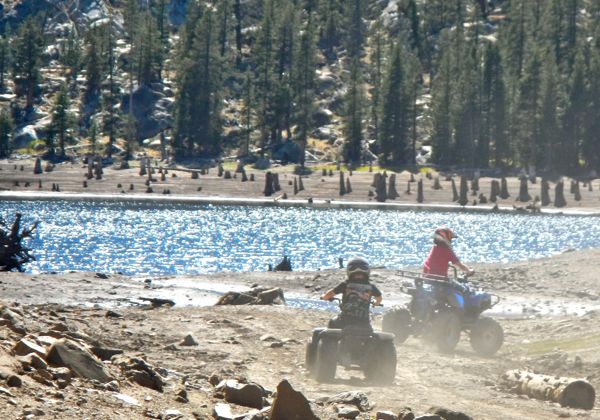
With each day that passes, the water level at Scotts Lake is receding. At an elevation 8,012, the conditions look more like spreading drought conditions at sea level than an alpine lake.

The edge of the lake is muddy, with cracks in it where it has dried. Grasses that are normally under water almost don’t look real. The tree trunks that are showing are well below the high water mark.

All-terrain enthusiasts romp near Scotts Lake. Photos/Kathryn Reed

A pipe almost blends in with the rocks. Presumably this would take water to the west fork of the Carson River.

Balls of lichen grow on downed wood and are stuck to the mud. They look like loofa sponges. We don’t touch them.

Friends come here to fish. It doesn’t look like much of a fishing spot – at least not on this September Saturday. And the road there isn’t one I would have wanted to drive with trailer in tow.

There are two main ways into Scotts Lake. One is to hike in from the Big Meadow trailhead off Luther Pass. We met a few people at the lake who did this.

It was Frank Riley’s description in “Tahoe Blues” about hiking to Scotts Lake and his encounter with a bear that made me want to know where it was. It’s in Alpine County on the edge of El Dorado County. Waterhouse Peak is nearby.

We opted for the route that involved a lot less work.

We drove in. The Jeep needed to get some 4-wheel drive action other than when white stuff is on the ground. It’s not a particularly challenging route, but at one spot on an offshoot from the main trail to the lake Sue thought she and AJ should get out of the vehicle.

The topo map describes this as a dirt road or bike path, possible 4-wheel drive needed. I would not take my bike up this road.

We are not the only ones who opted to use gas-powered means to get to our destination. Campers who are in RVs close to Highway 88 are playing on their four-wheelers.

They move on and we have the lake to ourselves. It’s quiet, desolate and tranquil as the sunlight shimmers on the lake. A gentle breeze sends little ripples toward the shore.

A few aspens are turning yellow. Fall is definitely in the air.

—–

Getting there:

From South Lake Tahoe, go west on Highway 50. Turn left onto Highway 89. Go until it dead-ends in Hope Valley. Turn right onto Highway 88. Make a right onto an unnamed road that has a cattle guard. (If you hit Blue Lakes Road, you went too far.) Veer to the right. Keep veering to the right and then start the climb.

ngg_shortcode_0_placeholder (Click on photos to enlarge.)


Governor signs bill to fund quagga mussel inspection program

By Lisa Lien-Mager, Association of California Water Agencies

Gov. Jerry Brown has signed ACWA-sponsored legislation designed to combat the spread of invasive quagga mussels.

SB215, authored by Sen. Bob Huff, R-Diamond Bar, extends the sunset of the successful mussel inspection program led by the Department of Fish and Game and the Department of Food and Agriculture. Previously set to expire at the end of this year, the mussel inspection program was first created in 2007 to allow the state to conduct inspections of vehicles and water bodies and order quarantines of any infested water bodies. The law also authorizes the state to implement measures to prevent and eradicate infestations, including education.

Quagga mussels are an invasive nonnative species that breed very fast, have no known predators, and can quickly colonize new areas within California waters. Once they infest a water body, they cover piers, boat launches, and water intake facilities. There is no effective eradication method, and the cost to manually remove these mussels from water intake screens and pipes is millions of dollars per year for the state’s water system operators.

The state has created an ongoing prevention and education program to help keep these unwanted guests away, including a marketing campaign to get recreational boaters and others to pay attention to the hidden cargo that they may be carrying. The cost to run the program and inspections is estimated at close to $10 million total for both departments combined through the end of 2014.

Despite the price tag during a difficult budget year, the Legislature determined the short-term investment of special funds was worth the cost to help avoid a long-term serious infestation in state waters that could cost billions of dollars in damage and repair costs.

“We are pleased that Gov. Brown and the Legislature recognized the importance of continuing this aggressive program to combat the spread of invasive quagga mussels,” said ACWA Executive Director Timothy Quinn in a statement. “S 215 will ensure that the current and effective efforts continue uninterrupted.”


TRTA’s building season to extend into October

Tahoe Rim Trail Association’s building season is coming to a close. Volunteers are needed for two major projects: Rim to Reno and Daggett Summit.

Workdays are every Tuesday, Thursday, and Saturday from 9am-4pm. No trail building experience is necessary.

Rim to Reno project volunteers will build new trail segments connecting existing trails in the vicinity of Mount Rose and creating a new system that includes loop trails along with the connector trail to Reno. The last work day is Oct. 20.

This is the fourth trail-building season of the multi-year Daggett Summit project, which will connect the Tahoe Rim Trail with the Van Sickle State Park, re-route the TRT off of paved roads, and provide stunning views of Lake Tahoe. Work goes on every Tuesday or Saturday through Oct. 13 at the Kingsbury North Trailhead.

To join a volunteer work crew, register online. For questions, contact Lindsey at (775) 298.0239 trails@tahoerimtrail.org.


Girls basketball leagues forming at Kahle

Douglas County Parks & Recreation Department is taking signups for the upcoming Girl’s Basketball League at Kahle Community Center.

Registration runs until the league is full.

Divisions:

3-5 grade — Tuesday nights, season is November-February.

6-8 grade — Wednesday nights, some Mondays possible, season is December-March.

Cost: $85.

All games will be at Kahle Community Center in Stateline. Teams usually have one practice and one game per week.

For more information, call (775) 586.7271.