Meeting to focus on trails through Martis Valley

By Barbara Barte Osborn, Sacramento Bee

A meeting for public review of a final environmental impact report for a proposed paved, multiuse trail through Martis Valley is scheduled Wednesday in Truckee.

The board of the Northstar Community Services District, lead agency for the project, will consider certification of the report at the meeting, scheduled for 5:30pm in the Truckee Town Hall council chambers, 10183 Truckee Airport Road.

If the district’s board certifies the report, it will later determine which of two alignments the approximately 9.5-mile trail would follow.

The alignment, width, aesthetics and potential user conflicts were among many concerns expressed during public review of the draft EIR.

Fifteen feet would be cleared for the 10-foot-wide, paved trail, which would begin on the south side of Highway 267 opposite Truckee-Tahoe Airport, continue through Martis Valley to the Village at Northstar, then climb to Forest Service Road 73, which leads into the Lake Tahoe Basin.

The originally planned route follows current walking trails and dirt roads and passes through a wildlife management area operated by the U.S. Army Corps of Engineers.

Because of protests from the public and the Corps, moving part of the trail closer to Highway 267 is also under consideration.

With an elevation change from 5,880 feet at its beginning to 6,200 feet at Northstar and 7,280 feet at the basin’s ridge line, the trail is planned to accommodate bicycles and all pedestrian uses except equestrian. The only motorized use would be powered wheelchairs.


Splash of autumn color shines throughout Lake Tahoe Basin

By Kathryn Reed

SPOONER SUMMIT – Autumn has such a distinct scent. You know it when you smell it.

All along the trail to Marlette Lake on Saturday I kept taking deep breaths. While it is really death that is in the air, the power of it gives me energy.

Perhaps it’s the power of nature to cycle through life and death with such relative ease that makes me jealous. We humans have such a difficult time with such monumental things like life and death.

But nature, well, she seems to embrace each season.

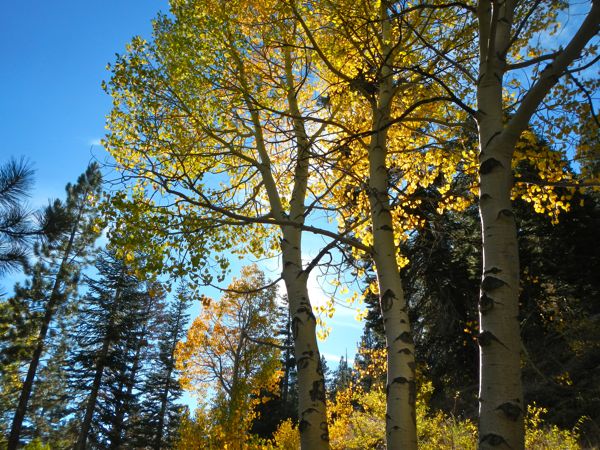
Fall is in bloom throughout the Lake Tahoe Basin. Photos/Kathryn Reed

Aspens really do seem to quake in the gentle breeze. Shimmering in the vibrant sun on this rather warm fall day, it’s hard to know if the leaves are hanging on for dear life or trying to shake free to move on.

It’s like a painters palette – all these shades of green, yellow and orange decorating the landscape.

A woman on the trail says she was out three days earlier and notes how much more color there is Oct. 13. She’s what a New Englander would call a “leaf peeper” – because of her ardent interest in the fall colors and desire to see them at different stages.

The abundance of green proves the peek is still to come. Maybe this week. Temperatures, wind and moisture play a role in this leaf changing business.

It’s such a ritual on the East Coast that foliage is tracked for when best to see it. Even the National Weather Service has a color meter.

Mostly it’s aspens along the route to Marlette Lake, though this is not the only flora turning color.

So many people are out – and many with their dogs – that it feels a bit like hiking to Winnemucca Lake during the height of wildflower season. But we don’t mind. Everyone is so friendly. Those of us with cameras seem to play a game of leapfrog with each other as we keep passing one another.

Instead of taking the North Canyon Trail, we take the Marlette Trail. It’s narrower and is not open to mountain bikers. While we didn’t see any horses along the way, we saw plenty of evidence they had been out that afternoon.

We aren’t sure how far we went. The sign at the trail on the Spooner side says it’s 3.75 miles to Marlette Lake. The sign at Marlette says it’s 4.5 miles to Spooner.

Along the way we saw people with shirts that said “Hike for Beer” and finally asked about it. There was beer for sale at the lake. We saw people walking back with cups of beer.

Then we were told the amber ale was gone. Yet visions of aspens seemed to remind me of my thirst that could not be quenched until I got home. Oh, the punishment for getting a late start.

Still, this was an excursion about foliage. And we were not disappointed.

Getting there:

From South Lake Tahoe, take Highway 50 east.

Either turn left onto Highway 28 and then park at Lake Tahoe State Park on the right for a fee; or pass that turn and at the true summit park for free on the left.

(That lot can get full and the state park can use your money.)

Note: For a less ambitious hike, but still one full of color, consider the 2.1-mile loop around Spooner Summit. This would be suitable for most ages and abilities.

ngg_shortcode_0_placeholder (Click on photos to enlarge.)


Controversy arises over using wastewater for snowmaking

By Mary Catherine O’Connor, Outside

Pointing to the sacredness of the San Francisco Peaks north of Flagstaff, Ariz., a coalition of Native American tribes has been fighting the development and expansion of Arizona Snowbowl ski resort since 1979. It remains defiant, reports the New York Times, despite having suffered a key legal defeat this winter. A federal court ruled against the tribes in a nearly decade-old lawsuit that claims the ski resort’s plans to use treated wastewater from Flagstaff’s sewage system to make artificial snow for the resort would interfere with religious practices and mar the mountains.

Wait. The resort will use sewage to make snow? Technically, yes. That’s why the story has garnered lots of attention. But recycling treated wastewater for applications that do not require potable water is not nearly as icky, nor as uncommon, as it might sound. This type of water is commonly used for irrigating golf courses and soccer fields, for example.

While Arizona Snowbowl would be the first resort in the U.S. to use 100 percent treated wastewater to make snow, it’s a common practice in Europe and in parts of Australia, says Hunter Sykes, an environmental sustainability consultant who closely tracks the outdoor recreation industry and produced a 2007 documentary about the environmental impacts of rampant ski resort development called Resorting to Madness. “Most people who work with wastewater don’t see this an issue, because it’s not going to make people sick and, as far as we know, it’s not going to contaminate flora or fauna,” he says.

Not everyone is quite so comfortable, though, with the idea of using treated wastewater for snowmaking. Among the groups that oppose it, on the grounds that the water may contain chemical inputs from pharmaceuticals and other potentially hazardous hard-to-trace sources, include the Center for Biological Diversity. Sykes agrees that there is still much we don’t understand about the chemical agents that persist in treated wastewater and how they could impact the ecosystems into which they’re released, but says if it was up to him, he would use the treated wastewater.

Taylor McKinnon, public lands campaigns director for the Center for Biological Diversity points to a study that linked wastewater effluent released into a creek in Boulder, Colorado, with abnormal fish gender distributions. “There is an emerging and growing list of compounds [about which] we don’t know the affects,” he says, but we know that endocrine disruptors [in wastewater] will change fish sex ratios. This points to the need for additional research and more advanced water treatment.”

But McKinnon and Sykes do agree on one thing: the real story here is the increase in snowmaking, industry wide, and the wider environmental impacts of making snow.

One can argue that for a ski resort in an arid landscape such as Arizona, reusing wastewater for snowmaking can be a much better alternative, environmentally speaking, than using increasingly scarce fresh water. In either case, other issues loom large. These include the energy required to pump the water, the quality of that water (even if it comes from “natural” sources), and the ways that artificial snowpacks change mountain landscapes.

In the Times story about Arizona Snowbowl, a forester with the U.S. Forest Service is quoted saying that climate change is making snowmaking increasingly necessary at ski resorts. That may be true, but the act of making snow where coal is used to generate the energy to make the snow is only exasperating the situation.

“Burning coal to make snow is a self-destructive behavior for federal agencies and for outdoor recreation industry,” says McKinnon.

The energy required to make snow will only increase if winters begin later and skew toward warmer or more erratic temperatures. “For a lot of [ski] areas, snowmaking is the biggest single expense, even before payroll,” says Sykes.

Fortunately, many ski resorts are increasing the wind, solar and other types of renewable, clean-burning fuel they use for power generation. Plus, snowmaking equipment is increasingly energy efficient.

Ski resorts often make snow using nearby natural streams or lakes, but that doesn’t mean the water is clean. Sykes points to how, in Colorado, water pulled for snowmaking from the Snake River is tainted with zinc, copper, lead and other metals that seep from old mining claims.

Even if water that is extracted for snowmaking is clean, the act of extracting it leads to other “externalities,” he says. For one thing, pulling clean water upstream from sources of contamination, such as mining claims, removes the benefits of dilution that the water would have otherwise provided.

Reducing stream flow could have other consequences as well. “Another extraction issue is that you’re removing sizable amounts of water from streams in the fall, which is a key time for aquatic life,” says Sykes.

As snowpacks decrease in some parts of country, the demand for terrain parks is growing everywhere. To manufacture a sizable terrain park, ski resorts must manufacture snow. A lot of it.

That has led to more snowmaking, using more water and energy every year. In some areas, summer comes and goes but the massive piles of snow that were once halfpipes or tabletops remain. This prevents the natural cycle of melting and of plant growth and while these areas are small on each mountain, they add up in aggregate.

“You have a longer runoff period, so you have a lot of water running off smaller streams and they’re carrying increased amounts of sediment. This is happening in parts of the mountain that have already been denuded, so topsoil is already depleted,” says Sykes. “You’re changing the profile of the mountain.”

While sewage for snowmaking makes for good headlines, the real environmental issues seem to be hiding within the business of making snow.


Trail building day on Rim to Reno section

Tahoe Rim Trail Association will put the finishing touches on a new section of trail within the Rim to Reno Trail System on Oct. 20.

This new section of trail was started in 2011 and allows hikers accessing the Tahoe Rim Trail at Relay Peak from the Mt. Rose Summit trailhead off Highway 431 to hike on approximately 2.5 miles of new single track trail from the Galena Waterfall. In the past, hikers on this section of trail walked on a dirt access road for approximately 4 miles.

This section of trail is part of the larger Rim to Reno Project that will connect the Tahoe Rim Trail to the Thomas Creek Trailhead in Reno. Since 2010, the Tahoe Rim Trail Association, United States Forest Service-Carson Ranger District, Great Basin Institute, Washoe County Regional Parks and Open Space, and hundreds of dedicated volunteers have worked to make this vision a reality putting in thousands of hours to construct new trail.

On Oct. 20, the Tahoe Rim Trail Association will be celebrating this herculean effort during its End of Season Work Day Celebration. Community members, trail enthusiasts, and the general public are invited to attend. Festivities will kick off at 8:45am in the Mount Rose Summit parking lot off Highway 431. From there, attendees will carpool to the work site where the Tahoe Rim Trail Association will provide an overview the project and accomplishments to date. Trail building volunteers will then dig into the last workday of the season and will build the connection between the new trail and the old.

Volunteers of all skill levels and physical abilities are welcome and encouraged to participate — no prior experience necessary. The Tahoe Rim Trail Association will be providing lunch to volunteers. Register online in advance.

Volunteers should bring water, wear long-sleeved shirts, long pants, and sturdy closed toed shoes. The TRTA will provide hard hats, trail building tools, expert crew leaders and lunch.


Sugar pine planting helpers needed

Help the Sugar Pine Foundation plant fungus-resistant sugar pine seedlings at two community planting days.

The first planting is Oct. 21 from 1-3pm. Meet at Rideout Community Center (740 Timberland Lane Tahoe City) to carpool to the planting site at Ward Creek.

The next planting is Nov 3 from 10am-noon. Meet at Jewell Drive, off Highway 50, across from Lake Tahoe Airport.

Seedlings, tools and instruction and light snack will provided. Bring gloves and a shovel.

For more info, email admin@sugarpinefoundation.org or call (650) 814.9565.


Brothers make a living at removing rattlesnakes from yards, homes

By Hudson Sangree, Sacramento Bee

Just above the tract homes of Empire Ranch, on a Folsom hillside covered in boulders and brown grass, Bruce Ramirez plies his trade: keeping the suburbs safe from rattlesnakes.

Greenbelts and golf courses are particularly hazardous, he said. In the past week or so, he and his brother Len have pulled about 50 rattlesnakes from around Northern California homes.

In the foothills, where suburbia and prime snake habitat intersect, homebuilding is picking up again after a long hiatus. That’s disturbing more rattlers. And with summer temperatures lingering into fall, young snakes, whose bite can be the most dangerous, are numerous and active.

“It’s beautiful country,” Ramirez said. “People want to live here, too. I guess we have something in common with snakes.”

It’s not an easy coexistence.

The slithering of rattlers onto suburban lots – biting pets, frightening children – creates demand for snake catchers such as Ramirez Rattlesnake Removal. The brothers’ clients include homeowners, schools, high-tech companies and hospitals.

The Ramirez brothers have removed snakes tucked behind toilets, coiled in bedrooms and lurking under TVs. More times than they would like, they’ve come face to face with rattlers in the narrow spaces under houses while crawling on their bellies.

“The babies are out in high numbers right now,” Bruce Ramirez said.

In Empire Ranch, a new development in Folsom, homeowners routinely call Bruce Ramirez to rid their yards of snakes. He has traced the creatures to their hillside dens and captured dozens.

Last week, he handed his card to Elisa and Manuel Cordero in the driveway of their Folsom home and suggested some preventive measures, such as sealing garage doors and keeping landscaping clean and open.

The Corderos have lived in Folsom for six years, during which time they’ve had a number of snake encounters. Once, Elisa Cordero killed a rattler with a shovel. Another time, her husband shot one with a BB gun after their 6-year-old granddaughter heard its rattle while playing in the backyard.

One day, they said, their 9-year-old grandson pounded on the front door after school, yelling and frightened. Elisa opened the door and saw a big rattler coiled in the corner, an arm’s length from the boy.

The couple moved from Citrus Heights and were surprised by the number of snakes. They didn’t hear about the rattlers from sales agents. A prospective neighbor told them, “There’s critters,” and left it at that, they said.

Northern Pacific rattlesnakes are common in growing suburbs such as Lincoln, Folsom and Granite Bay. The upscale community of El Dorado Hills is the epicenter of snake sightings, Len Ramirez said.

“We call it ‘Snake-orado,'” he said.

Bruce Ramirez told the story of a call to a home in Serrano, a gated community in El Dorado Hills. The family dog had been bitten overnight and refused to come inside. When Ramirez got there, he realized the reason: The snake was indoors with the family, including a 3-year-old child.

“The dog knew better than to go back in the house,” he said.

As of last Wednesday, the 50 snakes recently removed by the Ramirez brothers were stored in holding tanks at Len Ramirez’s Auburn home. He planned to take them into the mountains and release them, as he does with almost all the snakes he catches.

Patrick Foy, a spokesman for the state Department of Fish and Game, said the department has an informal agreement with Len Ramirez that allows him to distribute rattlesnakes on public wild lands.

Foy said state law gives residents “carte blanche” to do what they will with rattlesnakes – kill them, catch them – with no permit required. The snakes, native to this area, are not protected as either threatened or endangered.

Despite the law’s treatment of rattlesnakes as pests, the Ramirez brothers said they respect their quarry – in part for the vital role snakes play in controlling the state’s rodent population.

“We move onto their property, but we really need them,” Bruce Ramirez said.

Len Ramirez pulled out a bucket of small rattlers, youngsters that were born in late summer or early autumn.

They look almost harmless, and they are much harder to spot than older snakes, he said. But their bite can be the most dangerous, because they have yet to make a kill and cleanse their venom ducts.

“They can discharge more venom,” Len Ramirez said.

Children and dogs are especially in danger from the small rattlers, which they tend to approach with less caution.

“You wake up in the morning and your dog’s head is the size of a melon,” he said.

Using snake tongs, Len Ramirez pulled out a 3-foot rattlesnake he caught last week at the Twelve Bridges community in Lincoln. It coiled and rattled as he set it on the grass.

The snake was one of hundreds he has pulled from Twelve Bridges over the years. When the community’s golf course was being built, he said he removed 800 from that area alone.

Twelve Bridges is part of a snake zone that extends across the foothills of Placer, Sacramento and El Dorado counties. Over in El Dorado Hills, John Carle has called Bruce Ramirez to his house several times to remove rattlesnakes. His house sits at the end of a cul-de-sac, adjacent to open space. He said he’s seen hundreds of rattlers.

When he moved to the area 10 years ago, Carle said, new construction caused a mini-plague of snakes. Neighbors had dozens in their yards. Now the snake sightings have tapered off, and residents tend to take snakes in stride.

His Labrador retriever, Jackson, has been bitten four times, but Carle thinks he’s finally learned his lesson. “If he hears a rattle,” Carle said, “he’ll back up.”


USFS refuses to limit logging north of Truckee

By Tom Knudson, Sacramento Bee

Standing amid a scattering of stumps last week, an official from the U.S. Forest Service acknowledged the agency made mistakes by logging too many pine trees, including majestic old-growth giants, in an effort to help another Tahoe species: the quaking aspen.

But he rejected calls from local residents that the Tahoe National Forest sharply scale back the cutting along Independence Creek north of Truckee.

“Are there places where there are some trees that I’ve seen out here – some live trees still standing and some stumps – that I would have preferred be marked for retention? Yes,” said Tom Quinn, supervisor of the Tahoe National Forest.

His comments came at a meeting on Friday in the field with local residents and environmentalists to discuss the Outback Aspen Restoration Project. The project, which aims to promote aspen groves by logging conifers that compete with them, was the subject of a Bee story in August.

It entails toppling conifers – large and small – as far as 150 feet away from aspen, leaving large swaths of the Tahoe forest looking as bare as a shorn sheep. The idea is to remove conifers that have grown thick over the past century of fire suppression, allowing aspen the chance to expand and thrive.

The extensive cutting has incensed residents and conservationists, who were out in force at Friday’s meeting.

“We are shocked at the situation, the catastrophic damage being done by our government with absolutely no care for public input,” said Mary Leavell, who grazes cattle in the national forest with her husband.

“We all ultimately want forest health,” said Lauren Ranz, who lives part-time on a former 450-acre ranch near the logging zone. “But I don’t think this is the way to get it.”

Despite his concerns about cutting too many large, old trees, Quinn defended the project.

“To hear words today like devastated, destroyed … I can’t accept those words,” Quinn said.

He said the agency’s decision to allow the cutting of old-growth trees was consistent with the goal of aspen restoration, even though it angered neighbors.

“They were probably social mistakes, more than ecological mistakes,” he said of the agency’s actions.

To try to quell criticism, Quinn announced that Forest Service officials have decided to halt logging of conifers 40 inches in diameter or greater on the remaining 190 acres of the 479-acre project. But he rejected suggestions to limit cutting to trees 30 inches in diameter or less.

“We will not sacrifice the ultimate goal of the aspen restoration for retaining trees that some perceive as old-growth,” Quinn said.

“I’m extremely disappointed,” said Fred Mitchell who lives on 80 acres near where the cutting is taking place. “There are so few trees 40 inches and above, anyway.

“They’re brushing off the public like we are a minor nuisance, like we don’t count for anything,” Mitchell added.

Mitchell is one of a group of residents who have marshaled opposition by handing out flyers, contacting lawyers, political representatives and environmentalists, even placing mock tombstones on the stumps of large trees – some more than 2 centuries old – that have been logged.

“It’s not what they told us it would be,” said Gary Risse, a part-time area resident who is among those opposed. “I can tell you without a doubt there was no mention of clear-cuts whatsoever. That would have stopped it.”

Quinn said there was no intent to mislead.

“Am I disappointed at what most of you perceive as lack of transparency on this project? Very much so,” he said. “I don’t know how that happened. I guarantee you it wasn’t to be sneaky, surreptitious, to sneak this under the radar.”

Forest Service officials said the logging is supported by abundant agency science. But Chad Hanson, director and staff ecologist for the John Muir Project, said other agency projects have succeeded with less intense cutting.

“Scientific studies … do not support the assumption that you need to clear-cut forests, especially 150 feet or more away from aspen stands, or that you need to remove old- growth trees,” he said. “That is not scientifically necessary.”

Residents fear erosion will sweep off heavily logged sites this winter, polluting streams, and that stands of quaking aspen – without the shelter of surrounding conifers – will be toppled by wind and snow.

“We don’t all have to be scientists to know that this is absolutely destructive,” said Mary Leavell, the rancher. “I am appalled.”

They said too many big trees have been cut.

“I’ve covered about 300 acres of this project looking for legacy (old-growth) trees,” Mitchell said. “From what I can gather, there has only been one legacy tree left for every four and a quarter acres, which is not a very good number.”

Quinn, standing in one heavily logged zone Friday, defended the heavy cutting, saying it would benefit aspen.

“This I do not apologize for, if anyone was looking for an apology. If we are going to get aspen on the landscape, this is the type of treatment we are going to be doing.”

But he did acknowledge the logging has been more far-reaching than he would have liked.

“To have a 479-acre project and aggressively pursue aspen restoration on all 479 acres perhaps is something we need to rethink, even though we do need more and more aspen,” Quinn said.


Vonn wants to compete with the guys in downhill

By Doug Harrison, CBC Sports

Billie Jean King downed Bobby Riggs in tennis’ Battle of the Sexes in 1973, golf’s Michelle Wie played Luke Donald at the 2008 Reno-Tahoe Open and the following year Danica Patrick stepped behind the wheel against men at the Indy 500.

So, how about American downhill specialist Lindsey Vonn, last season’s overall World Champion, taking on 2012 men’s World Cup champion Klaus Kroll or fellow American Bode Miller in Canada?

Last week, men’s World Cup race director Gunter Hujara and the International Ski Federation (FIS) Alpine Executive Board were discussing the skier’s proposal to compete in the men’s downhill at Lake Louise, site of the first speed events of the season.

“We have been talking about it but no decision has been taken yet, it’s a matter that the FIS Council has to examine during its next meeting in November,” women’s race director Atle Skaardal told reporters in Zurich.

“It’s complicated because no racer is supposed to ski on a race course a week prior to his or her own competition. If Lindsey Vonn could train and compete with the men in November, she would have a huge advantage on her rivals the following week during the women’s races on the same course.”

With 1,980 points, Vonn compiled the most points ever by a female skier, despite being bothered much of the season by aching knees. In April, it was determined she wouldn’t require surgery and just rest, even though tests revealed some fraying of the meniscus in Vonn’s left knee.

The 2010 Olympic champion also became only the fourth woman to prevail in all five disciplines of modern alpine ski racing: downhill, slalom, giant slalom, super-G and combined.

Austria’s Hermann Maier holds the record for most points with 2,000, set in the 2000 World Cup.

Vonn has 53 World Cup victories including 26 downhills in her career, trailing only the 62 by Annemarie Moser-Proell of Austria, who won 36 downhills between 1970 and 1980.


Massive thinning project creates healthy Tahoe forest

By Kathryn Reed

FALLEN LEAF LAKE – Sunlight shines into campsites like never before. Piles of logs are scattered about the South Shore. Burn piles are dotting the landscape. Open space where trees once stood are visible from Camp Richardson to Fallen Leaf Lake.

All of this is the result of the multi-million dollar, multi-year, multi-acre South Shore Fuels Reduction Project the U.S. Forest Service started last month. The goal is to wrap up the work at the Fallen Leaf Lake Campground this month so campers are not impacted two seasons in a row.

But weather has been a problem. Four days last week the crews had to quit early because of the fire danger – the humidity level and temperature combined created hazardous conditions.

By the time the South Shore Fuels Reduction Project is done, more than 10,000 acres will have been treated. Photos/Kathryn Reed

“The big problem here is people are not considerate and are not obeying closure notices,” Robert Guebard, who is overseeing the operation for the Forest Service, told Lake Tahoe News last week on a tour of the site.

People have taken down signs – which presents a dangerous situation for others entering an area they don’t know is off-limits.

Even though the Lahontan Water Quality Control Board issued a permit for this project in the spring, that oversight agency requested more detailed plans. Those were handed over in late May, but Lahontan didn’t furnish the go-ahead permit until September. That is why the USFS got such a late start this season.

Of the 10,100 acres that will be treated, 6,000 will be hand thinned, while 4,100 acres will be mechanically treated. Slope, access and wetlands are the main factors that necessitate hand thinning. The Twin Peaks area is an example of this.

For the rest of the month, crews will be at Fallen Leaf Lake with what looks like oversized Tonka toys. One machine fells the trees, strips off the limbs and cuts it to a specific length before piling the logs for the next machine. The next apparatus lifts the logs into an open bed truck of sorts that has a massive “arm” to lift the wood into piles at the landing site.

The Sierra Nevada Framework, a document from more than 10 years ago, prevents trees with a diameter of 30 or more inches from being felled. The U.S. Forest Service team is not always appreciative of what can seem like an arbitrary rule. A half dead fir must be left behind near the road that leads from the campground to Fallen Leaf Lake. It’s too big to fell even though it’s not healthy.

Fallen Leaf also has archaeological sites and historic sites, like old flumes, where thinning is prohibited.

CTL Forest Management out of Placerville is doing the work. It will be up to CTL where the wood goes – whether for commercial use, biomass or firewood.

“These guys are at the whim of the market. Right now the biomass market has tanked. That’s why you see big burn piles,” Guebard explained.

While it looks like a significant logging operation is taking place in the Lake Tahoe Basin, the reality is it’s a massive thinning process.

The goal is in 10 years the South Shore will be a healthy forest when it comes to how dense it is, the ladder fuels that are gone, the tree canopy, the size and variety of trees left. Fire used to take care of all of this naturally. But with people living in the woods, fire suppression is the norm. That means forests need help to be healthy.

The goal is to have treated 1,100 before snow brings the operation to a standstill this fall. Camp Rich is done for the year. The Railroad Grade trail by Powerline is being worked on now.

Next year the Sierra Tract-Golden Bear area, and South Upper Truckee by Hawley Grade will be treated.

Maintenance will be ongoing so the forest doesn’t end up like it is today – overgrown and prone to a severe wildfire. It’s possible prescribed ground fires will be used down the road to keep the forest healthy.

ngg_shortcode_1_placeholder  (Click on photos to enlarge.)


Kokanee making their annual debut at Taylor Creek

It’s the peak time to see the Kokanee salmon spawning at Taylor Creek on the South Shore of Lake Tahoe.

The fish will continue migrating upstream from Lake Tahoe to spawn and then eventually die.

Early morning is a good time to see bears feasting.

Near the bridge on Highway 89 is the place to see where beavers have been gnawing on aspens and other trees.

The stream profile center explains the significance and whole process of this annual event.

— Lake Tahoe News staff report

Migration up Taylor Creek.

A Kokanee swims to its death in Taylor Creek on Oct. 7. Photos/Kathryn Reed

Kokanee at Taylor Creek.