Skiers enthusiastic about Kirkwood opening day

By Kathryn Reed

KIRKWOOD – It wasn’t exactly a powder day, but there was powder to be found and more of it falling – especially as the morning turned to afternoon.

Considering the calendar said Nov. 16 – it was a great opening day at Kirkwood Mountain Resort. The resort didn’t open daily last season until December.

If bartender Patrick relayed the forecast correctly, by Tuesday the ’Wood could have 5 more feet of snow. And if even half that amount falls from the sky, more terrain will keep opening – which is true at all the Tahoe area resorts.

What’s going on at lake level is never a good indication of what is happening at Kirkwood. While it rained in South Lake Tahoe, it was all snow in Kirkwood on Friday. This spot on Highway 88 where the counties of El Dorado, Amador and Alpine come together is a magnet for the white stuff.

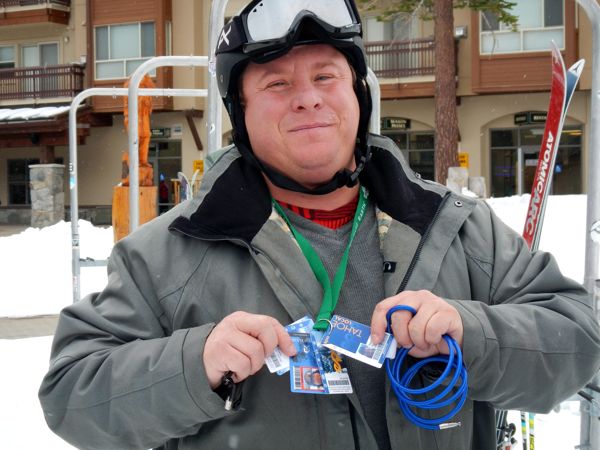
The number of passes proves Ben Russo likes skiing Kirkwood. Photos/Kathryn Reed

Ben Russo was proud to show off his slew of passes from Kirkwood from years past. He and buddy Greg Hutton thought it worth the drive from Orangevale to take in early season runs.

An addition they like is the safety bars that have been installed on all the lifts. It helps those with height issues.

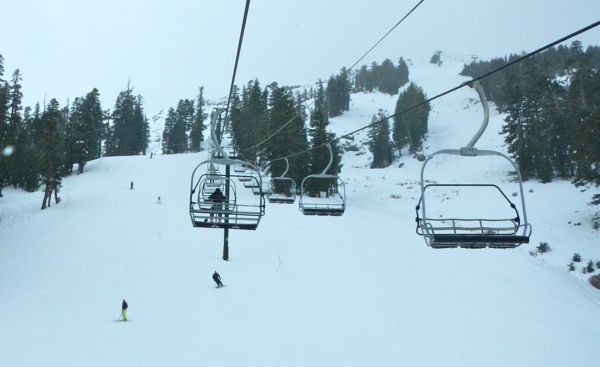
About six people were waiting for Solitude to start spinning at 9am Friday. More people quickly filled the few runs that are open off that chair.

Justin Oltesvig of Oakland and Daniel Valenzuela of San Leandro aren’t sure if they’ll buy a pass that would include the other Vail Resort properties in the Tahoe area – Heavenly and Northstar. They were satisfied to skip work and pay the daily rate just to experience opening day.

Troy Mayers of Santa Cruz was thrilled to be on his tellies for the first time this season. He’s been a longtime Kirkwood season passholder and wasn’t about to give up the opportunity to ski no matter who owns the resort.

Snow fell for most of the day Nov. 16 — which didn’t seem to bother anyone.

Colorado-based Vail Resorts bought Kirkwood earlier this year, with this being the first full season under the new ownership. For the time being, it’s mostly the status quo. Food prices are a bit more, but two bloody Marys at Monte Wolfe’s were $12.50 – about what one is at Tamarack Lodge at Heavenly. New to the eatery’s menu is the Epic Burger, which the parent company is known for.

What was strikingly noticeable was the attitude of every employee. The friendliness was refreshing – and seemed sincere. And when someone didn’t know the answer, they went to get it.


Why good skiers do dangerous things

By Gordy Megroz, Skiing

It was April 19, 2011, and Ian McIntosh, then a 29-year-old skier from Pemberton, B.C., felt invincible. His confidence had been building as he conquered steep Alaskan faces while shooting scenes for Teton Gravity Research’s One for the Road. Each run he took was more treacherous than the last.

And so it went until McIntosh decided to ski a line he had initially eschewed as too hairy. He even skipped inspecting the line from aboard the film crew’s helicopter, a precautionary step he normally took.

As McIntosh approached the rollover, he realized he wasn’t moving fast enough to air beyond the huge field of jagged rocks below. He hit hard, lost balance, and cartwheeled 400 yards. By the end he was alive, but he’d torn the labrum in his hip, broken his left femur, shredded his quad muscle, and torn his meniscus.

“We use fear to judge what is safe and what isn’t,” he says today, still rehabbing from all his injuries. “My mistake was getting complacent and forgetting about the risks.”

These days, McIntosh isn’t the only skier making that mistake. Across the sport, top athletes are ending up maimed and worse. A number of stars have died in high-risk circumstances — Shane McConkey, Doug Coombs, Billy Poole, Ryan Hawks, Arne Backstrom, Jamie Pierre, Kip Garre, and more. All the carnage has some wondering why so many experienced skiers are taking such extraordinary risks.

“Nobody wants to die,” says Robb Gaffney, a Squaw Valley psychiatrist and veteran big-mountain skier. “But people have ways of convincing themselves that what they’re doing isn’t that dangerous. They’ll come away from a few dangerous situations successfully and begin to identify as the guy who takes risks and can conquer them.”

But it’s not just hubris that’s getting skiers into trouble.

Last season, 12 experienced skiers trekked into the backcountry near Stevens Pass, Wash. Despite considerable avalanche danger, a few felt the terrain would be safe to ski. They rationalized that they’d skied it many times before in similar conditions without incident. Then a massive slide broke loose, killing three.

“The data shows that familiarity appears to create tolerance for high avalanche conditions,” says Ian McCammon, a Utah-based avalanche researcher and educator. “People think there’s a risk reduction because they know the terrain so well. But the snowpack is always different.”

Equipment designed to make the backcountry safer may also play a role. Pro skier Elyse Saugstad was caught in the slide. She survived by deploying an air-bag backpack. But Gaffney warns against the bloated sense of security that gear can provide.

“It remains to be seen if the air bag will actually save more lives or drive people into more dangerous situations.”

Then there’s ski-porn, now easily accessible via mouse-click or iPhone.

“In the past, two or three guys went out did a few tricks and that was it,” says Gaffney. “Now they go home and put a video of those tricks on Facebook. Other guys see that and try to outdo those tricks. There’s an instinctual drive to push things to the next level.”

Riley Bergseng, 27, was trying to find that next level while competing in the Freeskiing World Tour in Kirkwood last season. Instead, he cartwheeled through rocks and tumbled over a 30-foot cliff, tearing ligaments in his knee and nearly losing his leg.

“I wouldn’t have normally skied that line,” he says. “I pushed myself because it was being broadcast, there was a big crowd, and I wanted to win.”

Still, Bergseng says he’ll be right back out there next winter. “My mom asks, ‘Why are you doing this?’ Because I love it,” he says. “There’s no better feeling than flying over a gap.”

Ian McIntosh has a similar perspective. “That accident isn’t gonna hold me back,” he says. “What brings me joy is risk taking. It makes me feel more alive than I ever have before. I crave it. I need it in my life or I become depressed.”

If that sounds like an addiction, well, it is. “For risk takers, doing crazy things is an experience not unlike taking a drug in the sense that it involves a dopamine high,” says Tom Schonberg, a neuroscientist at the University of Texas.

Adds Gaffney: “The feelings described by somebody who regularly skis off cliffs are the same feelings described by drug addicts that I treat.”

But there’s something else going on in the brains of risk takers, and it may be the most compelling explanation for the uptick in mountaintop audacity. Several recent laboratory studies show that the brains of risk takers function differently from the brains of more cautious people.

“In risk takers,” says Schonberg, “the region of their brain that responds to value or reward becomes more active with increasing risks, whereas the self-control regions of their brain are not active enough to suppress the pursuit of greater risks.”

Given that skier numbers have risen sharply in the past 20 years, it just may be that more people biologically predisposed to taking risks are skiing.

For those people, can the urge to go big in dangerous situations be controlled? Julian Carr, the man most famous for hucking a front flip off a 210-foot cliff in 2006, believes it can. Carr says he has the ability to make rational decisions about the risks he’s about to take.

“I go through a checklist,” he says. “Do I have the skill set to do this? Are the conditions right? If something is off, I’ll walk away. That’s only happened once, at the Gargoyles near Alta. All my friends hugged me. I think it was because they were happy to know I had the ability to say no.”

But Gaffney sees Carr’s calculated approach as an anomaly within the sport.

“My prediction is that we will see an increase in the rate of deaths and injuries,” he says. “I can’t say comfortably that we won’t.”


Bridge in Incline will help prevent soil erosion

The Third and Incline Creeks watershed discharges more damaging fine sediment into the lake than any other watershed in Nevada.

To help curtail the amount of sediment reaching Lake Tahoe, the Tahoe Fund has given $10,000 to the interagency team responsible for implementing the restoration project. The grant finances a pedestrian bridge over Incline Creek to provide a recreational amenity in the heart of Incline Village and support the environmental improvement program.

The Incline Village General Improvement District, U.S. Army Corps of Engineers, and Nevada Division of State Lands completed the first two phases of this project in 2009 and 2010. Portions of Third Creek were restored, culverts were replaced, and bridges built. The final phase includes stream restoration improvements on Third Creek from Lakeshore Drive to Lake Tahoe, and on Third and Incline Creeks from Incline Way to Highway 28.


Vonn inspiring a generation of young girls to ski

By Lori Knowles, Canoe.ca

She’s the fastest female skier in the world.

U.S. alpine racer Lindsey Vonn — born in Minnesota, now based in Vail — is a four-time overall World Cup champion in ski racing and an Olympic gold medalist. Vonn, 28, is a female force so dominant, she made a recent bid to race against men at the Lake Louise World Cup in late November. (The request was denied.)

What makes Vonn want to ski so fast?

“I met (former Olympian) Picabo Street when I was 9,” she says. “As soon as I met her, I knew I wanted to be an Olympian.”

Which is why, two decades after meeting Street, Vonn has found her own way to inspire young female skiers. She has developed a learn-to-race program called Ski Girls Rock on the slopes of Vail.

“I know how much of an impact female role models can make,” Vonn says. “Picabo made a huge impact on me. She was so positive, so charismatic. But when I was young I also met some people who were not so friendly and it traumatized me as a kid. Picabo was the perfect role model for me, and that’s what I’m trying to give back with the Ski Girls Rock.”

Ski Girls Rock is a day camp aimed at girls — from 7-year-olds to teenagers — vacationing in Vail this winter. In a program designed by Vonn, coaches use fun and fast skiing to inspire girls to push beyond their comfort levels — to race slalom gates, to try steeper runs, to improve edging, and to learn techniques that will make them more aggressive and more successful on the ski hill.

“It’s not about a structured program,” Vonn insists. “It’s not about ‘ski school.’ Ski Girls Rock is about girls getting out there, being active, building self-esteem. I think that’s most important for girls this age.”

A day in the life of a Ski Girls Rock camp goes something like this: In a flurry of pink, intermediate and advanced skiing girls meet their female coaches — former competitors trained personally by Vonn to impart her philosophies. The girls are given white-and-pink ski racing bibs (numbers), then in a massive pack, they take off down Vail’s soft-powder-filled runs, dipping into the trees, jumping over bumps, whooping and hollering their way down the mountain.

While the girls are at many different levels — some ski like experts, others still novice — the coaches manage to keep the group together. The girls eat lunch as a group, engage frequently in giggling and tickling sessions, and high-five each other en masse when they make it successfully down a Vail slalom course. The girls are also given tips from Vonn on how to improve race times, what she thinks are the most effective training exercises and stretches — even what tunes she likes to work out to.

The World Cup champion drops in on the Ski Girls Rock program when she can, mostly in the fall and spring when she’s not active on the World Cup circuit.

In her absence, Vonn has added a new element for the 2013 ski season, which what Vail calls “EpicMix Racing” courses.

Girls are given an opportunity race a special EpicMix course, then compare their pace with Vonn’s. EpicMix (a mobile and web application to track and share ski data) adjusts the girls’ finish times according to age and ability, and assigns each racer a “Seconds Behind Lindsey” score.

When asked for whom Ski Girls Rock is best suited, Vonn says it’s a day camp for all girls, regardless of their ski-racing background.

“There isn’t an ideal ski girl,” she says. “They’re all here having fun and that’s the exactly the point. It’s about them going out there and finding out who they are, and what they want to do, and just being girls.”


USFS cutting off access to roads for the winter

The U.S. Forest Service Lake Tahoe Basin Management Unit has begun the annual closure of forest roads around the basin.

Fall closure dates are established by the motor vehicle use map. The MVUM also establishes target opening dates after the winter season. These dates are dependent on soil conditions in order to avoid resource damage and erosion potential.

Consult the MVUM by going online to find specific roads and dates.

For more information on gate closures, contact the Forest Supervisor’s office at (530) 543.2694.


Upper Kingsbury Grade burn scheduled

U.S. Forest Service fuels management crews will conduct prescribed fire operations on Upper Kingsbury Grade near North Benjamin Drive on Nov. 15.

Crews expect to burn one-quarter acre, conditions permitting. In addition, prescribed fire operations continue in the Bunker Road area near Tahoe City.

Residents and visitors can expect to see smoke from this prescribed fire project area. The Forest Service strives to minimize the impacts of smoke on local communities. Smoke-sensitive residents should consider staying indoors and keeping doors, windows and outside vents closed. To directly receive prescribed fire updates, send an email to pa_ltbmu@fs.fed.us.

Forest Service staff will post road signs around areas affected by prescribed fire, and update the local fire information line at (530) 543.2600, No. 6.


Ski-Snowboard Hall of Fame to induct 6 newcomers

Freestyle skiing pioneer Wayne Wong and world champion freestyle moguls skier Jeremy Bloom lead a class of six inductees elected to the U.S. Ski and Snowboard Hall of Fame.

Joining them will be Alpine World Championship medalist Kirsten Clark, world champion and snowboarding pioneer Craig Kelly, acclaimed international ski instructor and leader Horst Abraham and ski resort developer Hans Geier.

Wong is regarded by many as a living legend. He was the leading and most popular skier of his day when hotdog or freestyle skiing was emerging on the scene. The inventor of the famous “Wong Banger” and a star of countless skiing movies, Wong packaged his fame into being a true ambassador for skiing and continues to this day to convey his passion and enjoyment for the benefit of ski sports across the country. Skiand Powder magazines have named him among the most influential skiers in the 20th century.

Bloom was also a star of freestyle skiing who won two World Cup titles and a World Championship and was one of America’s most visible skiing stars in the mid-2000s. In 2003 he won gold in the dual moguls event at the World Championships and a silver in the individual moguls. Two years later he won his third World Championship medal as well as earning the moguls and overall World Cup titles. His six straight wins in World Cup competition set a record that stood for seven years. Bloom was also a football star at the University of Colorado and played for two years for the NFL’s Pittsburgh Steelers.

Clark started racing at the age of 7, developing her skiing skills at Maine’s Sugarloaf Mountain. During her 13-year career on the U.S. Ski Team she won 12 U.S. titles and reached the World Cup podium eight times. In 2003 she won a World Championship silver medal in the super G. From 1998 to 2002 she strung together five straight U.S. downhill titles. A three time Olympian, Clark was respected for her quiet leadership and the high standards she set preparing for competition.

Kelly is the third snowboarding honoree to be elected to the U.S. Ski and Snowboard Hall of Fame. A winner of four world titles in the early days of the sport, Kelly was one of its most influential pioneers working with Jake Burton Carpenter to open countless ski areas to the sport in the 1980s. He also played a key role during the early years of Burton Snowboards. The holder of an honors degree in chemical engineering, he starred in numerous skiing and snowboarding films over 20 years. The first true professional snowboarder, he was awarded TransWorld Snowboarding’s Lifetime Achievement Award in 2002. He died a year later in an avalanche while seeking to become the first fully certified Canadian Mountain Guide as a snowboarder.

Abraham is an Austrian native who rewrote the script for American ski instruction that had a significant impact internationally. Through his work America’s ski instructors emerged as world leaders in their field. Starting with the Aspen Ski School and later the technical director for the Vail Ski School, he eventually became the education vice president for the Professional Ski Instructors of America. As the developer of what became known as the American Teaching Method in 1980, focusing on teaching skiing skills instead of skiing turns, he led the U.S. to become the world leader in snow sports education.

Geier was a leading manager and developer of ski areas across the United States for nearly 30 years. From the time he completed Pennsylvania’s Ski Round Top in 1971 until his retirement in 1998, he had a large impact on the growth of the sport. Most notably he was the general manager of Steamboat Springs resort in Colorado from 1981 to 1990 when he led it through a $43 million expansion, growing annual skier visits from 360,000 to over a million and putting the resort’s finances in the black. In 1994 he was hired as president of Doppelmayr Corporation for North America, a position he held until his retirement in 1998. He also served on numerous ski association boards including the National Ski Areas Association (NSAA) and chairman of Colorado Ski Country. In 1988 the NSAA presented to him its Lifetime Achievement Award.

The induction of the class of 2012 will take place at the Marriott Vail Resort in Vail on April 13 as the concluding event for Skiing Heritage Week celebrating Vail’s 50th anniversary.


USFS Christmas tree permits available after Turkey Day

The U.S. Forest Service Lake Tahoe Basin Management Unit will begin the sale of holiday tree permits Nov. 23.

Permits cost $10 each (cash or check only, no credit cards) with a limit of two permits per family.

Permit holders may choose from a variety of pine, fir or cedar in designated cutting areas and must abide by specific permit conditions for proper and responsible collection. Harvesting smaller diameter trees offers residents and visitors a traditional holiday experience while helping to thin the forest.

Permits will be available in two locations:

· On the South Shore, permits will be sold at the LTBMU Forest Supervisor’s office, 35 College Drive, South Lake Tahoe. This office is open Monday through Friday from 8am-4pm.

· On the North Shore, permits will be sold at the Incline Village Forest Service office, 855 Alder Ave., Incline Village. This office is open Wednesday through Friday from 8am-4:30pm. During winter weather driving conditions, call the Incline office to make sure it’s open — (775) 831.0914.

This year the LTBMU will issue 3,000 permits available on a first-come, first-served basis. The last day to purchase a permit at the South Lake Tahoe office is Dec. 24, and at the North Shore office the last day is Dec. 21.

Individuals purchasing permits will receive information to help them make the best selection, as well as maps designating the tree cutting areas.


USFS to conduct 2-day burn on South and North Shores

U.S. Forest Service fuels management crews will continue prescribed fire operations in the Cold Creek area near South Lake Tahoe on Nov. 14.

Crews will be working near Sutter Trail and Sierra House Trail. Crews expect to burn one-half to 1 acre per day, conditions permitting. Operations are scheduled to last through Thursday.

They will also be burning in the Bunker Road area near Tahoe City those two days. One acre is expected to be burned each day.

Residents and visitors can expect to see smoke from this prescribed fire project area. The Forest Service strives to minimize the impacts of smoke on local communities. Smoke-sensitive residents should consider staying indoors and keeping doors, windows and outside vents closed. To directly receive prescribed fire updates, send an email to pa_ltbmu@fs.fed.us.

Forest Service staff will post road signs around areas affected by prescribed fire, and update the local fire information line at (530) 543-2600, No. 6.


Training helps dogs ski with their people

By Grayson Schaffer, Outside

All you need to know about going wild with man’s best friend.

Of all the hazards out there in the woods—mountain bikes, porcupines, thin ice, your trigger-happy hunting buddies—none are as dangerous as skiing with your dog. You’ve got four long, sharp metal edges that move at high speed; he’s got four soft paws and, most likely, a strong drive to chase and be near you. If you ski with your dog, chances are you’ve cut him. If you’re lucky, you didn’t sever a tendon or muscle. Of the half-dozen editors’ dogs who ski with us on a regular basis, including my dog Danger, I can’t name one that hasn’t either been cut or, worse, run over by a snowmobile.

The fix is investing the time and discipline into proper obedience. Your dog should wait patiently while you ski down, stop, and call him to join you. On cat tracks, he should heel beside you without nipping at your skis. Do it right and your dog gets to run around in the mountains all day. Avoid it and your dog is stuck at home. The only commands you need are heel, here, and sit. To ski with your dog, though, you’ll need these commands ingrained over time as behaviors.

Teaching him to wait


Start all new training drills in the home, where obedience is likely to be better than outside. Most dogs will master new skills better if they initially learn them without the distraction of unfamiliar places.

1. Have your dog sit. He should remain sitting until you either call him to you or ask him to heel. Practice by walking circles around your sitting dog. He should follow you with his eyes but not get up.

2. Now walk away from him. If he breaks and runs to you, correct him immediately and return him to his sitting position. Make him wait. Then call him to you and have him sit again. This is the way skiing should work: You move away from him and then call him to you. In some cases, you’ll want him to wait for you to stop, in others, like powder, you’ll get a head start on him and then let him follow.

3. Now take it to the field. Once you’re getting consistent results inside, build up your pup’s patience outside, where there are distracting smells. If he won’t do it while you’re in street clothes, he definitely won’t when you’re on skis.

4. If he’s consistent on land, then you’re ready for snow. Many local ski areas allow up-hill skinning and dogs on the slopes before the lifts open. Pick a mellow beginner slope, preferably groomed, where you can slide away from your dog backwards. Have him sit. Move only a few feet away, make him wait, then call him to you. Build up the distance slowly. You want him to succeed every single time. Once he’s solid on groomers, take him into the backcountry.

Read the whole story