Tour of California not coming close to Tahoe in 2013

None of the 12 cities on the 2013 Amgen Tour of California is in the Lake Tahoe Basin.

New this year is the course will go from south to north. Cyclists will travel approximately 750 miles from May 12-19.

The official race start will begin and finish in Escondido. The next day, Stage 2 will take riders through the hot desert terrain from Murrieta to Greater Palm Springs. For Stage 3, the race will return to Palmdale for a stage start and then travel approximately 100 miles west to Santa Clarita. The city, which hosted the race in 2007, 2008, 2009 and 2011, will also serve as the start of Stage 4. From there, the cyclists will ride north toward Santa Barbara, which last hosted the race in 2008, for the Stage 4 finish.

The race will remain in Santa Barbara for the start of Stage 5, with Avila Beach being the Stage 5 finish. San Jose will play host to Stage 6 and the Individual Time Trial, marking the eighth consecutive year the race has visited the city. San Jose is the only city to participate in all eight editions of the race.

Stage 7 will start in Livermore and head to Mt. Diablo for an intense mountaintop finish. The eighth and final stage of the 2013 Amgen Tour of California will start in San Francisco and finish in Santa Rosa, which played host to the official race start last year.


Ski, snowboard equipment designed with women in mind

By Karissa Bell, Wired

Adrienne Schneider, a former racer and member of Salomon’s women’s ski team, now runs women’s clinics and coaches master’s programs for men and women.

She sees the advent of rockered skis as one of the most exciting advancements in the industry, particularly for women. Unlike other cambered skis where the contact points are located at the tip and tail, a fully rockered design positions the contact points almost completely underfoot. Schneider says this makes for a more forgiving ski that’s much easier to coax into turns — especially for women, who tend to not be as strong as guys, who are more able to “muscle through” turns.

“Rocker technology is going to make more women want to ski,” she says. “Turning is a lot easier, they are more playful and friendly. They are like little Ferraris.”

Schneider says ski manufacturers have come a long way in making skis lighter and more optimized for the way women ski.

“Ten years ago, it was not a good experience to have a women’s ski,” she says. “They were junk, but now they are much more forgiving.”

Sarah Allen, a lifelong skier who now does marketing for a few Colorado resorts, says she has seen women’s lines improve by leaps and bounds during her 20-plus years in the sport. Though women’s gear is still not as plentiful as the men’s selection, women have a far wider range of equipment to choose from than ever before.

And, Allen says, we’ve thankfully moved on from the days when manufacturers just added pink graphics to their men’s models and called it a women’s ski. “Women and men ski completely differently,” she says. “They’re creating gear more customized to the way we ski.”

Snowboards: Better boots, new bindings

Amanda Cooper fell in love with snowboarding at an early age. When she started competing during her high school years, there weren’t many other women in the sport.

“There were some events when I would actually end up competing against guys because there weren’t enough girls,” she says.

Cooper thinks some of the most drastic improvements she’s seen have been in snowboarding boots.

“When I first started riding, it was hard to find boots that really fit very well.” She says she would do all kinds of funny things to get a good fit, like tear apart the boot liners and stuff her boots with inserts and footbeds. She laughs about it now, but it was frustrating at the time.

“Definitely, the women’s boots have come a long way. They’ve been able to make boots that are really solid and form-fitting and have the support and still allow for flexibility.”

She cites improvements like rear-entry bindings and the Boa system — a boot closure mechanism that uses steel cables and a crank knob instead of laces or clamps — as innovations that make it easier for beginners to hit the slopes.

“The Boa system is really good for new riders too, because it gives a lot of reinforcement and security and a custom fit.”

Rae Jamison is a self-described ski bum who lived in Denver and Jackson Hole before coming out to California, where she feeds her snowboarding habit in the mountains of Lake Tahoe. When it comes to gear, Jamison has a special appreciation for the fashion side of things.

“It’s about standing out,” she says, speaking of her preference for less-mainstream companies like No Mist. “It’s a small brand,” she says. “If someone has that on, they’re in. It shows they didn’t just go to the store down the street from the mountain.”

Get out of the park

Both Cooper in California and Allen in Colorado will say they’ve recently seen a significant increase in snowboarders and skiers heading into the backcountry.

If you look at the culture of a decade ago, Allen says, parks were huge — riders flocked to halfpipes, boxes, and other man-made terrain features. “Now, you’re seeing the pendulum swing back to where people are taking everything back to the backcountry,” she says, “kind of like taking it back to where skiing used to be where you just found a mountain and you skied it or snowboarded it.”

This shift is also reflected in the recent changes in gear, particularly on the ski side, according to Allen. AT (Alpine-Touring) bindings are becoming more popular and readily available. AT bindings are a cross between traditional alpine bindings used for downhill skiing and those used for telemark or cross-country. This gives skiers the flexibility to have their heels free for “skinning” up hills, as with a traditional cross country or telemark ski, and the ability to lock them down again, alpine-style, when descending.

In snowboarding, splitboards have gained momentum in recent years. Splitboards are often used by snowboarders who need versatility in backcountry conditions. They come apart like skis and have bindings that can be converted for skinning up hill and then reattached for riding on the descent.

Cooper says she sees this trend as a broader reflection of snowboarders and skiers wanting to take their respective sports back to their roots. Particularly in snowboarding, which began as a renegade sport — snowboarders’ only choice for access to the best terrain often was to take split boards onto the mountains or to head out into the backcountry.

“I feel like that’s a very natural and soulful thing,” says Cooper. “You’re connecting back with nature and you’re experiencing what snowboarding is really all about — going fast and experiencing the feeling and joy of being able to cruise at high speeds.”


Rain, snow to blanket Tahoe for several days

Wet. That’s going to be the dominant word to describe the weather starting Wednesday and lasting through the weekend.

Rain is expected at lake level to begin with.

“A more significant set of storms is shaping up for Thursday night into the weekend. These storms will likely tap moisture from the Central Pacific and confidence is high that it will bring a prolonged period of heavy precipitation to the Sierra and adjacent areas of Eastern California and far Western Nevada,” the National Weather Service in Reno said. “These storms will likely have high snow levels (above 7,500 feet) therefore significant snowfall will likely be relegated to only the highest elevations of the Sierra. Heavy rains in lower elevations may create some minor rises in streams, but flooding is not expected.”

Winds will pick up on Friday and blow into Saturday.

Mountain passes are bound to require chains or snow tires. For road conditions, click on the state icons on the home page of Lake Tahoe News.

These will be warm storms that will be passing through the basin, with highs expected to be in the mid-40s and lows in the mid-30s.

— Lake Tahoe News staff report


Snowmobile group to meet

The Tahoe Sierra Snowmobile Club is having its first meeting of the season on Dec. 6 at Tep’s restaurant in South Lake Tahoe.

U.S. Forest Service reps for the Lake Tahoe Basin as well as Hope Valley have been invited to give an update on the Forest Service Plan as well as what areas are open to riding this season.

The meeting begins at 6pm.


3 regional outdoor projects receive state funding

Three Lake Tahoe area projects will be receiving a share of the $34 million the California Natural Resources Agency is giving out for river parkway projects statewide.

“Our river parkway grants help communities connect children with nature, promote public health by providing families with greater outdoor recreational opportunities, and protect the rivers that provide us with clean water,” Secretary for Natural Resources John Laird said in a statement released Nov. 26. “The river parkways program is a great example of local agencies working together with the state to create increasingly sustainable communities in California.”

Regionally, Truckee is getting the largest sum — $2.9 million.

This will be for the Truckee River Legacy Trail Phase 3B. The money will be used to construct approximately 1.5 miles of class 1 bicycle/pedestrian trail, continuing the Truckee River Legacy Trail from the town of Truckee east just across Martis Creek where a trailhead will be constructed. The project will also install signage interpreting the natural and cultural resources of the Truckee River.

Tahoe City Public Utility District is getting $344,263 for the Truckee River Restoration and Access Project. This will create three formal access points to the Truckee River and the Truckee River Bike Trail along Highway 89, north of Tahoe City; restore degraded riparian habitat on riverbanks and wet meadows, create staging areas and install directional and interpretive signage.

In Alpine County, $136,000 has been granted for the 6-acre Markleeville Creek acquisition. The money will also be used to restore riparian habitat, re-establish historic floodplain and provide passive recreation in Markleeville.

In 2006, California voters passed Proposition 84, the Safe Drinking Water, Water Quality and Supply, Flood Control, River and Coastal Protection Bond Act, which authorized the Legislature to appropriate funds to benefit river parkway projects.

The California River Parkways Program, a competitive grant program administered by the secretary for natural resources, awards funds to public agencies and nonprofit organizations to develop river parkways in their communities. Thirty-three projects received funding in this round.

 — Lake Tahoe News staff report


El Dorado County tree growers become fish-friendly

By Debbie Arrington, Sacramento Bee

Some fresh-cut Christmas trees come with dividends downstream.

In their annual search for the perfect fir or cedar, visitors to the Sierra foothills may notice something different this holiday season. Some farms have joined California’s “fish-friendly” movement and have posted their smiling salmon signs proudly.

These farms follow environmental practices to preserve water quality and be kind to wildlife. They’re part of the same trends that bring us “slow food” and river-friendly landscaping. But instead of farm-to-fork, their product is farm to floor.

“We started talking about it five years ago,” said Dee Kobervig, co-owner of Crystal Creek Tree Farm in Camino. “We got certified fish-friendly this year. We’ve got three tree farms so far in the program – all family farms. It helps keep our area rural. If people can’t make a living farming, we lose those farms.”

Also selling fish-friendly trees this season are Carson Ridge Evergreens and McGee’s Christmas Tree Farm, both in Placerville.

Their customers will be folks who want to know where their tree grew – and that it helped wildlife and not hurt it.

“We’re seeing a new demographic among our customers,” said Kobervig, who also serves as president of the El Dorado County Christmas Tree Growers Association. “They want to start a new tradition, but they want to know what they’re buying and where it came from. They want to support local businesses, but they also want to be assured about how that product was grown.”

El Dorado County’s fish-friendly farming program was modeled after a similar one in Napa. As in wine country, it started with vineyards.

“I was so inspired by what people were already doing,” said Fred Hunt, who works with the El Dorado County and Georgetown Divide Resource Conservation Districts. “It was really neat to see how many people are actually doing this as part of their everyday business plan.”

So far, 44 sites in El Dorado County have joined the Fish-Friendly Farm program, Hunt said. Altogether, they encompass 2,755 acres including 14.3 miles of creeks. Part of the American River watershed, those little creeks affect the quality of water that flows down to the Valley and everything that uses that water – including fish and people.

“We have Christmas tree farms, a lot of vineyards, tree fruit orchards,” Hunt said. “We’ve been very proactive. We want to assure people that water leaving here is as pure as it can be.”

As part of a voluntary program run through the U.S. Department of Agriculture’s Natural Resources Conservation Service, farms get intensive surveys of their property plus the advice to correct any issues.

“The goal is to keep your water – and what’s in it – on your property,” Kobervig said. “They started with an aerial view of our farm. We got a bird’s-eye view of our whole place – every slope, road, streambed on our 20 acres. Then, we came up with a plan.”

That plan included sediment ponds to catch runoff, erosion control on slopes, integrated pest management to fight bugs naturally, nesting boxes for birds and mulch to keep down weeds.

Said Hunt, “What people are getting at no cost is a detailed plan for their property. We’re being good stewards of the land.”

With new grant money expected for 2013, the program is ready to expand. Hunt is accepting inquiries from farms and property owners; reach him at (530) 295-5638.

“We’re hoping to open it up to cattle ground, traditional rangeland,” Hunt said. “We could reach 10,000 to 15,000 acres.

“We’ve done quite a lot already, and it’s only going to get better,” he added. “That’s what’s really neat.”

As for the trees, this year’s crop should be wonderful.

“Last year and this year have been just phenomenal,” Kobervig said. “The warm weather (in October) actually gave the trees a little growth spurt. But we had a little snow and a good cold snap; that sets the needles. And people love it with snow on the ground when they come up, looking for a Christmas tree. It just feels right.”


Sullivan takes third in downhill

By USSA

LAKE LOUISE, Alberta — Veteran U.S. Ski Team downhiller Marco Sullivan of Squaw Valley parlayed a strong training run Thursday plus two weeks of training at the U.S. Ski Team Speed Center at Copper into a third place downhill finish Nov. 24 in the opening Audi FIS Alpine World Cup speed event of the season in Lake Louise.

Starting 42nd, Sullivan hit a perfect line to tie with Austrian Klaus Kroell 0.64 seconds behind winner Aksel Lund Svindal of Norway.

Sullivan solidified his comeback with his first Audi FIS Alpine World Cup podium since 2009 with a third in the opening dowhill.

It was the fourth podium of his 13-year career with the U.S. Ski Team that includes a downhill win at Chamonix, France, in 2008.

Sullivan switched to Atomic skis and boots in the off season and spent a long six-week stretch in Chile to dial in his new equipment.

He had been training at the U.S. Ski Team Speed Center at Copper Mountain since late October before traveling to Lake Louise.


U.S. teen tops Mancuso, Vonn in giant slalom

By USSA

ASPEN — The U.S. Ski Team’s Mikaela Shiffrin put together two solid runs, coming out of the 42nd start position to finish ninth — a career best giant slalom — at the Nature Valley Aspen Winternational.

Slovenia’s Tina Maze picked up the win Nov. 24 to remain undefeated in GS as the Audi FIS Alpine World Cup began a two weekend swing in the United States.

Julia Mancuso of Squaw Valley was 15th, while a still ailing Lindsey Vonn of Vail was 21st.

The 17-year-old Shiffrin of Eagle-Vail in just her second year on the Audi FIS Alpine World Cup has six top 10s — five in slalom. Her previous best GS was 26th in Andorra last season.


Sledding provides hours of outdoor thrills

By Kathryn Reed

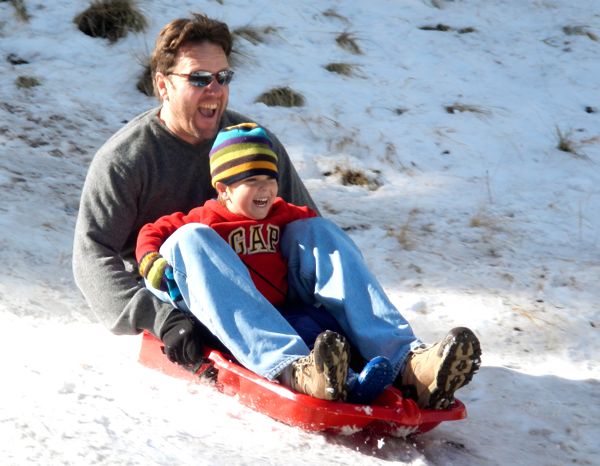
SPOONER SUMMIT – Based on the smiles and whoops of joy, sledding clearly has no age limit.

“There’s nothing like this back East,” Bill Stump, 50, of Palo Alto said surveying the hill. He and his family recently moved to the Bay Area from New Jersey. They were in Tahoe for the long Veterans Day weekend.

His 13-year-old daughter, Alexandra, thought the forest they used to live in was fun, but when she talked about the steepness of the hills in the Sierra, a big smile came across her face.

Joe and Nick Cortez are all smiles as they descend the Spooner Summit sledding hill. Photos/Kathryn Reed

And she’s been at this a few years, so she knows what type of device works best. Pointing to the rectangular purple sled that has an edge a few inches high all the way around it, she said, “I like these kinds because they are easier to shred.” Alexandra said the saucers are too hard to steer.

Steering, though, didn’t seem to be on option on any of the sleds. And one that had brakes didn’t work. That didn’t matter to Nick Cortez.

“I liked the part where I went by myself. I put my legs out to stop like brakes,” 4-year-old Nick said.

Before most ski resorts started spinning chairs people were eager to play in the white stuff. This hill at the junction of highways 50 and 28 is popular all winter. Part of it has to do with the steepness, part because it’s free, part because it’s at a high enough elevation to have snow when it’s dirt elsewhere and definitely because it’s fun.

Sledding, while seemingly a tame sport, if one can call it a sport, is not necessarily safe.

“Sledding is a lot of fun, but we see most injuries in the early season when hard objects are barely covered, [like] stumps, branches, rocks and when the snow is very hard,” Warren Withers, medical director of Barton Health’s Emergency Medical Services, told Lake Tahoe News.

While objects were clearly visible and the worn path of white was showing dirt Monday last week, no one was taken to the ER. But some bruises turned up.

Withers suggests helmets be worn – just like on the ski slopes. One kid had a helmet, but everyone else was taking his or her chances.

A few parents also didn’t heed the doctor’s advice when it came to riding with their kids.

“Parents should think twice about going on the same sled with children too small to sled by themselves. Crashes can be bad for smaller children riding with adults,” Withers said.

Everyone who wiped out seemed to do some sort of flip or at a least hard fall to one side, so it would be easy to see how a little one could be hurt riding with an adult during a tumble.

Even this early in the season bits of plastic were strewn about – an indication the hill won and the sled lost. An old-time metal saucer needed some waxing to go faster. Then there were the Body Glove sleds that worked well for those going down on their stomach. Plus, they looked durable and like they would work well on the water in another season at Lake Tahoe.

ngg_shortcode_0_placeholder (Click on photos to enlarge.)


Tahoe City planning 3-day Nordic fest

Alpenglow Sports has teamed up with Tahoe Cross Country to present the inaugural Lake Tahoe Nordic Festival Dec. 14-16.

All events are free and open to the public at Tahoe Cross Country.

The festival will include local Nordic ski and snowshoe community to lead its clinics, groups skis and races, including Olympians Marcus Nash and Glenn Jobe, Far West Nordic Head Coach Ben Grassechi, Tahoe Peak Endurance’s Colleen Connors-Pace, Andy Pasternak and Julie Young of Silver Sage Sports Performance, Tim Hauserman of Tahoe Cross Country, Kara LaPoint of NTHS Nordic, and Peter Fain of Atlas Snowshoes.

Local organizations Tahoe Institute for Natural Science and Tahoe Rim Trail Association also lead a Natural History Snowshoe Tour and Snowshoe Hike, respectively.

A full schedule of events is available online.