Vail Resorts buys 2 Midwest ski resorts

By Ed Sealover, Denver Business Journal

Vail Resorts Inc. has entered into agreements to buy two Midwestern ski resorts, making the Broomfield, Colo.-based company’s cache of out-of-state resorts larger than its in-state collection for the first time.

The company that owns and operates Heavenly, Northstar and Kirkwood in California, and the Vail, Keystone, Breckenridge and Beaver Creek resorts in Colorado will add Afton Alps in Minnesota and Mount Brighton in Michigan to its portfolio for the combined price of $20 million, CEO/chairman Rob Katz announced Thursday.

Vail Resorts then plans to upgrade the ski areas and to include them for the 2013-14 season in what will be a nine-resort season pass, he said.

“These acquisitions are part of a new strategy for Vail Resorts to drive season pass sales and build broader guest loyalty by looking at premier smaller ski areas located near major urban markets,” Katz said in a news release. “We plan to bring state-of-the-art racing, terrain parks, coaching and technology to the guest experience.”

The announcement comes two days after KSL Capital Partners LLC of Denver, which owns Squaw Valley, announced that it will buy a 24 percent stake in Whistler Blackcomb Holdings Inc., the Canadian company that owns the popular Whistler ski resort near Vancouver, British Columbia. Katz was asked during Vail’s quarterly earnings call Tuesday about whether his company had looked at buying Whistler, and he responded that he was not interested in buying a minority stake in a resort company because it would not allow Vail to make changes and drive value the way it feels is necessary.

Afton Alps and Mount Brighton host a combined 468,000 active skiers each year and are near the Minneapolis-St. Paul and Detroit markets. Both currently are family-owned.


Tahoe Fund helping put bike trail on the ground

Tahoe Fund wrote a check for $12,850 to the Tahoe Transportation District to be used for Rabe Meadow Bike Path.

This is part of the Stateline-to-Stateline bike trail.

The Rabe Meadow segment is the first section of the 3-mile segment that goes from Stateline to Round Hill Pines Resort.

The funding was contributed by private donors at the Tahoe Fund annual Founders Circle Summer Dinner in August, including the South Tahoe Alliance of Resorts.

The bike path includes environmentally sensitive design features, including boardwalks over wetland areas, and connections to major transit hubs.


Placer County has sno-park passes on sale

With the early snow, Placer County Visitor Bureau/California Welcome Center has sno-park passes for sale along with a map and directions to the 19 sites.

The center is located at 1103 High St. in Auburn. The phone number is (530) 887.2111.

A permit is required for each vehicle parked at a sno-park site from Nov. 1 through May 30. Day Permits are $5 for a single day. Season permits are $25.


Salt Lake City commits to seeking 2026 Winter Olympics

By Howard Berkes, NPR

Ten years after jumpstarting Mitt Romney’s political career with a widely-praised Winter Olympics, officials in Utah say they’re ready to do it all over again.

But there’s no word on whether the unemployed Romney is interested in reprising his role as Salt Lake City Olympics chief. He would be 78, after all, when the 2026 games roll around. That’s the earliest opportunity for a Winter Olympics in the United States.

“Salt Lake City and the great state of Utah are ready, willing and able to host a future Olympic Games” if the U.S. Olympic Committee pursues another winter Olympic bid, according to Gary Herbert, Utah’s Republican governor, in an announcement Monday at the Olympic Cauldron Park on the University of Utah campus.

Herbert and Salt Lake City Mayor Ralph Becker made the decision after reviewing a report from an exploratory commission.

The commission referred to a survey finding 74 percent support for another Utah Olympics among those polled. The report also said that 40 percent of the nation’s winter Olympic athletes train at the 2002 Olympic facilities in Utah, which include an indoor speed skating oval, ski jumping ramps, a freestyle skiing training ramp and pool and a bobsled, luge and skeleton track.

The bidding process for the 2002 Olympics was tainted by a bribery scandal that involved more than $1 million in illicit gifts for members of the International Olympic Committee. The scandal prompted congressional hearings, criminal charges and a painful reform process for the IOC and the USOC.

Lingering embarrassment from the scandal may hinder Salt Lake City’s new bid. But a bigger barrier is the USOC and a pending decision on the best time to nominate a U.S. city to be the next Olympic host.

“We obviously are appreciative that the Olympic movement is strong enough to have cities interested in potentially bidding,” says Patrick Sandusky, the USOC’s spokesman. “However the USOC is focused on determining when it would be the right time to potentially bid for an Olympic Games.”

The USOC has decided that the next Olympics to possibly have an American bid is the 2024 summer games. The USOC is considering a bidding strategy and if it decides to nominate a U.S. city for the summer Olympics, it’s not likely an American city will also bid for the winter games that follow two years later.

There are also at least three other possible U.S. bidders for the 2026 winter games: Reno-Lake Tahoe; Bozeman, Mont.; and Denver.

An American nominee would go up against other cities around the world and the IOC would make a final decision.

A USOC working group on Olympic bidding is set to report to the USOC board at a meeting scheduled for Dec. 19. But Sandusky says that the group is only providing an update and not a recommendation for a future bid.

New York failed in its bid for the 2012 Olympics and Chicago lost out in the bidding for the 2016 games. Both bids were hampered, in part, by a persistent revenue-sharing dispute between the IOC and the USOC.

That dispute was resolved in May. One of the key negotiators for the USOC was Fraser Bullock, Romney’s second-in-command during the 2002 Olympics, an adviser for Salt Lake City’s new Olympic exploratory committee and a respected figure among IOC members.


Parent company of Squaw-Alpine buys part of Whistler

By Kathryn Reed

KSL Capital Partners, the owners of Squaw Valley and Alpine Meadows, now owns nearly one-quarter of Whistler Blackcomb in British Columbia.

The deal is expected to be completed today.

Denver-based KSL will acquire Intrawest’s 9,092,500 common shares of Whistler Blackcomb Holdings, which amount to about 24 percent of the corporation’s issued and outstanding common shares, for $12.75 per common share for almost $116 million.

Whistler is now partly owned by the same people who own Squaw Valley and Alpine Meadows. Photo/LTN file

Intrawest has long been a financially troubled enterprise. In fact, just before the 2010 Vancouver Winter Olympics folks at Intrawest threatened to not be able to stage some of the events at Whistler. That threat never materialized.

Intrawest built the village at Squaw. That development was sold to former Squaw owner Nancy Cushing in January 2010.  It was then sold to KSL when it took over the Squaw Valley ski report the following November.

With the transaction comes a shakeup of the management team and board of directors.

Bill Jensen has resigned as a director and CEO of Whistler Blackcomb Holdings. Directors Wes Edens and Jonathan Ashley will be off the board when the transaction is done. Current president and COO Dave Brownlie will continue as president, but will also be the CEO and a director. Eric Resnick and Peter McDermott, both of KSL, will be directors.

In a statement to shareholders, KSL said it plans to hold the purchased shares for investment purposes. However, they added that KSL and its affiliates expect to evaluate on an ongoing basis the financial condition and prospects of Whistler Blackcomb Holdings and its interest in the corporation, and may from time to time acquire additional common shares of Whistler Blackcomb Holdings or may dispose of all or a part of their shares.

Whistler is the largest ski resort in North America.


Competitors become partners to lure skiers, snowboarders to both ends of Lake Tahoe

By Kathryn Reed

No ski resort is going to please all of the people, but it is possible one pass can please most of the people.

That is the hope of officials at Sierra-at-Tahoe, Alpine Meadows and Squaw Valley. (Alpine and Squaw have the same owners.) All three resorts are unique – in terms of terrain, amenities, and vibe. It’s not about becoming a homogenous, non-descript corporate (though all are corporate entities and not indie resorts) mountain.

“What it’s about is the different experiences. The differences and variety each can offer customers,” Andy Wirth, who runs Squaw and Alpine, told Lake Tahoe News.

Squaw is legendary. After all, it hosted the 1960 Winter Olympics. Terrain is steep. Cliffs are rugged. The mountain is sprawling. Alpine is definitely more laid back. It’s known more for its bowls than traditional ski runs. Sierra is all about the mountain – no village necessary – exceptional terrain parks and being a place all ages can feel comfortable.

When it’s windy at Squaw, those pass holders will find plenty of sheltered area at Sierra. Photo/Provided

Squaw and Sierra are home to a slew of past and current Olympians and X Gamers – think Tamara McKinney, Jonny Moseley, Julia Mancuso, Travis Cabral, Hannah Teter, and Jaime Anderson. So their mountains aren’t just for the recreational skier – though that is mostly who is schussing down their slopes.

“We are partnered with two of the best resorts in the United States,” John Rice, general manager of Sierra, told Lake Tahoe News. “I have had days at Squaw Valley in terms of quality that don’t compare to anything else in the U.S. It’s got it all.”

Rice has intimate knowledge of Squaw, having worked there early in his career. He started as an intern and left as director of all outdoor operations, which included managing a staff of 350.

What he believes Sierra will offer Squaw and Alpine pass holders is terrain parks like they aren’t used to.

“I think we will see a huge sampling from their youth to see what we are about,” Rice said.

The three-in-one pass is a one-year deal – at least to start with. Head honchos and money crunchers will assess how the partnership is working throughout the winter and figure out what to do for the 2013-14 year.

(Both resorts have limited deals with other ski resorts that are separate from this offer.)

While resort officials can’t completely attribute the bump in season pass sales to the Nov. 12 announcement of this promotion, they know people are excited about it.

Wirth said, “Since the announcement we have seen an overwhelming response from the marketplace. We’ve clearly seen a lot of new customers through our season pass sales.”

He said people have upgraded their passes so they can ski at Sierra.

“On opening day we had 12 Squaw people,” Rice said. This was Thanksgiving Day and Squaw was open.

For most pass holders at Squaw-Alpine, it means being able to ski at Sierra throughout the season. For most Sierra pass holders, it means access to Squaw-Alpine until Dec. 21 and after April 15.

With Squaw and Alpine during normal snow years having closing dates in May, this will mean another month of skiing (for free) for Sierra pass holders.

Having a north-south option was appealing to Rice because he had it before when Booth Creek also owned Northstar. He saw the benefit to a deal like that even if skiers are apt to predominately be at one end of the lake.

Wirth likes that Sierra attracts a sizeable crowd from the Sacramento area. Now he hopes they’ll take Interstate 80 a few times instead of Highway 50.

Once a rider is at a resort there’s more money to be spent beyond having bought the pass. There’s food, gear, rentals, lessons, preferred parking and more. That’s one way the resorts will cash in on the deal.

It’s also about the perceived value of the pass. Even if people don’t take advantage of skiing the multiple resorts, the possibility always exists.



Comments being taken on trail plans for Truckee

Comments are being taken until Jan. 8 on the draft initial study-proposed mitigated negative declaration for the Truckee River Legacy Trail Phase 3B Project.

The project would construct a paved Class I trail south of the Truckee River, connecting Phase 3A trail (located west of the TTSA Wastewater Treatment Plant) to Glenshire Drive. The project would also construct a bridge over Martis Creek by its confluence with the Truckee River. The trail would travel through property owned by Truckee, U.S. Forest Service, and Tahoe-Truckee Sanitation Agency.

Written comments should be sent to: Becky Bucar, Town of Truckee, Engineering Division, 10183 Truckee Airport Road, Truckee, CA 96161.

The Truckee Town Council is scheduled to consider adoption of the IS/MND on Jan. 8.

For more info, contact Becky Bucar at (530) 582.2932 or bbucar@townoftruckee.com.


June Mountain to reopen in 2013-14 season

By George Shirk, Mammoth Times

After a one-year planned hiatus, June Mountain Ski Area will re-open for the 2013-14 winter season, CEO Rusty Gregory said.

“We’re going to open it up,” he said. “We submitted our operating plan to the Forest Service and now we’re waiting for approval, and part of that operating plan is letting them know that we intend to open it as normal for the 2013-14 season.”

It is in essence a relaunch of the ski area, which is owned by Mammoth Mountain. Gregory said Mammoth would take the year to more clearly hone June Mountain’s mission and to target its marketing base.

“Carl Williams [the general manager of June Mountain] is going to working closely with the community on working to define a more clearly-identified market niche for June,” Gregory said. “That will involve both the mountain and the community.”

As of now, Gregory said June would be a destination for “young families.”

What that means in specific terms, Gregory said, is still up in the air.

“You’ll be hearing a lot more of that in the weeks and months to come.”

The news of the reopening did not exactly achieve the magnitude of the news of its closure for the current 2012-13 season, which was made last spring in the heels of a near-disastrous, snow-starved season for June and Mammoth.

“We haven’t made a big deal about it, not because it isn’t big news,” Gregory said, “but because we’ve got a lot of work to do and make sure we have our plan down and approach the community in the right way.”


Threat of flooding along Truckee River subsides

Updated Dec. 2 5pm: NV Energy is reporting 300 customers in Round Hill and 50 along the Mt. Rose Highway are without power. Crews are on scene trying to fix the problems.

Latest outage update: 300 customers in Round Hill/South Shore; 50 along Mt Rose Highway; 200 in Hawthorne; 20 in Wadsworth. Crews on site.

The National Weather Service in Reno is calling off the threat of significant flooding along the Truckee River in Truckee and Sparks.

At 2:30pm Sunday the Weather Service lifted the flood warning in Carson City and western Douglas County.

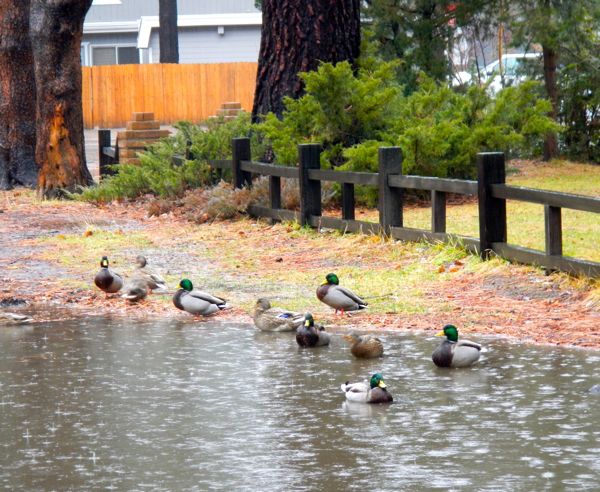
When the rain turned to snow earlier in the day that helped reduce the chance of the river causing damage. However, all rivers and creeks in the Tahoe-Truckee-Reno area are flowing faster than usual for this time of year.

Ponding on Jeffery Street in South Lake Tahoe has neighbors calling it Lake Jeffery. Photo/LTN

Several surface streets have substantial standing water, so motorists are urged to use caution.

Those living where the water table is high have been running their sump pumps – something that usually doesn’t happen until the spring runoff.

There is a 40 percent chance for rain and snow Sunday night in the Lake Tahoe and Truckee area.

 — Lake Tahoe News staff report


Mancuso finishes second to Vonn in super G

By USSA

In a day full of superlatives, Lindsey Vonn took an Audi FIS Alpine World Cup record seventh straight win in Lake Louise with U.S. Ski Team teammate Julia Mancuso second to complete a one-two U.S. women’s sweep of the weekend.

Vail’s Vonn came down 21st in a snowy, foggy super G to knock Mancuso out of the lead. Leanne Smith (Conway, N.H.) was the early leader and finished eighth. Five U.S. women cracked the top 30. Vonn’s 56th career win put her alone in second on the all time victory list behind Austrian Annemarie Moser-Proell’s 62. She also became only the fourth woman to score 100 podiums.

“I’m just happy. It was a good run and I’m excited to start the season off with a podium. I had confidence from skiing well here in the past,” Squaw Valley’s Mancuso said. “The downhill went pretty well for me so it was just a matter of getting going.”