Snowboard sales decline, more people buying skis

By Hugo Martín, Los Angeles Times

At the height of the nation’s snowboard craze, Rod Rice was a so-called blazin’ raisin — an older dude who loved to bomb the slopes at breakneck speeds.

That is, until he wiped out and dislocated his shoulder on a trip to Canada. The 65-year-old engineer still loves to carve fresh powder, but now he does it on a pair of extra-wide skis.

“I’m not planning on going back to snowboarding,” said the Lakewood grandfather.
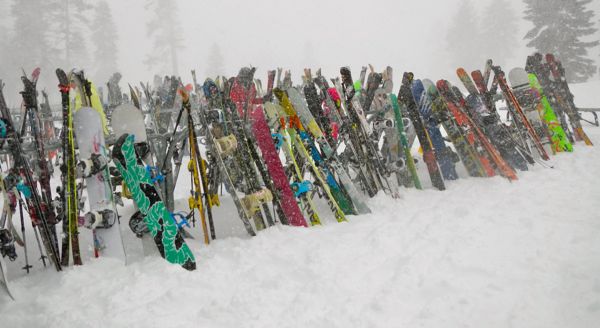
A mix of skis and snowboards at Northstar. Photo/LTN

Once the king of the mountain, snowboarding is on the down slope.

The rage that transformed the nation’s ski resorts and planted such terms as “jib,” “face plant” and “biff” into America’s lexicon is cooling off partly because many older riders are shifting to new, easier-to-ride skis to preserve their aging bodies.

Sales of snowboards and snowboard equipment have slipped 21 percent over the last four years, while sales of skis have climbed 3 percent in the same period, according to SnowSports Industries America, a trade group that tracks the $3.5-billion snow sports and apparel industry.

Baby boomers aren’t the only ones bailing. Last season alpine skiing replaced snowboarding as the most popular snow sport among kids ages 6 to 17, according to the trade group. That’s the first time in nearly a decade and a troubling sign for snowboard makers battling for a key demographic.

The once hip, ultra extreme sport may have lost its lure when mom and dad began snowboarding a few years ago.

“Kids don’t want to do what their parents do,” said Chris Riddle, a spokesman for Snow Summit and Bear Mountain ski resorts near Big Bear Lake. He said he’s seen an increase in skiers in the terrain park typically dominated by snowboarders.

A snow-loving member of the millennial generation, 17-year-old Arten Yegikyan from La Crescenta tried snowboarding on Bear Mountain a few months ago. He said he gave it up because he felt beat up and frustrated when he was done.

“It felt like you had no control over the direction you are going,” said Yegikyan, who now prefers skiing. The limitations snowboarders face in powder and flat terrain are a reason Kristy Chocholaty, 35, of Truckee has given up on the sport.

She jumped on the snowboard bandwagon in the late 1990s. “I wanted to check it out because so many people were snowboarding at the time,” she said.

But she said she gets frustrated when she tries to keep up with her skier husband and gets stuck in places that he can simply push through with his poles.

Ski and snowboard manufacturers acknowledge the factors weighing on snowboards. But they predict sales will rise again as manufacturers push new board designs that will make them easier and safer to ride.

“Like anything else, you will see the snowboarding trend wax and wane,” said Nick Castagnoli, a spokesman for Rossignol Skis USA, a longtime manufacturer of skis, snowboards and other snow gear.

Meanwhile, new ski designs are making it easier than ever for ski fans of all ages to enjoy the sport. Thanks to so-called shaped skis, many beginners are gaining proficiency quickly, while some veterans are mastering tricks that would have been difficult on conventional skis.

Shaped skis are shorter than traditional straight skis. They’re also wider at the front and back. That hourglass shape enables skiers to turn with less effort — and with fewer wipeouts. These wider skis are also better for schussing over powder and cruddy snow. Plus, skis with upturned tips on both ends can be ridden forward and backward, just like a snowboard.

As a result, powder hounds who want to try downhill skiing, backcountry trekking and terrain park tricks can do it all and save money by buying one set of skis.

Thanks to such new designs, skiers will compete for the first time in slopestyle and half pipe competitions at the 2014 Winter Games, the International Olympic Committee recently ruled.

“It’s interesting where the industry is going now,” said Josh Holm, who manages the ski rental shop at Squaw Valley Ski Resort. “You can ski on a half pipe and land backward just like a snowboarder.”

Modern snowboarding was invented in the 1960s, but most ski resorts refused to let riders on their slopes until the 1990s when the sport’s popularity began to boom. Snowboarders made their debut in the Winter Olympics in 1998, and by 2004 they outnumbered skiers on U.S. slopes.

From 1990 to 2004, the number of Americans who participated in snowboarding jumped about 340 percent, from 1.5 million to 6.6 million, according to the National Sporting Goods Association. In the same period, the number of skiers dropped 48 percent, from 11.4 million to 5.9 million, the trade group said.

Since 2004, however, snowboard participation has dropped 22 percent while skiing has climbed 16 percent, according to the trade group.



Resorts don’t limit their fun to skiing, boarding

By Kathryn Reed

TWIN BRIDGES – Don’t ski? Don’t worry. Ski resorts have something even for guests who don’t want to strap a board or two to their feet.

They can provide a different way for you to slide or let you strap other devices on your feet that are less scary than skis or a snowboard.

“At Sierra we are so passionate about progression. We hope they go down the sledding hill and then want to ski,” resort spokesman Steven Hemphill told Lake Tahoe News. “We don’t look at it as just a tubing option. We look at it as getting them on the snow and then intrigued about sliding on skis or a snowboard.”

Plus, Sierra-at-Tahoe offers other activities that aren’t snow related – like the Cal band that is playing this weekend and various wine events throughout the season.

Tubing at Sierra is an option for those who don’t ski or want a break from schussing. Photos/Kathryn Reed

Most Tahoe area resorts have something other than skiing or snowboarding for their guests.

Chris Sathre, 46, of San Juan Capistrano brought his 4- and 6-year-old to Sierra’s tubing hill. It was hard to tell which of the three was having more fun. Sathre liked the hill because it’s safe and you “get a little speed.” While he skis, the tubing allows him to have fun with his kids.

Twelve-year-old Sonya Pinsky of Alameda gets a running start to fly down the tubing hill at Sierra-at-Tahoe. As she goes over the rollers she pulls up on the tube to get some air.

Scary? Not to her. Pinsky is all smiles talking about the fun at the resort’s Blizzard Mountain.

Two routes are available for tubers; both with curves where riders can go up embankments. When the worker spins the tuber there is no telling what direction one is going – except down. What might be around the corner or even when the next corner is can’t be ascertained unless the rider only received a normal push to get going.

For the more experienced tubers like Pinsky, it was all about running  about 15 feet from the start line, landing on her stomach on the tube and going fast.

“So many people may not have seen snow. It’s a great way to ease into it,” Hemphill said.

The tubing hill used to be on the Broadway run. Three years ago the resort created Blizzard Mountain near Lot E.

In addition to the tubing lanes, there is a bouncy house, snow fort and sledding.

It costs $25 to tube for two hours. The number of runs one can get in all depends on how many people are there – just like skiing. Food and beverages are sold at the bottom where the tickets are purchased. The sledding is at the top of the tubing hill.

The top of the tubing hill is also a turn-around point for snowshoers.

Jen Soto and her mom Patti Brecht, both of El Dorado Hills, have opted to snowshoe while others in their party are skiing. Soto is recovering from a back injury, so she wanted a less strenuous activity. This was her first time on snowshoes, second for mom.

They rented their equipment from the little telemark hut near the Grandview lift. All-day rentals are $25 – which includes access to the trails. For those with snowshoes, the three-mile roundtrip trek is free.

Starting off the signs clearly point where to go. Then markers lead us into the woods where it’s incredibly quiet and no longer do we realize we’re at a bustling ski resort on a Sunday.

But then the signs are gone and the packed snow goes in opposite directions. One route is over a creek with no clear indication there is any sort of bridge other than snow covering the water, while the other leads out of the woods to the trail that is wide as a road.

We choose the safer route. However, a resort official later said that the true route crosses the creek and goes to a lookout where Pyramid Peak looms tall in the distance.

An option for those who don’t want to be outdoors is to participate in the Wednesday wine tastings from 3-4pm in the Pub. El Dorado County’s Madrona Vineyards pours a variety of wines.

Besides the Cal band, various musical acts come to the resort at different times.

All of Sierra’s events are online.

ngg_shortcode_0_placeholder (Click on photos to enlarge.)


Free guided snowshoe at Van Sickle Park

Explore Tahoe: An Urban Trailhead and the Tahoe Rim Trail Association are putting on a snowshoe trek through Van Sickle Bi-State Park in South Lake Tahoe on Feb. 2 from 10am-1pm.

The nearly 3 miles is rated as “moderate” in terms of difficulty.

Meet at the Heavenly Village Parking Garage at 10am.

Participants must provide snowshoes, dress appropriately and bring plenty of water and food to last through the hike.

The event is free.


Sullivan top U.S. contender in downhill at 13th

By USSA

WENGEN, Switzerland — Marco Sullivan (Squaw Valley) led the U.S. Ski Team Saturday by finishing 13th in the fabled Lauberhorn, one of the most punishing downhills on the Audi FIS Alpine World Cup.

“Today was not my best performance here. It was not a bad result, but I was really hoping to capitalize on my early start number which is always seen as an advantage on this long course that gets continuously more bumpy as the day wears on,” Sullivan said. “The result did move me back into the top 10 in the season downhill standings.”

Italian Christof Innerhofer took the win.

Travis Ganong (Squaw Valley) was 21st. Ted Ligety (Park City) did not ski the downhill, but caught a break when World Cup overall challenger Aksel Lund-Svindal of Norway went out.


Full moon snowshoe on West Shore

California State Parks and West Shore Sports will host a full moon snowshoe on Jan. 26 along Tahoe’s West Shore at Ed Z’Berg Sugar Pine Point State Park.

For those new to snowshoeing, there will be a beginner’s clinic at 6:30pm.

The full moon hike starts at 7pm and ends at 8pm.

Cost is $20/adults and $5/children under 12 years, which includes parking and snowshoe rentals.


Vonn returns to podium

By USSA

CORTINA d’AMPEZZO, Italy — Lindsey Vonn (Vail) climbed back on the top step of the podium Saturday winning the Cortina downhill, with teammate Leanne Smith (N. Conway, N.H.) third – her second podium of the season.

It was the 58th career Audi FIS Alpine World Cup win for Vonn – fifth of the season – and left four Americans in the top six in the Audi FIS Alpine World Cup downhill standings.

Super G is on tap for Sunday in Cortina.

Despite missing a large number of races due to illness this season, Vonn still stands fourth in the World Cup overall standings, leading three Americans into the top 10.

Vonn continues to lead to World Cup downhill standings, with Stacey Cook (Mammoth Mountain) second, Alice McKennis (Glenwood Springs, Colo.) fourth and Smith sixth.

In the final World Cup downhill before the World Championships, Julia Mancuso (Squaw Valley) was ninth, McKennis 11th, Cook 15th and Laurenne Ross (Bend, Ore.) 27th.


Heavenly celebrates Safety Week with myriad events

Heavenly Mountain Resort’s theme for National Safety Week is All in for Safety.

Highlights of the Jan. 19-26 Safety Week events include: sweep Mott Canyon with a ski patroller; avalanche beacon competitions in Milky Way Bowl; tours of the gondola and tram motor rooms; tours of the Prinoth Beasts; tours of CalStar’s helicopter ambulance; photo opportunities and rescue demonstrations by the avalanche dogs; snowmaking demonstrations; and safety expos.

For specific times and events, go online.


Discounted Alpine-Squaw lift tickets benefit nonprofits

Squaw Valley and Alpine Meadows are providing lift tickets to five local nonprofits to sell at a discount. Skiers and riders can show their goodwill by purchasing a lift ticket from Arts for the Schools, KidsZone Museum, Sierra Senior Services, Sierra Avalanche Center or Truckee Tahoe Humane Society. Tickets are valid Feb. 3-8 at either resort.

Squaw Valley and Alpine Meadows provided 300 lift tickets to each of the participating nonprofits – a total donation of $148,500 at ticket window rates.

Rates for the tickets start at $30 per ticket – a savings of up to $69. Tickets must be purchased directly from the organizations.


Heavenly ski patrollers learn ice rescue techniques

Ice rescues aren’t common at Heavenly Mountain Resort, but the potential is there with the two reservoirs.

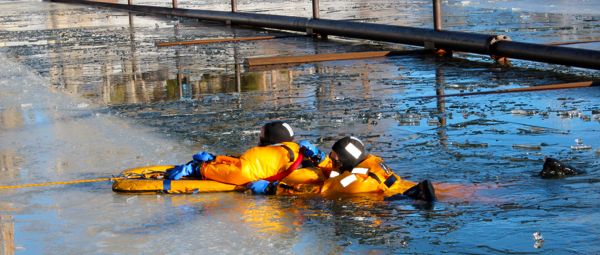
Tahoe Douglas firefighters and Heavenly ski patrollers practiced ice rescue techniques at the reservoir by East Peak Lodge on Jan. 17.

“It is very common for untrained would-be rescuers to become victims themselves as they take desperate action and are drawn into a bad situation,” Chris Lucas, Tahoe Douglas engineer, said in a statement. He instructs the Dive Rescue International Ice Rescue Program to new firefighters.

Ice rescue practice at Heavenly on Jan. 17. Photo/Provided

“You can’t judge the strength of ice by its appearance even its thickness can be deceiving. The only way to be totally safe is to stay off the ice. Any frozen body of water is a hazard,” Lucas said.

The first responders learned about appropriate gear and equipment to use in an ice rescue. This included a specialized dry suit that insulates and provides buoyancy. Another tool is the ice awls, small ice picks that help grip into the ice.

“This is some of the best training we’ve done in a real long time,” Dave Hellod, Heavenly’s assistant ski patrol director, said in a press release.

The falling are tips from Tahoe Douglas fire:

What if you fall in?

First, try not to panic. This may be easier said than done, unless you have worked out a survival plan in advance. Read through these steps so that you can be prepared.

1. Don’t remove your winter clothing. Heavy clothes won’t drag you down, but instead can trap air to provide warmth and flotation. This is especially true with a snowmobile suit.

2. Turn toward the direction you came. That’s probably the strongest ice.

3. Place your hands and arms on the unbroken surface. This is where a pair of nails, sharpened screwdrivers or ice picks come in handy in providing the extra traction you need to pull yourself up onto the ice.

4. Kick your feet and dig in your ice picks to work your way back onto the solid ice. If your clothes have trapped a lot of water, you may have to lift yourself partially out of the water on your elbows to let the water drain before starting forward.

5. Lie flat on the ice once you are out and roll away from the hole to keep your weight spread out. This may help prevent you from breaking through again.

6. Get to a warm, dry, sheltered area and warm yourself immediately. In moderate to severe cases of cold water hypothermia, you must seek medical attention. Cold blood trapped in your extremities can come rushing back to your heart after you begin to re-warm. The shock of the chilled blood may cause ventricular fibrillation leading to a heart attack and death.

What if someone else falls in?

What if someone else falls through and you are the only one around to help? First, call 911 for help. There is a good chance someone near you may be carrying a cell phone.

Resist the urge to run up to the edge of the hole. This would most likely result in two victims in the water. Also, do not risk your life to attempt to save a pet or other animal.

Preach, Reach, Throw, Row, Go

PREACH: Shout to the victim to encourage them to fight to survive and reassure them that help is on the way.

REACH: If you can safely reach the victim from shore, extend an object such as a rope, ladder, or jumper cables to the victim. If the person starts to pull you in, release your grip on the object and start over.

THROW: Toss one end of a rope or something that will float to the victim. Have them tie the rope around themselves before they are too weakened by the cold to grasp it.

ROW: Find a light boat to push across the ice ahead of you. Push it to the edge of the hole, get into the boat and pull the victim in over the bow. It’s not a bad idea to attach some rope to the boat, so others can help pull you and the victim to safety.

GO: Non-professionals shouldn’t go out on the ice to perform a rescue unless all other basic rescue techniques have been ruled out.

If the situation is too dangerous for you to perform the rescue, call 911 for help and keep reassuring the victim that help is on the way and urge them to fight to survive. Heroics by well meaning, but untrained rescuers, sometimes result in two deaths.


Lake Tahoe may host Winter X Games

By Kathryn Reed

The last time the two main visitors authorities for Lake Tahoe worked to bring a major sporting event to the basin it was snowed out. Snow would be a good thing for their latest endeavor.

Lake Tahoe is one of four cities in the running to host the Winter X Games for a three-year period starting in 2015.

Aspen, which is one of the contenders, has been the host city-resort for a dozen years. This year’s event is Jan. 24-27. The other cities vying for the three-year contract are Park City and Quebec City, Canada.

The local bid is sponsored by Lake Tahoe Sports Organizing Committee, a recently created coalition designed to bring high-end events to the area. Committee partners include Lake Tahoe Visitors Authority, North Lake Tahoe Chamber/Convention & Visitors Bureau/Resort Association, Heavenly Mountain Resort and Squaw Valley.

The two visitors bureaus put together the successful bid to bring the Tour of California bike race to Tahoe in May 2010. But snow canceled the Stateline and Squaw starts.

Now they will be doing a snow dance and having fingers crossed nothing like January 2012 is repeated when snow was so scare that a cycling event would have been welcome. Heavenly and Squaw would be the mountains where athletes would compete.

Tahoe athletes have a history of doing well at the X Games – Jaime Anderson, Hannah Teter, Shaun White and Elena Hight are a few who have found success at these extreme games that include skiing, snowboarding and snowmobiling.

“The demographics of the X Games align perfectly with attractions and appeal of Lake Tahoe and its combination of outdoor recreation, spectacular natural beauty and 24-hour lifestyle,” Carol Chaplin with the LTVA said in announcing Tahoe making the initial cut.

The 2012, four-day event attracted approximately 108,000 spectators who contributed between $6 million to $10 million to the Aspen economy.

In the history of the games, which are owned by ESPN, they have been at Big Bear Lake (1997), Crested Butte (1998, 1999), Mount Snow, Vt. (2000, 2001), and Aspen (2002 through 2014).

Finalists will be picked in April, with the host area announced later this year.