Safety of ski resort terrain parks questioned

By Elyce Kirchner, Jeremy, Carroll and Kevin Nious, NBC Bay Area

When skier Kenny Salvini, 23, took off on a terrain park jump at more than 35 miles an hour, it changed his life forever.

“The landing ramp was way too short,” Salvini recounted of the 2004 accident. “It dropped me down onto flat ice instead of dropping me down on to more of the slope landing which in theory would have prevented the injury that I got.”

Salvini was paralyzed from the neck down.
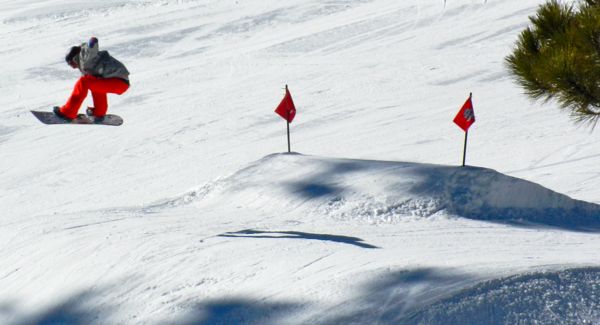
A snowboarder catches air at Heavenly earlier this month. Photo/LTN

In recent years, terrain parks have become an increasingly popular attraction at ski resorts. These skate parks on ice are equipped with rails, ramps, and jumps that provide riders with all the thrills of a high speed roller coaster, without any of the restraints.

But as the NBC Bay Area Investigative Unit has learned, many of the jumps at these terrain parks have been designed absent any engineering or safety standards. Most ski resorts, like the ones found in Tahoe, have these terrain parks.

Now, experts within the engineering community are working to increase the oversight of the design of these jumps which now have the potential to launch jumpers as high as 90 feet in the air.

UC Davis engineering Professor Mont Hubbard has written several papers on the safety and design of terrain park jumps.

“You want to minimize that impact, or control it in some sense,” Hubbard said. “Typically, you can’t do that by just pushing snow around and hoping that it’s the right shape.”

Hubbard has served as an expert witness in several lawsuits against various ski resorts, including Salvini’s case against The Summit at Snoqualmie in Washington.

Hubbard believes that a properly engineered jump can be designed to reduce the impact of a jumper’s landing, preventing some of the more serious injuries.

“It accommodates for any place you want to land, and it makes it so that he lands equally softly everywhere,” Hubbard said.

According to a recent survey by the National Ski Areas Association, terrain parks can be found at 90 percent of ski resorts in the United States.

Chris Gunnarson is the president of Snow Park Technologies in Verdi. Gunnarson has been designing terrain parks at resorts like Northstar, Squaw, and Heavenly for over a decade.

“It’s impossible to design a safe jump,” Gunnarson said.

Snow Park Technologies is also responsible for dreaming up and constructing the jumps for professional competitions like the X Games and the Dew Tour.

Gunnarson argues that there are too many variables involved in designing a terrain park to accurately calculate how a jumper will land.

“As an industry there are not standards because the snow changes all the time. It’s kind of impossible to have standards.”

While there are no set safety standards or calculations involved in the design process, Gunnarson maintains that there is a lot of thought put into how the jumps are designed.

Skiing and snowboarding accident data is kept private by the resorts.

However, a recent study presented at a conference held by the International Society for Safety in Skiing, found that the rate of spine and head injuries at terrain parks is double that compared to other areas at a resort.

Hubbard says the key to preventing serious accidents like Salvini’s is calculating the distance from the jump to the landing.

“I had no idea that these jumps had almost little to no design involved with them,” Salvini said.

After his accident, Salvini received $14 million in damages in his suit against The Summit at Snoqualmie.

Salvini said the judgment came as a shock to the ski industry since resorts are rarely found liable for injuries on the slope.

Salvini’s case was the exception as jurors found that he was injured in part because the jump constructed by the ski area was not reasonably safe.

While the jump has since been removed from the park, Salvini fears that jumps at other parks are similarly flawed.

“Something has to be done, but it doesn’t mean you need to tear down all these parks. With a little bit of science and some common sense, I think that these terrain parks can be built safely,” Salvini said.

NBC Bay Area reached out to The Summit at Snoqualmie for comment, however our calls were not returned. At the time of the trial, the company released a statement saying in part that “Voluntary participation suggests that a skier or rider accepts the risk associated with the activity.”

NBC Bay Area also reached out to several ski resorts in the Lake Tahoe area to for comment on the issue to discuss the safety of terrain parks. None of them would agree to an interview on-camera.

The American Society for Testing and Materials has formed a committee to help determine whether a standard for terrain parks is possible.

The committee is made up of ski resort operators, engineers including Hubbard, and park designers including Gunnarson.

“I would certainly be willing to try,” Gunnarson said, “but there is no proven model out there out there yet.”


Squaw, Alpine to host The North Face Masters of Snowboarding event

The North Face Masters of Snowboarding presented by PrimaLoft will take place Feb. 13-17 at Squaw Valley and Alpine Meadows.

The event will feature top big mountain snowboard competitors battling for The North Face Masters of Snowboarding champion title, $15,000 in prize money and a chance to advance to the 2014 SWATCH Freeride World Tour by The North Face.

The event will feature one open two-star Freeride World Qualifier event at Alpine Meadows (Feb. 13-14) with the top five men and top three females advancing to the Masters four-star Championship event.

The Masters Championship event will take place over two days at Squaw Valley immediately following the qualifier event at Alpine Meadows.


Potential 2014 Sochi Paralympians in Lake Tahoe for qualifying snowboarding competition

By Kathryn Reed

Fifty-four riders from eight countries will be competing this weekend at Sierra-at-Tahoe in the first qualifier for the 2014 U.S. Paralympic snowboarding team.

Today begins a two-day camp for riders, with the race on Sunday.

With the folks associated with next year’s Olympics in Sochi, Russia, deciding less than a year ago to include snowboarding in the Paralympics, riders are scrambling a bit.

“I have personally met several of the athletes. They are inspiring as they have overcome their disabilities, and not only get on the mountain — but can beat about half of us through a race course,” Sierra General Manager John Rice told Lake Tahoe News.

Some of these disabled U.S. athletes and coaches at a World Cup event will be in Tahoe this weekend. Photo/Provided

Sunday’s race will be on the boardercross trail on Smokey. It is tied to the USASA event the same day.

More than 20 officials from the International Paralympic Committee and U.S. Paralympic Committee will be in town this weekend.

Brent Kuemmerle, who has a prosthetic leg, has been instrumental in getting people with physical disabilities into high-level competition. It doesn’t get higher than the Paralympics.

With the assumption Sochi would not host snowboarders at the Paralympics, Kuemmerle decided it was time to return home to the South Shore and open the Tahoe Adaptive Competition Center. He figured he had until 2018 to have athletes ready for the next Paralympics.

Then Sochi officials changed their mind and Kuemmerle was in limbo. Potential Paralympians are sticking with one of the three established U.S. resorts where they have been training.

“This camp was going to be my coming out party,” Kuemmerle said.

And while it won’t have the splash for TACC it would have had if TACC were home to future Paralympians, Kuemmerle is not giving up on his dream. He is still bringing recognition to his business, to Sierra and Lake Tahoe as a whole.

Tahoe Adaptive Competition Center is a new organization, but it’s an extension of everything I’ve been doing for close to 15 years,” Kuemmerle told Lake Tahoe News.

He spent the previous two winters coaching a disabled snowboarding team in Winter Park, Colo., home of one of the largest Paralympic training centers in the world. But it’s a mountain known for skiing, not snowboarding.

“At Winter Park you are on the hill five days a week training, then to the recreation center and work on off hill training — weights, swimming, running. That is what I intend to bring to Tahoe,” Kuemmerle said.

He envisions other winter sports like Nordic skiing, downhill and sled hockey being components of TACC. Then he wants to branch out into summer sports.

TACC has a five-member board, volunteers and coaches with Sierra and Heavenly Mountain Resort.

“I believe his heart is in the right place, and once he gets his organization off the ground it will be successful and a great addition to the South Tahoe winter recreation community,” Rice said of Kuemmerle.


California park passes can be bought when filing tax return

By Matt Weiser, Sacramento Bee

Californians can purchase a state parks annual pass on their income tax return for the 2012 tax year.

The pass costs $195 and provides unlimited day-use access for one year to 130 state parks, or about half of all parks in the California Department of Parks and Recreation system. Taxpayers can also contribute more than $195 and the additional amount is tax-deductible and will go to support park operations.

The program was created by AB 1589, a state law approved in September and authored by Rep. Jared Huffman, D-San Rafael, then in the Assembly.

Only one pass can be purchased per tax return, and only if the taxpayer expects a refund at least equal to the price of the pass.

The passes cover daily admission fees, not additional fees such as camping and boat launching.

The “Contributions” section of the 540 and 540a tax returns contains a new line to enter the price of the parks pass, and a description is found on Page 15 of the instructions for the forms.

For more information, including a list of parks that accept the annual pass, go online.


Rescue teams tapped out physically, monetarily

By Nina Keck, NPR

Fresh snow lures a lot of people to do some outdoor exploring, but sometimes that exploring can go too far. When snowmobilers or skiers wander off or get in over their heads, many call 911, putting a strain on already underfunded search-and-rescue budgets.

Some states can bill skiers for search-and-rescue efforts. Often, those who need rescuing wandered into out-of-bounds areas and couldn’t find their way back.

In Vermont, state police have had to help find 50 lost skiers in the past four weeks.

At the Killington resort in Vermont, snowboarders are checking out an expert run on the summit, watching others hit the white powder. These folks may not be troublemakers, but there are riders who go looking for fun in all the wrong places.

Bob Giolito, a former Killington ski patroller who is now part of the state police, points to an unmarked trail into the woods. “It’s almost moguled up,” he says. “You see all the ski tracks? There’s high volume of people coming through here.”

Areas like these aren’t quite accessible. There’s a bright orange rope that a person would have to duck under, and several big signs say “Out of Bonds” and “No Skiing Beyond This Point.” Despite all that, Giolito says, an alarming number of ill-equipped skiers keep trekking on.

“I mean, if we look out here, you’ll see tracks into that field,” he says. “Now, if I’m looking out there, I’m like, ‘Wow, that looks like some powder, I’m going to ski that.’ So they’re going to head downhill. And as they go down, the trees get closer and tighter and tighter, and then they’re in a problem.”

This part of the ridgeline drops off fast and leads far away from any lifts, so within a few hours, the skiers will be exhausted, cold and in the dark.

Giolito and Vermont State Police Capt. Donald Patch believe more skier education is needed, but how to accomplish that remains unclear. In the meantime, Patch says, the cost to taxpayers for so many search and rescues is troubling.

“When a trooper is tied up on a lost skier case, that’s time when they’re not following up on their other investigations,” Patch says.

Vermont is one of a handful of states that allow billing for certain rescues. But because Vermont depends on skiing and tourism — and because of safety reasons — billing is controversial and rarely used.

“As search-and-rescuers, we feel very strongly that there should never be any disincentive for somebody to call for help when they need it,” says Neil Van Dyke, who heads Stowe Mountain Rescue and is a former president of the Mountain Rescue Association.

He says there have been documented cases in Colorado where people in trouble have put off calling for help because they were afraid of getting billed.

But not everyone agrees with that.

Kevin Jordan, who helps run New Hampshire’s search-and-rescue program, says “when people get in trouble, they don’t hesitate to call.”

“They call immediately because they are in trouble,” he says.

His program — which frequently handles rescues in the White Mountains, an area known for severe weather — has been less squeamish about billing when it finds that those who were rescued have been reckless or negligent.

Jordan says the policy has stirred up debate, but he doesn’t think it deters anyone from seeking help — though he admits there isn’t a way to prove that.

“What I did notice is when we conduct the mission, as we’re getting this person down, our conversation now is generated, ‘Am I going to get a bill?’ And that’s the only difference I’ve seen,” he says. “I’ve seen no effect on tourism.”

But billing isn’t ideal, Jordan says. Many people simply can’t pay. He says they’ve collected only about two-thirds of the $83,000 they’ve billed in the past five years. And that’s just a fraction of the roughly $1.5 million New Hampshire spent on all rescues during that time.

“It’s a very hot debate in this state because people are very passionate and have very strong feelings about it,” Jordan says. “But the problem is that on Monday the bills have to be paid. And when we’re not buying equipment and we don’t have a training budget and we’re sending guys up above tree line in January in 60-below weather, we have a responsibility to ensure their safety — so we’re walking a dangerous tightrope.”

It’s an issue many states are struggling with.

In Wyoming, a state lawmaker pointed out that demand for search and rescue in the state hasn’t necessarily increased. But he says more funding is needed because those who need help are taking bigger chances and ending up in more dangerous situations.


Hight may go to new heights at X Games

By Pat Graham, AP

There’s a snowboarder working on a trick so difficult that if the feat is pulled off in a competition, it just may be game over for everyone else.

Heard this one before?

Only, this time it’s not Shaun White honing the mechanics of an intricate maneuver in a hush-hush location as he did before capturing gold at the 2010 Vancouver Games.

No, this is Elena Hight, South Lake Tahoe’s 23-year-old two-time Olympian who doesn’t have White’s name recognition — who does, really? — but she can alter an event just like him, especially once she dials in her game-changing trick that’s essentially two backflips with a 180-degree rotation.

She plans to debut it this weekend at the Winter X Games in Aspen.

That is, if she can work up the nerve. Because, really, it’s still a work in progress.

“There’s a lot that can go wrong,” said Hight, who’s chasing after an elusive Winter X gold after taking second in Aspen and again in Tignes, France, last season. “More than anything, it’s getting past that fear.”

Hight has landed the trick — the one snowboarders refer to as a “double alley-oop backside rodeo” — on a trampoline, into a foam pit and then onto an air bag set up at the end of the halfpipe. Her breakthrough moment came last May at U.S. team camp, when she successfully performed the feat on the course to become — as the snowboard community is saying — the first female to do so.

Now comes the tricky part: Taking it from practice and attempting the endeavor in a competition, under the bright lights and in front of a big audience.

Pull this off, though, and Hight instantly leaps into the role of favorite heading into the 2014 Sochi Games. As it stands, she’s someone that everyone is carefully watching.

“I was there that day when she landed it and what she did was just amazing,” said Gretchen Bleiler, an Olympic silver medalist at the 2006 Turin Games. “By doing that, she’s already progressed women’s snowboarding. It’s already on everyone’s mind. It’s like, ‘OK, maybe this is something I need to start doing?'”

This is the sort of trick that even White is trying to incorporate into his repertoire.

That’s saying something, right?

“It’s the only double I’ve tried,” Hight said. “I wouldn’t want to do some of the doubles that Shaun or some of the guys do. Hopefully, I can get it going and show it off at X Games.”

She very well may need it, too, given the talent in the halfpipe these days. Also expected to compete this weekend are reigning Olympic champion Torah Bright of Australia and 2002 Salt Lake City Games gold medalist Kelly Clark of West Dover, Vt. Clark also is the two-time defending champion in Aspen.

“Kelly is riding amazing,” Hight said. “She’s out there doing her thing, always pushing it. It’s great to see. We’re all such good friends, so it’s awesome when someone is stepping it up, because it makes you push yourself even more.”

Born in Hawaii, hardly a hotbed for snowboarding, Hight’s father moved the family to the mountains of Lake Tahoe when she was a kid. She’s been constantly pushing the field since bursting on the scene, landing a 900 — two full rotations — in a competition at just 13.

“Snowboarding was just our family’s sport,” she said. “Once we started, we just never stopped.”

Hight has had plenty of unique experiences on a snowboard, including this: Gliding down a volcano.

That’s right, a volcano.

A few years ago, she coasted down the side of Mauna Kea, which is on the island of Hawaii and has an elevation around 13,800 feet.

“It was really cool,” she said.

Almost as cool as this: Landing her new trick a few times in practice. Obviously, she had to build up to it. The trampoline helped, as did the foam pit and jumping into an air bag, with each stage giving her more confidence.

“I didn’t go out and just throw it. You have to be safe about these types of things,” she said.

Then, she attempted it for real. Not in some secretive place, either, but in Mammoth Lakes at a training camp.

That’s a little bit different from White. Before the Vancouver Games, the snowboard icon trained in seclusion on a halfpipe built for him in the back country of Colorado. White perfected his daring Double McTwist 1260 in secret, before unveiling it for the world to see, ultimately leading to an Olympic gold medal.

Ever thought about keeping her trick a secret until closer to Sochi?

“One of my favorite parts of snowboarding is snowboarding with all of my friends,” Hight said. “I think it’s way easier to progress when you have your friends there rooting for you. We want each other to progress and we cheer each other on. I’m not a … secretive person.”

And when she finally landed it?

“It’s like landing any new trick: You come around and you’re like, ‘Whoa, I actually did it,'” Hight said. “I was definitely really stoked.”


People urged not to skate on Donner Lake

Truckee police officers and firefighters are warning people to not skate on Donner Lake.

With conditions warming, the ice is generally unstable.

“Unlike the Eastern United States, we generally do not have the consistently cold temperatures to sustain ice on area lakes and ponds due to their size and water currents,” authorities warn.

Five years ago a skater fell through the ice and drowned in conditions similar to what they are now.

There is no law or ordinance prohibiting ice skating on Donner Lake.

Truckee rescue teams urge people who recreate on area lakes or ponds to consider wearing a life jacket, bring a rope, and a buddy.


Harbaughs set to meet biggest fan — each other

By Judy Battista, New York Times

Until last season, when they faced each other across a football field for the first time, John Harbaugh had never rooted against his little brother, Jim. Except for the one time they were on different American Legion baseball teams in high school — and John wants it known his team won, 1-0 — the brothers were always on the same side, whether it was on their high school football team or on the ice rink they made in the backyard of their childhood home.

On Feb. 3, the brothers, separated by just 15 months but alike in so many other ways, will be on different sides of the country’s biggest sporting event when the Baltimore Ravens — the team John has coached for five seasons — play the San Francisco 49ers — the team Jim has coached for two — in the Super Bowl. The Harbaughs are the first brothers to be head coaches in the N.F.L. There are only 32 such jobs, making the odds of brothers securing two of them at the same time slim. But for two weeks at least, the Harbaughs will supplant the Mannings as the first family of football, the title game serving as the next installment of a sibling rivalry that used to include competitions to see who could throw a football over a towering tree and fights over which brother was scheduled to mow the big backyard lawn at their parents’ home in Ann Arbor, Mich.

The brothers, who had not spoken to each other by late Monday afternoon, do not seem impressed by their impending meeting.

“Is it really going to be written about?” John Harbaugh said. “It’s not exactly like Churchill and Roosevelt.”

Maybe not. But when Jim Harbaugh arrived in San Francisco to rebuild the 49ers last season, he took with him an exhortation his father used to dispense to the entire family.

“Who’s got it better than us?” their father, Jack, a former college coach to whom the sons still send game film, would ask.

“Nooobody!” the family would respond in unison.

Certainly nobody in the N.F.L. has it better than the Harbaughs do right now. In seven combined seasons, John and Jim have never failed to get their teams into the postseason. Indeed, the brothers act as if they expected this extraordinary confluence all along, indicating they are already tired of the sentimental story line.

Jim Harbaugh said that playing his brother in the Super Bowl was “a blessing and a curse.”

“We’re not that interesting,” John Harbaugh said. “There is nothing more to learn. It’s just like any other family. We get it, it’s really cool and it’s exciting and all that. It’s really about the players.”

Good luck with that. Last year, both teams lost in their conference championship games. This year, Jim’s team beat the Atlanta Falcons on Sunday afternoon, leaving him to cheer on the Ravens as they beat the New England Patriots a few hours later. Their father and their mother, Jackie, watched from their home in Mequon, Wis. And when asked what his father might have been thinking Sunday night, John Harbaugh said he hoped he had drunk four or five beers.

The elder Harbaughs are expected to attend the Super Bowl in New Orleans, though, just as they attended the Thanksgiving night game during the 2011 season, when the Ravens beat the 49ers, 16-6, on the day before Jack and Jackie’s 50th wedding anniversary.

That the brothers have reached the pinnacles of their careers at exactly the same moment seems fitting, because their lives have wound around each other, fierce competition and football since they were children. Among many stops in his long coaching career, Jack Harbaugh was an assistant to Bo Schembechler at Michigan. The boys would go to practice, but they were also budding businessmen. They would take wristbands and write the name of the starting quarterback at the time on them, selling them to their classmates as if they were all game-worn wristbands.

John was supposed to be the starting quarterback his senior year at Pioneer High School in Ann Arbor. But by then, Jim had grown taller — and better. He started as a sophomore and John switched to fullback and defensive back.

John Harbaugh has joked that he dominated his brother for most of their lives, but Jim had the far better athletic career, going on to become an all-American at Michigan and then a first-round draft pick of the Chicago Bears. John was mostly a nonstarting defensive back at Miami of Ohio.

But while his brother played 15 years in the N.F.L., John Harbaugh’s coaching career began in anonymity, and after 10 years as an assistant with the Philadelphia Eagles, he became the coach of the Ravens in 2008 — after Patriots Coach Bill Belichick, whose team the Ravens vanquished Sunday night, called the Ravens’ owner, Steve Bisciotti, to recommend Harbaugh.

Even while Jim Harbaugh played in the N.F.L., he served as an assistant to his father, who was then the coach at Western Kentucky. In 2002, his playing days final over, Jim Harbaugh became the Raiders’ quarterbacks coach.

But the job that led him to the N.F.L. was at Stanford, where he tutored Andrew Luck — who was the first pick last year — and returned the Cardinal to national prominence.

On Monday, Jim Harbaugh was asked if, while growing up, he ever dreamed of coaching in the Super Bowl, and he flashed the sense of humor that his brother has said he possessed.

“I don’t think I had that dream,” Jim Harbaugh said. “I will share this with you, just the way Colin Kaepernick runs, the gracefulness of his stride, it reminds me of me when I run. Then I wake up.”

After Sunday’s games, John Harbaugh said he would like to think the Ravens and the 49ers are mirror images: physically imposing, able to run the ball, but with quarterbacks who throw well, and possessing “roughhouse” defenses. It is impossible, though, to miss the brothers’ differences in personality.

John Harbaugh smiles more, making a point to thank everyone for coming when he begins his postgame news conferences. Jim Harbaugh, who seems to wear the same black 49ers sweatshirt tucked into khaki pants every day, has been known for his wild-eyed, emotional style since his playing days.

He had an epic meltdown after what he considered a bad call Sunday, sending the marker that always hangs from a lanyard around his neck swinging furiously.

The brothers said they had not fought since they were about 25, but they used to fight so vigorously that their mother cried as she begged them to stop.

“He’s an incredibly competitive person,” John Harbaugh said of his brother. “He will fight you for anything. That’s what made him a great player. What makes him the man he is. The gym teacher in fourth grade said he was too competitive, and he needs to ease off. My dad said ‘No, he doesn’t need to ease off.’”

Last year, John Harbaugh told an associate that the brothers had vacationed together recently. They were goofing off in the water and their horseplay — as it has since they were schoolboys — got a little heated.

Jim Harbaugh held his brother under the water, the Ravens’ public-relations chief Kevin Byrne said, until bubbles started coming out of his nose. Then he finally let go of him.

But when the Harbaughs surface with their teams at the Superdome, they will not ease off, any more than they did in grade school.


U.S. tax structure could send major boxing bouts out of Nevada

By Steve Carp, Las Vegas Review-Journal

Bob Arum is known for making bombastic statements, and occasionally they even come true. The 81-year-old Top Rank founder and boxing Hall of Famer has made a career of getting people on edge.

So it probably rattled boxing’s major players in Nevada last week when Arum said an anticipated fifth fight between Manny Pacquiao and Juan Manuel Marquez in September would not be in Las Vegas – or elsewhere in the United States.

Why not? Because of the increase in federal income tax rates for individuals making more than $400,000 a year.

“Close to 40 percent goes to the (federal) government. Enough is enough,” Arum said in New York, where he was promoting a Top Rank triple-header Saturday at Madison Square Garden.

The 2013 rise of the top federal income tax rate to 39.6 percent has prompted Pacquiao and Marquez to have Arum seek out venues elsewhere in the world, the promoter said.

“They came to me about it,” Arum said. “As an American, I have to pay taxes regardless. They don’t.”

Arum is looking at Mexico City, where Marquez lives and which has a new arena, as a possible location. Macau and Singapore also are being considered.

“Manny has told me he’d be willing to fight Marquez in Mexico City,” Arum said. “They have a beautiful arena, and Manny wouldn’t have to worry about taxes the way he would in the U.S.”

Pacquiao made about $26 million for the fighters’ fourth clash Dec. 8 at the MGM Grand Garden, and Marquez made about $10 million. Both were taxed at 35 percent, and spared an even larger bill because Nevada has no state income tax.

Arum expressed concern that other foreign fighters will follow Pacquiao and Marquez in deciding not to fight in the U.S.

“I think Las Vegas should be concerned,” Arum said. “If I was a fighter from out of the country, why would I come fight in Vegas knowing 40 percent of what I make is going to the U.S. government?”

Keith Kizer, executive director of the Nevada Athletic Commission, said he isn’t worried about federal tax rates hurting boxing in the state.

“No, it’s not on my radar,” Kizer said. “If people want to fight in Las Vegas, Reno or Lake Tahoe, we will welcome them; if they want to fight elsewhere, more power to them. Most people wish they had those kind of problems.”


Mancuso’s 7th tops for U.S. women in super G

By USSA

CORTINA, Italy — Julia Mancuso (Squaw Valley) blasted through heavy snow Sunday to finish fifth and lead three U.S. Ski Team women into the top seven as Germany’s Viktoria Rebensburg picked up the win.

Leanne Smith (N. Conway, N.H.) was sixth and Lindsey Vonn (Vail) seventh.

Vonn remains second in the Audi FIS Alpine World Cup super G standings with Mancuso third. It was the final speed event before next month’s FIS Alpine Ski World Championships in Schladming.

Vonn and Mancuso remained second and third in the Audi FIS World Cup super G standings.

Mancuso survived a scare coming out of the start where she lost her pole and almost went out. She mastered challenging weather conditions with heavy, wet snow falling throughout the race.

“It was really tough to be fast today with it snowing so hard. It was OK until the bottom and I had to wipe my goggles coming around the corner, but I don’t think it cost me much time,” Mancuso said.