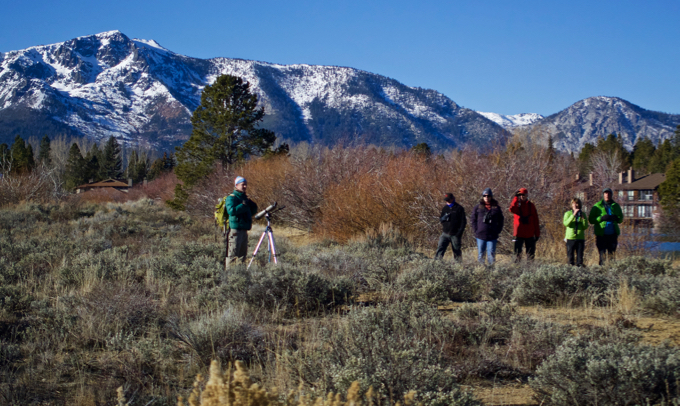
Squaw Valley Park to be open in winter

Squaw Valley Park in Olympic Valley will remain open this winter to offer a free snow play option.

The park’s parking area will be plowed all winter, creating a free and convenient place to park and play.

For the backcountry enthusiast, the park offers access to a spur trail that leads up a steep ascent to the Western States Trail, providing backcountry skiing and snowshoeing opportunities.

The Squaw Valley Trailhead is also located at Squaw Valley Park, connecting the park to the Village at Squaw Valley with a nearly 3-mile stretch of paved, multi-use trail.

A partnership with Squaw Valley Public Service District will ensure the paved trail will be plowed.

Squaw Valley Park, located at the intersection of Highway 89 and Squaw Valley Road, is just across the road from the Olympic torches.

Keeping the park open during the winter season is in response to feedback provided through the Placer County Park and Trail Master Plan surveys and focus groups.


Decrease wildfire risks by choosing the right plants

By Ciji Taylor

Traveling at speeds up to 14 mph, wildfires can quickly ravish landscapes and homesteads. Experts with USDA’s Natural Resources Conservation Service, (NRCS) are studying what plants can slow fire rather than fuel it.

NRCS’ Plant Materials Centers evaluate and study plants, including those that can reduce fire damage or losses, helping keep people, property and natural resources safe. These centers, located across the United States, can provide information on the type plant best suited for an area given factors such as geography and climate.

“All plants burn, but using the right management and plant materials gives you a better chance of lessening damage,” said Jim Jacobs, NRCS plant materials specialist for Montana and Wyoming.

“Weather, topography and fuels dictate fire behavior,” Jacobs said. “A landowner can only control the type and amount of plant fuels, so the focus should be on managing what you can manage.”

A perimeter or firebreak of about 30 feet should be created around homes and other buildings. This area can be created by planting low-stature grasses or perennial herbaceous plants and shrubs. Plants in the 30-foot area should be kept green, since green plants don’t burn as hot and can buffer buildings from the heat’s intensity. Plant maintenance is an important preventive step.  Pruning trees and shrubs, mowing, and keeping dead material out of the perimeter will decrease fuel load around structures.

If planting trees, they should be planted far enough away that their canopy doesn’t grow within 10 feet of a building. Trees that hold more moisture are better than trees containing resin, such as pines, because they won’t burn as fast or as hot. Trees can also help block heat, slow wind and intercept embers, which are the main causes of structural fires and costliest part of wildfires.

In shelterbelts and wind breaks, farmers and ranchers should work to reduce what’s known as ladder fuels or plants that enable fire to climb from the ground into canopies. Keeping fires out of tree canopies helps reduce the number of embers in the air.

“Wildfires race across fields, so farmers and ranchers don’t have time to react,” Jacobs said. “At that point, it’s left to the preparation and management of your plant materials to help protect you and your structures.”

On wild lands, low- and moderate-intensity ground fires actually help forests by rejuvenating understory growth. But high-intensity fires can kill the entire plant leaving the soil bare, which increases the chances of erosion and flash flooding. In order to stabilize the soil and provide food and shelter for wildlife, landowners should reseed with grasses that establish quickly.

The Plant Materials Center in Aberdeen, Idaho, is supporting post-fire reseeding management by providing foundation seeds to the commercial seed industry. These foundation seeds come from plants that are evaluated to ensure establishment and performance under specific conditions, such as post fire.

“Firefighters aren’t our only defense to fires. Simply by using the right plants and management, we’re dispatching another type of preventive firefighter,” Jacobs said.

Ciji Taylor is with the Natural Resources Conservation Service.


Bears make comeback in Nevada

By Doug Puppel and Nikole Robinson Carroll, Nevada Public Radio

After being declared nearly extinct in Nevada in 1979, black bears have staged a comeback in the state, with a population today numbering in the hundreds.

Fanning out east and south from Lake Tahoe, bears are repopulating the Great Basin ranges that hunting, logging, and encroaching civilization drove them from a century ago.

A study by UNR and the Wildlife Conservation Society credits the bears’ return to long-term conservation efforts. Also, modern grazing and forestry practices have allowed for reforestation of historic bear habitats.

Read the whole story


Founding chapter of Disabled Sports USA celebrates 50 years

Achieve Tahoe started as a way to get wounded veterans, mainly amputees, out on the slopes. Photo/Provided

By Ally Gravina, Moonshine Ink

Achieve Tahoe, formerly Disabled Sports USA Far West, was founded 50 years ago by the late Jim Winthers, a World War II veteran of the 10th Mountain Division and director of the Soda Springs Ski School.

To recruit participants, Winthers and other vets would walk around Letterman Army Hospital in San Francisco talking to wounded Vietnam soldiers, mainly amputees, about coming up to Tahoe to ski.

Doug Pringle, who would later become one of the founding members of the organization, was apprehensive the first time he saw the WWII guys walk through his ward at Letterman. A West Point graduate who lost a leg in Vietnam, Pringle had skied only once before his injury. He described his time skiing with two legs as falling down the entire mountain, and he thought the WWII guys were crazy to talk about skiing on only one leg.

Declining the first offer to go to Tahoe, Pringle quickly changed his mind after his fellow hospital mates returned after a weekend of skiing saying they not only made turns, but also hung out at the bar with a bunch of beautiful women.

Read the whole story


Climate change hits Winter Olympic preparation

By Associated Press

AAS-FEE, Switzerland — The athletes’ half-hour commute in the Swiss Alps — up two gondolas, then through a tunnel in the world’s highest underground train to a glacier at 11,000 feet — served up daily grim reminders that global warming is threatening their line of work.

After exiting the train, they squelched through a field of grayish mud to reach shrinking snowfields scarred by new crevasses. Occasionally, they heard the sharp roars of glacial ice breaking off in monster chunks, then echoing across the peaks where they trained jumps, tricks and turns for the Pyeongchang Olympics. Most days, they basked in brilliant, snow-melting sunshine that bathed the whole scene in deceptive beauty.

Another subtle but telltale indicator of climate change’s disruptive impact on winter sports: Many athletes — here 5,000 miles away from the Rockies and 3,500 miles from the Green Mountains of New England — had the letters “USA” emblazoned on their jackets. Americans once had little need to swap continents to guarantee offseason access to snow. But warming is forcing athletes to hunt farther from home for wintry conditions, particularly just months away from an Olympics.

Read the whole story


How the USFS grows millions of seedlings each year

By Greg M. Peters, Forests Magazine

Tucked into the Douglas fir and ponderosa pine forests of Northern Idaho sits the quaint lakeside town of Coeur d’Alene. The former lumber town is now a popular tourist destination drawing families from across the Pacific Northwest and beyond. Gone are the pounding mills, replaced with fancy lakefront hotels and bustling shopping centers.

But it’s not hard to find relics of the region’s once-thriving industry: Huge logs chained together to form breakwaters protect marinas and lakeside restaurants scattered around Lake Coeur d’Alene—the region’s main tourist draw. In the sprawling Idaho Panhandle National Forest that nearly surrounds the town, century-old stumps the size of boulders rot beneath a canopy of trees that themselves seem a hundred or more years old. Both the stumps and the Forest’s now abundant trees provide clear evidence of a century of forest management that has played out in this quiet corner of America.

A short 10-minute walk from the box stores and fast food restaurants that skirt Coeur d’Alene’s edges is another example of how connected this small city is to the forests that surround it. Here, just off of an unassuming and ordinary street is the U.S. Forest Service’s Coeur d’Alene Nursery. Established in 1960, the Coeur d’Alene Nursery straddles the past, the present and the future on a 220-acre plot of land. A squat single-story building greets visitors who enter into a small lobby decorated with a few posters, some t-shirts and hats. Greenhouses, warehouses and fields, some fallow and some flush with small green trees, spread out behind the office, a tapestry of incongruous shapes and colors. An assortment of sheds, tractors, four wheelers and other custom-built contraptions rounds out the scene.

Read the whole story


Birders flock to Tahoe’s waterways for annual count

TINS Executive Director Will Richardson, left, leads a group Dec. 17 at Cove East to count birds. Photo/Kathryn Reed

By Kathryn Reed

It was a hunting expedition of a different kind, which netted more than a hundred waterfowl, a ruby-crowned kinglet, magpie, stellar jay, meadowlark and more.

These birds were captured in photos, through binoculars, high-powered telescopes, and with pen and paper.

The birders were out in force on Sunday for the annual Christmas bird count. This one organized by Tahoe Institute for Natural Science is the only one in the basin.

“Our focus is on the lake level wetlands and meadows. They tend to be where most of the birds are,” Will Richardson with TINS told Lake Tahoe News.
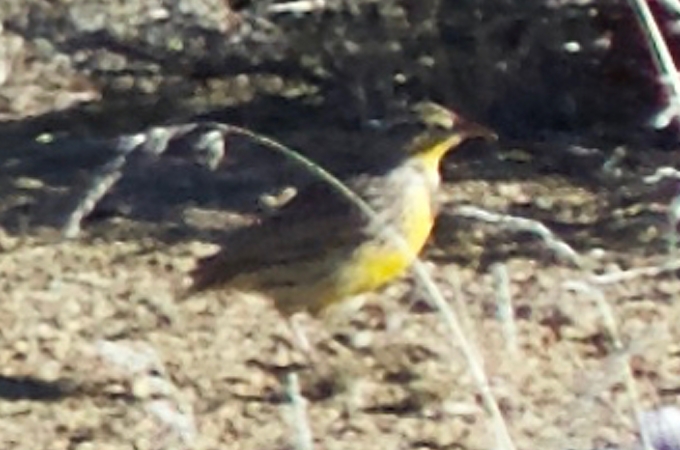
Meadowlarks are identifiable by their yellow chests. Photo/Kathryn Reed

The weather cooperated for the count. While it was near freezing temperature-wise, the wind was non-existent unlike the day before. This was a good thing because birds tend to hole up in the wind, and don’t make their presence known.

A large throng on Dec. 17 had their eyes focused on the water and in the trees at Cove East. Other groups were scattered about the South Shore. The local count goes through Dec. 20, after which the tally will be available.
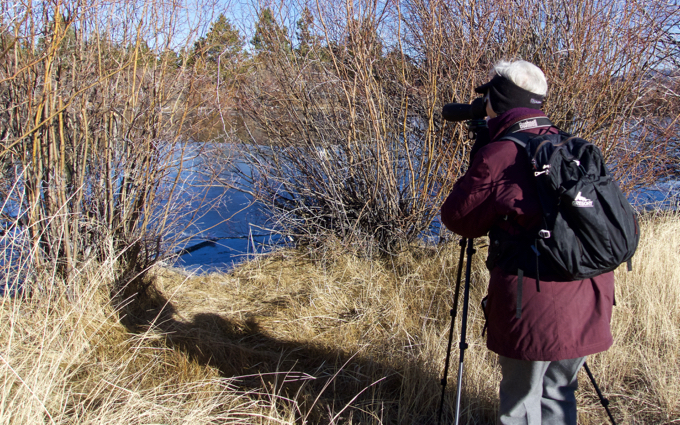
Sue Stevenson gets an up close view of waterfowl. Photo/Kathryn Reed

“These people are so knowledgeable. I learn so much,” Grace Anderson of Meyers told Lake Tahoe News as she walked near the Tahoe Keys Marina. “Tahoe is an amazing bird place.”

Richardson and other TINS staff dispensed tidbits of information along the way. The ruby-crowned kinglet used to breed in the lodgepole pines throughout the basin in the early 1900s. Today it would be hard to find them nesting. They come here in the winter because they are tough, Richardson said.
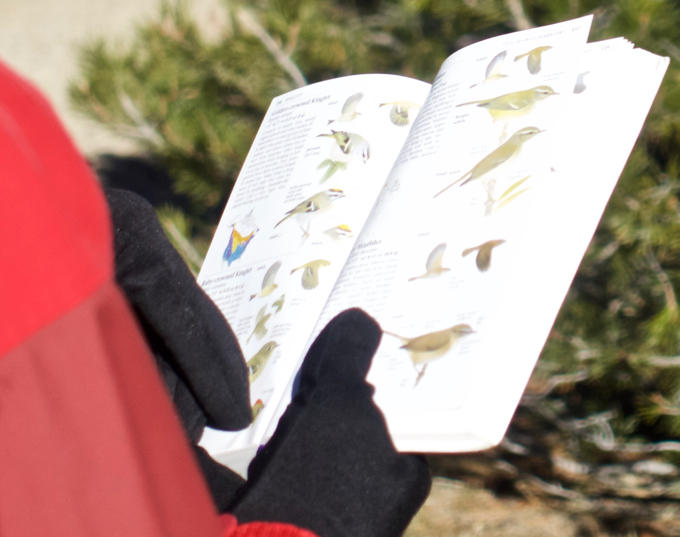
Resources are at the ready to help birders with identification. Photo/Kathryn Reed

At the lagoon that juts north from the Tahoe Keys Marina area toward Cove East are more than 100 ducks. But then the group is told they aren’t all ducks. A coot is not a duck; it’s a rail. It doesn’t have webbed toes like a duck, but instead has lobbed toes.

Those in the know are surprised to see coots, redheads, ruddys and gadwalls all swimming together.

Sue Stevenson of South Lake Tahoe has her scope out watching a redneck dive for food. It’s like a dance of sorts that is mesmerizing.

She’s been birding since the 1980s, having started in New Jersey. She’s been doing so in Tahoe since 2000. Stevenson is a regular in the birding group led by Lynn and Don Harriman. They have been counting birds every Wednesday for the last nine years – either at Cove East or in the Upper Truckee Marsh.

At the Cove East count are people from South Lake Tahoe, Truckee, Carson City, Sacramento, Penryn and the Bay Area.

The group pauses to watch a meadowlark scamper about. It’s distinct with its yellow breast and black collar. While it’s not unusual to see them in the basin, it’s not an everyday bird like a stellar jay or mountain chickadee or magpie.
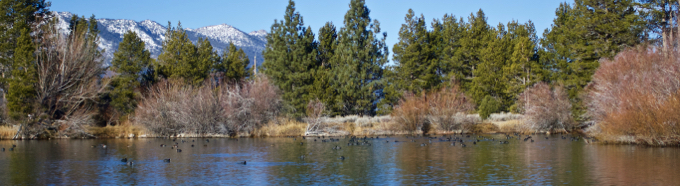
Waterfowl are a predominant fixture in the Lake Tahoe Basin. Photo/Kathryn Reed

This is the Audubon Society’s 118th annual bird count. Tahoe has been doing it since the early 1980s.

“The data collected by observers over the past century allow Audubon researchers, conservation biologists, wildlife agencies and other interested individuals to study the long-term health and status of bird populations across North America,” according to the Audubon Society’s website.

The concept of the Christmas bird count came about as an alternative to the annual hunt where two sides tried to kill as many animals as possible. Ornithologist Frank M. Chapman came up with the idea, which in that first year in 1900 involved 27 birders in 25 locations.

Now the count goes beyond Christmas Day, spanning the period from Dec. 14-Jan. 5. While most counts are in the United States, the event is global.


Bowman still in contention for Olympic team

By Karen Price, Team USA
 
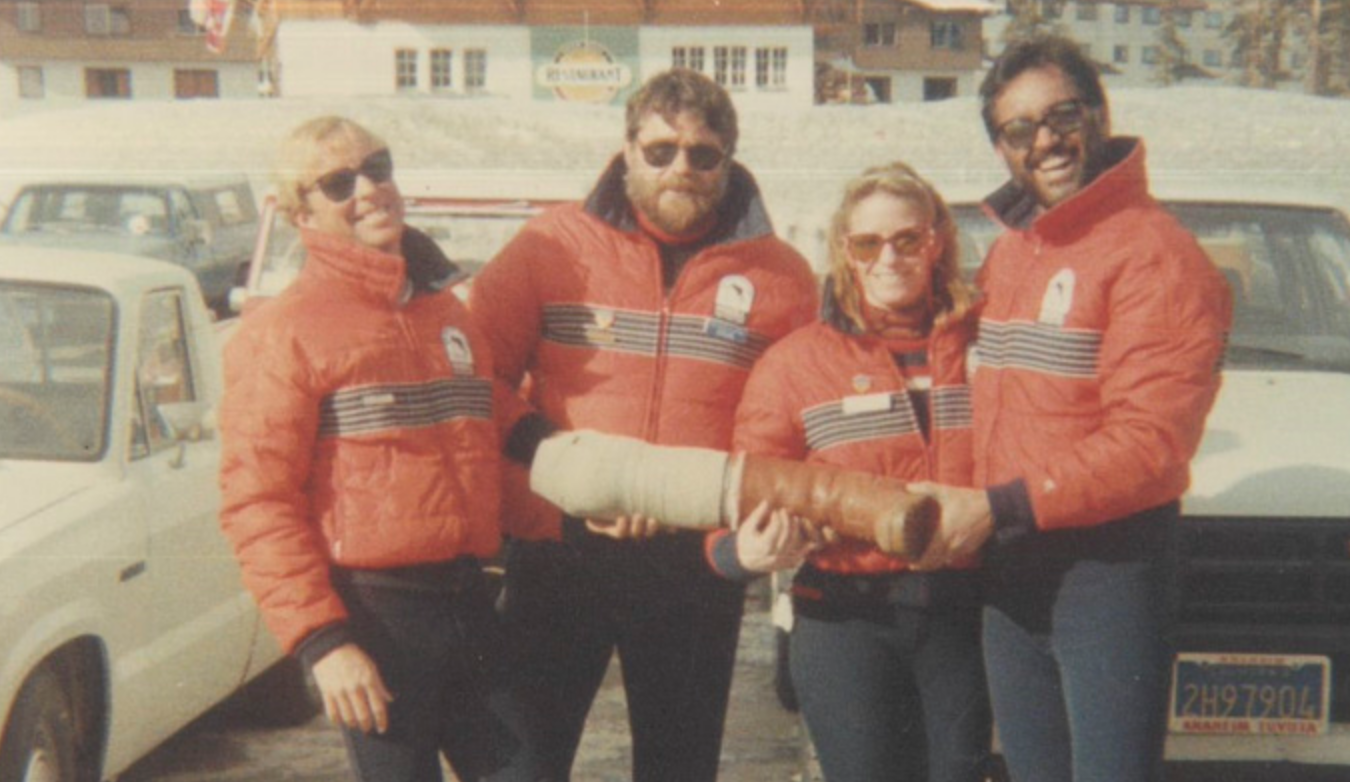
Olympic medalists Maddie Bowman and Devin Logan both had the opportunity to qualify for the 2018 U.S. Olympic halfpipe skiing team with a win at Friday’s Dew Tour stop in Breckenridge, Colo.

Instead, Canada’s Cassie Sharpe took first place, and the Americans will have to wait.

Bowman, the defending Olympic gold medalist in women’s halfpipe skiing, led briefly after rebounding from a fall early in her first run with a big second run, but Marie Martinod of France and Sharpe pushed the Meyers resident to third place going into the third and final run.

Read the whole story


Hight ready to prove herself in South Korea

By Garvin Thomas, NBC

Elena Hight moved to Lake Tahoe from Hawaii when she was 6, so snow was new to her.

Acrobatics, weren’t however.

Her parents tell her she was jumping off everything by the age of 2. And now, after a big setback, Hight is hoping to jump back into the games.

Read the whole story


Public transit part of the ski industry traffic solution

By Matt Hansen, Powder
 
For a pastime that was built around the notion of escape and freedom in the mountains, getting to the ski hill now feels like we’re lurching in the opposite direction from those ideals: stop-and-go traffic, idling cars spewing exhaust, drivers angry at one another as they jockey for position.

Though this is nothing new for Colorado skiers trying to navigate I-70, bad traffic has coughed its exhaust-laden tentacles into even the most isolated Western ski towns. The parking lot at Bridger Bowl, Montana, overflows on powder days; the ski area even shut it down once because there was simply no more room. Ever tried driving into Aspen or Jackson or Breckenridge or Squaw Valley on a powder day? Not exactly the quiet life in the mountains we all envisioned. And then there’s Little Cottonwood Canyon. Traffic is so bad there it has a name, the Red Snake, a line of brake lights that extends 11 miles from Alta and Snowbird to the valley floor.

“Unfortunately, it’s become part of the deal, just like rising lift tickets,” says Tom Hudachko, who, at 41, has skied Alta his entire life. “Just like everybody else, I’m getting up at the ass-crack of dawn to sit in my truck on the side of the road, with a thermos and breakfast burrito two hours before the lifts open.”

Like you and me, Hudachko knows he’s part of the problem. And just like you and me, Hudachko knows things would probably be better if everyone just took the bus.

Read the whole story