Number of snowboarders on the slopes declining

By Christopher Solomon, New York Times

Late last summer when Shaun White, the two-time Olympic gold medal snowboarder and X-Games superstar, was charged with public intoxication and vandalism, he became at age 26 an accidental metaphor for his sport: a young phenom all grown up and in a spot of trouble.

After exploding onto the scene about two decades ago, snowboarding is now sputtering in the United States, according to a recent study by RRC Associates, which tracks trends that affect the winter-resort industry.

“Today, there is every indication that the growth in snowboarding we took for granted has stalled, and visitation from snowboarding is headed toward a path of substantial decline,” Nate Fristoe, RRC Associates’ director of operations, wrote in the National Ski Areas Association Journal.
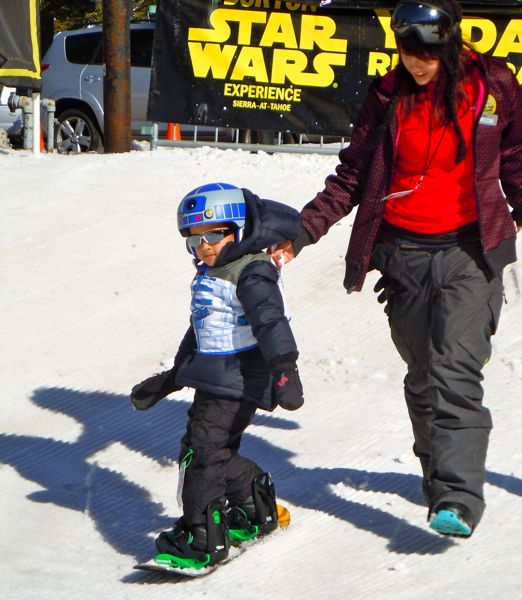
Sierra opened a Burton Riglet snowboard learning area to lure younger riders. Photo/LTN file

For several months now, Fristoe’s report has been the buzz of the industry. For some it’s also become a rallying cry to revive this sport, which, with its bad-boy image, was widely credited with saving a dull and moribund ski industry in the early 1990s.

From just 7.7 percent of all visits to U.S. ski slopes two decades ago, snowboarders accounted for nearly one-third of visitors two years ago. Now that surge has fizzled. The percentage of visits to resorts by snowboarders even declined slightly each of the past two seasons, to 30.2 percent last winter, according to a survey by the National Ski Areas Association. The average number of days that snowboarders — usually a more hard-core bunch than skiers — hit the slopes also has seen a “sharp drop” from 7.6 days a year at its height 15 years ago, to 6.1 today, Fristoe wrote. Meanwhile the average number of days that skiers went to the mountains has remained consistent at about 5.5 days for several years.

“Snowboarding lost some of its mojo around 2005, 2006, and we’ve been running on fumes since then,” Fristoe said. “It’s like any kind of trend: It’s full of all sorts of energy … until it isn’t.”

The causes of the slowdown are many, Fristoe said. Chief among them is age: The young “grommets” who fueled the sport’s explosion have matured. A 15-year-old who started snowboarding in the 1996-97 season is now 30. Nearly 38 percent of snowboarders are either part of a couple or have children, up from 23 percent a decade before, the report said.

“They’re getting older, they’re forming families, they’re in their career-building phase,” he said.

Translation: less free time to shred, and less money to burn.

Yet other forces are at work, too, including the fact that fewer young people seem to be taking up snowboarding. In the 2003-04 season more than 42 percent of all beginners on the slopes ages 14 and younger started out on a snowboard. The percentage has steadily fallen since then, last season dropping to about 34 percent, according to the ski areas association.

One reason may be that snowboarding simply doesn’t have the rebel cachet that it once did. Skiing has appropriated everything from snowboarding’s swagger to its trendy clothing to technology like fat skis. Simply put, it’s cool to be on two planks again.

Then there’s the gender gap. Although male and female boarders start the sport in equal proportion, many more women are dropping out as proficiency grows.

“We’re not retaining our female participants like we should,” Fristoe said.

Furthermore, he said, those female boarders don’t switch to skiing and are “lost” to the resorts.

“Combine all those factors, and that’s what makes us fearful of a lack of rebound of snowboarding.”

If nothing is done to reverse the slip, visits by snowboarders to resorts could plunge by one-third from its high by the winter of 2021-22, Fristoe predicts.

Although some industry leaders say Fristoe’s projections are too dire, others are listening.

“We need skiing and snowboarding to grow in lock step” for the continued growth and health of the industry, said Michael Berry, president of the National Ski Areas Association.

To that end, efforts have been made to attract new snowboarders by making the entry into the sport easier, especially for young children.

Jeff Boliba, vice president of global resorts for Vermont-based Burton, the world’s largest snowboard maker, has been at work on that challenge for years. He dreamed up the Riglet Reel — a retractable cord that can be attached to some Burton boards so parents can tow children around on carpets or on snow, to help give them the feel of sliding. (It’s available at some snowboard shops and at Burton.com for $29.95.)

Burton has also established 20 Riglet Parks at resorts nationwide, where children as young as 3 can start learning how to snowboard. These include a Star Wars-themed park at Sierra-at-Tahoe, and another that features a “treehouse” at Smuggler’s Notch in Vermont. The company has also developed children’s snowboards — including its Chicklet and Chopper boards, which have convex bases that make the boards easier to turn.

The recent statistics, Boliba said, “don’t take into effect kids 7 and under, and from my business, that’s where we see great growth around the globe,” he said.

For snowboarders — no matter what their age — who might not want to enter an intimidating half-pipe, Burton has also established Stash Parks, or terrain parks that use more natural features (branchlike rails to slide, stumps to hop), at Jackson Hole Mountain Resort in Wyoming, Killington in Vermont, and Northstar at Lake Tahoe.

Meanwhile, Squaw Valley and its sister resort Alpine Meadows, have opened Start Parks: special beginner areas with mini-terrain features, gentle transitions, soft pitches and signs describing how to navigate them, all built in a way so that there’s no cross-traffic to fear.

“What we’re trying to do is connect new skiers and riders to sensations they will get on the mountain” but in “a very controlled setting” where “there’s less to take in,” said Josh Thompson-Bourrie, Squaw’s snowboard supervisor.

This winter both resorts are again offering a specially priced “progression package”: three days of lift tickets, snowboard rentals and full-day group lessons, for $299 with advance purchase.

Other resorts are trying other things, including eliminating what Karl Kapuscinski, president and chief executive of Stevens Pass Mountain Resort near Seattle and Mountain High Resort outside Los Angeles, calls “the hassle factor.” For instance, both areas now have benches at the top of chairlifts so riders can buckle in without wallowing in the snow. Snowboard boots that dispense with annoying shoelaces are available for rent, and there are newer, easier terrain parks at both resorts for less daring snowboarders.

Kapuscinski said the dwindling number of snowboarding visitors makes such changes necessary. Last November, he said, “literally mimicked” a November 10 years ago — the same snow conditions, the same number of runs open. That year his resort saw nearly 80,000 visits, an overwhelming proportion of them snowboarders.

“This last year we did almost 42,000 visits — so, basically half,” he said, even though his resort today offers much better terrain parks and half-pipes for snowboarding. “That fanaticism,” he said, “has disappeared.”

Controlled burn to start in Galena, Davis Creek areas

North Lake Tahoe Fire Protection District’s fuels crew will continue the hazardous fuels reduction project in the Galena and Davis Creek Park areas Feb. 5-19.

This project is a cooperative effort between North Lake Tahoe Fire Protection District, Truckee Meadows Fire Protection District, Washoe County Parks Department and Nevada Division of Forestry. The debris or slash piles were created as a result of a hazardous fuels reduction and defensible space project over the last year, to help minimize the risk of wildland fires in the area.

The project’s safety plan calls for cancellation of the controlled burning based on weather conditions each day, such as significant wind activity or precipitation. The burning piles are expected to produce smoke that may be visible throughout the area. Smoke resulting from the pile burns will affect the surrounding areas for approximately 24-36 hours.

People who are smoke sensitive are advised to please stay inside and close their windows and doors as much as possible until the smoke dissipates.

For further information, call (775) 831.0351, ext. zero.


5th-graders learn on slopes instead of classroom

By Kathryn Reed

Sitting in the snow, as snowboarders often do, the three friends chat about what it’s like to be on the slopes.

This is Day 2 for these fifth-graders from Sierra House Elementary School. And it’s not exactly what they thought it would be like.

Camille Dahili, Yesenia Garcia and Serena Palaroan all agree snowboarding is more difficult than they expected, but it’s way more fun, too. Balancing and stopping are the hardest, they say.

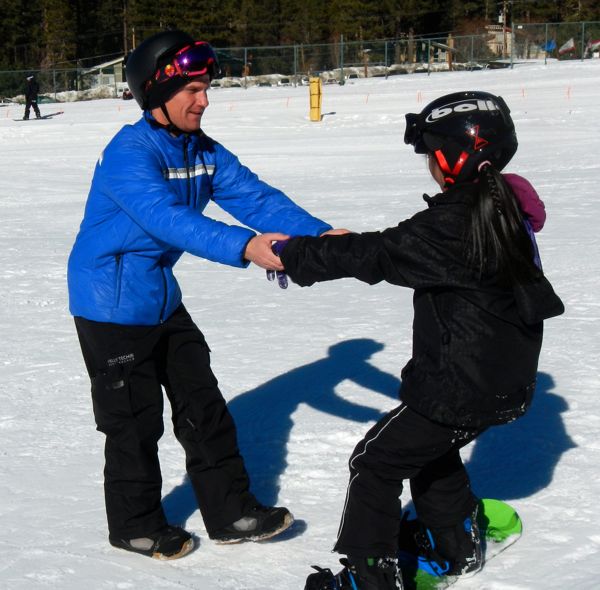
Serena Palaroan learns to use her edges from Heavenly instructor Jonathan Lyman. Photos/Kathryn Reed

For three days all fifth-graders in Lake Tahoe Unified and St. Theresa School learn to ski or snowboard at Heavenly Mountain Resort. And if they already know what it’s like to have a plank or two strapped to their feet, they are paired with an instructor who can cater to their appropriate level.

“We think three times is enough to get a taste … to learn to turn and stop, ride the lift safely, a little bit about skier and rider etiquette, and the skier responsibility code,” Mike Allen, Heavenly’s director of skier services, told Lake Tahoe News.

The program has been in place since at least the late 1980s.

Allen said this age level is ideal for first-timers.

“It’s an age when kids get their own sense of independence. They have good strength, good sense of balance,” he said.

It’s not all fun and games – even if the kids don’t realize this.

“It’s an extension of the classroom,” Sierra House Principal Ryan Galles said of the ski program. “There is the PE benefit, learning about health and safety. We live in a mountain town so safety decisions are a huge piece of the discussion. We do writing activities with this before and after.”

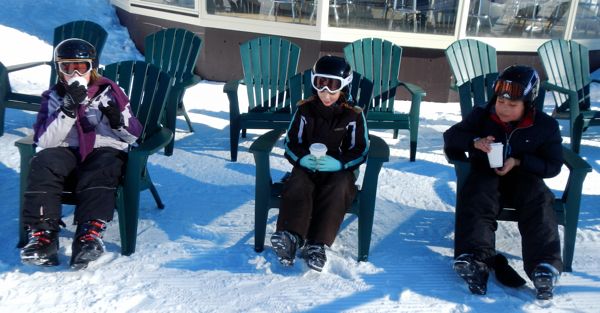
Lily Smith, Bryona Ziegler and Christian Arcinega-Pineda take a hot cocoa break.

For many of these kids, this is their first time to be at a ski resort. Galles estimates almost half of the kids have not skied or boarded before.

There is something about food and skiing that go together – whether it’s making a pizza with skis in the snow, or putting them together like a sandwich when taking a break, or holding poles like a cafeteria tray and not spilling.

These little triggers are ways ski school instructors help youngsters to learn to be better skiers.

Lily Smith, who isn’t new to the sport of skiing, said, “I like challenging yourself and having fun.”

She is paired with Christian Arcinega-Pineda and Bryona Ziegler.

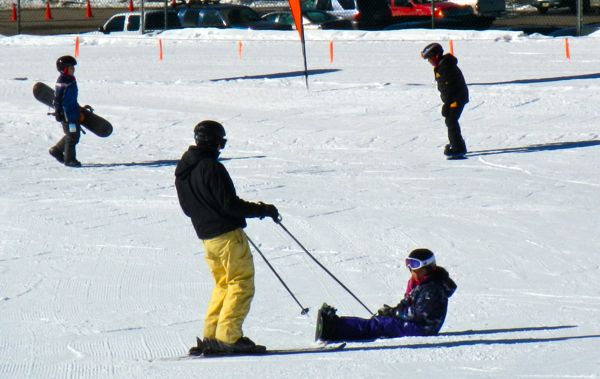
Sierra House Principal Ryan Galles makes sure Yesenia Garcia is OK after falling.

Instructor Gavin Lynch gives them advice as a group about how to hold the poles in front of them and individual tips as they ski to him.

Arcinega-Pineda said he’s learned “how to control myself down the slope.”

Mostly it’s all smiles — except for the the snowboarders when they fall. But that is another part of the learning process.


Prescribed fire planned for Spooner Summit

U.S. Forest Service fuels management crews will conduct prescribed fire operations on Spooner Summit beginning Feb. 5.

Crews expect to burn approximately 10 acres per day, weather permitting. Operations will continue through the week as weather and conditions allow.

Residents and visitors can expect to see smoke from this prescribed fire project area. Smoke may be visible on Highway 50.

The Forest Service strives to minimize the impacts of smoke on local communities. Smoke-sensitive residents should consider staying indoors and keeping doors, windows and outside vents closed. To directly receive prescribed fire updates, send an email to pa_ltbmu@fs.fed.us.


Sports handicapping skills can turn into good money

By Ron Sylvester, Las Vegas Sun

Professional bettors spent the week scouring electronic boards at sports books, looking for the best line and studying hundreds of proposition wagers for ways the Super Bowl could play out Sunday.

For them, betting football is a full-time job.

But most of the estimated 285,000 people who will swarm to Las Vegas to make Super Bowl Sunday the biggest day of the year at the sports books don’t depend on football wagers for their livelihood. It’s just fun — a way to make watching even a blowout a little more interesting.

People with an ability to pick winners can make a name for themselves, earn thousands of dollars and generate a following of other bettors.

Las Vegas has a history of people who have parlayed sports gambling into fame and fortune. The most notable may be Jimmy “The Greek” Snyder, who made sports betting understandable to the average fan, parlayed his knowledge into a gig on CBS and whose life story is the subject of a “30 for 30” documentary.

Among those in Las Vegas now making a name for themselves in sports betting are a golf guide, a cocktail waitress and a car salesman.

The golf guide

“It’s a hobby I enjoy and that I take very seriously, but I’m different from the guys who are real pros. I have a day job,” said Brady Kannon, who runs BK’s Golf Services, a concierge of the Las Vegas links. “I bet very casually, but I try to be good at it and put my skill on the line.”

Kannon and three of his friends won the Supercontest two years ago at the LVH. Playing under the team name Sans Souci, French for “without worry,” they took home $320,200.

This year, Kannon reached the semifinals in the Eye on Gaming invitational football contest. This week, Gaming Today included Kannon among its experts for its Super Bowl picks. As @lasvegasgolfer on Twitter, he has 2,000 people following his musings on golf and betting football.

“When I won the LVH contest, I gained about 1,000 Twitter followers,” Kannon said. “Most golfers are also gamblers, so I try to marry the two.”

Kannon learned about serious sports betting while working as a radio sportscaster after moving to Las Vegas 19 years ago. He picked up betting tips from sports gaming analysts and professional handicappers, such as Dave Cokin, Jim Feist, Marc Lawrence and Bob Stoll.

“That’s how I learned the whole skill of handicapping,” Kannon said. “Following their techniques and learning from their rules of thumb gave me a really good perspective on how they think.”

The cocktail waitress

Kelly Stewart can’t pull into the Bellagio without a valet or a host asking her which teams she likes. She serves cocktails at the Hyde nightclub. But placing bets averaging $1,000 a pop on college football, basketball and NFL games, she’s earned a tidy bankroll and become an Internet sensation among bettors.

“I’m definitely not an expert. There are guys who have been doing this for 30 years,” Stewart said. “I had a successful first couple of weeks and hit an 85-to-1 parlay. All of a sudden, people were calling from ESPN Radio and Don Best.”

Stewart has more than 9,000 followers on Twitter (@kellyinvegas). A former bikini contest winner, Stewart also appears in YouTube videos for DonBest.com in which she cracks wise and offers predictions, usually dressed in a revealing, ripped football jersey and boy shorts. Videos by veteran male handicappers at Don Best get a few dozen views. Stewart’s draw thousands.

The videos aren’t scripted for her. Stewart develops her own picks and point spreads.

Her sex appeal and handicapping ability helped her build the website HottieHandicappers.com. There, she and her online partner, a handicapper named Marlana, make picks on a weekly three-game parlay, the “Hottie 3 Some.”

“Nobody ever does parlays like this because they think they’re such big risks,” Stewart said. “To me, they’re such low risks. It’s $100 to hit $9,000. If you lose a hundred a week, you’ll lose $5,200 but if you hit one of the parlays, you’re up.”

She’s hit at least a half dozen during the past year.

Stewart picks up cash on tips by people who visit her website and profit from the picks. She’s had customers at Hyde who followed her tips. After one man hit a parlay, Stewart said, he showed up to one of her tables at Hyde and dropped several thousand dollars on Champagne.

She said she wants to keep sports betting fun, separate from her real job at Hyde.

“The second year of a club is always the best year, so I’m really looking forward to it,” she said of Hyde. “This is my job. I’m passionate about the betting. But it’s like my play money. I’ve won enough it’s house money. When you’re playing with house money, if you lose it, it was never really yours to begin with.”

The car salesman

Hobby handicappers aren’t merely weekend warriors.

“I tell people I bet every day and they just kind of look at me, like ‘What?’ But I just enjoy it,” said Larry Koziarski, better known to friends and acquaintances as “Larry K.”

Larry K. works in sales for Findlay Auto Group in Las Vegas, but he’s been betting sports since 1965. Originally from Michigan, Larry K. moved to Las Vegas permanently 10 years ago.

“I moved here so I could bet sports,” he said. “First, it’s legal here. And when you win, you always get paid in Las Vegas.”

He shares his insights on the paid online message board at Anthony Curtis’ Las Vegas Advisor, where he talks sports and money with pros who bet 30 times as much as he does.

“That’s where you’ll find most of the big boys in town, on that message board,” he said. “Most of the professional bettors are participants on that. They impart a lot of knowledge. You take everything you read and kind of just move forward. It’s a constant process, never ending. Every day, every bet is different. You see how much you won or lost, and then you start over.”

Down to business

Larry K. and Stewart both like betting online, where it’s easier to shop for lines and point spreads from their phones. Kannon likes the feel of betting inside a casino at the sports book counters at the LVH, Station Casinos or the Wynn.

For beginners, or squares as they call them in the books, numbers should outweigh emotions. Put simply, don’t always bet on a favorite team.

“One of the rules of thumb that anybody involved professionally or seriously (is) don’t get so tied up in betting on teams,” Kannon said. “What is more important is what numbers are you beating. The numbers are so key, especially in NFL football.”

Kannon said even a naive bettor could do well simply by not wagering on a team favored by more than one field goal or touchdown. Betting a favorite with a -2½ spread is better than -3½, he said.

Then again, rules are made to be broken. That’s why it’s called gambling.

“One of the rules of sports betting people break all the time is bet the numbers, not your heart,” Stewart said. “That’s what I do when I bet on Kansas State. I bet on them all the time. People tell me I’m crazy. I tell them I’ll stop when K-State quits covering the spread.”

Then again, Stewart will take rival University of Kansas most any night in basketball. To Wildcats fans, only a real gambler would do that.

But Stewart isn’t alone when breaking the rules. Sometimes, betting is just a gut feeling.

In this weekend’s Super Bowl, the San Francisco 49ers are 3½- to 4-point favorites over the Baltimore Ravens. The basic tenet would dictate taking the Ravens +4.

Most weeks, the golfing guide, the cocktail waitress and auto salesman would follow those rules.

This is the Super Bowl, after all.

All three said their money was on the 49ers.


Babe Ruth looking for players on South Shore

South Tahoe Babe Ruth Baseball sign-ups are Feb. 5-6 at the Kahle Park Recreation Center from 6-7pm and Feb. 7 at the South Tahoe Ice Rink from 6-7pm.

All boys and girls ages 13-15 are welcome. Players must have been born between May 1, 1997, and April 30, 2000, to participate.

The cost is $100 per player.

Anyone interested in playing, helping coach or assist the league is asked to attend one of these sign-ups.

For more information, contact, Eric Eymann (530) 721.2113 or eric@stationhouseinn.com.


Bowman continues to dominate

By USSA

PARK CITY – X Games champions Maddie Bowman (South Lake Tahoe) and David Wise (Reno) stayed on their roll Feb. 2, winning in Park City’s superpipe at the Visa U.S. Freeskiing Grand Prix.

It was the third straight win for Bowman – second straight for Wise. The two were crowned U.S. champions for their results across the two U.S. Grand Prix halfpipes.

Men’s and women’s finals saw amazing runs with high scores for the combination FIS Freestyle World Cup and AFP Platinum level contest.

The win gave Bowman a clean sweep of the two Grand Prix’s after her win at Copper Mountain in January.

Wise’s win avenged a defeat to Canadian Mike Riddle in Copper, matching his season-ending win last year in the March Mammoth Mountain contest.

Teen Torin Yater-Wallace (Aspen) was second in a men’s event.

Less than a single point separated first and third with Wise taking the win by a mere two-tenths – 93.8 to 93.6 over Yater-Wallace.

U.S. Freeskiing Rookie Team skier Aaron Blunck (Crested Butte, Colo.) was fifth in just his fifth World Cup. Rookie Annalisa Drew (Andover, Mass.) was sixth.

Bowman claims her fourth first place finish on the 2013 AFP World Tour and overtakes Annalisa Drew in the top spot on the AFP womens Halfpipe World Ranking.


Obermeyer at 93 still a visionary in outerwear industry

By Suzanne S. Brown, Denver Post

He laughs. He yodels. He talks to everyone from the new kids just getting started to industry kingpins. At age 93, Klaus Obermeyer is a snow-sports veteran with no thoughts of retiring.

An estimated 19,000 people will file through the Colorado Convention Center this weekend buying and selling ski parkas and snowboards, boots and poles at the annual Snow-Sports Industries America trade show, and many of them will make a point of stopping by Sport Obermeyer’s showroom to show their respect.

While a brigade of sales reps shows the brand’s collections, Obermeyer acts as the company’s genial ambassador, greeting buyers with a hearty handshake or hug and honest interest in finding out what’s on their minds. Sometimes he’ll wear lederhosen or an embroidered shirt as a nod to his native Germany, where he learned to ski as a child in the Bavarian village of Oberstaufen.

Obermeyer’s now-legendary story goes like this: He was teaching skiing in Aspen in 1947 when he got tired of being cold during long days on the slopes. In those days, people skied in wool coats and suits. Looking for a solution, Obermeyer cut up a down comforter his mother had insisted he bring with him when he moved to America, and fashioned part of it into a crude parka.

“I looked like the Michelin Man and had feathers in my cereal for weeks,” he said with a laugh. But the jacket was warm. And one of his students paid the unheard-of sum of $250 to buy it off his back. “A new Buick was $1,250 in those days!”

Next, he had to design a better prototype and figure out how to manufacture it. Obermeyer persuaded a friend in Bavaria to do so. “But he told me I’d have to supply the zippers and knit cuffs,” Obermeyer recalled.

Sixty-five years and many innovations later, the crafty German is still in business in Aspen. The privately held company sells its men’s, women’s and children’s apparel at 600 specialty retailers in the United States and Europe, and is moving into such markets as Russia and China.

“He’s the patriarch of the industry,” said David Ingemie, who has known Obermeyer since the 1960s. Now president of SIA, Ingemie worked in a New York retail ski shop back then and remembers Obermeyer as a friendly guy who looked out for what would be good for the industry as well as his own business.

“He was funny, always smiling and yodeling,” Ingemie said.

But beyond the joviality, Obermeyer had solid plans for his company.

“He was looking long-range,” Ingemie said. “In those days there were a bunch of egotists, but Klaus wasn’t that way. He knew the importance of making the industry grow.”

Retailers today say the same thing.

“He is one of the most forward thinkers I’ve met — he’s always thinking of the retailer and what our needs are as well as his own business,” said Linda Klein, who with her husband and son owns six Willi’s Ski and Snowboard Shops in Pennsylvania and Virginia. She has known Obermeyer since 1970.

“When you have a meeting with him,” she said, “you don’t have to feed his ego. He just wants to know what he can do to make the line better and improve business.”

That simple philosophy continues to be a driving influence in the company, according to Robert Yturri, who joined Sport Obermeyer as senior vice president for product and brand management three years ago after working for such companies as Spyder and North Face.

“Klaus just wants to get all kinds of people outdoors, which is why we fit everyone from a kids size zero to adults size XX,” Yturri said.

The company is also staying current by using eco-friendly and sustainable fabrics, such as recycled polyester made from textiles and bottles, and Cocona, made from coconut shells. It has also instituted practices to be more environmentally conscious in its manufacturing processes, such as using water-based dyes.

Yturri describes Obermeyer as a big family and says Klaus often walks around the office with a basket of apples, which he hands out as he checks in with employees.

Obermeyer takes it all in stride and tries not to work so hard that he forgets to enjoy the mountains. In Aspen, he skis every winter day the weather is good, and company policy is that if it snows more than 6 inches, employees can hit the slopes in the morning and come to work later in the day. Obermeyer broke his leg in an accident on Buttermilk two years ago, but with surgery and physical therapy, he was back on the slopes the next season.

He swims in the company’s solar-heated pool and plays tennis in the summer, but skiing remains his first love. And you won’t find him on the gentle or intermediate runs.

“The steeper, the better,” he says with a hearty laugh.


Search and rescue looking for Tahoe team members

The South Lake Tahoe arm of the El Dorado County Search and Rescue team is looking for volunteers.

Applicants must be 18 years or older.

While the primary focus is backcountry response, no special skills are necessary to join.

Candidate training academy prepares volunteers to safely execute a wide variety of missions. The academy includes search theory, lost person behavior, helicopter operations, man tracking, GPS/land navigation, wilderness survival and downed aircraft/emergency locator transmitters.

After initial training, volunteers have the opportunity to participate in specialized teams including technical rope rescue, alpine mountaineering, Nordic rescue, snowmobile/off highway vehicle team, swift/still water rescue and incident command.

South Lake Tahoe teams respond to an average of 65 calls annually. In 2012, the team provided emergency response to approximately 140 victims.

Volunteers are also needed in non-fielding roles, with a focus on planning, operations, logistics and administrative support.

For more information, contact El Dorado County sheriff’s Deputy Greg Almos at (530) 573.3058.


U.S. men dominate Sprint Grand Prix

By USSA

PARK CITY — Olympic champion Shaun White, who rides for Northstar, led a U.S. sweep in the Sprint U.S. Grand Prix at Park City on Friday.

Olympic bronze medalist Scotty Lago (Seabrook, N.H.) was second and Luke Mitrani (Mammoth Lakes) third in the FIS World Cup.

Chinese rider Jiayu Liu took the women’s title over FIS World Champion Arielle Gold (Steamboat Springs, Colo.) with Kaitlyn Farrington (Sun Valley, Idaho) third.

The finishes for Mitrani and Gold were enough to clinch the Sprint U.S. Grand Prix season title, along with the U.S. Championship crown – plus a payday of $20,000 for the series win.

White left the door open, falling near the bottom of his first run. Lago and Mitrani both rode at an extremely high level, putting the pressure on White for his final run.

Favorite Kelly Clark (W. Dover, Vt.) struggled in her two runs, crashing both times. Gold, who recently won the FIS Snowboard World Championship halfpipe, rode strong and picked up the Sprint U.S. Grand Prix series title and $20,000.