STHS girls basketball team wins first round in playoffs
In a repeat of last week’s game between the South Tahoe Vikings and Truckee Wolverines, the Vikings won.
But this game on Feb. 13 had more meaning. The girls fought their way into the next round of the playoffs. The Vikings won before their home crowd, 35-28.
Next up for the girls basketball team is Elko on Feb. 15 at Wooster starting at 6:15pm.
Wednesday night’s game was physical and full of fouls by both teams.
The Vikings played most of the game with nine players because Melanie Grady was sidelined in the first quarter with what is believed to be a broken nose. Bailey David was on the bench after sustaining a concussion last week. It’s too soon to know if she will be cleared to play Friday.
— Lake Tahoe News staff report
STHS boys basketball team advances in postseason
South Tahoe High School’s boys basketball team prevailed over Churchill County on Tuesday, 66-54.
Brandon Cramer led the Viking charge Feb. 12 with 24 points.
For a team full of seniors, this was the last home game for most of the players. And this was the first home playoff game in more than a decade.
There was a time when STHS was a force to be reckoned with on the hardwood. Before Tom Orlich left a dozen years ago, in 25 years of coaching his teams won 521 games. Among those were 17 division titles, nine regional championship and two state titles.
Before the Vikings can play in another championship game they must travel to Wooster on Friday where they are likely to meet No. 1 seed Elko. Elko will be formidable opponent coming in undefeated. (Elko was beating Spring Creek 62-22 in the fourth quarter Tuesday night.)
But it was a squeaker when STHS and Elko met in December. Elko won 52-47.
— Lake Tahoe News staff report
From humble start, largest U.S. ski resort turns 50
By Susan Wood
VAIL — With just a passing glance of the sweeping views off the Mountaintop Express chairlift at 11,250 feet, it’s difficult not to get naturally sentimental about how a vision of a mountaineering soldier turned into Colorado’s premier ski resort and the flagship for a corporate empire running nine ski area properties. Heavenly, Northstar and Kirkwood are among them.
That’s because Vail Mountain Resort had modest beginnings.
In 1957, rancher and engineer Earl Eaton and Pete Seibert – who was a member of the U.S. Army’s 10th Mountain Division in World War II – climbed to the top of Vail’s distinct ridge that divides the front side and its massive back bowl area that stretches seven-miles across. The founding duo was seeking an adventure that would keep their feet in the mountains professionally and personally.
The One gondola opened in November at Vail. Photos/Kathryn Reed
Five years later in December, Vail opened with one gondola and two chairlifts – two-person seats with wooden slats, fewer than 50 employees and two bowls to frolic in, Sunup and Sundown. A lift ticket cost $5.
“It was small,” Pete Seibert Jr. told Lake Tahoe News.
Sometimes he remembers those days like they were yesterday. His late father was engrossed in getting the ski area off the ground, but had fun in the process.
“(Dad) used to say that if you’re doing it right, you don’t need a vacation. He never complained about what was going on. He loved the whole process. I think it was because he saw how each day’s progress fit into his ultimate dream. His stories were about the characters working on the mountain or the next ‘big thing’,” said Seibert, one of three children. “(Dad) passed on the ‘mountain’ side to me.”
The 57-year-old Vail real estate executive, who has worked for Slifer Smith & Frampton Real Estate for 20 years, grew to love skiing through his father.
“I would get out of school every day at 1 and skied every day, and that’s what my childhood was like,” he said.
What were his favorite runs?
This depends on the snow conditions. But the protégé has a fondness for China Bowl, especially in the spring with its grainy corn snow. The Genghis Khan run serviced by the Tea Cup Express chairlift provides wide-open, steep terrain that looks like something straight out of a Warren Miller film.
Then again, Seibert Jr. was influenced by the legends of the sport.
“Of all the runs we skied, I’d have to say Riva Ridge was my favorite. I learned to love big sweeping turns from following (dad),” he said. “The other part to skiing Riva is to roll right into Tourist Trap without stopping.”
The 4-mile run that starts between the Mountaintop Express and Northwoods chairlifts empties into the Vail Village. At the time, the Village, as it has become to be known, was a small collective of shops the neighborhood children roamed in until it was time for supper at home.
“(The kids) always skied with friends and visited the shopkeepers.
“Everybody knew us. We would go to the deli and if a parent was looking for us, they’d say: ‘He was here 15 minutes ago.’ In the summer, it was real (Huckleberry) Finn stuff,” Seibert said.
Vail has embedded itself into Seibert’s life.
“In the beginning, everybody was in it for the success of the area. It took teamwork to survive – from the (ski area) employees to the shopkeepers,” he said. “(Dad) was convinced it would be successful from the start.”
Seibert left Vail to attend Middlebury College. He returned to Vail to work on the ski patrol, followed his father to Snowbasin, Utah, then moved on to Sun Valley, Idaho, working at Bald Mountain. He came home to Vail 26 years ago, and now with children of his own, is dug in to his home base.
A lot has happened along the way to this gigantic ski mountain that lives up to its tagline: “Like nothing on Earth.”
The skiable terrain amounts to 5,289 acres. Almost 200 runs are blanketed with an average of 366 inches of snow per year. Vail’s staff members provide complimentary tours including those reaching Blue Sky Basin – the farthest back bowl that provides some of the most fun one can have outside. It opened a dozen years ago. Two years after, Seibert Sr. died of cancer at age 77.
Today, express chairlifts line the multi-mountain resort and spread the million skiers and snowboarders out. By California’s standards, it’s hardly crowded – even on the weekend.
“While the technology has given us faster lifts and better equipment, the best part is we get more runs in, and there is more to ski,” Seibert said.
In honor of its 50th anniversary, Vail replaced the Vista Bahn chairlift and unveiled in November the One Gondola based at the village. The 10-seater cars (probably six-to-eight comfortably) comes equipped with WiFi capability for the technology crowd and heated, padded seats for when it’s chilly. It ends at the mid-Vail area.
Much has changed in chairlift technology.
So to appreciate what it had in the past, the largest ski resort in the United States placed an original Bell Gondola car at the village base where the new one is located.
On a recent run, the new gondola stopped for what seemed like half a minute. As passengers relished the quiet scene, a Denver man noted: “This doesn’t usually stop this long.”
The ride time is just less than eight minutes, traveling 1,200 feet per minute.
“One” – named as a tribute to Colorado’s first “Bell” gondola — is swift, comfortable and apparently reliable.
Of the 111 cars, the 50th is painted gold as a reminder that the lift represents an integral part of Vail’s celebrations honoring its heritage.
Along with its returning events such as the Taste of Vail and Vail Film Festival, Vail has scheduled a few new ones for its big occasion. They started last December and span the ski season into April.
In February, the ski area switched its attention from the downhill skiing exploits of mega host athlete Lindsey Vonn to snowboarding. The ski area introduced a 22-foot halfpipe in order to host the Burton U.S. Open Snowboarding Championships, which was staged in Vermont for the last 30 years.
Vail plans to cap off its 50th birthday season with Ski Heritage Week. The April 8-15 event will feature the U.S. Ski and Snowboard Hall of Fame Annual Induction Ceremony. Seibert was inducted in 1980.
Fitting indeed, considering that steps away from ground zero for Vail Mountain lies the Colorado Ski Museum. Inside, the historic site plays a DVD featuring the founding of the resort as a sentimental, passionate tribute to Seibert and company.
One could almost imagine what Eaton and Seibert were thinking when they hiked to the top.
“It’s a once in a lifetime opportunity for me to be a part of something that has significantly contributed to who I am and how I feel about skiing and snowboarding, the mountain, the town and my home,” Vail Senior Vice President and Chief Operating Officer Chris Jarnot told Lake Tahoe News.
One can visit a small plaza called Seibert Circle off Bridge Street built in Seibert’s honor. Riders may also feel his spirit in Pete’s Bowl off Blue Sky Basin. Others may experience the late Eaton’s by dropping into Earl’s Bowl on the perimeter right alongside Pete’s.
ngg_shortcode_0_placeholder (Click on photos to enlarge.)
3 Diamond Peak racers land in top 5
By Lisa O’Daly
Far West under 14 athletes from around the Lake Tahoe Basin met at Squaw Valley over the blue sky weekend to compete in the third race of the season, the Parallel.
GS gates, or panel gates, are set approximately every 15 meters, with a similar course set adjacent to it. Frozen spectators witnessed an exciting race on Exhibition as two skiers raced side by side, each in their own course with every inch in the full view of the crowd. While each course has its own timing system so technically participants only race against the clock, racers still attempt to beat the athlete they pair with at the start. It was a cold weekend of spectacular crashes and close finishes on hard snow conditions for the 150 ski racers who competed.
Casey Delaney of Diamond Peak lands on podium in weekend race. Photo/Provided
“This race was essentially a sprint. The short, 30-second course requires athletes to be tight on the panel and keep their skis in the fall line. This means taking risks,” commented Diamond Peak Ski Foundation Coach Mark Norton.
Some of those risks paid off for the Diamond Peak racers, with several earning top 15 and podium finishes.
On Saturday, Diamond Peak’s men’s team sparkled with three racers in the top five. Casey Delaney’s combined time of 1:06.75 landed him at the top of the podium. Teammate Payton Norton’s solid runs earned him third place (1:08.08), followed by Winston Pretti in fourth at just 0.06 seconds behind (1:08.14). Dashiell Prince-Judd of Sugar Bowl was second (1:07.38).
On Sunday, Prince-Judd took the win (1:04.05) and Diamond Peak’s Delaney came in second (1:04.79), with Norton a close third (1:04.81).
Diamond Peak’s team continued to show its strength in the U14 boys with Noah Cleary placing 12th (1:10.25) on Saturday and 19th (1:07.41) on Sunday, followed by Corey Huber (23, 23). Other teammates racing at Squaw also skied well: Nick Fischer (24, 35), Tommy Corcoran (32, 42), Daniel D’Olimpio (38, DNF), Connor Huber (39, 41), Bodie Glavish (40, 53), Trent Funke (41, 50), Jeff Miller (43, DNF), and Tim Novak (DNS, 57).
“There is a lot of depth in this 12-, 13-year-old age class (U14) and our kids continue to dazzle the coaches with their dedication, camaraderie, and spirit,” said DPSF Coach Raquel Norton.
The Diamond Peak ladies skied solidly both days. DPSF racer Madison Idso led her teammates on Saturday with a 17th place (1:12.23), with Bridgette Johnson right on her heels in 18th (1:12.38), Emily Donahue 21st (1:12.79), Sophia Holm 23rd (1:13.20), and Laurel Taylor 26th (1:14.29). Taylor fired up on Sunday and really pulled out the stops to post a fast enough combined time (1:08.96) to crack the top 15 with 15th place. Donahue showed her consistency with a 20th (1:09.97), and Johnson was not far off in 30th (1:11.75). Unfortunately, both Idso and Holm had crashes and did not finish on Sunday. Teammates Rachel Meyer (50, 49) and Katie Fisher (67, 62) had repeatedly consistent runs.
Lisa O’Daly is a parent volunteer with the Diamond Peak Ski Education Foundation.
STHS basketball teams playing at home in postseason
The boys and girls basketball teams at South Tahoe High School will be hosting playoff games this week.
This is the first time in years for the Vikings to be playing at home in the postseason. For the boys, it’s the first home playoff came since 2000.
The boys host Churchill County on Feb. 12 at 7pm. The girls entertain Truckee on Feb. 13 at 7pm.
Snowshoe at Van Sickle Park
There will be a guided snowshoe at Van Sickle Bi-State Park on March 9 from 10am-1pm.
This snowshoe hike is being offered through a partnership between Explore Tahoe: An Urban Trailhead and the Tahoe Rim Trail Association. The distance of the snowshoe hike is 2-3 miles and is rated as moderate in terms of difficulty.
Meet at the Heavenly Village parking garage at 10am.
Refreshments will be served at the end of the program at Explore Tahoe.
All participants are expected to provide their own snowshoes, dress appropriately and bring plenty of water and food to last through the hike.
For more information, call (530) 542.4637.
Snowshoe benefits Eric Nageotte-Lowe Scholarship Fund
The Eric Nageotte Memorial Fresh Tracks 5K Snowshoe Walk and Race is Feb. 24 at 10am.
You don’t have to race, just have fun.
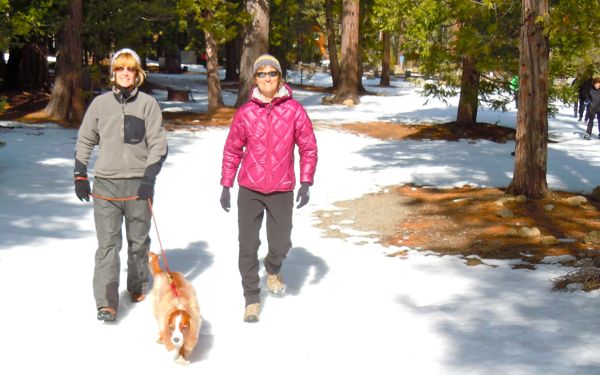
Pam and Darla don’t need snowshoes at the 2012 event. Photo/LTN file
Sign up by Feb. 16 to save $10 over race day registration and be sure to reserve a pair of snowshoes if you need them or bring your own. Register by Feb. 16 for $30. This includes a sweat shirt, snowshoe rental if needed, post-race refreshments, and continued day use of groomed Camp Richardson trails. Sweat shirts for the first 50 registrants. Day of race registration is $40. Register online.
The Tahoe Mountain Milers Running Club is hosting the event at Camp Richardson Resort.
The beneficiary is the Eric Nageotte-Lowe Scholarship Fund for the Heavenly Freestyle Team.
Sierra snow surveying techniques more than 100 years old
By Norimitsu Onishi, New York Times
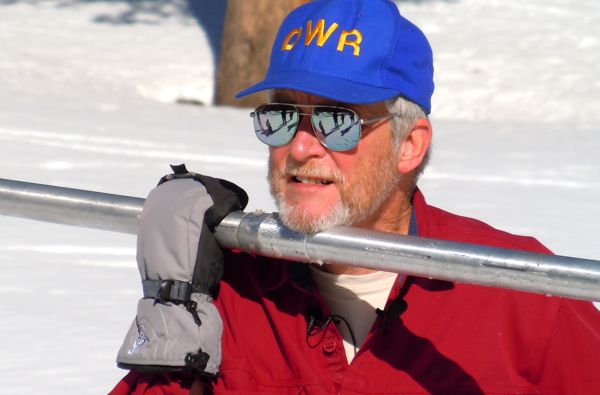
PHILLIPS — Along Highway 50, elevation 6,820 feet, a California winter ritual unfolded here on a recent morning. In the snow-blanketed meadow of a local homeowner’s backyard, reporters representing news organizations from across the state followed a man on skis who kept plunging an aluminum tube into the snow.
Leading the pack was Frank Gehrke, California’s chief snow surveyor, the man responsible for measuring the Sierra Nevada’s snowpack, the source of a third of this state’s water supply. Part groundhog, whose appearances signal the shift of the seasons, and part Federal Reserve chairman whose utterances on the state of the snowpack can move California’s multibillion-dollar agricultural industry, Gehrke has led the Department of Water Resources’ snowpack surveys for a quarter-century.
Frank Gehrke is the face of snow surveys in the Sierra. Photo/LTN file
In the state that is home to Silicon Valley, Gehrke and his team use the stick-the-tube-into-the-snow method developed by a local classics professor more than a century ago.
“There’ve been only incremental changes,” Gehrke said, interspersing this winter’s second monthly survey with a veteran’s calm observations of the snowfall and hints of the possible coming drama that is California’s annual snowmelt. “This course is very uniform, which is normal, because the snowpack during accumulation is kind of uniform. But once you start getting into the melt, it starts to go crazy.”
His assessment of this month’s survey — after a strong start, the snowpack’s water content fell to 93 percent of average for this time of the year because of a “midwinter lull” — was covered by the media throughout the state.
In California’s water system, one of the world’s most sophisticated and complex, the snowpack plays a leading role by supplying water to more than 25 million people and almost one million acres of farmland. Snow that accumulates on the Sierra Nevada’s 400-mile range starts to melt in the spring, draining into rivers that feed reservoirs below.
As Gehrke and his team gauge the depth and water content of the snowpack, other department officials begin forecasting how much water the snowpack will be able to deliver this year.
Those who depend on the snowpack for water adjust their plans accordingly. Water districts may start looking for water elsewhere or carry out conservation measures. Farmers consider the forecasts in deciding what crops to plant or whether to take bank loans to buy more seed and equipment for the year.
Ryan Jacobsen, who is executive director of the Fresno County Farm Bureau and also sits on the board of the Fresno Irrigation District, said that the snow surveys are the “bible for what decisions irrigation districts are going to make for the rest of the year.”
“Fresno County is the No. 1 agricultural county in the nation, but we also happen to be situated climatically in the middle of a desert,” he said. “It really is the Sierra Nevada snowpack that makes this desert bloom.”
It was in 1908 that James E. Church, a classics professor at UNR developed the existing method of forecasting water runoff from the depth and water content of snow. To settle a dispute over water rights in nearby Lake Tahoe, he was able to predict the water from the snowpack on Mount Rose by using a hollow tube that he called the Mount Rose snow sampler. Government agencies adopted his technique and, in 1929, California passed a law mandating that state officials measure the Sierra Nevada snowpack and issue forecasts of the water supply.
“You can almost say it made the development of the West possible,” Gehrke said. “Prior to that, they really didn’t even have tools to use to hope to predict how much runoff they would have.”
A civil engineer, Gehrke, 65, grew up in Missouri, where snow was considered more of “a nuisance” than anything else. “We would get occasional snowstorms, and our big hope was that the schools would close, though they rarely did,” he recalled.
He joined the Department of Water Resources in 1987, which coincided with the start of a six-year drought. The drought brought more resources and public attention to the snow surveys. The monthly surveys, which run from January through April, became media events starring Gehrke.
“He’s sort of iconic,” said John Laird, secretary for the state’s Natural Resources Agency, who had come to participate in the snow survey. “He’s the face of snow measurement.”
The water resources department issues forecasts after studying the data collected by Gehrke as well as 40 cooperative agencies at about 250 locations. His team includes 10 snow surveyors, some of whom travel with their measuring tubes to remote spots by hiking, snowmobile or even helicopter. Sensors located throughout the Sierra Nevada provide real-time data but are not considered as accurate as the manual surveys.
A new project by NASA’s Jet Propulsion Laboratory in Pasadena could soon enrich the snow surveys’ findings. As part of what the laboratory calls the Airborne Snow Observatory, scientists will begin flying over the Sierra Nevada next month aboard a plane equipped with an imaging spectrometer and a laser system known as lidar. The findings, which will be used for water management as well as the study of the impact of climate change on snowpacks, are expected to yield a broader view of the snowpack and more precise predictions of the snowmelt, said Thomas H. Painter, a research scientist heading the observatory.
Gehrke, who is working with the laboratory, has flown on some preliminary flights.
“Frank is the bridge across the legacy of water management and snow observation in the Western U.S. to this technology,” Painter said.
Perhaps no one was better than Gehrke at finding the drama in California’s snow cycle. Would the midwinter lull be followed by steady accumulation in February? If February turned out to be dry, would there be what he calls a “March Miracle” before the final, comprehensive survey in early April?
Gehrke started skiing back to Highway 50, catching up with the reporters who were already packing up their gear. Fewer reporters would show up next month, he said, but April’s snow survey would draw the biggest crowd.
“March is sort of the shoulder season for snow surveys,” he said. “Everybody’s looking forward to April.”
Mancuso barely misses podium in downhill
By USSA
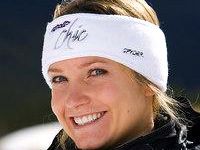
SCHLADMING, Austria — The U.S. narrowly missed the medals Sunday in the women’s downhill at the FIS Alpine Ski World Championships. Julia Mancuso (Squaw Valley) was 0.15 out of the prizes in fifth, with Stacey Cook (Mammoth Mountain) sixth.
In an aggressive race that saw higher speeds than training, the twisty, turny Schladming S turn midway down the course took its toll on U.S. racers as France’s Marion Rolland took the surprise gold.
Julia Mancuso
Mancuso and Cook were dominating their runs up to the midway point where a series of turns through the Schladming S slowed them down.
“I don’t know where I lost it – I’m a little frustrated right now. I want to talk to my coaches to find out where all that time went,” Cook said.
Leanne Smith (N. Conway, N.H.) was 12th with Alice McKennis (Glenwood Springs, Colo.) 17th.
Google Maps adds ski resorts
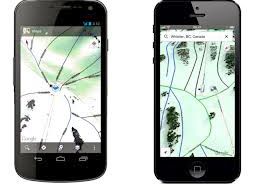
Seven California ski resorts are now part of Google Maps.
The traditional green-blue-black to designate the difficulty of the run are used, with a red dotted line signifying the actual lift.
In all, 38 resorts in the U.S. and Canada are mapped out.
The California resorts are: Alpine Meadows, Heavenly Mountain Resort, Mammoth Mountain, Mount Shasta, Sierra-at-Tahoe Resort, Squaw Valley, and Sugar Bowl Resort.
 But this game on Feb. 13 had more meaning. The girls fought their way into the next round of the playoffs. The Vikings won before their home crowd, 35-28.