Beaver Creek — the pinnacle of customer service

By Susan Wood

BEAVER CREEK – This service-oriented resort does everything but ski it for you.

And one could argue that sometimes they do. At least that’s how Kae would describe her experience negotiating the famed Colorado resort’s gnarliest run off the Birds of Prey chairlift. The double black diamond Golden Eagle run starts the Men’s Downhill Course, home to the Alpine World Ski Championships set for 2015.

Kae, who identifies herself as more of an intermediate skier, had help on one of the world’s three toughest downhill racing runs with a guide she felt at home with. Beaver Creek ski guide John “J.B.” Bell, who hails from Truckee, is familiar with the terrain and the reality of feeling like he’s skiing over his head. He recalled on our recent visit to the area how he skied at an amazing speed on the men’s downhill run at Snowbasin outside Salt Lake City, home of the 2002 Winter Games. At the time, the run was labeled as the steepest racing run ever.
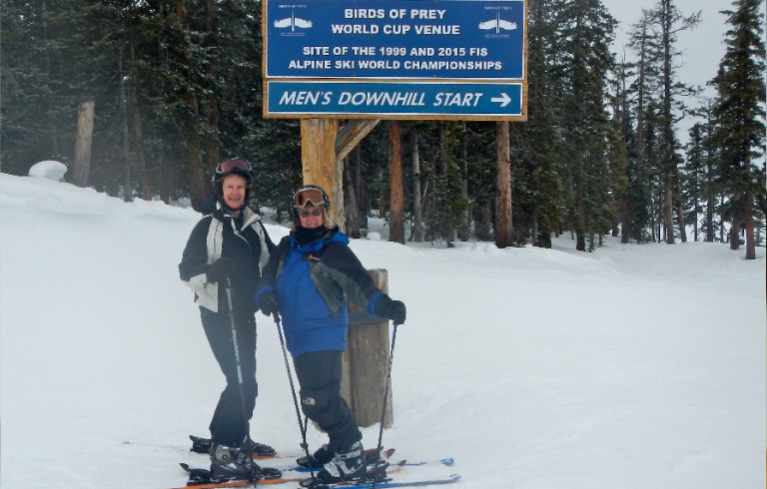
Kae only smiles before she sees the run; Sue smiles the whole time. Photo/J.B.

“I thought: ‘J.B., you’re going too fast’,” he described as if he was flying. So he knew what an apprehensive Kae was going through.

“I’ve been a bodyguard on the slopes. So I hope they trust me enough that I’m there for them,” Bell said, using an example of a client who calls him every year to get that kind of assistance. He added that working in the beginning ski school hones a Beaver Creek employee’s patience.

It’s a good thing Bell was there as the guide and not me, otherwise Kae wouldn’t have spoken to me for the rest of the ski, food and wine trip.

It’s like this. Upon cruising down the run called Golden Eagle of the downhill course, a skier approaches an area called The Brink, a seemingly bottom-less lip where the grade tilts about 50 degrees and the entire valley below opens up miles away. Of course, there’s a right turn the racers will need to negotiate, rather than tangle with the trees.

“(The racers) fly off here at 80 mph,” Bell said.

The terrain was hard-packed with limited clumps of snow to use to turn. Most downhill runs are designed that way – hard and fast.

Bell proceeded by skiing in front of Kae, as if he would hurl his body on top of her if she fell and started sliding. She skidded over a challenging spot to a safe place, and I waited as the backup sweep.

I must admit. It was fun. I felt the adrenaline I haven’t experienced since skiing the Dave Murray Men’s Downhill run at Whistler-Blackcomb, home to the 2010 Winter Games.

Afterward, the three of us looked up at the steep grade, sighed and continued toward the Larkspur Express chair. Along the way, Bell pointed out how the Women’s Downhill Run starting at Peregrine meets the men’s course at the Kestrel run. It took 700 days of dedication to carve out the women’s racing run.

It dawned at me that Bell is in the right job at the right place. And not just because he was the most qualified person to safely and confidently get Kae down the slick double-black racing run. I witnessed his poise all morning during last month’s Food and Wine Festival ski day. He helped two 5-year-old children on and off the chairlift, stayed friendly with everyone he met and provided pointers for us.

Upon skiing the superior snow of the Rose Bowl chairlift area, Bell talked us into taking a leap of faith and ski with our two poles suspended in front of us like a platter. The exercise was intended to keep our upper body level and hands in front. If the poles tilted, “you dropped your wine glasses,” he joked.

Beaver Creek’s attentive experience goes way beyond ski instruction and guidance from a coach with a 30-year background. The mantra of providing excellent service is engrained in every practice, every product, every employee. That’s why its advertising tagline “Not exactly roughing it” seems so fitting. Even Mamie’s Cabin for the casual-faire declares on a sign “only slightly roughing it.”

There are the warm chocolate chip cookies handed out at the base at 3:30pm, gourmet hot chocolate given away at the top of the Centennial Express Chairlift and a variety of cabins where residents have access to these isolated culinary hideaways.

And beyond those offerings, Beaver Creek operates with an overriding service program in which the employees provide suggestions to improve a guest experience. The program is extensive and serious.

The staffers at Beaver Creek may strike the guests as a little older than the more-common, young, ski-bum types living between high school and college or career path.

“We want to be the industry leader in guest service. And that means being proactive,” Beaver Creek spokeswoman Jen Brown told Lake Tahoe News. “We have a little more of a mature audience serviced by mature employees.”

Take Beaver Creek shuttle bus driver Ned Weiss, a single senior from Ohio who comes up to Colorado for the winter to work.

“I came here for the great benefits,” he said. Of course, as with all age groups, access to superior skiing conditions tops the list of benefits. He’s friendly, helpful and forthright.

Despite all the pampering, one cannot reduce Beaver Creek to a ski bunny hill where riders spend more time having every whim addressed than carving serious turns. Much of the terrain, like the Birds of Prey area, is not for the faint of heart. Eight high-speed chairlifts service more than 30 black diamond runs, adding up to a 4,000-plus foot vertical drop. Then, there’s the Stone Creek Chutes on the backside. And that’s just the advanced terrain.

Whatever the territory, the mountain stretching to 11,400 feet with 1,815 acres of ski terrain comes with skiing ambassadors who roam the grounds.

The ski resort is even kind to the resident elk herds who also meander through the landscape by providing tree “islands” consisting of clusters of trees on Bachelor Gulch side of the resort. At its base, a Ritz-Carlton stands to further the extraordinary guest-service experience. (Note: more on that in this article.)

History

• Beaver Creek opened Dec. 15,1980, with six chairlifts and a temporary base lodge. Development costs ran $300 million.

• The decade brought much growth to the resort with the opening of the Larkspur Bowl and the unveiling of the Centennial Express chairlift from the village base.

• In 1989, the World Ski Championship came to Beaver Creek.

• In the following decade, Grouse Mountain at Beaver Creek opened. In the later years, the Arrowhead Ski Area was connected to the resort.

• The Birds of Prey area was developed and included an express chairlift in 2003 to accommodate the resort’s quest to be a dominant force in hosting the World Alpine Ski Championships.

• In 2004, the town lift that crosses Highway 6 was put in to take skiers from the Lower Beaver Creek area to the upper side.

ngg_shortcode_0_placeholder (Click on photos to enlarge.)


Full moon snowshoe benefits Winter Discovery Program

Tahoe Cross Country’s last full moon yurt dinner of the season is Feb. 22.

Chef Doug Baehr of Uncommon Kitchen will be doing the cooking.

The evening adventure starts with a moonlit ski or snowshoe from the Tahoe Cross Country Ski Area to the trailside warming hut on Yellow trail where there will be fireside hot drinks. Dinner is served in the yurt.

Cost is $65 per person. It includes a three-course meal, tax, two beverages, and trail pass. Ski or snowshoe equipment is available for rent.

This is an evening for adults.

All money raised benefits the Winter Discovery Program at Tahoe Cross Country.

Snowshoers should expect to leave the parking lot by 5:30pm and skiers should leave no later than 6pm. Headlamps are available upon request. If you are dining only and not skiing or snowshoeing, the yurt will be open for mingling at 7pm.

Reservations are being taken. Seating is limited — (530) 583.5475.

The center is at 925 Country Club Drive, Tahoe City.


Nevada parks department has money to give away

Nevada Division of State Parks is accepting applications to help fund eligible projects that include new construction, maintenance, trail related facilities or education projects.

Parks has approximately $1.25 million in grant funds from the Federal Highway Administration trails assistance program. A minimum of 30 percent of funds will go to motorized projects. A maximum of 5 percent will be awarded to environmental education trail training projects.

Federal, state, city and county governments, special governmental districts, trail organizations and private individuals are potentially eligible for the grants.

The 2013 Grants Manual and Application packages are available online. Applications are due April 5 by 5pm.

For further information or questions, contact Jenny Scanland at (775) 684.2787 or email jscanland@parks.nv.gov.


U.S. shines at World Ski Championships

By USSA

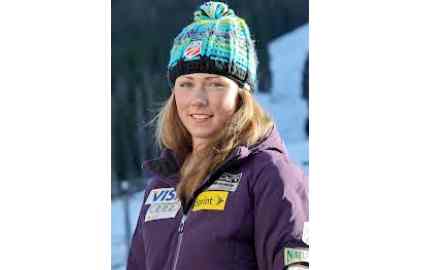
SCHLADMING, Austria — Teen Mikaela Shiffrin (Eagle-Vail, Colo.) skied a powerful, aggressive second run to come from behind Saturday to win gold in slalom at the FIS Alpine World Ski Championships in Schladming.

Third after the first run, Shiffrin overcame a 0.18 lead by Sweden’s Frida Hansdotter who took bronze. Austria’s Michaela Kirchgasser took silver.

Mikaela Shiffrin

It was the first World Championship medal of their careers for each of the medalists.

Shiffrin became the third youngest woman to ever win a slalom World Championship and youngest American to win any title since 17 year old Diann Roffe won gold in giant slalom in 1985.

It was the fifth medal for the United States and fourth gold. Ted Ligety (Park City) won in super G, super combined and giant slalom. Julia Mancuso (Squaw Valley) won in giant slalom.

A sold out stadium of over 30,000 was on hand in Schladming for the final weekend of the Championships.


Tahoe area freeskiers in back of the pack

By USSA

ROSA KHUTOR, Russia — Torin Yater-Wallace (Aspen) and Gus Kenworthy (Telluride, Colo.) battled through fog and rain Feb. 16 to go one-two for U.S. Freeskiing in the pre-Olympic test event of the halfpipe at Rosa Khutor outside Sochi. It was the first opportunity for the top athletes in the Olympics’ newest event to visit Sochi and test the new pipe.

Torin Yater-Wallace

Yater-Wallace soared to his first win of the season.

David Wise (Reno) was unable to impress the judges as he has through the Visa U.S. Freeskiing Grand Prix and X Games events recently and was fifth.

Top American woman was Jamie Crane-Mauzy (Park City) in ninth.

South Lake Tahoe’s Maddie Bowman said, “I’m really disappointed with myself. I just couldn’t get my trick dialed on this pipe. It’s been a great experience to check out Russia and where the Olympics will be.”


Ice sculptors take over Northstar Village

By Nathan Hurst, Wired

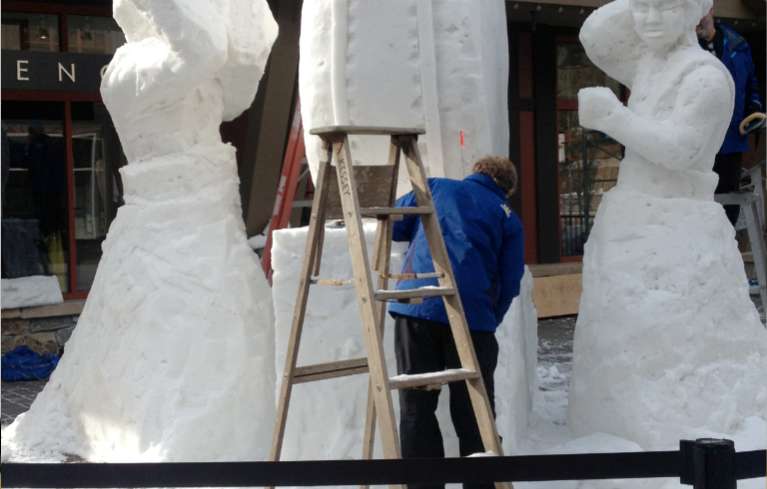
Last weekend at Northstar was beautiful, sunny, and in the 30s. For eight teams of snow carvers from around the world, though, it’s terrible — the melty snow is sloppy, hard to carve, and even dangerous.

Teams of three from Finland, Japan, Germany, Canada, and the U.S. were selected from more than 40 applicants for the inaugural Carve Tahoe, a five-day competition to hew works of art from 14-foot-high, 20-ton blocks of snow. But despite the bad snow, the teams rely on decades of experience, handcrafted tools, and creative techniques to fashion their massive sculptures. The team members are sculptors and artists and designers, but also doctors and lawyers. Though they spend weeks each year carving, nobody makes a living doing it.

“Everyone seems to have their own method of doing things,” says Team Wisconsin’s Mark Hargarten. “It’s amazing how different they are.”

Sculpting at Northstar. Photo/Kathleen Jay

The Wisconsin team uses a grid system for their carving — a Native American wearing an eagle costume, its feathers turning to flames, called “Dance of the Firebird.” The polyurethane model they built is scaled so one-half inch equals one foot on the finished snow sculpture. They cut a copy of the model in four, and covered each section with clay, sectioned in half-inch increments. They etch corresponding lines in the snow, one foot to a side, and they peel off one piece of clay, carve the part of the sculpture they can see, and move on to the next.

“You never get lost using the method,” says Dan Ingebrigtson, a professional sculptor from Milwaukee. “Three or four guys can work from different angles, and meet in the middle.”

Wisconsin’s got several other strategies behind their carving as well. From the south, it looks like they haven’t even started; they left the southern side of the block intact to protect the rest of it from the sun, and the wall has been decimated by the heat. More than 20 percent of its thickness has melted by Sunday night, three days in. After the sun goes down, the team is hollowing out the interior of the structure, so it will freeze faster overnight.

Other teams are relying on nighttime freezing as well. A team partly from the U.S. and partly from Canada carves spires from blocks they removed from the sculpture, and plans to attach them to the top of their sculpture, “The Stand,” which incorporates four interwoven trees. They’ll use melty snow pulled from the middle of the block right when the sun goes down to cement the tops onto the trees, says team member Bob Fulks from the top of a stepladder as he cuts away at the sculpture with an ice chisel.

Fulks’ team is leaving Tahoe after the competition to go straight to Whitehorse, in the Yukon, for another competition, where he anticipates no problems with warm weather.

“It’s a good gig, you can travel all over the world doing it,” he says. “You go around and see the same people.”

Many of the carvers know each other from previous competitions.

“We’ve sculpted with almost everybody here before,” says Team Idaho-Dunham’s Mariah Dunham, who is working on “Sweet House (of Madness)” with her mother, Barb. The creation is a beehive, with the south side as the exterior, and the north side (intentionally placed out of the sun) as a representation of the comb, including hexagonal holds that perforate all the way to the hollow interior.

Though Carve Tahoe is new, snow carving is not. Many of the sculptors have been at it for more than 20 years, traveling around the world and meeting and competing against many of the same people — though each competition demands unique new designs from all the sculptors. Kathryn Keown discovered snow carving while Googling something completely different, and decided she wanted to host an international event.

“First we fell in love with the sculptures, then we fell in love with the sculptors,” says Keown, who founded the competition with Hub Strategy, the ad agency where she works.

Keown contacted several ski areas before Northstar, but the resort was on board right away; its owner, Vail Resorts also owns Breckenridge, where one of the biggest and most prestigious snow carving competitions is held.

But Keown wanted to commit to the design of the competition, not just the sculptures. Applicants submitted their designs last summer, and Keown enlisted Lawrence Noble, chair of the School of Fine Art at the Academy of Art University to help choose modern, complex, realist designs. She wanted no artsy, kitschy snowmen.

Then she chose a design-friendly logo and judges. In addition to Noble, the panel of judges features a sushi chef from Northstar, two interior designers, a photographer from nearby Squaw Valley, and Bryan Hyneck, vice president of design at Speck, which makes cases for mobile devices and was one of the event’s sponsors.

“The level of complexity and sophistication in this type of sculpture is just amazing,” says Hyneck, who has judged industrial and graphic design competitions, but never snow carving. “It’s amazing how organic some of the shapes can be.”

As a judge, Hyneck says he’ll focus on the craft and the execution of the sculptures, and how the sculptors use particular techniques to take advantage of the snow’s properties. But he adds that subject matter, point of view, message, and relationship to a theme are all important points as well.

“Anybody that is really going to push the limits of the capabilities of the media is going to get a lot of my attention,” he says.

For some, like the Germans, that means suspending massive structures made completely of snow. Their sculpture, titled “Four Elements”, features four large spires encircled by a tilted disc. Despite a trickle of melted snow dripping off the bottom edge, one — or even two — of the German carvers frequently stand atop the sculpture, using saws or chisels to shape the towers.

Sunday evening, after the sun has gone down and the temperature dropped, Josh Knaggs, bearded, with a cigarette in his mouth, is sitting in the curve made by the largest bear from the Team Idaho-Bonner’s Ferry sculpture, “Endangered Bears.” Wearing a blue event-issued jacket, he’s brushing out the hollow loop made by mama and papa bear.

Three days later, the judges award Knaggs and his team third prize, with Japan’s modern work, “Heart to Heart” coming in second and Germany’s gravity-defying “Four Elements” taking first. The teams disperse, and after a few more sunny days, Northstar tears down the structures before they get too soft and fall — all except the German piece, which can’t bear its own weight and collapses after judging is complete. But the ephemeral nature of the snow is part of what attracts the competitors.

“It’s for the moment, and it’s a beauty all in itself, creating something that’s gonna be disappearing, you know, it’s okay that it disappears,” says Team Truckee’s Ira Kessler. “We are making it for the moment.”


Vikings basketball teams lose to Elko

South Tahoe High School’s girls and boys basketball teams’ seasons are over after losing Friday night in the second round of postseason play.

The Viking girls took to the floor first Feb. 15 at Wooster. They lost 49-34 to Elko.

Kayla Griffiths and Ally King fouled out. Bailey David returned to action after having to sit out earlier this week with a concussion. Melanie Grady was out because she sustained a broken nose in the Feb. 13 game.

The boys also played Elko. The Vikings lost 80-42 to the No. 1 seed. Elko will go the championship round being undefeated throughout the season.

— Lake Tahoe News staff report


Diamond Peak offers straight-A students free ski pass

Diamond Peak Ski Resort and the Incline Village General Improvement District rewards Incline Village students for academic success with its Excellence in Education Program.

Students enrolled through grade 12 in Incline Village schools, including the Lake Tahoe School, receive a free 2012-13 season pass in exchange for a report card with straight-A’s. The offer is also for children of Incline Village property owners attending other schools.

To claim the complimentary season pass, students must present the original report card from the period ending Jan. 18, 2013, at Diamond Peak Guest Services. Students who have already purchased season passes receive a full refund.

Diamond Peak’s Excellence in Education Program is designed to recognize the importance of academic success and reward the hard work and dedication of students in the local community.

For more information, call (775) 832.1177.


North Shore controlled burn to continue

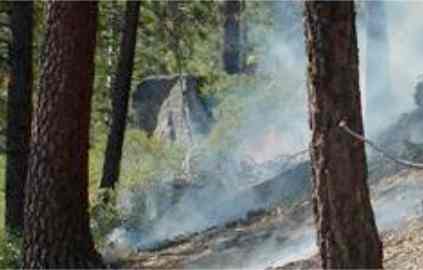
North Lake Tahoe Fire Protection District’s fuels crew will continue the hazardous fuels reduction project in the Galena and Davis Creek through Feb. 26, weather permitting.

This project is a cooperative effort between North Lake Tahoe Fire Protection District, Truckee Meadows Fire Protection District, Washoe County Parks Department and Nevada Division of Forestry. The debris or slash piles were created as a result of a hazardous fuels reduction and defensible space project over the last year, to help minimize the risk of wildland fires in the area.

The project’s safety plan calls for cancellation of the controlled burning based on weather conditions each day, such as significant wind activity or precipitation. The burning piles are expected to produce smoke that may be visible throughout the area. Smoke resulting from the pile burns will affect the surrounding areas for approximately 24 to 36 hours.

People who are smoke sensitive are advised to stay inside and close their windows and doors as much as possible until the smoke dissipates.


Avalanche dogs train with CalStar

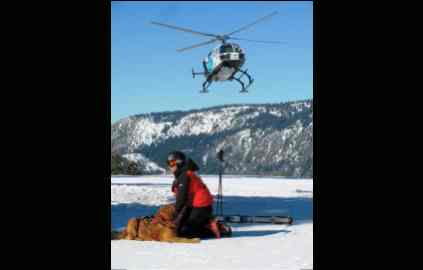
Ski patrollers from Sierra-at-Tahoe and Heavenly Mountain Resort spent part of Wednesday working with CalStar to make sure the rescue dogs are comfortable around the helicopter.

The annual training allows for the avalanche dogs and their handlers to operate around a running helicopter in a safe and practiced environment prior to needing to respond to a real incident.

The dogs and handlers were transported into the Huckleberry area of Sierra to practice search scenarios.

CalStar and Sierra conducted the first Avalanche Dog Days in 2008. It is now an annual event.

Last summer CalStar also had a training with CARDA Dogs (California Rescue Dog Association) as part of its ongoing work with other agencies like El Dorado County Search and Rescue.

Part of the goal is to have dogs be comfortable flying in helicopters to be able to be airlifted to a search site so they aren’t exhausted by the time they hike in and their real work begins.


CalStar works with ski patrol avalanche dogs at Sierra. Photo/Provided