S. Tahoe bike trails to be upgraded

Publisher’s note: This is one of a few stories about construction planned for the Lake Tahoe Basin this summer. On April 16, the South Lake Tahoe City Council will be discussing this summer’s construction plans. The meeting at Lake Tahoe Airport starts at 9am.

By Kathryn Reed

Bike trails in Tahoe are so bad that some routes that were designed for road bikes, now necessitate the use of a mountain bike or are not rideable even when snow is gone in most places.

That is about to change in some locations of the South Shore.

The bridges over Trout Creek and Upper Truckee River will be overhauled this summer. The decking will be replaced with a hardwood material similar to what is on the 15th Street bridge.

The bike trail behind Meek's in South Lake Tahoe will be resurfaced this summer. Photo/LTN file

The bike trail behind Meek’s in South Lake Tahoe will be resurfaced this summer. Photo/LTN file

The city received a $475,000 grant from the state and the recreation joint powers authority allocated $100,000 to be used to repave the trail behind Meeks Lumber in South Lake Tahoe.

“We will be pulverizing the existing bike trail, regrading and paving over,” Jim Marino, capital improvements project manager for the city, told Lake Tahoe News. “It’s a very efficient way to replace the system.”

The affected area goes west from Los Angeles Avenue at Harrison Avenue to the intersection of Third and James streets.

“We want to raise it so it’s not so wet,” Marino said.

Part of this trail is often covered with water well into the spring because of how the trail dips and in some parts parallels a marsh area. Plus, some businesses along the route push their snow onto the trail.

Cyclists and walkers heavily use this plot of asphalt. It keeps people off Highway 50 and in doing so provides a linear east-west link between much of the city limits.

The trail will not be widened to meet current new trail standards. Permitting and coverage issues precluded doing that. What will be done falls into maintenance replacement.

Another low-lying trail that needs substantive work is behind McDonald’s at the Y.

“We are going to have to look at ways to raise it and put a culvert under it. A lot of time in the year it is not useable,” Marino said.

The segment of trail only gets touched this summer if funding is found or other projects come in under bid.

The Bicycle Coalition is looking at installing wayfinding signs for the various trails so people will be able figure out how the trail systems connect, Marino said.

In 2014, the El Dorado to Ski Run trail will be built. This will be paid for from state and federal sources.

“Right now we are 98 percent funded,” Marino said. “We do have to acquire land. We will do that this summer.”

This will be a class one trail on the lake side of Highway 50 going from the Alta Mira Building to Ski Run Boulevard. That building will eventually be the eastern terminus for the Lakeview Commons project. (California Tahoe Conservancy is planning to buy the structure-land to return it to open space-recreation.)

When the Linear Park project begins this summer it will also include repaving of that entire trail.


Day of winter to interrupt spring in Tahoe

Measurable snow is on its way to Lake Tahoe.

Snow levels will start just below 6,000 feet and continue to fall to valley floors throughout Monday and into the evening, according to the National Weather Service in Reno. One to 3 inches are predicted for lake level.

Drivers should be prepared to deal with slick roads for Tuesday morning’s commute.

With the cold front comes a dramatic drop in temperatures. The high Monday will be 40 degrees, 38 on Tuesday. Lows for most of the week will be in the 20s.

By the time Thursday rolls around the high is supposed to be 56 degrees in the basin.

— Lake Tahoe News staff


Winter athletes sound climate change alarm

Jeremy Jones of Truckee takes his cause to the White House. Photo/Protect Our Winters

Jeremy Jones of Truckee takes his cause to the White House. Photo/Protect Our Winters

Warning that “winter is in trouble,” 75 Olympic medalists and other winter sports athletes – including White House “Champion of Change” awardee and pro snowboarder Jeremy Jones of Truckee – sent a letter to President Obama urging him to take action on climate and clean energy.

Jones was in Washington on April 11 with other 11 Champions of Change to be honored as “ordinary Americans doing extraordinary things in their communities to out-innovate, out-educate, and out-build the rest of the world.” Obama created the Champions of Change program as part of his Winning the Future initiative.

Jones was being recognized Thursday for his contribution to raising awareness about the impact of climate change on the winter sports industry by creating Protect Our Winters, a foundation established in 2007 to unite and mobilize the global winter sports community against climate change.

“This nomination is an absolute honor for me and the work we’re doing at POW. But it’s now my responsibility to take this recognition and help secure a place in the climate discussions in Washington. The letter that’s been enthusiastically signed by so many amazing athletes is a strong showing of solidarity from the leaders in snow sports on climate action, so together, we have to keep that momentum going,” Jones said in a statement.

The letter to the president references a December 2012 report published by Protect Our Winters and the Natural Resources Defense Council highlighting the economic impact of inconsistent winters on the U.S. snow sports community and tourism-dependent states.

The athletes’ letter calls on Obama to follow through on the promise he made in the State of the Union address to fight climate change.

“Mr. President, it’s time to force our transition to clean energy, and we need your leadership,” the letter states. “…on behalf of 23 million of us who love winter and depend on it for our economic livelihoods, please take the action on climate change you have promised.”

Julia Mancuso of Squaw Valley and Hannah Teter of South Lake Tahoe were among those who signed the letter.

“Without a doubt, winter is in trouble,” the letter states. “… at risk are the economies of tourist-dependent states where winter tourism generates $12.2 billion in revenue annually, supports 212,000 jobs and $7 billion in salaries. Those are the jobs and businesses owned by our friends and families, generators of billions in federal and state income.”

 — Lake Tahoe News staff report


Tahoe Rim Trail to launch outdoor challenge

The inaugural Tahoe Rim Trail Challenge will officially launch on National Trails Day — June 1.

The Tahoe Rim Trail Association has selected six scenic points on the Tahoe Rim Trail. Participants will hike, bike, snowshoe, ski or ride horseback to each of the destinations and receive invitations to select experiences designed exclusively for Trail Challenge members.

The official kick off is at Van Sickle Bi-State Park in Stateline. The challenge will go through the end of the year.

Registration begins May 15 online.

Cost is $55 for new TRTA members (includes $35 individual annual TRTA membership), $20 for current TRTA members.

All participants will receive an inaugural Trail Challenge T-shirt and access to everything related to the program including exclusive admission to the members-only website where people will track achievements, share pictures as well as access GPS waypoints for the six destinations.


Homewood a contender for environmental award

At the same time Homewood Mountain Resort is being sued by environmental groups because of its proposed development it is a finalist for the National Ski Areas Association’s Golden Eagle award. The award is NSAA’s highest environmental honor and recognizes exemplary environmental performance in the ski resort industry.

Homewood is being recognized for its watershed management and the water-quality monitoring work performed resort-wide.

Homewood has been selected as one of three resorts in the Small Ski Area category — resorts with less than 200,000 skier visits annually. The other finalists are Beaver Valley Ski Club in Canada and Mt. Abram Resort in Maine.

The winner will be announced May 1.

“Homewood’s goal is to build the most environmentally progressive resort in the Lake Tahoe region and set a high bar for the ski industry as a whole. We are honored that the NSAA has acknowledged our efforts with this nomination,” Art Chapman, founder of JMA Ventures, said in a statement. JMA owns the West Shore resort.


Time to help plant sugar pines in Tahoe

The Sugar Pine Foundation is preparing to plant thousands of fungus resistant sugar pines and other native tree seedlings throughout the Lake Tahoe region.

The nonprofit based in South Lake Tahoe is working to save Tahoe’s sugar pines and other white pines from the threat of a non-native, incurable fungus called white pine blister rust.

The spring planting blitz began with a planting at the Lake Tahoe Community College on Wednesday. LTCC instructor Sue Kloss’s Botany students helped to plant more than 300 sugar pine seedlings on the LTCC campus. The students enhanced the woods along the footpath on the hillside above Trout Creek.

On April 27, the foundation will be present at the South Tahoe Earth Day Celebration at the Bijou Community Park from 10am to 4pm. SPF staff will be on hand to sell seedlings – $10 each – and talk about the organization’s work.

The SPF is hosting a community planting on April 28 from 1-3pm at Spooner Lake State Park. Members of the Soroptimist International of Tahoe Sierra will be assisting in the planting, but more volunteers are needed. SPF plans to put more than 500 trees in the ground at this site. The planting is a kid-friendly event and is open to all ages. Seedlings, tools, and instruction will be provided. Volunteers are encouraged to wear boots and sunscreen, and to bring their own gloves, water, and a pointed shovel.

On April 30, the SPF is conducting a special planting at Zephyr Cove Park with employees of the Tahoe Regional Planning Agency. TRPA employees approached the SPF and then raised $1,000 to cover the cost of seedlings. For more information about the organization or to order seeds or seedlings, go online.


Helping rehab wild animals — a joy and honor

By Deborah Thompson

I have been an animal lover all my life. I have always had pets and love wildlife. When my husband and I moved to the North Shore a few years ago, we did so for the environment and activities.

In the Lake Tahoe Basin I feel in my element and am often blessed with wildlife sightings, be it lake, land or air. It was only a matter of time before I became aware of Lake Tahoe Wildlife Care, and the fact that I had just missed their scheduled open house to the public. I literally put on my calendar to check the website the following spring for the next scheduled open house so that I would not miss it.

I immediately signed up to participate in the adventures to come.
ltwcThe training

The training was two full days over a weekend in May. When I arrived the first day, I was impressed with how organized the setup was, how friendly the folks were and the baby birds in the back of the room. As we took seats, Cheryl began her lecture with Tom working the video for visual on the overhead screen. I noticed these were folks who enjoyed what they were doing and were ready to educate and welcome us in.

My attention was locked from the start.

Cheryl lectured from both experience and the heart. She spoke of how she started in wildlife rehabilitation and described a person with interests that were not far from my own. She exhibited such knowledge depth and passion that I felt encouragement and excitement about my decision to attend. Through the day I learned about LTWC’s mission, how to care for the tiny wildlife, regulations around the larger wildlife, how to create a “bird-purse” to carry hatchlings in for the frequent feedings, and how to make mush-mouse. I was hooked.

The second day was on site at the wildlife center. With the various sessions on rabbits, ducks and procedure on wildlife pick up and transportation, I began to understand that I might get more wildlife volunteer opportunities than I thought possible. Everyone I spoke to assured me that, as a trainee, I’d get out of it what I put into it. Any size commitment was mine to give and no size was too small.

I was afraid of mistakes.

The trainers talked of their own mistakes. It was clear that from both mistakes and successes came knowledge depth. The sign-up sheets went around and my name went on them. I signed up for assisting with fundraising booths at local events, I signed up for on-call transportation out of North Shore. I signed up for cleaning shifts at the center. Eagle flight exercise training.

The experience

Two days later I attended the orientation. That was the first step before I could start shifts. This one was hard as there was a not so healthy resident in a cage in the room where part of the orientation was held. Normally this sight would distress me, but what I learned in the previous week was that the center was the right place for this creature to be, and that we were there to help. I already felt part of a team and that I could get past the hard parts, as the good parts outweigh them.

The orientation session was filled with many process details that, as I look back, are now second nature to me. They walked us through the basics from training, how to log our hours and closed the orientation by simply cutting us loose to sign up for shifts.

I did, but was disappointed to find that the first available shift at the center was a week out. No worries, it was great to see folks eager to help. Although my first center shift was a week away, I was also signed up to work the bike race booth that next weekend. So my experience began right away.

Here is some of what I experienced in my first year:

1. Fundraising booth volunteering – Here I learned how much the community appreciates LTWC and all it stands for. I met board members and other volunteers who share the same passion and had great stories to share. I learned of the Kokanee festival – a wonderful treasure right in my back yard.

2. Many, many evening shifts at the wildlife center. While any number of shifts is appreciated, I got so hooked on what I was learning and participating in each time, that I averaged two, sometimes three shifts a week.

a. I cleaned bear cages and learned how to corral wide-eyed cubs from one den to the other for a dinner of fish and fruit.

b. I cleaned bobcat cages and fed bobcats, not once getting grossed out by what they eat.

c. I cleaned raccoon cages, while they washed their marshmallows in their pool and stared at my every move.

d. I helped teach a river otter to swim and be happy again. She was then transferred to another facility with a lone otter in need of a buddy. She, in turn, taught him to swim.

e. I fed a bat, and wanted to tickle his little head as he was so cute in his own way, but Cheryl said no.

f. I fed swallows mealworm “toothpaste”. Probably not as fresh tasting as it sounds, but a very interesting feeding technique.

g. I held a cottontail rabbit and bottle fed it until it fell asleep on my lap.

h. I hand fed stellar jays in the aviary while their buddies swooped my head to get in line for their turn.

i. I watched and assisted Cheryl in a Canada goose wing repair.

j. I observed up close, with instruction, a feeding of a Saw-whet owl mush-mouse. With a frightened and stubborn owl, feeding can be a negotiation process and Cheryl has the skills for success.

k. I bottle fed baby raccoons that like to hold your hair until you put them down. This is cute until they are bigger.

l. With hands-on training from Tom and Cheryl, I tube-fed a red-tailed hawk that refused to eat.

m. I learned a bit about the center’s on-site policy and procedures, helped organize equipment and was entrusted to come back at the end of the season and help winterize the property.

3. Eagle flight exercise – I held a golden eagle in my arms and tossed it for flight to help exercise its wings. I did the same for a bald eagle. There are no words for this so I will leave it at that.

The joy and honor

If the list above doesn’t illustrate the joy in experience while volunteering at Lake Tahoe Wildlife Care, let me summarize in closing with a story about a house guest I was honored to have. In October after the snow season started, a call came into the wildlife center from my neighborhood on the North Shore. A red tailed hawk had hit a window and was down, but alive. Cheryl called me in for action. I went to the house. With my knowledge that I had gained in the past four months, I was able to handle the hawk, assess its condition and report back to Cheryl my findings. She had determined the hawk simply needed a quiet dark place to rest, as it could not be left out if it was not ready to fly, and shake off its dizzy spell.

The roads were wet so I agreed to secure the hawk at my house. It was then when Cheryl stated to me, “You now have the hawk in your possession on behalf of Lake Tahoe Wildlife for care and recovery.” A chill of went up my spine. I felt privileged.

I felt knowledge in something I respect. I felt confident because of the experiences and training I had received so far. The next morning, with Cheryl’s coaching over the phone, I was able to assess if the hawk could fly adequately, and it was sent flying out my garage and high over my neighbor’s house. There was that chill again. Joy and honor.

For anyone who loves wildlife, appreciates the advocacy behind LTWC’s mission, but is not sure if, or how, to get involved, I invite you to contact the center and talk to any of the volunteers, board members or the Millhams directly. Then, register for training and simply begin.

Deborah Thompson lives in Incline Village and has been an active volunteer with Lake Tahoe Wildlife Care since May 2012.

—-

Note:

LTWC’s next training is May 18-19. More info is online.


Sequestration impacts Donner, Truckee area projects

By Sara Schrichte

Donner Summit, like other areas, is seeing some trickle down effects of sequestration. In March, the Balanced Budget and Emergency Deficit Control Act mandated budget reductions totaling $85 billion across the federal government for fiscal year 2013. These mandated cuts, known as sequester, impact a number of federal programs including the Secure Rural Schools legislation.

Under this legislation, counties or the National Forest receive funding in several different titles, including Title II funding which goes to support projects that benefit National Forests; and Title III is slated for fire and emergency service projects.

In order to spend the funds, a Resource Advisory Committee has been established jointly for Nevada and Placer counties. The purpose of the RAC is to recommend funding for projects that benefit National Forest according to the legislation’s requirements.

The Judah Loop trailhead at Lake Mary may not get upgrades because of the federal government. Photo/Provided

The Judah Loop trailhead at Lake Mary may not get upgrades because of the federal government. Photo/Provided

Several Donner Summit projects were granted Title II funds by the RAC, but are now subject to a sequestration mandated 5.1 percent reduction. The Donner Summit Area Association (DSAA) was granted $1.300 for a bear-proof trash container at the Judah Loop trailhead at Lake Mary as part of a local effort to provide restroom and trash facilities to reduce trash and waste on and near the trails.

A portion of the Serene Lakes Property Association’s (SLPOA) $15,000 Donner Summit Fuels Reduction project for 2013-14 was to be funded by Title II funds. The project aims to reduce the threat of wildfire in National Forest service areas and complements the defensible space efforts made by owners of adjacent properties.

This summer’s trail maintenance and reconstruction along the Donner Lake Rim Trail and Summit Lake Trail were to be partially funded by Title II funds via the RAC. The project addresses repair of washed-out erosion control structures, reconstruction of “failing” sections of trail and improvement of drainage and sediment discharge. Included in this project are several Truckee Trail Foundation “Good Dirty Fun” volunteer maintenance projects and the replacement of a trail bridge along a portion of the Donner Lake Rim Trail.

Sugar Bowl Corporation’s Van Norden and South Yuba River Headwaters Enhancement and Forest Health Project began in 2012 and was funded, in part, by Title II funds. The project is designed to enhance the forest ecosystem, restore and improve land health, and restore water quality.

Although carryover funds from previous years can be spent, RAC grantees have been asked to stop spending current Title II funds until the state clarifies what funds will be available. That clarification will likely come before the end of April.

Sara Schrichte is with the Donner Summit Area Association.


Sierra to close with Customer Appreciation Day

On April 15, Sierra-at-Tahoe Resort will give skiers and riders one last chance to shred Sierra with its annual Customer Appreciation Day. Customer Appreciation Day is all about celebrating the season with fun stories of a season gone by.

Skiers and riders of all ages may purchase a lift ticket for $25 on April 15. All of the proceeds raised from the day’s lift ticket sales will be donated to sponsor youth recreation and education including youth baseball, soccer, swimming, and other youth activities.

Sierra Resort will operate a limited number of lifts from 10am-2pm, including Grandview and Easy Rider.

All guests are invited to join John Rice, general manager, and the rest of Sierra Resort’s managing team for the official “last run of the season” from the top of Grandview Express beginning at 2pm. Last call at the Sierra Pub will be at 2:45pm, in time for the ending of all winter operations at 3pm.


Graffiti closes parts of Joshua Tree

By National Parks Traveler

A recent spate of vandalism has prompted Joshua Tree National Park officials to close the Rattlesnake Canyon area to the public for the near term.

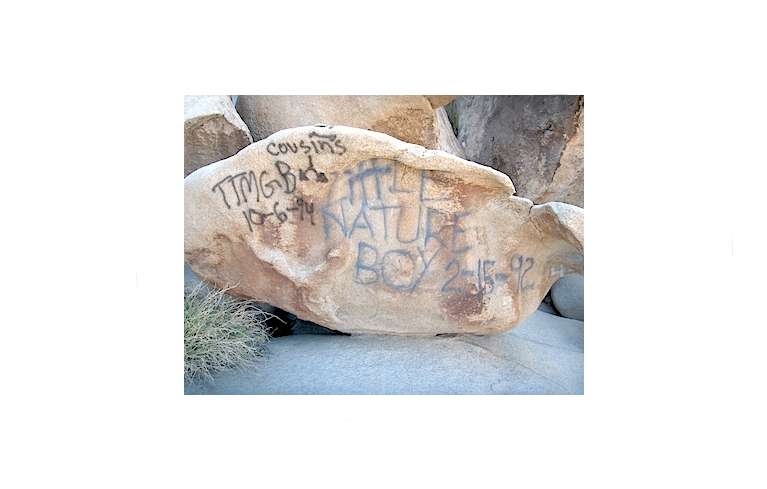
Since January, individuals have defaced the day use and canyon area of Rattlesnake Canyon with graffiti. While this started as a few markings, the use of social media has appeared to spark numerous individuals’ interest in adding to the vandalism of this scenic canyon.

Vandals have forced parts of Joshua Tree to close. Photo/National Parks Traveler

Vandals have forced parts of Joshua Tree to close. Photo/National Parks Traveler

The continued malicious desecration of the national park has now impacted archeological sites, according to park officials. Limits to fiscal and personnel resources restrict the immediate remediation of the area. Therefore, to prevent continued damage to scenic, natural, and cultural resources, the entire day use area of Rattlesnake Canyon from the day use closure gate to the top of the canyon is closed to public entry.

The closure is in effect through midnight April 30 to allow evaluation and restoration of the site. This closure will be reevaluated after April 30.

Last fall there was another episode of vandalism in the park, in an area of Queen Mountain known as “the Underground Chasm.” At the time, park officials discovered approach steps gouged into the rock, some climbing routes appeared to have been “enhanced and overly bolted,” and there were “hundreds of illegally placed bolts, fixed rope, burnt Joshua trees, (and) stashed camping and climbing gear,” an Access Fund release noted at the time.

While park officials could have moved to close the area to climbers, instead they reached out to the Access Fund and Friends of Joshua Tree to help right things at the Underground Chasm. The outcome was that officials decided to 1) Use the incident to educate climbers about proper wilderness ethics; 2) Evaluate the illegally established routes under the park’s permit application protocol; and, 3) Only remove those routes that would not have been granted a permit.

Joshua Tree National Park reminds visitors that they appreciate your assistance in watching for and reporting acts of vandalism or suspicious activity to the nearest park personnel.