Taylor Creek Visitor Center going to the birds

The U.S. Forest Service Lake Tahoe Basin Management Unit and the Tahoe Institute for Natural Science are hosting the fourth annual Lake Tahoe Bird Festival on June 8.

This free family event from 10am-4pm is at the Taylor Creek Visitor Center, located three miles north of South Lake Tahoe on Highway 89.

The event includes guided bird walks along the Rainbow Trail every hour from 10:30am-1:30pm, a bird art contest for all ages, information on migratory birds and spotting scope use, and a presentation by Master Falconer Marie Gaspari Crawford that includes live birds of prey.

Art submissions (photography, sculptures, drawing, paintings, etc.) for the bird art contest may be submitted to Rena Escobedo at rescobedo@fs.fed.us or dropped off before June 4 at the LTBMU office at 35 College Drive, South Lake Tahoe.


Pyramid Lake fishing stories getting bigger

By Nate Schweber, New York Times

PYRAMID LAKE — For most fishermen a 20-pound trout is a trophy, but for Paiute tribe members and fish biologists here the one Matt Ceccarelli caught was a victory.

That Lahontan cutthroat trout he caught last year, a remnant of a strain that is possibly the largest native trout in North America, is the first confirmed catch of a fish that was once believed to have gone extinct. The fish has been the focus of an intense and improbable federal and tribal effort to restore it to its home waters.

“I was in awe,” said Ceccarelli, 32, an engineer from Sparks, of the speckled trout with hues of olive and rose.

Early settlers told stories of Pyramid Lake Lahontan cutthroats that weighed more than 60 pounds, though the official world record was a 41-pounder caught by a Paiute man in 1925. The explorer who discovered this electric-blue oasis in 1844, John Fremont, called them “salmon trout.” Mark Twain raved about their flavor. Clark Gable, the actor, chased them. President Bill Clinton and tribe members called for their restoration.

“When I heard about them I was like, man, I want to see these guys,” said Desmond Mitchell, 40, a fish supervisor for the Pyramid Lake Paiute Tribe.

Lahontan cutthroats, Nevada’s state fish, evolved in the Great Basin, which was flooded under a giant inland sea called Lake Lahontan during the last ice age. Pyramid Lake, which today lies on a Paiute Indian reservation, was part of that ancient lake, and inside its unique inland water system, which includes the Truckee River and Lake Tahoe, a giant strain of trout evolved.

“Our fish have deep meaning for us, spiritually,” said Albert John, executive director of fisheries for the tribe. “And if they could get to 40 pounds again, whoa, that’d be awesome.”

In the late 19th and early 20th centuries, fishermen netted scores of Lahontan cutthroats to feed miners and loggers gnawing at the Sierra Nevada Mountains. But the Truckee River, where the fish spawned, was dammed, and its level dropped as water was taken for irrigation. It was also polluted with chemicals and sawdust. And Lake Tahoe was stocked with a nonnative char called lake trout, which gobble baby cutthroat. By the mid-1940s, all the native trout in Pyramid Lake and Lake Tahoe were dead and the strain was declared extinct.

“They never should have gone in the first place,” said Fred Crosby, 66, owner of Crosby Lodge, the only bar, restaurant, gas station and tackle shop in tiny Sutcliffe, a poor reservation town on the west shore of Pyramid Lake.

In the mid-1970s, the Paiute Tribe opened a fish hatchery in Sutcliffe and stocked Pyramid Lake with strains of Lahontan cutthroat from nearby lakes. The water in Pyramid Lake is saltier than Lake Tahoe, and that kept out the lake trout. The tribe re-established a Lahontan cutthroat sport fishery and saved Pyramid Lake’s endangered Cui-ui sucker from extinction. Anglers bought tribal licenses, hauled ladders out into the lake’s bracing water and considered any catch that weighed 10 pounds or more a trophy.

In the late 1970s, a fish biologist identified what he thought were surviving specimens of the vanished Pyramid Lake strain of Lahontan cutthroat in a small creek near a 10,000-foot mountain on the border of Nevada and Utah called Pilot Peak. A Utah man used buckets to stock the rugged stream with trout in the early 1900s, but made no record, federal biologists say. Geneticists recently compared cutthroats from the Pilot Peak stream with mounts of giant Pyramid Lake trout and discovered an exact DNA match.

“They are the originals,” said Corene Jones, 39, the broodstock coordinator for the Lahontan National Fish Hatchery in Gardnerville.

In 1995, United States Fish and Wildlife Service biologists harvested cutthroat eggs from Pilot Peak and brought them to the Gardnerville hatchery, just a few years before a devastating wildfire scorched the mountain and killed off the creek. In 2006 federal officials, in cooperation with the tribe, began stocking Pyramid Lake with what many now call Pilot Peak cutthroats. They waited to see how the fish might readapt to its ancestral home.

The answer came from ecstatic anglers. Late last year, a Reno man caught and released a 24-pounder. David Hamel, 27, of Reno, just did the same with a pair of 20-pound cutthroats.

“Biggest fish of my life,” he said. “Amazing.”

Since November, dozens of anglers have reported catching Pilot Peak cutthroats weighing 15 pounds or more. Biologists are astounded because inside Pyramid Lake these powerful fish, now adolescents, grew five times as fast as other trout species and are only a third of the way through their expected life span.

Around this arid reservation of burnt sienna mountains and sagebrush tufts, workers from the gas station clerk in the windblown town of Nixon to the bartender who sells fishing licenses in Sutcliffe say they have seen a spike in revenue because of the big fish.

“The lake is basically the bread and butter for the tribe,” said Elwood Lowery, the tribal chairman. The reservation has no casinos because of competition from nearby Reno, he said.

Biologists and Paiute officials are calling the return of Pyramid Lake’s original cutthroats a rare win-win-win for native wildlife restoration, the tribe’s economy and anglers.

“The fish is now telling its own story,” said Lisa Heki, 51, complex manager at the Lahontan National Fish Hatchery. “Along with the fishermen who get to catch them.”


State: Plenty of inmates to fight fires

By KCRA-TV

The state expects to have nearly as many inmates available to help during this year’s firefighting season as it did before a 2-year-old law began sending lower-level felons to county jails instead of state prisons, officials said Wednesday.

Currently, 3,820 inmates are training in the state’s 44 fire camps, said state corrections department spokeswoman Dana Simas.

The Riverside County Board of Supervisors this week approved a five-year contract sending up to 200 of its offenders to the state-run camps as an alternative to keeping them in jail. The contract will cost the county $46 a day per inmate.

That would boost the camp population to more than 4,000 inmate firefighters, about the same as before the law enforcement realignment law took effect in October 2011.

California relies heavily on inmate firefighters to dig fire lines and cut brush to halt the spread of wildfires. In a typical year, the inmates work more than 2.5 million hours fighting fires and responding to floods, earthquakes and other disasters. The state projects that it saves more than $80 million annually over what it would cost to hire employees to do the same work.

But officials had feared the program would be endangered by the state law enacted in response to federal court orders to reduce prison crowding.

The population of California’s 33 adult prisons has dropped by about 25,000 inmates, but Simas said a sufficient number of camp-eligible inmates are still serving lengthy prison sentences that were imposed before the new law took effect.

Moreover, the department re-evaluated its security classifications, so more lower-security offenders are now eligible for the camps. By 2015, a projected 7,000 additional inmates will be at the lower security level required of inmate firefighters. Inmates who are convicted of arson, violent or sexual crimes are ineligible.

The state had more than 4,500 inmate firefighters when the prison population was at its peak in 2006.


LTCC may field intercollegiate soccer teams

Lake Tahoe Community College is putting on a community forum April 30 from 6:30-7:30pm to discuss the possibility of intercollegiate men’s and women’s soccer programs.

The college is researching developing a program in an effort to serve the community’s and students’ interests, and to create a more connected campus and a more vibrant sense of community spirit.

LTCC wants to hear from the community about their thoughts on this potential athletic program, and to answer questions about it.

The meeting will be in the Aspen Room.

For more information about this forum, contact Tim Johnson at (530) 541.4660, ext. 557 or Johnson@ltcc.edu.


Ski resort safety bill passes first hurdle

By Elyce Kirchner, Jeremy Carroll and Kevin Nious, NBC-Bay Area

A bill aimed at improving safety standards at ski resorts moved one step closer toward becoming law on Wednesday. This comes following an NBC Bay Area investigation that exposed numerous safety hazards at resorts across the state.

Senate Bill 564 would require ski areas to prepare an annual safety plan and make the number of accidents and fatalities available to the public.

The bill passed a Senate committee hearing Wednesday by a 6-1 margin.

It would be impossible to mark every obstacle at a ski resort. Photo/LTN file

It would be impossible to mark every obstacle at a ski resort. Photo/LTN file

Snowboarder Brian Kirby testified in support of the new regulations. In 2011, Kirby told NBC Bay Area that he nearly died after falling into an unmarked raven at a ski resort in Big Bear. He said the area has since been boarded up and blocked off to prevent future accidents.

“Why would you let someone enter the death trap before blocking it off,” Kirby told NBC Bay Area. He believes that with more oversight, his accident could have been prevented.

Julie Kozberg knows all too well that accidents like Kirby’s are not uncommon at ski areas. In 2008, Kozberg’s sister Olga Stepakova fell and hit her head on an unmarked bolder while skiing near Lake Tahoe. The 26-year-old was later pronounced brain dead and died at a local hospital.

“There were boulders, three stumps right over the snow that you could never see,” Kozberg remembered. “A couple of days later, we had to bury my sister and life has never been the same. She was the only sister I’ve ever had.”

Kirby and Kozberg hope a new ski safety bill sponsored by state Sen. William Monning, D-Carmel, will prompt resorts to be more transparent about the risks.

“When there are injuries or deaths, that should be a matter of public record,” Monning told NBC Bay Area.

The bill would require ski resorts to prepare an annual safety plan and create a monthly accident report that will be made available to the public.

In February, former ski patroller Dick Penniman showed NBC Bay Area and NBC Los Angeles some of the safety hazards that lurk on the slopes. Penniman pointed out steel cables at neck height, rundown chairlifts, exposed metal poles, and degrading signage among other correctable safety concerns.

President of the California Ski Industry Association, Bob Roberts, says that ski resorts track every incident that happen on the mountain; however, his organization only supports making serious accidents public.

“In Sacramento, with three hearings to go, amendments happen and so our full board will reserve until we get to the end and see what the final document looks like,” Roberts said.

The next hearing will be before the Senate committee on judiciary. Similar ski safety bills have been brought before Govs. Jerry Brown and Arnold Schwarzenegger and were ultimately vetoed. If SB564 manages to pass the state Legislature, it is not expected to reach the governor’s desk until later this fall.


TRTA backcountry camps just for youth

The Tahoe Rim Trail Association is offering a series of summer youth backcountry camps.

They are an opportunity for teens to develop backcountry skills mountains of Lake Tahoe. Youth will be introduced to wilderness survival and first aid; backpacking; maps, gps and compass; backcountry cooking; leave no trace; and more.

Maintaining part of the Tahoe Rim Trail is also part of the activities.

For questions, contact Hayley at (775) 298.0238.


Defensible space even more critical in dry year

By Cathy Locke, Sacramento Bee

CalFire will begin defensible space inspections Monday in Amador County and on the West Slope of El Dorado County.

“Hopefully people have been working on their defensible space this spring as it has been a relatively dry one,” Kelly Keenan, chief of CalFire’s Amador-El Dorado Unit, said in a written statement. “With the strong potential for drought this year, it is critical that everyone get to work today to give their home the best chance of surviving a wildfire.”

Proper defensible space spared this house in the Angora burn area. Photo/Lake Valley Fire

Proper defensible space spared this house in the Angora burn area. Photo/Lake Valley Fire

In an area extending 30 feet from each structure on the property, or to the property line, whichever is closer, fire officials advise people to:

• Remove all dead and dying vegetation.

• Remove leaf litter from the roof and rain gutters.

• Relocate wood piles well away from the home.

• Trim trees so that they are at least 10 feet from the chimney and roof line.

• Remove “ladder fuels”, low-level vegetation that could allow fire to spread from the ground to shrubs and bushes, and to tree canopies.

In the area extending between 30 and 100 feet from structures, or to the property line, officials say the key is to keep plant material separated from each other both horizontally and vertically. This prevents the vegetation from acting like a ladder and allowing fire to move from the ground to tree canopies. Annual grasses should be cut so that they are no more than 4 inches high.

Residents also are advised to:

• Check the chimney to make sure it has an approved spark arrestor, or screen, covering the opening and that it is in good condition. The screen should have openings no smaller than there-eighths of an inch and no larger than a half-inch.

• Keep the area under decks and balconies free of combustible material. Never store firewood under a deck.

• Consider having multiple garden hoses that are long enough to reach any area and any other structure on the property.

For more detailed information, see CalFire’s Ready-Set-Go website  or call (530) 644.2345 to request a free brochure.


Burned bobcat returned to wild

Chips the bobcat, whose rescue by a firefighter from the Chips Fire in Plumas County last August gained national attention, was released back into the wild Friday along with her den mate Sierra.

The juvenile cats are 8 months old.

Their other den mates, Tuffy and Sutter, are being released together in another region.

Chips is back in the wild. Photo/Sierra

Chips is back in the wild. Photo/Sierra Wildlife Rescue

Chips was about 4 weeks old when rescued by U.S. Forest Service firefighter Tad Hair. Chips’ eyes were full of soot and ashes and her paws had second-degree burns.

The bobcat kitten, which weighed about 1.5 pounds, was taken to Lake Tahoe Wildlife Care for intensive medical treatment by veterinarians and rehabbers, and subsequently transferred to a Sierra Wildlife Rescue rehabber in Placerville to continue her recovery.

Early concerns were that she would not become wild enough to be released. However, over many months in the exclusive company of the other bobcats, she became extremely cautious of any human contact, emerging from her den only when no one was in evidence, and grew up eating, playing, wrestling and competing with her den mates, as a proper bobcat kitten should. Along with the others, she became very competent at chasing down her own food (live mice), supplemented with additional nutritious foods she will hunt in the wild.


Bighorn herd re-established in Sierra

By Julie Cart, Los Angeles Times

Sierra Nevada bighorn are a genetically distinct subspecies of bighorn sheep, with the rams tending to grow flared, curling horns.

The newly formed group of Sierra Nevada bighorn sheep barreled up rugged Olancha Peak last month, the 10 females and four males becoming the first new herd of the endangered animals reintroduced in California in 25 years.

Once abundant throughout the region’s alpine areas, the state’s population of Sierra Nevada bighorn had dwindled to two herds by the 1970s. Their numbers have been devastated by disease spread by contact with domestic sheep and goats and unregulated commercial hunting.

The new herd is a success story for the distinct population of Sierra Nevada sheep, which were listed as endangered in 2000. Since 2007, the California Department of Fish and Wildlife has been working to recover the animals by reestablishing herds in areas identified as containing suitable habitat — rugged, steep mountain slopes ranging from 5,000 feet to 14,000 feet in elevation.

The reintroduction program is designed to disperse the animals across a wide area to give them the best chance to thrive.

“When you recover an endangered species you want to restore as much of the historic range as you can,” said Tom Stephenson, a fish and wildlife bighorn recovery program leader.

“You don’t want small isolated populations prone to catastrophe. So our recovery goals are both numeric and geographic.”

The animals’ historic range is now largely protected within five national forests and five national parks, a factor that will provide a buffer and aid in the species’ recovery, Stephenson said.

The new herd was released at the southern end of the Sierra range in Inyo County, officials said.

The animals had already been through a lot, having been captured from two of the largest wild herds in the Sierra Nevada and transported by truck to the release site.

There, they were blindfolded to keep them calm, given a medical check and fitted with a wide leather radio collar.

Once the door slid up on the wooden holding crates, the rams bolted away and the ewes waited a moment before bounding out and scooting up the hillside.

There are now 10 herds of Sierra bighorn between Owens Lake and Mono Lake. The state has plans to establish three additional herds to meet recovery goals for the bighorn, which number about 500, up from a low of about 100 animals.

Sierra Nevada bighorn are a genetically distinct subspecies of bighorn sheep, with the rams tending to grow flared, curling horns. The animals are herbivores and spend their days grazing. Bighorn summer in alpine regions and come down to lower elevations in the fall.

Stephenson said that ideally each pack would contain include 20 to 30 females, meaning that in coming years more animals will be released in the same area.

Also last month, six female sheep were moved to become part of two small northern herds in Convict Creek and Mount Gibbs, according to wildlife officials.


Lake Tahoe Basin lacks policy about beavers

Kathryn Reed

No one is counting the beavers in the Lake Tahoe Basin. No one knows if the population is growing, decreasing or has stayed stagnant through the decades. No one is even managing them.

But anyone who wants to touch the beavers’ habitat or potentially do anything to the water they are building dams in, well, there are plenty of agencies to take your money, delay your desires and bog down the process with paperwork.

While the meeting on April 19 hosted by the Lahontan Water Quality Control Board in South Lake Tahoe was civil, the message was – don’t mess with beaver habitat without first asking. Who to ask, well, that is a bit murky. The overriding response: Start with Lahontan.

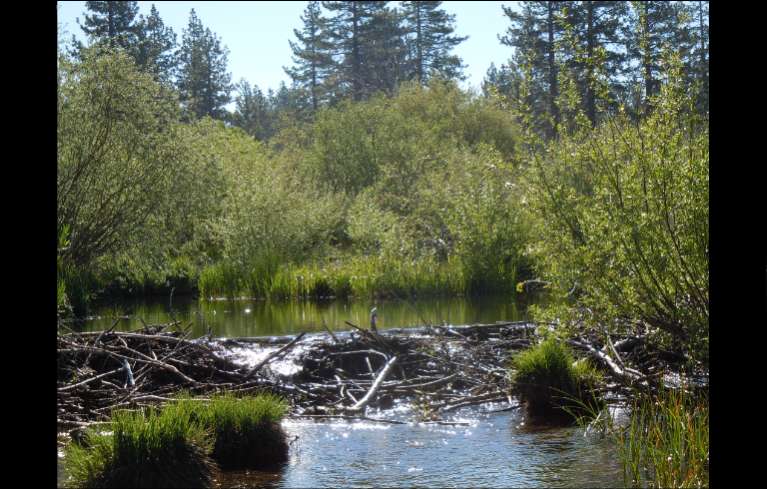
Beavers create dams like this one in Taylor Creek which then prevent the free flow of water. Photo/LTN file

Beavers create dams like this one in Taylor Creek which then prevent the free flow of water. Photo/LTN file

It was also abundantly clear that the officials – U.S. Forest Service, Lahontan, California Department of Fish and Wildlife, Tahoe Regional Planning Agency and U.S. Army Corp of Engineers – are not all on the same page as to what people should do, what the most effective means of dealing with problematic beavers is, and what can be done.

Data about beavers along the Upper Truckee River go back to the 1970s, Sarah Muskopf with the USFS said. But she didn’t provide any of that data.

“Regarding specific policies (for beavers), we don’t have any,” she said.

Muskopf said the Forest Service mostly cares about beavers in terms of public safety and infrastructure.

Sue Novasel, who has lived on the shores of the river for decades, said she has noticed a lot more beaver activity lately.

“I don’t want these beautiful animals harmed. I want more education,” she told the group.

Shelly Blair with Fish and Wildlife said, “We don’t have a formal outreach program.”

The Sierra Wildlife Coalition was in the audience and provided advice the panel didn’t have. Abrasive paint the color of a particular tree can thwart beavers from chewing it down. Sometimes wire-mesh fencing works. Removing dams is a short-term fix. Installing flow devices can get the water moving.

But those devices might require a permit from one or more of the agencies at the meeting – and maybe others.

It was pointed out it’s easier to get a permit to kill a beaver than it is to get a permit to extract a dam or put in a device that would alter the flow of the waterway. Blair with Fish and Wildlife agreed, but said all she can do is follow the law.

Edwin James with the Carson Water Subconservancy District was one of nearly 40 people at the Friday meeting. He lamented that maybe he should not have attended the discussion because now he knows he’s supposed to have a permit to remove a dam.

What he took issue with is that a dam could be discovered one day, needs to be taken out immediately, but permitting could take months. The water he is dealing with is going to farmers and ranchers in the Carson Valley. (Lahontan has jurisdiction there.)

Alan Miller with Lahontan said it’s possible a more general permit could be issued from his agency instead of needing one for each dam. No time line was provided.

Patrick Stone, senior wildlife and fisheries biologist with TRPA, admitted the fastest a permit would be issued is three months, but it’s likely an 18-month process.

The cows would have died of thirst by then, so it’s good cattle don’t graze in the basin any more.

Kris Hansen with the U.S. Army Corps of Engineers said her agency is looking into regional permits regarding beavers, but none would be available this summer.

Several people at the meeting wanted solutions for how to deal with beavers – something other than killing them.

Brendan Ferry with the El Dorado County Department of Transportation said beavers caused problems after his agency restored part of Angora Creek.

“We were forced into killing it. A lot of us in the office didn’t want to go that way. But we felt we had to,” Ferry said.

Blair with the state said relocation is not an option because of “biological reasons.”

TRPA’s Stone said putting a beaver in another habitat would be like dropping one of the people in the room in the middle of China. (This reporter has been to China, did fine, came back to the U.S. healthy, and still doesn’t understand his analogy.)

Stone said there is evidence beavers were native to the basin, were trapped to the point of not existing, and then intentionally re-introduced.