Justin Lichter, aka Trauma, has hiked more 35,000 miles since 2002. He has completed the Appalachian Trail, Pacific Crest Trail, Continental Divide Trail, and the Hayduke Trail.
On May 23 at 7pm he will be in South Lake Tahoe showing slides of his most recent trip to the Himalayas and sharing stories of his adventures.
Lichter is also the author of “Trail Tested” a through-hikers handbook. Copies will be available for purchase by cash or check the evening of the event.
The free talk is co-hosted by Lake of the Sky Outfitters and Tahoe Area Sierra Club.
It will be at Unity at the Lake, 1195 Rufus Allen Blvd. RSVP to (530) 541.1027.
TAMBA raising money to build flow trail
Tahoe Area Mountain Bike Association is looking for donations to build Corral Trail into a flow trail.
The folks with the Salesforce Foundation will be matching all donations up to $15,000.
TAMBA has collected $7,000 to date.
Donate online or mail a check with “Build Corral” in the memo line to: TAMBA, P.O. Box 13712, South Lake Tahoe, CA 96151.
All donations are tax-deductible.
Pinnacle Peak — more than a walk in the desert
By Kathryn Reed
SCOTTSDALE – It’s a bit of a freeway as people zip past us. They are running. Sweat drips. And the sun hasn’t been up long on this last Monday in April.
Hiking in the desert this time of year means getting an early start. Temps are in the triple digits and there are no towering pine trees to provide shade. And even though some of the trail is in the shade, it’s still hot.
My friend Penny lives near Phoenix and makes the decision about our start time. I whine. I don’t do mornings well on a good day and I really don’t relish a 6:15 start while on vacation.
It didn’t take long before I was thanking her. I was hot before 7am. And to think I used to live in Vegas and loved, loved, loved the heat. Not so much anymore. I’m kind of wimpy. (It’s so hot in Scottsdale now that on May 19 the park will open at 5am.)
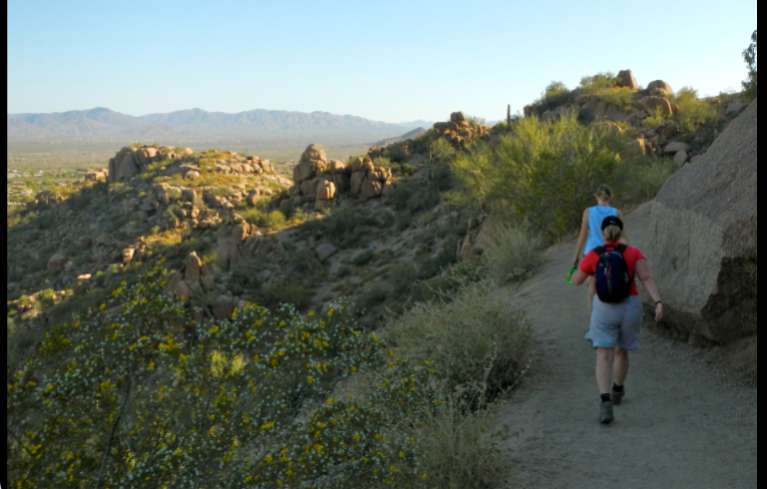
Penny and Sue lead the way hiking Pinnacle Peak. Photos/Kathryn Reed
But the hike was worth it – even with all the people – even with feeling the heat so early in the day.
The 150-acre Pinnacle Peak Park is run by the city of Scottsdale. While the starting point is at 2,570 feet, the low point is actually 2,366 feet. The highest point is 2,889 feet. But with all the up and down of the trail, the elevation gain is about 1,300 feet.
Day hikers never actually reach the summit. Rock climbers with the appropriate gear may access it.
The Sierra Club rates this a moderate hike. If it weren’t for all the stair stepping, it would probably get a lower rating.
It is 3.5 miles out and back.
The trail winds around, providing an expansive view that goes for miles and miles. At the base of the peak are massive houses. Close by are lush golf courses. Farther out are the McDowell Mountains, Four Peaks and Granite Mountain.
One of the great things about the hike is all the signage on the plants. In some ways it’s like being at a botanical garden.
While much of it is cactus; they are all so different. And the blooms are as stunning as the wildflowers found on a Sierra hike – just in a different way.
With all the people on the trail, the critters were hiding. But animals that have been seen along this trek include desert tortoises, rattlesnakes, gila monsters, coyotes, grey foxes, mule deer, javelina, bobcats and mountain lions. It is considered a wildlife sanctuary.
We were fortunate to have seen a javelina earlier on the Troon North Golf Course. Pinnacle Peak is a constant fixture when walking the course. The flowers and variety of cacti and other plants on the golf course are reasons to play a round – or just rent a condo and walk it with a glass of wine after the golfers have all left for the day.
ngg_shortcode_0_placeholder (Click on photos to enlarge.)
Ironman swim change will affect Tahoe event
By Michael Buteau, Bloomberg
World Triathlon Corp., the owner of the sport’s Ironman-branded events, is making changes to the swim portion of select races after an increase in competitor deaths in recent years.
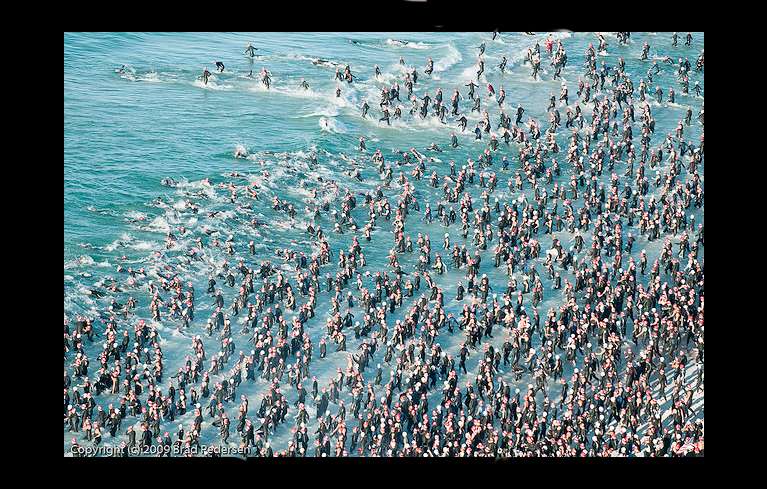
Events in Coeur d’Alene, Idaho; Lake Placid, N.Y.; and Mont-Tremblant, Quebec, will no longer feature a mass swim start format, eliminating a long-standing Ironman tradition. Athletes at those races will either enter the water in a continuous stream through an access point, with their time starting when they cross a timing mat, or in staggered waves based on their age group.
Ironman is making changes to swim starts. Photo/Brad Pederson
The changes come two months after Ross Ehlinger, a 46-year-old man from Austin died during the swim portion of the Escape from Alcatraz Triathlon and nine months after Andy Naylor, a 43-year-old member of the Hong Kong Police Force, died near the conclusion of the 2.4-mile swim portion of the New York City Ironman. In 2011, two competitors died during the swim portion of the Olympic-distance New York City Triathlon.
All North American Ironman events will also include a pre-race, in-water warm-up when possible. In addition, if the water temperature is below 52 degrees or above 88 on race day, the swim portion will be canceled or shortened, World Triathlon said in a statement May 9.
The Coeur d’Alene and Lake Placid races will feature the rolling start process, while Mont-Tremblant will begin in age-group waves entering the water every five minutes.
Events in Lake Tahoe (Sept. 22) and Panama City, Fla., will alter their mass swim start, with seeding into corrals based on the competitor’s estimated swim finish time.
USA Triathlon, the governing body for the sport in the U.S., released a study in October that found 30 of 43 athlete fatalities in triathlons from 2003 through 2011 happened during the swim portion. The study found most triathlon-related deaths were caused by sudden cardiac incidents and that course conditions didn’t play a role.
All swim courses will now include numbered buoys to assist in locating and helping distressed swimmers. Anchored rafts, as well as an increased number of rescue boats, kayaks and in-water personnel, will be included along the courses. Competitors who use the rafts to rest won’t be disqualified, World Triathlon said.
The swim changes will also include educating athletes about reducing anxiety, including pre-race screening for potential health issues, pre-race training and race-week preparation.
Film captures the short life of Shane McConkey
By Mina Hochberg, Outside
When freeskier Shane McConkey of Squaw Valley passed away at age 39 during a ski-BASE accident in 2009, he left behind an inspiring legacy that’s deftly captured in the documentary “McConkey”.
The film leads you through the many phases of McConkey’s career: After an unsuccessful attempt to join the U.S. ski racing team, he forged his own path as a freeskier, then a BASE jumper, then a ski-BASE jumper—all the while documenting his exploits on camera, becoming an adventure film star. Directed by a team of his friends, “McConkey” is as heartfelt as it is gripping. We spoke with two of the directors, Rob Bruce and David Zieff, about the film.
When did the documentary first start coming together?
Bruce: Pretty much the moment he passed away it seemed like a logical thing to do. It seemed like it would be a wonderful living tribute to him, his family—and a great thing for his daughter [Ayla] to have. The fact that Ayla has a film about her father that she can refer to throughout her life is fantastic.
David, what did you know of Shane before doing the film?
Zieff: I didn’t know him and I really didn’t know of him, frankly, beforehand. Little did I realize that I’d come to love him indirectly through the footage and all the stories that everybody told about him.
The cliché, and it’s not such a cliché in his case, is living life to the fullest. He truly did that, but what was almost more attractive to me was the fact that he knew how to laugh with himself. He was self-deprecating and humble and he knew how to enjoy life and not take it too seriously.
It’s been a motivator in my own life, taking each day as a challenge to do more and enjoying myself and living life to the fullest and not taking things so seriously. That, in addition to learning how to ski better by way of footage through a point-of-view camera.
Rob, how far back did you and Shane go?
Bruce: Shane and I knew each other ski racing [as teenagers]. We both quit ski racing at the same time and we both pursued figuring out a way to be professional freeskiers at the same time — him as a skier, me as a cameraman.
More importantly, every day that I was with Shane, regardless of whether we were shooting, or hanging out, or in an airport, was always a great day. And that’s what he really gave all of us. When we were around Shane, everybody was elevated. It was impossible to be having a bad time because nothing got Shane down. If you started whinging, or complaining about having to climb something, or the snow wasn’t good, or that we’ve been in Alaska waiting for shoot day for three weeks, Shane would just laugh at you. He’s like, “Look guys, we’re living our dream, this is part of it.” He was able to overcome fear to have fun no matter what was going on.
Seeing the 80s ski rockumentary “Blizzard of Aahhhs” seemed like a real pivotal moment for Shane. What changed him?
Bruce: Our last ski race was at U.S. Nationals. We were in the lift line and he looks at me and he’s like, “Have you seen that movie “The Blizzard of Aahhhs”? And I looked at him and I was like yeah. He’s like, “Can you f—— believe that? Those guys are doing that? They’re getting paid to do that? We do that when we’re not training. That’s what we do on a powder day when they’re setting the course.”
We were probably supposed to train that afternoon but we went out with his mom and practiced skiing like those guys. So for me and a lot of other people, seeing that film was an example of an alternative way to keep playing in the mountains and possibly getting paid to do it. We were all really good skiers and we felt we could ski like that. We just had to figure out how we could make our own films and find a sponsor and figure out the business of it.
There are so many milestones in his career. How did you decide which ones to highlight?
Bruce: I sort of took the responsibility of tracking things in his life that would be relatable to audiences, so that became a matter of finding the events in his life where he overcame something. Because he was sort of Superman. The sports he was doing and inventing and his interests are not of the mainstream, so that’s not very relatable to a lot of people. What is relatable is having a difficult childhood. What is relatable is having a goal and failing — but then overcoming. That’s ultimately the message of the film.
How many hours of footage did you have altogether? Shane shot a lot of video throughout his life.
Zieff: I estimated it’s probably a thousand hours of footage. So there was a fair amount of work just in labeling and getting through it all.
When people talk about who directed this film, Shane directed it. It started 20 years ago when he was 18 years old with a yellow handycam camera capturing everything.
I wanted to ask about the footage of his fatal accident in the Dolomites. Did you know from the start that you didn’t want to show any of it? Can you talk about editing that?
Zieff: I think all of us knew that was something we would be very respectful about. The footage has been destroyed of the actual accident. I don’t think anybody would want to see that. In fact, I never did. I was given censored footage myself.
I think this is a film about his life, and that’s what matters. Obviously there’s a logistical issue that we’d have to deal with — people need to know something. So we only show the lead-up to it and not the actual moment, out of respect for the family and obviously for Shane’s wife, Sherry, and daughter. That’s not something they need to see. No one really does.
Rob, as someone who knew Shane for so long, was it difficult editing that whole sequence in the Dolomites?
Bruce: Yes, it’s hard. It’s hard for all of us, and it’s hard for audiences that are watching that portion of the film. It’s incredibly sad. So it was a hard film to make in that regards. Every time I see the film I come out a little bit rattled.
Do you guys have any favorite shots from the film?
Bruce: The college sequence I found hugely important because that’s a common time in a lot of people’s lives where people are trying to find themselves. And if you think about making the U.S. Ski Team and getting dropped early, that’s like having a mid-life crisis when you’re 18, 19 years old, right? It’s like, oh, now I have reinvent myself, and I’m in this academic environment and I haven’t really gone to school. There’s not a lot of footage from that period, and I was just so pleased with how it worked out because it shows him overcoming a tough spot.
Did his mother, Glenn, ever express regret that she hadn’t tried to restrain him from becoming a daredevil?
Bruce: She is obviously incredibly sad that her son is gone, but she never held him back. It’s so clear that the mountains and skiing — and eventually skydiving — were the things that he loved so much, and you just can’t ask people to stop doing what they love.
He only lived 40 years, but the way he lived them is so incredible. That’s much better than spending 70 years unhappy and without passion. I’d take the 40 years in a heartbeat.
Time to clean Tahoe’s bike trails
The 2nd annual Tahoe Bike Path Clean Up Day is May 30 from 3-6pm.
Bring water. There will be free waste facility passes for participants, and snacks will be provided at the end of the event. Gloves, trash bags, and brooms will also be provided.
Locations:
South Lake Tahoe — Meet at Sierra Nevada Alliance, 2311 Lake Tahoe Blvd. Clean up sites are behind Red Hut and Meeks Lumber, Motel 6 and Push Fitness.
To register, contact Taylor Fargo at (530) 542.4546 or taylor@sierranevadaalliance.org.
North Lake Tahoe — Meet at UC Davis Field Station (Historic Fish Hatchery), 2400 Lake Forest Road, Tahoe City. Site to be clean is the bike path between the Field Station and Commons Beach.
To register, contact Kelsey Poole at (775) 881.7560 or klpoole@ucdavis.edu.
This is community collaboration among the Sierra Nevada Alliance, Tahoe Regional Planning Agency, UC Davis Tahoe Environmental Research Center, AmeriCorps, Incline Village Waste Not, and Lake Tahoe Bicycle Coalition.
Gardening in Lake Tahoe — it’s possible
By Kathryn Reed
While it can be dicey in the Lake Tahoe Basin to put plants in the ground before Memorial Day weekend, it doesn’t mean there isn’t gardening to be done now.
Carolyn Meiers drove that point home Tuesday night during a talk at the South Lake Tahoe library that was sponsored by Friends of the Library. Meiers, who is a master gardener, knows the soils of Tahoe well from living here for decades and being part of various garden clubs.
“Just because they sell it in Lake Tahoe, don’t assume it will be OK. There are a lot of things you should not be buying,” Meiers said May 7.
She suggests people go to reputable garden centers to talk to experts about plants.
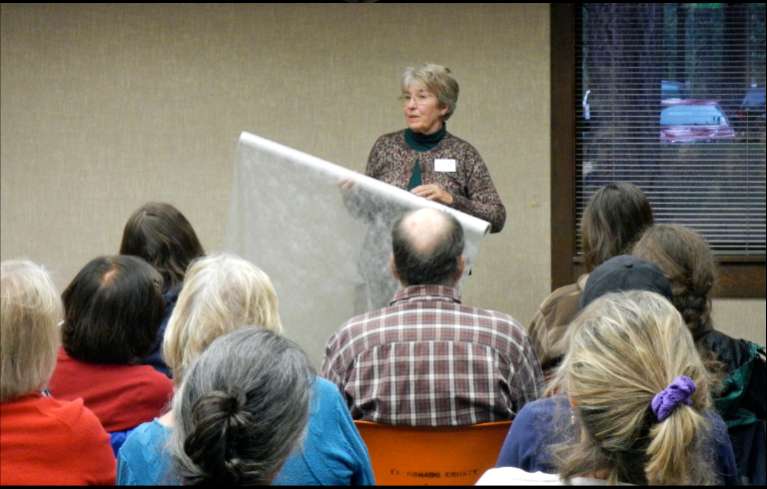
Master gardener Carolyn Meiers says frost cloth will protect plants from freezing. Photo/Kathryn Reed
Reading the information on the tags that come with plants is also critical because they talk about sun and shade, growing season and how tall the plant will become.
While there are rules to follow, Meiers also advocates for just trying something to see how well it does in your yard.
Sun, shade, wind, water, soil – they all play a role in the success of a plant’s life.
“You don’t want to put a $5 plant in a 50-cent hole” is a phrase Meiers said she has borrowed from a fellow gardener. This means making sure the soil is nutrient rich.
“You need to modify the soil. There are all kinds of mulches you can buy,” she said.
Ideally, much of the work on the soil is done in the fall so when spring rolls around it’s perfect for planting.
Now is the time when everything should be raked, weeds dug out and anything that has blown into beds plucked out. Meiers even said people should be picking their daffodils. Some of the nearly 50 in the audience laughed, saying theirs were barely out of the ground and blooms have yet to be seen.
“Be careful how you fertilize. It’s either going in the air or water or on your own body,” Meiers said. “Use the least toxic pest control method. We do have a beautiful lake that we need to protect.”
Critters are something every gardener has to contend with. Rabbits have been growing in numbers on the South Shore in recent years. Meiers talks fondly of climbing roses she once had. Then a beaver “decimated” them. She is left with photographs of them.
A member of the audience suggested using sonar devices that are stuck into the ground to rid a yard of voles. Steer manure compost was another suggestion.
Putting tulip bulbs in nylon stockings stops the squirrels from uprooting them.
There are always daffodils. Squirrels don’t go after them.
A trend in gardening is to have edible plants as landscaping, and not just be part of a vegetable garden.
Even after Memorial Day the basin is susceptible to freezing nights. Meiers recommends using a frost cloth to put over plants on those occasions. She said lots of things could be used – just use something that is not too heavy.
For those who are going to start with seeds, time is ticking because they usually take four to six weeks before needing to be transplanted.
Meiers suggests everyone in the basin have a copy of “Home Landscaping Guide for Lake Tahoe and Vicinity” to use as a resource for gardening.
—-
Note: University of Nevada Cooperative Extension will host its annual Master Gardener Plant Faire and Sale from 7am-2pm May 18 at the Master Gardener Greenhouse, No. 13, 920 Valley Road in Reno. Thousands of certified organically grown plants will be available for sale.
Minn. uses dogs to sniff out zebra mussels
By Jim Adams, Minneapolis Star Tribune
A novel player will show up at the governor’s fishing opener on Saturday in Park Rapids.
But it will be a work day for the new guy.
Brady, a brown Labrador, will be sniffing around boats and trailers, looking for uninvited guests — namely zebra mussels, which have been spreading across Minnesota lakes and rivers. Brady will be joined by his handler, Lt. Julie Siems, a water resource enforcement officer for the Department of Natural Resources.
Brady and two K-9 pals, Digger and Laina, will be deployed in the metro area and outstate for the opener, the first time the DNR has used dogs to detect the invasive species, said Travis Muyres, a DNR enforcement officer.
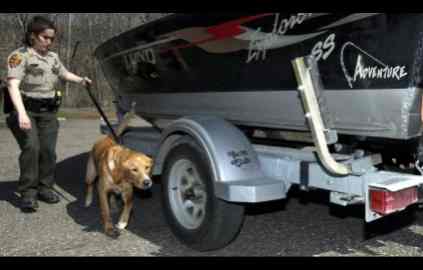
Lt. Julie Siems with the Minnesota Department of Natural Resources has her K-9, Brady, detect zebra mussels. Photo/Joel Koyama/Star Tribune
Minnesota is the second state to use dogs for this purpose, said Muyres. The first was California, which Muyres visited in March to learn how to train the dogs.
The canines were certified this week for mussel detection, making them part of the DNR’s effort to enforce laws banning the transport of the mussels, milfoil and other invasive species between state waterways on boats and trailers, Muyres said.
Digger, a 3-year-old black Lab, displayed his new skills on Tuesday. He and DNR handler Lt. Harry Hanson co-produced a media demonstration at a boat trailer in a parking lot at Fort Snelling State Park. Zebra mussels had been hidden from the nosy dog in the right rear headlight.
As Hanson led Digger, pointing to parts of the boat and trailer, the Lab sniffed and moved on. But when Digger reached the hiding place, he promptly sat down and awaited his reward: a bright yellow ball that he gleefully chomped and slobbered on. “He loves the ball,” Hanson said.
Muyres trained the dogs for five weeks. For the first four, they learned to smell, locate and signal deer meat. In the last week, they learned to locate zebra mussels.
“We brought out the mussels and after four hides, they had it down,” Hanson said.
Brady was obtained for free and Digger for $300, both from animal rescue shelters, Muyres said. Laina, a Belgian Malinois, was purchased from a breeder for $2,500, funds donated by the North Country Bowhunters.
Muyres said the dogs will be trained this summer to detect weapons and ammunition and to track scents to find people, evidence or other objects. The DNR already had two sniffing dogs, one of which will retire soon, and has used canines to sniff out weapons and to track and find illegally taken game and fish since 1995, he said.
Muyres said Laina will be in the metro area for the fishing opener and Digger will be in Alexandria, Minn.
The dogs will help stop invasive aquatic species, but the main responsibility still rests with boaters and fisherman, who must inspect their equipment, Muyres said.
“We have 120 inspectors, three dogs and 23 [hot water] decontamination units,” he said. “But with 10,000 lakes, we can’t do it all.”
Cycling camp a prelude to Death Ride
Riding 129 miles and climbing 15,000-plus feet all in one day demands a rigorous training schedule and Kirkwood’s annual Near Death Experience bike camp can give riders the inside edge they need to complete such a challenging task.
The annual Near Death Experience will take place at Kirkwood Mountain Resort from June 6-9.
The Near Death Experience is a training camp for riders preparing for the Death Ride, the 129-mile bike tour of the California Alps on July 13.
The camp is led by elite coach Robert Panzera from Cycling Camp San Diego. Each day consists of on-the-road coaching focused on climbing, descending, bike fit/position and instruction in pacing, breathing and focus. Also included are evening clinics and seminars, covering topics such as nutrition, altitude, performance drills, quick mechanical fixes, strength and conditioning and more.
Riders will also have a chance to experience all three mountain passes of the Death Ride tour, depending on ability and inclination.
Summer is known as rescue season for many in law enforcement. That is why for the last two months the El Dorado County Sheriff’s Office Search and Rescue team based in South Lake Tahoe has been undergoing basic training in areas involving technical rescue, basic radio communications, land navigation, basic survival, helicopter operations and preparation for rescue responses.
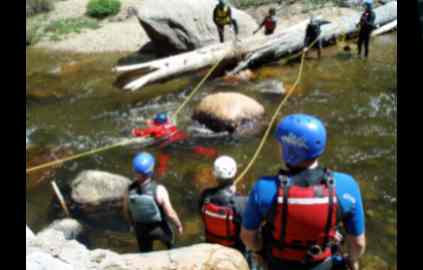
A swift water and water safety training was just conducted. Volunteers learned basic safety around the water, basic recovery methods and technical rope systems used to aid in the recovery of victims in a water environment.
El Dorado County search and rescue prepare for water events. Photo/Provided
Even though temperatures will return to being warm and the rain will go away, it will take longer for the waters in the Lake Tahoe region to warm. This makes it even more imperative to wear a life jacket at all times.
In this last month a team has been organized to specialize in technical rope rescue. This team has been organized to train and have a vast knowledge of rope rescue techniques in order to effectively respond to low and high angle rescue incidents. This team is comprised of members from the El Dorado and Douglas counties sheriff’s offices.
2012 was a busy year for the El Dorado SAR, as they responded to more than 90 calls for service. The trend is continuing, with about 20 calls for this year.
The El Dorado County Sheriff’s Office is accepting applications for volunteers for the search and rescue team. Anyone with a passion for the outdoors and who has experience with hiking and recreating in the backcountry, should contact Deputy Greg Almos at (530) 573.3058 or almosg@edso.org