South Tahoe golf course — oldest in the basin

Bijou Golf Course first opened in the 1920s. Today a mix of locals and tourists play the 9-hole course. Photo/Kathryn Reed

Bijou Golf Course opened in the 1920s. Today a mix of locals and tourists play the 9-hole course. Photo/Kathryn Reed

By Kathryn Reed

While modern golf dates to the Middle Ages in Scotland, Tahoe’s links history isn’t quite 100 years old.

“There were kids around in the neighborhood who would get odd jobs as caddies. I did that. One time I caddied for Max Baer the fighter. He trained in the summertime with Mr. Goldman at Al Tahoe,” Knox Johnson told Lake Tahoe News.

The 88-year-old Johnson grew up on the course, but said he was never much of a golfer. Instead, he and his friends would find errant golf balls. On occasion they’d hit balls on the ninth hole after everyone had gone home.

It was the 1920s when the Bijou Golf Course first opened on land owned by Johnson’s parents – Knox William Johnson and Stella (Van Dyke) Johnson. Virgil Gilcrease of San Leandro leased the land from the Johnsons and operated the course.

Johnson and South Lake Tahoe officials say Bijou is the oldest golf course in the Lake Tahoe Basin. He believes Brockway is the second oldest and Glenbrook third.

“When it first opened there was just sand greens,” Johnson said. “The clubhouse was right where it is now.”

At the time there were living quarters above the clubhouse.

This was at a time when his family was running cattle and owned much of the land in that area. He still owns 5 acres by the clubhouse, including a house his mother had built in the 1940s. It has a view of Freel, including the No. 27 that the snow makes on the peak. “It’s our lucky number,” Johnson said.

The Bijou area was the hub of South Lake Tahoe and the place to be. Most summer nights there was a dance at Bal Bijou – at what is now the CVS drug store.

Johnson, along with his brother, Bill, and sister, Marjorie Springmeyer – who are both still alive – had to raise some money after their mother died. That is when the city of South Lake Tahoe bought the land where the golf course still resides.

Johnson says it was the late 1950s that the city took over the course. The city says it was November 1983.

He said there was talk of extending the course beyond the cemetery – other land that once belonged to the Johnsons – to make it an 18-hole course, but that never materialized. Instead, the 9-hole course remains much the way it did nearly a century ago.

“They used to irrigate it with ditches,” Johnson said. It was after World War II that the first sprinkling system was put in.

“The pipes that they used came from Perkins where steam engines were. This is where they redid the boilers for trains. They salvaged pipe from there,” Johnson explained.

Then it became possible to water the greens and some of the fairways.

In 1991, the city put in a modern irrigation system.

Today, the city continues to operate Bijou Golf Course.


Fishing Derby at Sawmill Pond

The annual Dale Sare Memorial Optimist Club Fishing Derby is June 8 from 8-11am at Sawmill Pond.

Fishing is free to all children up to age 14.

In addition, the Optimist Club will be hosting a free raffle to give children and opportunity to win prizes.

The Optimst club will also be handing out free hotdogs, sodas and chips donated by Raley’s.

Fishing tackle and bait will be provided for anyone who does not have their own. Volunteers will be on hand to clean fish that are caught that day.

The pond is at the corner of Lake Tahoe Boulevard and Sawmill Road in El Dorado County.


Proper seal needed to launch boats at Fallen Leaf

For motorized boats to be launched at the Fallen Leaf Lake marina they must have a Fallen Leaf Lake sealed boat.

If there is no seal, then boats will have to be decontaminated at an approved decontamination station in Meyers, Homewood, or any other approved locations that have seals for Fallen Leaf Lake.

For information, call (530) 544.5323.


It’s all about the water along the Rubicon

By Kathryn Reed

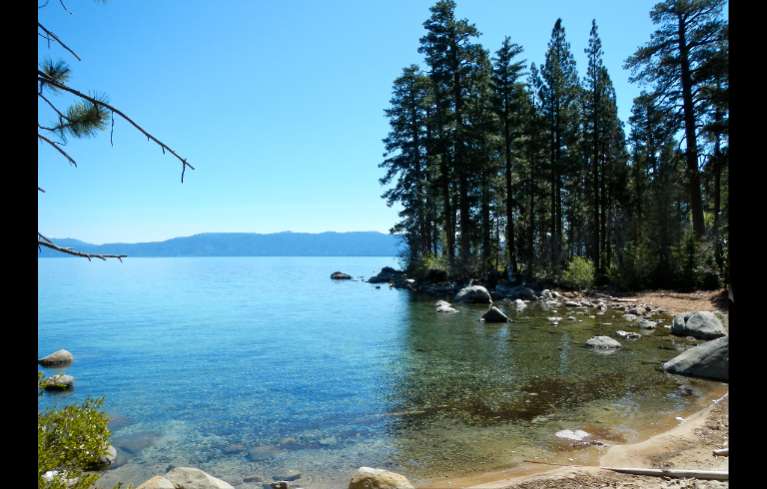
EMERALD BAY STATE PARK – It says something about a trail when the camera still comes out and the oohs and ahhs are endless even after being on it so many times.

That’s the thing about the Rubicon Trail; it never gets old. It connects Emerald Bay State Park to D.L. Bliss State Park.

It’s all about the scenery on what turned out to be a 7.5-mile one-way trek. It’s a mile down from the parking lot at Vikingsholm to the trailhead, then 4.5 miles along the water’s edge. The worst part of the hike was the end. It was an unexpected 2-mile climb from the beach to the Jeep. D.L. Bliss State Park does not open until June 15 (because of budget cutbacks), so right now it’s not possible to park closer.

Still, Sue, Brenda and I would do it all again, just like we have before.

We are still in awe of the endless hues of blue and the depths to which we can see the floor of the lake.

Plenty of photo opportunities along the Rubicon Trail. Photos/Kathryn Reed

Plenty of photo opportunities along the Rubicon Trail. Photos/Kathryn Reed

It’s calm on this particular day. The lake looks inviting, but we don’t even want to dip our toes because we know how cold it is.

A motorboat goes along the shore. Kayakers are in Emerald Bay.

A treat was discovering what we think was an osprey’s nest. Brenda pulled out her binoculars, which showed us there was movement in the nest perched on top of a dead tree.

Only a few yards down the trail and overhead we see an osprey. We guessed she was hunting for her little one.

The odd-looking snow plant is out. Otherwise, not much colorful flora. This hike really is about the water.

It’s a great early season trek, especially in heavy snow years, because it is at lake level. Plus, there are no crowds. On a weekend day in mid-May we saw a handful of other people.

And no one is in the boat-in campground.

It’s not a difficult hike, but there also aren’t a ton of places to take a break. Much of the route is flat, though there are spots with slight undulations.

Closer to the D.L. Bliss side is an offshoot trail to an old lighthouse. We opted to skip it this time. The Rubicon Point Lighthouse is the highest elevation lighthouse in the United States.

—-

Nuts and bolts:

This can be a roundtrip trek starting at either state park or a one-way if a car if left at each park.

It costs to park at each state park. Some free parking can be found near Eagle Falls on the other side of Highway 89.

From South Lake Tahoe, take Highway 89 north, through the hairpin turns, around Emerald Bay and park in the Vikingsholm lot on the right. Go down the paved trail toward the castle. Before reaching the castle, the Rubicon Trail is to the left.

Dogs are not allowed.

ngg_shortcode_0_placeholder (Click on photos to enlarge.)


Celebrities signing on for Tahoe golf tourney

Future Major League Baseball hall of famers Chipper Jones and Iván Rodríguez are the latest to join the field of 80 sports legends and entertainment celebrities at the 24th annual American Century Championship.

The annual celebrity golf tournament at Edgewood Tahoe is July 16-21.

Tournament officials are not following Nike’s lead, which abandoned its affiliation with Livestrong, the charity that Lance Armstrong started. Livestrong will continue to be one of the charities the tournament will support.

Other stars who will be at this year’s tournament are: Michael Jordan, Charles Barkley, Aaron Rodgers, Stephen Curry, John Elway, Bode Miller, Ray Romano, Larry the Cable Guy, Jerry Rice, Brian Urlacher and J.R. Smith.

While Colin Kaepernick was invited, he will not be attending.

Other first-timers at this year’s tournament include former MLB All-Star Tim Wakefield, NFL Hall of Famer John Randle; former NFL Pro-Bowl wide receiver Andre Reed, former NBA All-Star Detlef Schrempf; and blue collar comedians Larry the Cable Guy and Bill Engvall.

Advance tickets are available online. Discount tickets are also being sold at 127 Raley’s, Nob Hill and Bel Air grocery store locations throughout Northern California and Nevada. During the tournament, tickets are available daily at the gate.


Study: Climate change may eliminate 82% of Calif. native fish

By Matt Weiser, Sacramento Bee

Climate change may cause the extinction of 82 percent of California’s native fish species, including iconic ones such as Central Valley salmon and Delta smelt, according to a new study.

The peer-reviewed study by fishery experts at UC Davis created a framework to measure how vulnerable numerous species are to climate change. It assesses habitat conditions, climate change projections and temperature sensitivity for the 121 native and 50 non-native fish species that inhabit California.

It found that 82 percent of the native species are at risk of extinction in the next 100 years, largely because climate change will make water temperatures too warm. For nonnative fish, which are generally more adaptable to warm water, only 19 percent are likely to die off.

A Kokanee swims to its natural death in Taylor Creek. Photos/LTN file

A Kokanee swims to its natural death in Taylor Creek. Photo/LTN file

The top 20 vulnerable native species identified include Delta smelt, Central Valley late-fall run chinook salmon, upper Klamath-Trinity River spring chinook salmon, Clear Lake hitch, Kern River rainbow trout, Central Coast coho salmon and Southern Oregon-Northern California Coast coho salmon.

Peter Moyle, lead author of the study and a UC Davis professor of fish biology, said the mix of cold-water fish species that define California’s aquatic environment are at risk. Decades hence, they could be largely usurped by invasive species such as carp, largemouth bass and green sunfish.

He said some native species could avoid extinction if changes are made to store more cold water behind existing dams and release it at times important to each species.

Also, plans to restore access above large dams for some species, such as salmon, may help. But it remains to be seen if these efforts will help enough fish to preserve entire populations.

“All the climate change projections suggest that water temperatures are going to get significantly warmer as time goes on,” Moyle said. “We’ll be making choices. Either we have these species around for the future, or we don’t.”

Options are much more limited for species such as Delta smelt, which spends its entire life well downstream from dams in the Sacramento-San Joaquin Delta. Cold water releases are unlikely to help so far downstream.

Smelt begin to experience stress when water temperatures exceed 68 degrees, Moyle said, and temperatures above 77 degrees are considered deadly.

“The prognosis for Delta smelt, frankly, is just not very good,” Moyle said. “It’s going to be really stressed.”

Delta smelt, already an endangered species, are at the vortex of a decades-long battle over statewide water supplies. The species is considered an important indicator species for the health of the entire estuary.

Jon Rosenfield, a conservation biologist at The Bay Institute, said the study’s results are not a complete surprise. That is because many of the species at issue, especially salmon and steelhead, are known to be vulnerable to climate change because they live at the southern end of their range, and are more vulnerable to warmer weather as a result.

But Rosenfield called the study “an overwhelming and historic call to action.”

“A misinterpretation that I’d be concerned about is that there’s nothing we can do, therefore we should give up: Build more dams, divert more water, because they’re all going extinct anyway,” he said. “We have the ability, and some would say the mandate, to change what needs to change to save these fish, and all the other resources that go along with them.”

The study is available .


Free fishing day in Nevada

Nevada State Parks is waiving entrance fees and the need for a fishing license on June 8 to encourage kids and families to explore America’s great outdoors.

This is also to recognize National Get Outdoors Day.

State parks with fishing opportunities include:

Washoe Lake, Sand Harbor and the Lake Tahoe backcountry (Spooner and Hobart), Rye Patch, Lahontan, South Fork, Wild Horse, Cave Lake, Spring Valley, Echo Canyon, Beaver Dam and Big Bend of the Colorado.


Wildlife management — an ongoing debate

By Jon Beckmann, National Geographic

In the original poem-turned-song “Home on the Range”, Dr. Brewster Higley affectionately recalled building his Kansas cabin in a place he shared with buffalo, deer, and antelope. Notably absent from his poem are the other species of large mega-fauna that at one time called his region home, including grizzly bears, black bears, wolves, and mountain lions.

Bears in neighborhoods are common in Tahoe. Photo/Judy Brown

Bears in neighborhoods are common in Lake Tahoe. Photo/Judy Brown.

When Higley wrote his popular ballad in the late 1800s, most of these species were gone, and by the early 1900s species such as grizzly bears and wolves were absent from more than 90 percent of their original range. However, over the last 40-50 years large carnivores have slowly begun to reclaim both their range and their numbers in the United States and across North America.

This recovery is a conservation success for these species, but it presents new challenges for people living with them, particularly in many western states.

Since the mid-1990s I have worked in the Lake Tahoe Basin in Nevada. Using historical records, several colleagues and I recently published a paper confirming that black bears were present throughout the state until about 1931, despite the fact that Nevada has not previously been recognized in the historical distribution maps for black bears in North America.

The lack of historical references after 1931 suggests that black bears were extirpated from Nevada’s interior mountain ranges by then. While over-hunting and conflicts with domestic livestock contributed to the bear’s local extinction in the Great Basin, the clear-cutting of forests throughout western and central Nevada for timber used in mining played a key role as well.

Two primary factors have led to bears’ return back to parts of Nevada. First, as fossil fuels replaced timber as a heat and energy source and as forestry and grazing practices evolved, habitat regeneration occurred in the bears’ former range in the Great Basin. Second, an investment in bear-proof garbage cans and dumpsters has lowered mortality rates of bears stemming from conflicts with people.

From the late 1990s to 2008 the Nevada population of black bears grew at an average annual rate of 16 percent. One result is that bears have been deemed fair game for hunters. In fact, the data we collected with the Nevada Department of Wildlife documenting growing bear numbers was the basis for the Nevada Board of Wildlife Commissioners’ decision to approve the state’s first-ever bear hunt in 2011.

The new hunt, which allows the killing of 20 bears in a year, set off a fierce debate in Nevada over how the state wildlife agency would manage recovering populations of large carnivores. Concerns included the role of hunting in management plans and determining which communities in the state were comfortable having recovered bear populations nearby.

All stakeholders – from hunters and ranchers to the larger agricultural community and environmentalists/wildlife preservationists – must determine together how we manage and live with these species. The recovery success of bears in Nevada could inform efforts with grizzlies and wolves in places like Idaho, Wyoming, and Montana – or mountain lions as they begin to recover in the Dakotas, Nebraska, and perhaps even Higley’s home state of Kansas.

A complete hunting ban on grizzly bears and wolves, both no longer protected under the U.S. Endangered Species Act due to population recovery, is doomed to fail and disenfranchises hunters, who have contributed much to conservation during the last century. More useful is finding a consensus on the number and distribution of large carnivores we hope to sustain.

Hunting regulations can then be formulated and adjusted to reach mutually recognized goals. Communities will need to grapple with how to live with big predators rather than simply whether or not to hunt them. Clear definitions will likely be needed of where large carnivores should never occur in a given landscape, something that has been poorly done if at all previously.

Hunting of large carnivores must be done under sound monitoring, not simply to remove animals that kill big game species or livestock. If done sustainably, we need not fear that these predators will slide back onto threatened species lists. And as they begin to recover, it will be up to each community and state to decide whether their songs and poems will express longing for a home where, like deer and antelope, bears get their chance to play.

Jon Beckmann is a Conservation Scientist for the Wildlife Conservation Society’s North America Program.


Tahoe National Forest implements fire restrictions

Effective June 1, residential burn permits will be suspended for Nevada, Placer and Yuba counties and fire restrictions will go into effect in the Tahoe National Forest.

Despite the recent light rain, conditions in the foothills and the high country remain unseasonably dry. Warming temperatures, dry winds, and very dry fuel moisture levels have prompted this early fire season response.

Anyone who burns in violation of the suspension will be subject to civil or criminal action and could face cost recovery charges for the fire suppression response. All fires or smoke reported will be considered a wildfire and a full suppression response will be dispatched to the scene.

In the Tahoe National Forest beginning June 1 campfires are not permitted in the backcountry, but only in developed campgrounds and other designated sites (in the metal rings/grills provided). Portable stoves, including those that use gas, jellied petroleum or pressurized liquid fuel are permitted in backcountry areas with a valid campfire permit. Propane-type barbecues can be used outside designated sites where camping is permitted, but charcoal barbecues can only be used in designated campgrounds. Smoking is only permitted in an enclosed vehicle or developed recreation site.

Internal combustion engines, including off highway vehicles can continue to be operated on roads or motorized trails and within the Prosser Pits OHV area.


Caution urged for cyclists, motorists in work zones

Caltrans is reminding motorists to be aware of increased bicyclist activity in the Lake Tahoe region during Bike Month in June.

Motorists need to share the road with bicyclists on roadways where there are no designated bike lanes. Bicyclists also need to take precautions when traveling through construction areas.

Caltrans offers the following reminders:

· Do not ride into the cone pattern, which is the contractor work zone, whether you see the contractor working there or not. There may be hazards in the cone pattern that are not readily apparent to the cyclist, such as drop-offs, trenches, excavations, ground-out rough surfaces, tack coats put down prior to paving, hot asphalt surfacing, or moving equipment, materials or personnel. If you are involved in an accident in the work zone, the authorities may find you in violation of provisions of the California Vehicle Code for entering a contractor work area.

· This means that you may need to ride in a narrowed lane with motorized vehicles to pass by the cone zone. If you are uncomfortable doing so, you may need to find an alternate route on city streets or county roads to bypass the cone zone.

· If you are riding in the traffic lane next to the cone zone and workers are near the cones performing operations, you may want to announce yourself by saying something like “bike” so that contractor workers know you are passing by. Cyclists normally ride much closer to the cone pattern than motorized vehicles and workers are used to having some additional buffer space over the cone where they may swing a tool or a rake or similar.

The 22nd annual America’s Most Beautiful Bike Ride takes place June 2, and the Tahoe Bike Challenge, which encourages bike riding rather than driving, is June 1-14.

Sunday’s bike event, which is sold out, will take riders on portions highway 50, 89 and 28 around Lake Tahoe. Signs will be posted alerting motorists of the event. Highway 89 will be closed from Spring Creek Road to Vikingsholm Vista Point in Emerald Bay from 6:30 to 8:30am on Sunday for the event.

For more information on the bike challenge, go online.