The importance of youth snow safety education

By Jack Foersterling, Powder
 
Every year, our sport progresses as new ski and binding technologies emerge to enable us to go bigger and faster, while new lifts bring us to higher peaks and steeper terrain. But with these rapid advancements in technology, one thing remains constant. Skiing is, and always will be, an inherently dangerous activity to take part in.

That’s why, over the last decade, there has been an increased emphasis on education and safety within the ski industry. For many, this can be seen in the increasing number of adult skiers getting their Level 1 avalanche safety certification or taking other various safety courses. Others, however, are looking to take on the issue from the ground up, focusing their attention on an often overlooked demographic of the ski population–the youth.

“The biggest risk today is that there are so many amazingly talented kids going out there with little to no snow education,” said Chris Anthony, a professional skier and the founder of a nonprofit, Chris Anthony Youth Initiative Project, that focuses on the younger generation of skiers.

Read the whole story


Truckee cross country skier an Olympic hopeful

By Giuliana Rende

TRUCKEE — When asking homeowners and visitors what they love most about Tahoe Donner, one might expect them to start with praises for the majestic scenery, the convenient accessibility and the huge array of activities and programs. Yet, what you’re more likely to hear from both long- and short-term residents is that it’s the people. The personal connections. The chance to unplug from their devices, and swap their online “communities” for a real-life community, taking place in real-time, with real people.

Tahoe Donner residents are bonded together under one powerful passion – love for the outdoors. And no one understands the strength of this community and its bond better than Hannah Halvorsen.

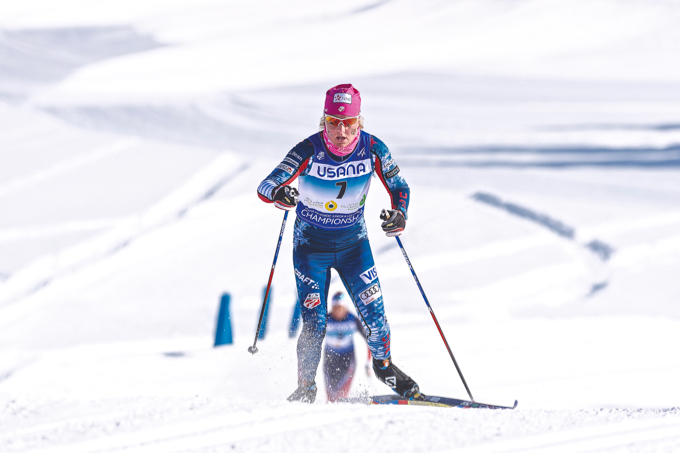
Born and raised in Tahoe Donner, Hannah Halvorsen is a 19-year-old cross country skier on the U.S. Ski Team. She’s a member of the 2017 World Junior Championships bronze medal-winning relay team, and has her sights determinedly set on representing the U.S. at the 2018 Olympic Games in PyeongChang, South Korea.

When talking with Halvorsen, it quickly becomes clear that she credits Tahoe Donner’s warm community and world-class programs as integral parts in helping her get where she is today, and reaching her goals for the future.

Hannah Halvorsen of Truckee is a contender for the 2018 Winter Olympics. Photo/Provided

Where it all began

“My first introduction to cross country skiing was being pulled in the back of a sled by my parents at the Tahoe Donner Cross Country Center,” Halvorsen says. Her successful career began not only on the cross country trails here, but also in the many places and programs throughout the community.

A big smile overtakes her face when she talks about getting up, snow or shine, every weekend for a family ski, hitting the trails not only with her parents and brothers, but also with the other kids and families in the community.

Halvorsen also talks fondly about her elementary school memories of attending the cross country after-school ski program, crediting it as a vital part of her development as a junior skier.

“The weekend family ski became constant, as did the people we ran into. The same people were always out there to a level of consistency that if we didn’t run into Mark Nadell we would ask him the following week where he was last Saturday,” Halvorsen said.

It was there that she began to form life-long bonds with other skiers who were also becoming passionate about skiing.

Hannah Halvorsen and her teammates celebrate their bronze medal at the 2017 World Junior Championships. Photo/Provided

Passion grows, talents flourish

Halvorsen continued her development as a competitive ski racer throughout middle and high school, spending countless hours training on and off the snow. She worked tirelessly, honing her cross country skills and her fitness levels to become a serious competitor on the international stage. According to Halvorsen, it was during this time that she quickly realized the rare and valuable opportunity she had to be training at one of the world’s premier Nordic ski training centers.

“Older teammates of mine who had traveled the world for racing would confidently name Tahoe Donner as the most spectacular place to cross-country ski. We could go for hours without repeating a single trail,” Halvorsen said.

She recalls hitting the trails daily, often twice per day, for hours at a time. Her common routine was to start at the break of dawn doing hard intervals to Hawk’s Peak before school, and then back to the trails after school, often training past sundown. In fact, Halvorsen estimates that she probably did several hundred evening recovery jogs around Lion’s Leap.

From junior racer to Olympic hopeful

Throughout high school, Halvorsen continued to develop as a ski racer, and began reaching goals that proved she was on track toward realizing her Olympic dreams. In her sophomore year she qualified to represent the U.S. in Finland at the Under-18 Nations Cup, and in her junior year she competed in Sweden and Norway. In her senior year, Halvorsen qualified for and competed in the Youth Olympic Games in Lillehammer.

After graduating high school in 2016, Hannah was nominated to the U.S. Development Ski Team. She and her relay team went on to compete at the World Junior Championships in Park City, Utah, where they earned the first U.S. bronze medal in the event’s history.

Just this past June, Halvorsen moved to Anchorage to join the Alaska Pacific University Ski Team and enroll as a psychology major. As much as she loves her amazing new surroundings, she is already eagerly anticipating her visits back to Truckee.

Support Halvorsen

Although Halvorsen is now a member of the U.S. Ski Team, her ski training and travel are not fully funded. Halvorsen and her family are working to raise funds, and hoping that the Tahoe community can help. To donate, go online.


Dense blob has kept California weather dry

By Dale Kasler And Ryan Sabalow, Sacramento Bee

Think of it as a dense blob of air. When it parks itself over the Pacific Ocean, it can act like a wall – and prevent rain and snow from reaching Northern California.

When meteorologists say a “high pressure system” or a “ridiculously resilient ridge” is keeping the West unseasonably dry, this is what they mean.

A series of persistent high pressure systems over the Pacific factored heavily in the five-year drought that ended last spring. The latest high pressure system produced one of California’s driest Decembers on record, left the Sierra Nevada snowpack woefully thin and raised fears of a drier-than-average winter. Although the system appears to be fizzling out, allowing some precipitation to hit California this week and next, the outlook for the rest of winter remains uncertain.

Climatologists say California is essentially at the mercy of high pressure systems.

Read the whole story


Landscape, fire vegetation grants available in Nev.

The Nevada Division of Forestry is soliciting pre-proposals for two competitive grant program areas – landscape scale restoration and state fire assistance.

Nevada’s urban and rural ecosystems are continuously threatened by invasions of non-native species, vegetation diseases, development disturbances, unsustainable management, and destructive natural events such as floods and wildfires.

This funding opportunity is made available through the USDA Forest Service, which enables cooperators to identify needs and apply for funding. Funds may be used to implement restoration treatments that improve or restore urban/rural forests, rangelands, water resources, riparian areas, and wildlife habitat. Projects that mitigate extreme wildfire behavior, noxious weed infestations, and negative ecosystem impacts are also eligible.

For more information on landscape scale restoration grants, contact Heather Giger at 775.684.2552 or hdgiger@forestry.nv.gov. For more information on hazardous fuels grants, contact Ryan Shane at 775.684.2511 or rshane@forestry.nv.gov.


Where do those snowfall totals come from?

By Bill Syrett, The Conversation

The Blue Hill Observatory, a few miles south of Boston, recorded the deepest snow cover in its 130-year history a couple of years ago, an incredible 46 inches. In February 2015, Bangor, Maine tied its record for deepest snow at 53 inches. Mountainous locations will sometimes see triple-digit snow depths.

Impressive numbers for sure, but assuming you have a measuring stick long enough to reach the ground beneath all the white, really, how hard can it be to measure? You stick a ruler or yardstick into the snow and get a number, right? Well, not so fast. It’s a little more complicated than you might think to get those oh-so-important snow totals for winter storms.

Since 1890, the National Weather Service has relied on a network of volunteer observers, all strictly adhering to the NWS guidelines, to come up with snow measurement numbers over a region. There are over 8,700 cooperative observers across the country who send in their weather data to the NWS daily, some who have done it for over 75 years!

Snow measurement is inherently inexact, but attention to one’s surroundings and sticking to the guidelines help those of us who do it on a regular basis stay consistent – and with long-term weather records, consistency is arguably just as important as accuracy.

First, we do need to differentiate between snow depth and snow fall.

How deep is your snow

Snow depth should be a measure of the average depth in a given location and its immediate surroundings. It’s usually rounded to the nearest whole number. To get a representative number, you need a site with minimal drifting (not always easy to find) and several measurements should be averaged to get a final number. I like 10 because it makes the math easy.

Careful measurement is vital so we can make reasonable estimates for the amount of liquid contained in the snowpack. As hard as it is to believe at times, the snow will eventually melt, and rapid melting could cause problems with flooding. Also, hydrologists’ models to predict water levels critically depend upon good initial data collection (though improved satellite data has helped reduce their reliance on any individual measurement).

Snow depth is like the sum of individual snowfalls, if one assumes no sublimation – snow turning into water vapor – or melting from the first snowfall until the present day. That assumption would almost always be wrong, of course, but if we suspend reality for a moment, the depth will still never exceed the sum of all snowfalls because snow is compressible. So, two 10.5-inch snowfalls may only accumulate to a depth of 17 inches. It’s the compressibility of snow that causes the greatest consternation and controversy with snowfall measurement.

How much snow did a storm bring

Snowfall is the amount of snow that accumulates during a given time, usually a 24-hour period. In a perfect world this 24-hour period would end at midnight, but the vast majority of National Weather Service cooperative observers take their daily observation in the morning.

To properly measure snowfall, you need a level and flat surface. As with snow depth, measuring snowfall should be unaffected by drifting. The National Weather Service suggests the use of a snowboard, which is a white surface that will absorb very little sunlight and stay close to the ambient air temperature, but any “cold” surface will do. Keeping in mind that consistency is critical, the goal here is to make a measurement that is representative of the surrounding area and consistent with others making snowfall measurements.

More complicated cases…

So, let’s consider three common scenarios. Here in the East, we often have to deal with snow that changes to rain during the course of a storm. Imagine 6.0 inches of snow falls, then an inch of sleet which compacts the snow to a 4-inch depth. Then, on top of that we have an inch of freezing rain which further compacts the snow to 2.6-inch depth by the end of the observation period. What should be listed as the daily snowfall? The snow depth?

In this situation, when the snow transitions to sleet, the snowboard should be cleared and the maximum depth of snow recorded, which is 6 inches in this case. Do the same with the sleet and this will add an inch to the snowfall (technically, “solid precipitation”) total. Freezing rain is never added to the daily snowfall total because it is in liquid form when it reaches the ground. Thus, the daily snowfall is 7.0 inches (measured to the nearest tenth of an inch) while the snow depth at observation is rounded to 3 inches.

In the case where, say, three heavy snow showers occur one afternoon, each dumping 1.5 inches before melting completely, the daily snowfall would be 4.5 inches with an observed depth of zero at the daily observation time. This assumes an observer is there to measure each short-lived accumulation. But because most observers are volunteers that’s not always the case, unfortunately.

 Finally, we come to the controversy. Let’s assume a steady snow falls for the entire 24-hour period at a rate of 2.0 inches per hour. If the snow board were cleared every hour, the daily snowfall would be 48.0 inches. But what if the observer could only be there at the daily observation time? By then the snow will have compacted some, depending upon the temperature and the amount of liquid in the snow, which can vary between about a quarter inch and three inches of liquid water for every 10″ of snow.

This observer would log significantly less snowfall – for the exact same event – than the person who cleared the board every hour. This is a problem. The National Weather Service addresses it by mandating that no more than four snowfall measurements should be made in any 24-hour period. Ideally then, an observer who went to the snowboard every six hours and cleared 10.5 inches, 9.3 inches, 11.5 inches and 10.8 inches would get the officially correct snowfall measurement of 42.1 inches.

Several years ago, an observer in New York measured 77.0 inches of snow in a 24-hour period, which would have broken the record for heaviest one-day snowfall in U.S. history. However, it was determined that he cleared the snowboard much too frequently, thus inflating the daily total and invalidating the record.

Intrigue, suspense, mystery, controversy! So much more than just sticking a ruler in the snow. If it all sounds like a daily dose of meteorological fun to you, maybe you’ve got what it takes to volunteer for the NWS’s Cooperative Observer program, where it’s not all about the white stuff. Daily high and low temperatures and precipitation of all forms are also measured, to strict NWS standards, of course.

Bill Syrett is a senior lecturer in meteorology and manager of the Joel N. Myers Weather Center, Pennsylvania State University.



Wild horse advocates urge Nev. to undo giveaway plan

By Benjamin Spillman, Reno Gazette-Journal

Wild horse advocates want Nevada to reverse a decision they say puts free range horses between Reno and Carson City in grave danger.

More than a dozen gathered in front of the state capitol building Wednesday to call on Gov. Brian Sandoval to intervene. 

Protestors want the state to reverse a decision by the Nevada Board of Agriculture to relinquish ownership of an estimated 3,000 horses roaming the Virginia Range.

Read the whole story


Truckee’s Engel matches career best in slalom

By U.S. Ski & Snowboard

Mark Engel of Truckee matched a career-best FIS Ski World Cup slalom result in 24th on a soft, grooved and punchy course under the lights in the capital of Croatia on Thursday night. But most important, he maintained a World Cup start position for the United States.

Austria’s Marcel Hirscher came from behind in the second run to snatch victory away from his teammate Michael Matt, who finished second. Norway’s Henrik Kristoffersen was third.

For Engel, finishing was not only important from a team standpoint, but from a vindication standpoint too. Last year on the same course he finished third in the first run, only to crash spectacularly near the finish of the second run.

“I felt the pressure to finish here today because our team is going to run out of World Cup spots unless we make up some points,” said Engel, who almost repeated last year’s incident near the finish of Thursday’s first run.

“I’m so happy I made it through,” he said after his first run. “I had really tired legs down here and I got a little back seat, but managed to pull it off.”

In the second run, Engel attacked the course. Following the flat middle section, he charged the bottom with a smile on his face. “I’m really happy that my best split was down the last pitch, which has troubled me before,” he added.


Outdoors: 7 things to watch for in 2018

By Benjamin Spillman, Reno Gazette-Journal

It’s a new year and by now, hopefully, you’ve ushered the relatives out the door and taken down the holiday décor.

Now it’s time to look ahead to 2018 and think about things to come.

We’re not in the prediction business because, as anyone who lived through 2016 and 2017 can tell you, predicting things is rough business.

But we can take a look at the landscape and anticipate what will be hot outdoors and environment issues in 2018 and explain why they’re important to all of us.

Read the whole story


EDC has money for seniors to remove dead trees

Funding is still available for eligible seniors living in high hazard areas specific to tree mortality, including South Lake Tahoe, Camino, Pollock Pines, Somerset, Garden Valley, Greenwood and Georgetown.

Applicants for the Hazardous Tree Removal Program must be 60 or older, own the property on which they reside and have incomes at or below 60 percent of the county’s area median income. Dead and dying trees must be greater than 10 inches in diameter and 20 feet in height; must be within 300 feet of, and pose a structural threat to, the residence; and must also be reasonably accessible by equipment or machinery.

Funding for the program comes from a CalFire and State Responsibility Area Fire Prevention Fund (SRAFPF), and Tree Mortality Grant. El Dorado County received approximately $200,000 to help senior citizens, remove dead and dying trees that endanger their residence.

Homeowners must complete an application packet. Completed applications will be accepted on a first-come, first-served basis. For more information, call 530.621.5159.


Controlled burns planned for North Shore

Weather permitting, the Tahoe Fire and Fuels Team may conduct prescribed fire operations this week on the north end of Lake Tahoe. 

Smoke may be present. To receive prescribed fire notifications, send an email to pa_ltbmu@fs.fed.us. 

When weather and conditions allow, prescribed fire operations are conducted to reduce overgrown vegetation, which helps decrease the severity of future wildland fires, protects communities, reduces the risk of insect and disease outbreaks in our forests, recycles nutrients that increases soil productivity and improves wildlife habitat. 

The TFFT coordinates closely with local county and state air pollution control districts and monitor weather conditions carefully prior to prescribed fire ignitions. 

Before prescribed fire operations are conducted, the TFFT posts road signs around areas affected by prescribed fire, sends email notifications and updates the local fire information line at 530.543.2816.