Boating safety class in South Tahoe

There will be a six-lesson, eight-hour course on boating safety developed by the U.S. Coast Guard on July 13.

The instructors will teach boating safety to adults and youths (grades 6-12). A basic course will provide information on a variety of subjects of importance to anyone using a boat.

The 8:30am-5pm class will be at the Tahoe Keys Homeowners Pavilion, 56 Ali Wai Blvd., South Lake Tahoe.

The cost is $15.

For more info, call (530) 541.4654.


Erosion project to affect Bijou golf course

Bijou Municipal Golf Course will be affected by the massive erosion control project in that section of South Lake Tahoe.

Holes 6, 7 and 8 will be closed from July 15-26. No more than two holes will be closed at one time.

The project is designed to reduce sediment flowing into Lake Tahoe.

Project plans may be reviewed at the city office at 1052 Tata Lane.


Hiking with kids — its about fun, not distance

By Mary Meehan, Lexington Herald-Leader

Author Jeff Alt didn’t have to look far for inspiration for his book about hiking with children. He has two kids and started hiking with daughter Madison, 8, “right out of the gate.” Son William, 5, also takes to the trail.

His hiking philosophy? If you start hiking with kids in a carrier when they are little, they will be more than ready to take to the trails on their own two feet as they grow older.

Alt’s new book is “Get Your Kids Hiking: How to Start Them Young and Keep It Fun” (Beaufort Books Inc., $13.95).

Alt is a member of the Outdoor Writers Association of America. He has walked the Appalachian Trail, has hiked the John Muir Trail with his wife, and he carried his daughter, when she was 21 months old, across a path in Ireland.

He wrote the book “because we as a nation have become lazy. Everything is at our fingertips now.”

Life is so fast-paced and programmed, he said, that even kids get into a dull routine: school, home, school, home. They are not exposed to the sensory experiences that come with being out in nature. He said he hopes the book will help encourage families to get off the couch and hit the trail.

The key to hiking with kids, he said, is letting them be the leaders. And, he said, parents need to focus on the experience — the butterflies on the trail, the mud on their shoes, the sounds of the forest. “That helps them engage in the outdoors. They can touch, feel and just see, learn and discover.”

Distance is not a priority, he said.

“I let the child lead. If they stop, I stop,” he said. “The child is showing me what they are interested in. You may only get a half a mile into the forest, but they are going to have so much fun they will want to do it again.”

Alt, a speech pathologist, laid out the tips in his book to match the developmental stages of children. Hiking with elementary school-age children is different from hiking with teenagers.

He admits that getting teens to disconnect from their digital world to take a hike can be a challenge.

“With teenagers, you kind of have to intrigue them,” Alt said. One way, he said, is to invite them to bring a friend along.

The right equipment is important, too, he said, no matter the age of the child. Food, water, a backpack and proper shoes are the basics.

There is another advantage to being on the trail and away from things, he said. It’s a great time to talk to your kids.

“You can talk to them about some life lesson or ask them how they are feeling just before the go off to college.”


Parasailing camp for teens

Through South Lake Tahoe’s STAR camp teens can learn to parasail Aug. 5-7.

Preregistration is required. Space is limited. Campers will parasail over Lake Tahoe.

Bring swim stuff, sunscreen, tennis shoes, lunch, and a water bottle.

Cost is $200.

For more info, call (530) 542.6056 or email Jen Menzel at jmenzel@cityofslt.us.


Uneducated boaters a danger on Calif. waters

By Elyce Kirchner, Kevin Nious and Felipe Escamilla, NBC-Bay Area

In California, boat operators can be as young as 12 years old, have no boater education, no license, and still be legally allowed to operate a boat.

The NBC Bay Area Investigative Unit has also discovered the Golden State is the second worst in the nation in number of boating accidents. And, within the state, the 1,000-mile stretch of the California Delta, which consists of the lands and waterways between the San Francisco Bay and the Sierra mountains, has had the most accidents occur in its waterway since 2007.

In light of the dangers, some groups have been arguing for tougher boating regulations, but have been met with stiff opposition each time.
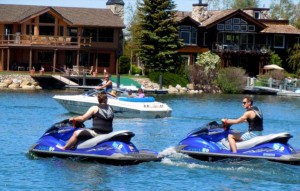
California does not require a license for any type of watercraft. Photo/LTN file

California does not require a license for any type of watercraft. Photo/LTN file

Lt. Doug Powell of the Contra Costa County sheriff’s marine patrol unit has been one of those lobbying for more stringent regulations.

“You wouldn’t give a 16-year-old the keys to your car, and tell them to go out and drive out on the street without any education. It’s hard to believe that we are doing that with boats,” Powell said, whose unit is responsible for patrolling more than 200 miles of linear coastline along the Delta from Richmond to Discovery Bay.

He believes that boater education should be required in the state. California is one of only five states, including Alaska, Arizona, South Dakota, and Wyoming, with zero boater education.

And many believe that the dearth of education is why California had about 2,775 boating accidents from 2007 to 2012, according to an NBC Bay Area Investigative Unit analysis of U.S. Coast Guard data. To compare, only Florida had more such accidents – more than 3,800 in the same time period. Texas ranked third with about 1,110, and New York and Michigan came in a close fourth and fifth with about 1,000 each.

“Yes, alcohol has been a problem but education is the main reason for accidents in our county,” Powell said. He said many tragic accidents could have just been avoided if boaters knew the basic rules of the road. In fact, according to the California Division of Boating and Waterways, the most common causes of collisions are operators not paying attention and lack of education- just a fraction of incidents are fueled by alcohol or drug use.

Jason and Maryann Hale know firsthand what can happen when boaters are neither equipped with adequate skills nor focused on operating a boat. On June 22, 2007, the Hale family was celebrating their son’s birthday on Whiskeytown Lake near Lake Shasta. The day of celebration took a tragic turn when a power boat plowed into a boat carrying several of their children, including their 12-year-old daughter, Trevienne.

The operator of the powerboat was “was out doing tricks spinning around and going through the no wake zone,” Jason Hale said. According to vessel accidents reports obtained by NBC Bay Area, not only was the operator not paying attention but he was going 20 to 30 miles an hour; Trevienne’s boat was traveling at 5 to 10 miles an hour. The documents show that the boat was speeding in a “no wake” zone, where boats aren’t allowed to go faster than 5 miles an hour.

Trevienne was knocked unconscious but was breathing. She was flown to Mercy Medical Center in Redding, where she eventually died.

“It’s like Russian roulette with your children and your loved ones out there, if someone doesn’t do what they are supposed to do out there,” Maryann Hale said. The Hale family is left devastated with the loss of their daughter, frustrated by the few safety requirements, and terrified to return to what once was a favorite leisure spot.

San Francisco Sailing Company owner, Erik Ostrander, is one of the many proponents supporting mandatory boating certifications. He exclusively rents out boats to customers who pass two certification courses, hoping to raise awareness that “the waters in the central bay are the most challenging in the world to sail.”

“It is ridiculous. I think it’s a mentality of thinking that the only person you are going to hurt is yourself, but they don’t realize that these people are colliding with other boats,” Ostrander said standing in front of Pier 39.

However, mandating boater education and similarly increasing regulations for waterway safety has been met with great opposition. In 1999, Gov. Gray Davis vetoed a bill that would have required education training for boat operators. Davis in part argued, “There is little evidence that a written test alone will improve the piloting skills of motor boat operators or reduce boating accidents.”

Yet, the Investigate Unit found that on average, states that require boater education on average have a lower rate of fatal accidents than states that do not. For example, New York and Illinois, which have long required boating education, have about three to less than one boating fatality per 100,000 boats over a four-year period. California, however, averaged four fatalities per 100,000 boats in that same period.

A similar bill in California was introduced in 2007, but also failed.

Ed Swakon from the Marine Council, an industry trade organization, believes that boater education is important but should not be a requirement. Swakon also believes that boaters should not be forced to obtain a license to operate.

“It might just be a taxation or revenue source that we don’t think needs to be imposed on the boating community at this time,” Swakon said.



Fish for free in Calif. on Saturday

California Department of Fish and Wildlife waves the fishing license requirement twice a year.

July 6 is the first day, with Sept. 7 the other.

On the other 363 days, California residents 16 years and older must pay $14.61 for a daily sport fishing license.

On the free days, bag and size limits are still in effect.


Sierra Valley cycling event to debut in fall

The inaugural Sierra Valley Gran Fondo cycling event will feature four distances. There’s the Mega Fondo at 160 miles, the Gran Fondo is 96 miles, Medio Fondo is 66 miles and the Piccolo Fondo is 33 miles.

The ride is Sept. 21 in the Sierra Valley, north of Truckee.

The ride benefits the Sierra Schools Foundation.

More info is online.


Lightning strikes much of eastern California

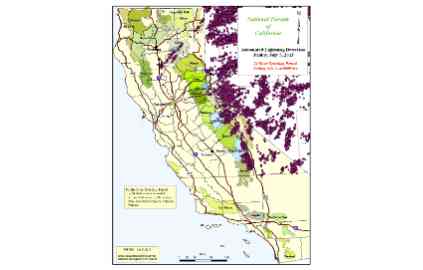
lightning strikeThere were 1,754 lightning strikes within California and 1,008 strikes within the National Forests in the state in the 24-hour period ending at 6am July 5.

None of them was in the Tahoe National Forest.

However, the two fires from Wednesday evening, south of Truckee and west of Highway 89, are in patrol status.

No additional lightning is expected today for the TNF.


Death Valley eager to celebrate the heat

By Jay Jones, Los Angeles Times

Record heat is drawing tourists to Death Valley at possibly the most uncomfortable time of the year, where they are snapping a photograph next to a thermometer or attempting to fry an egg without a stove.

Death Valley National Park has posted warnings to visitors on how to survive the heat. It wouldn’t seem a great time to visit, but on the other hand, the national park has issued an open invitation for folks to come celebrate the 100th anniversary of the hottest-ever temperature on the planet.

Along Artist's Drive travelers are able to witness a natural palette of colors. Photo/LTN file

Along Artist’s Drive travelers are able to witness a natural palette of colors. Photo/LTN file

The thermometer soared to 134 degrees on July 10, 1913, at what’s now the appropriately-named settlement of Furnace Creek.

The celebration will kick off at noon July 10. The Furnace Creek Visitor Center will host a series of discussions, led by meteorologists and rangers, on a variety of topics related to the region’s extreme climate.

At 1:50pm, Weather Underground historian Christopher Burt will explain how Death Valley recently snatched the temperature record previously claimed by El Azizia, Libya. Park Service employees will also discuss how they cope with life at the hottest place on Earth.

At 4pm, visitors can join park rangers for a ritual that’s taken place every day since recordkeeping began in 1911: the reading of the official thermometer at the Furnace Creek weather station.

On Sunday, the temperature there peaked at 129 degrees. That set a record as the hottest June temperature ever recorded in the United States.

July and August are typically the hottest months in the Mojave Desert, according to the National Weather Service.

Death Valley’s geography helps account for its scorching temperatures. A sign at the Furnace Creek Resort’s golf course notes that its elevation is 214 feet below sea level.


Possible alligator in Nevada reservoir

By Melissa Carlson, KTVN-TV

Northern Nevada is flooded with myths, folklore and talk of “strange sightings,” but a report from a Carson City family of a possible alligator in Lahontan Reservoir may actually have some teeth.

It was a normal kayaking trip for 12-year-old Andrew and his mom of Carson City last weekend. They were near Beach 8 in the south end of Lahontan Reservoir when Andrew says he saw what looked like a log in the water. So, like any kid, Andrew went to check it out, and realized it was not a log.

“I saw the eyes and the top of a head that looked like an alligator,” Andrew says. “It was dark green and had tough-looking skin.”

But, this wasn’t just another 12-year-old boy with an active imagination. Tony Beauregard, the supervisor for Lahontan Reservoir Park, says he has gotten three reports of alligator sightings. He says visitors have estimated the alligator to be about 6-feet long and says rangers have investigated each and every sighting.

“Our best estimate is they’re schools of carp, and about four to five feet long,” Beauregard says.

They haven’t found any evidence of an alligator, like tracks or dead animals.

Chris Healy of the Nevada Department of Wildlife says they haven’t gotten any reports, and while this may sound a little fishy, it could actually be a case of bucket biology. “People decide ‘hey, I don’t want this fish,’ or in this case, a small alligator, and instead of calling the authorities and having them deal with it, they dump it,” Healy says.

We’ve seen it before with giant goldfish in Lake Tahoe and picca, the cousin to the piranha, in Paradise Pond. “It’s unfortunate, but it’s not necessarily strange, Healy says.

So, will Andrew be back? He says yes, but adds, “I really don’t want to swim in [Lahontan Reservoir] now.”

If you are out on the reservoir and see something strange, please let a ranger know.