Disagreement over how to manage wild horses

By John M. Glionna, Las Vegas Sun

ANTELOPE VALLEY — Just after dawn, a dozen mustangs stampede across the high desert, harassed by a white helicopter that dips and swoops like a relentless insect. Frightened stallions lead a tightknit family band, including two wild-eyed foals that struggle to keep up.

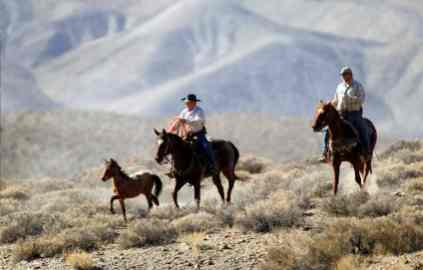
 Rick Loomis / Los Angeles Times A cowboy working for the BLM lassos a wild young Mustang horse during a round up held on BLM land, Nov. 4, 2012. Read more: http://www.lasvegassun.com/news/2013/jul/07/mustang-debate-wild-ride/#ixzz2YNCGcIF7

Wild mustangs in Nevada have long pitted animal groups against the government. Photo/Rick Loomis/Los Angeles Times 

Three animal activists watch through long-range camera lenses as wranglers hired by the federal Bureau of Land Management help drive the animals into a camouflaged corral. The private-contract pilot is paid $500 for each captured horse, dead or alive.

After a 10-mile run, one band of horses storms past the corral, prolonging the chase. While most of the horses enter the trap, a few break for open territory, the chopper in pursuit.

Few escape. The roundup corrals 180 mustangs, often employing a tactic that sets the species up to betray itself: A wrangler holds the reins of a tame horse at the mouth of the trap. As the mustangs draw close, the worker releases the animal — known as a Judas horse — which dashes into the corral, followed instinctively by the others.

Read the whole story


Nevada officials need help tracking invasive moth

The Nevada Division of Forestry wants help determining how widespread and severe the White Satin Moth, Leucoma salicis, infestation is in Northern Nevada.

mothThe non-native insect is capable of defoliating aspen, cottonwoods and willows.

The moth can be found flying in the upper canopy of any poplar species and laying eggs or mating on trunks, leaves or branches. Eggs laid in July and August will hatch in a few weeks, and larvae will skeletonize leaves on aspen, cottonwoods and willows before moving to bark fissures and spinning protective coverings to winter in.

White Satin Moths appear all white except for the body which looks like it has black bands and are about 1½-inches wide at full wing span. New larvae will be small, furry, brown and black caterpillars. Late stage caterpillars mature at about 1¾-inches long.

To report a sighting of the moth, email Gail Durham at the Nevada Division of Forestry at gdurham@forestry.nv.gov or call (775) 849.2500.


Low water level impacts Lahontan Reservoir

Due to low water levels, both launch ramps at the Silver Springs and the Fallon sides are closed at Lahontan State Recreation Area.

Beach launching is available at boaters’ own risk. Decreasing water levels continually expose new rock and sand bar hazards; extreme caution is advised for boats pulling skiers or traveling at higher speeds.

The reservoir is open for camping, swimming, canoeing and fishing.

For more info, call (775) 577.2226.


Beer drinkers want some exercise while imbibing

By Brad Tuttle, Time

Beer tends to be paired with burgers, not bicycles. But around the country, a new recipe in tourism mixes craft-beer tastings with cycling, running and rafting. Think of it as a sweaty spin-off of the foodie craze.

While the clientele tends to be fit, the physical demands of these brew tours are not all that daunting. John Stevens launched Port City Running Tours in his hometown of Portland, Maine, in 2012 and now offers 3-mile jogs on Saturdays with samplings at three breweries.

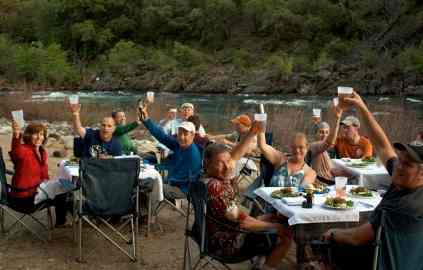
OARS offers a variety of beer-rafting adventures. Photo/OARS

OARS offers a variety of beer-rafting adventures. Photo/OARS

“The longest stretch is just under a mile,” he says. “Anyone can run that, especially if there’s beer at the end.”

Last year alone, more than 400 new breweries opened in the U.S., as sales of craft beer increased by a whopping 17 percent. Not surprisingly, beerercise expeditions have been popping up in areas with high concentrations of craft breweries and active residents. There’s no national count of such tours, but Portland, home to no fewer than 35 breweries, has at least three beer-focused cycling tours — including the funky Brewcycle, a jointly pedal-powered contraption that fits 15 riders.

And in Fort Collins, Colo. — 145,000 residents, nine breweries. Bob Williams launched Beer and Bike Tours last year, offering scenic day tours and multiday rides in the Rockies with ample brewery breaks. This autumn, the company is peddling beer-bike-foliage tours in Vermont, which has the most craft breweries per capita of any state in the country.

Beer-themed rafting trips have become a big draw for the California outfitter OARS, where in addition to the usual adventure equipment — tents, life jackets and sleeping bags — beer tours require an extra raft just to carry 10 or 11 5-gallon kegs.

“We try to put the kegs down on the bottom of the raft, near the water, to keep them cool,” explains Scott Saulsbury, head brewer for Southern Oregon Brewing Co., who has accompanied OARS on multiday trips down Oregon’s Rogue River for the past two summers.

As for what kind of beer goes best with rafting and cycling, there’s no consensus.

“Some people like porters regardless of what they’re doing, or if it’s 110 degrees,” says Saulsbury. Doctors might suggest water as the best postaerobics beverage, but don’t tell that to craft-brew aficionados. “Beer is just a terrific reward,” says Evan Ross, founder of Oregon’s Cycle Portland Bike Tours. “After working hard, that great feeling you get from beer is your body’s way of saying thank you.”


Mancuso focuses training on Sochi Olympics

By AP

Julia Mancuso is holding her breath for the Sochi Olympics. So far, she can stay under water for more than a minute.

The Squaw Valley skier incorporated freediving into her training program this summer in Maui, plunging under the ocean’s surface to collect shells and gaze at aquatic life.

Mancuso usually spends her offseason mountain biking and surfing the big waves around the island. Being an Olympic year, though, she’s decided to stay “a little less radical in my other sports I do.”

That’s why she picked up freediving, which is like snorkeling, except without, well, the snorkel.

Later this month, Mancuso will swap the sea for snow as she ventures to New Zealand for camp with the U.S. ski squad.

After all, Sochi is just seven months away.

“It’s approaching really fast,” said Mancuso, who splits her time between Hawaii and Squaw Valley. “Just have to keep getting strong and stay healthy.”

Mancuso is coming off a solid World Cup season, but one that was pretty much overshadowed by Tina Maze’s amazing run. The Slovenian compiled a record 2,414 points to take the overall crown away from Lindsey Vonn, who sustained a season-ending knee injury in a February crash.

The 29-year-old Mancuso finished on the podium four times, all in the super-G. She wound up second overall in that discipline, behind Maze.

Given Maze’s extraordinary season, though, along with Vonn’s expected return from a torn ACL and the rise of U.S. teenager Mikaela Shiffrin, Mancuso realizes that she probably won’t be among the favorites heading into Sochi.

That’s fine with her. She hardly ever is at the Olympics, even though she typically saves her best for the biggest of stages.

Mancuso captured gold in the giant slalom at the 2006 Turin Games. Four years later in Vancouver, she stole some of the spotlight from Vonn, taking silver in both the downhill and super-combined.

“I definitely perform well under pressure,” said Mancuso, who recently added ZICO Pure Premium Coconut Water as a sponsor. “I think it will be really exciting having a little more pressure going into Sochi.

“I’ve always thought of the Olympics like it’s another race and just try to shine.”

Rain or shine, she’s been enjoying her time in Maui, even if she’s curtailed some of her usual activities.

By this time of year, she’s normally visited most of her treasured spots to surf and stand-up paddle. And by this time of year, she’s also put plenty of daring miles on her mountain bike.

Not so much this offseason.

“I’ve been training really hard. But it’s just a little more focused, like instead of going on a crazy mountain bike ride, I might ride the stationary bike and watch a movie,” Mancuso explained. “Every summer I train hard, but it’s more important to stay injury free. In the past, I’d just be playing and maybe hurt myself. A sprained ankle or something, or just little tiny things that kind of put you back a week in training.”

And that’s why she picked up freediving to fill her time. In the process, she’s amassed quite a collection of sea shells.

“It’s a lot of fun,” said Mancuso, who’s planning a vacation to Fiji later this summer to freedive with friends. “We have these really cool fins, three-foot fins, and we stay in the water for a really long time, dive and just search for shells.”

These days, Mancuso is in a good place — more at peace and more relaxed. That has a lot to do with being healthy, which hasn’t always been the case. For years after winning gold in 2006, Mancuso dealt with nagging back problems that fragmented her training.

“It’s horrible trying to perform when something is hurting you. You couldn’t train that extra day because something was hurt, couldn’t push yourself as hard because you were holding back,” Mancuso said. “But I’ve learned to take care of my body. Dealing with injuries is a big part of being an athlete and being happy.”

There’s also this: Things are well with boyfriend and fellow skier Aksel Lund Svindal of Norway, even if they don’t see each other as much as they would like.

“We’re so busy that it’s fine. We’re both really driven,” Mancuso said. “That’s just part of the game, when you have a lot of personal goals, when you want to win, and you live on other side of the continent.

“But it’s cool to have a good friend on the World Cup circuit, a good friend who’s your boyfriend.”

Her new goal? Introduce Svindal to freediving.

“Maybe he will be into freediving. We’ll see,” Mancuso said. “This summer has been really good for me.”

TAMBA to work on Tahoe Rim Trail

In partnership with the Tahoe Rim Trail Association, TAMBA has adopted the segment of the TRT from Tahoe Meadows to Hobart Road.

This segment gets the highest bike use of any section of the Tahoe Rim Trail. Last week a group did a trail assessment to plan out what is needed to bring the trail back to the original design standards. Brushing the corridor is needed along much of the trail, there are braided go-arounds that are being created around some of the rocky sections as well as general wear and tear on the trail in many areas that need shoring up.

Work on the trail every Monday in July starting at 5:30pm.

July 15- Meet at 5:30pm at the west end of Tahoe Meadows. Hike in with tools about one mile to Chickadee Ridge.

July 22- Meet at 5:30pm at the west end of Tahoe Meadows.

July 29- Meet location TBD.


Incline Lake may forever be dry

By Kathryn Reed

INCLINE VILLAGE – Should a manmade lake at Lake Tahoe be restored? Or should the acreage be returned to what it was pre-1930s?

Those are some of the basic questions being asked by the Lake Tahoe Basin Management Unit. The answers aren’t as simple.

A handful of people showed up Monday night to give the U.S. Forest Service input into what was Incline Lake. The 777-acre parcel was acquired in 2008 from the Incline Lake Corp. The final price, though, of $43.5 million was not settled until 2011.

The private lake had existed since the 1930s. It was regularly stocked so fishermen would have something to catch. The lake covered 19 acres of the land that is situated along Mount Rose Highway. It is about a mile below Tahoe Meadows and to the left if driving toward Reno.

Two national forests and Incline Village General Improvement District own the land surrounding the parcel. That is in large part why the Forest Service wanted the land – to remove that private parcel from the middle of forest and make it contiguous public property for recreation use.

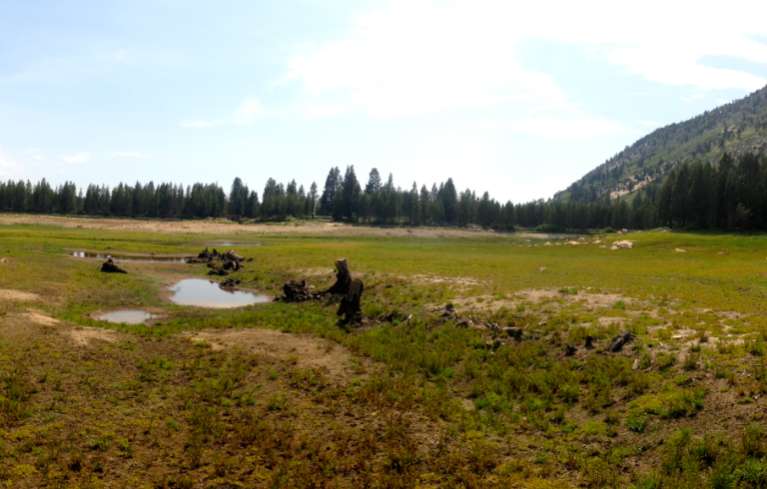
Ponds are naturally forming where Incline Lake used to be. Photo/Matt Dickinson

Ponds are naturally forming where Incline Lake used to be. Photo/Matt Dickinson

The lake was drained in 2009 because the dam was deemed seismically unfit. It was the previous owner that drained the lake and took down all structures on the property.

The entire area is open for public use. Hikers and bikers are welcome, but no motorized vehicles.

The Forest Service is taking comments on the scoping documents until July 19. Today the agency is looking at removing the dam and restoring the land to a marsh area. It could resemble what Grass Lake on Luther Pass is like. This would be 15 to 20 years out to allow Mother Nature to do her work.

“I’m leaning more toward rustic wetlands. I like their proposal,” Sue Hughes of Incline told Lake Tahoe News as she was leaving the July 8 open house at the IVGID offices.

Ponds are already starting to naturally form. John Gregory of Incline said water flows year-round at this location.

Leaving the dam and refilling the lake are not options because of the instability of the rock structure. This area is prone to earthquakes and downstream is where the bulk of Incline Village residents live. It is possible a smaller dam could be built, but that would also mean a smaller lake.

Dan Dominy of Incline is a fisherman who for years enjoyed casting a line there. He worries about what the impacts might be if more people use the area in the future, especially since there is a road on the land.

The Forest Service has $5 million set aside for improvements. Dam building and then the subsequent maintenance would require more money.

A network of trails and signage are possible. Informal trails exist today. One leads to the Mount Rose Wilderness, another goes along Third Creek to downtown Incline.

An environmental analysis will likely be released in January 2014. Work – whatever that looks like – could begin in 2015 building season.

Notes:

• The next meeting about the future of his property is July 10 from 5-7pm at Homewood Suites, 5450 Kietzke Lane, Reno.

• Comment deadline is July 19.

• More info is online.


Nature’s East Coast classroom may benefit Tahoe

By Patricia Craig, Penn State

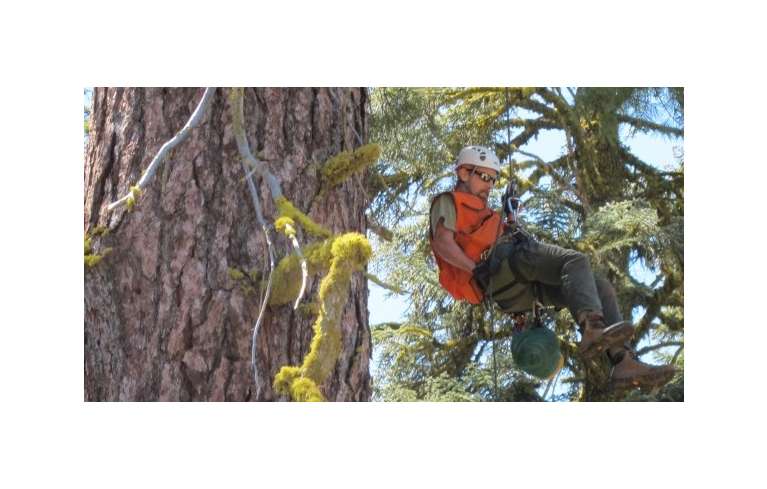
UNIVERSITY PARK, Pa. — Matt Hurteau spends a lot of time climbing trees. The assistant professor in the Department of Ecosystems Science and Management in the College of Agricultural Sciences, joined Penn State in July 2011, filling an Earth Systems Ecologist position jointly funded by PSIEE and the college.

“The position asked for someone who worked across disciplinary boundaries to tackle the kinds of questions I’m interested in,” Hurteau said. “And the thing that was abundantly clear to me when I came to Penn State was that ‘interdisciplinary work’ was not just an idyllic vision. It was reinforced that I was expected to work interdisciplinarily, which really piqued my interest.”

At the base of Hurteau’s work is the concept of carbon sequestration, particularly in forest systems. When trees photosynthesize, pulling in carbon dioxide from the atmosphere, they assimilate the carbon into wood.

Matt Hurteau, assistant professor in the Department of Ecosystems Science and Management, rappelled down a sugar pine. Image: Penn State

Matt Hurteau rappells down a sugar pine.
Photo/Penn State

“In fact,” Hurteau said, “about half of all annual accumulated growth ring mass is carbon.” That carbon comes directly from carbon dioxide, therefore if we can encourage trees to grow more each year through an ecologically based approach, they can pull in and store more carbon from the atmosphere.

Hurteau leads the Earth Systems Ecology Lab, which includes a team of both undergraduate and graduate researchers and postdoctoral scholars. The two main undertakings of the lab are forest-based climate change mitigation and adaptation.

“The quality of people I have in my lab is absolutely integral to the work we – undergraduates, graduates and post-docs – are excited about what we are doing that really makes this fun,” said Hurteau.

One of his lab’s current projects is modeling the carbon implications of ecologically based forest management. Funded by the U.S. Department of Defense Strategic Environmental Research and Development Program (SERDP), Hurteau and his colleagues are working across three military installations to link a growth-and-yield model with a process-based model to quantify the carbon trade-offs between a range of forest management strategies.

“As the fifth largest landowner in the country, the Department of Defense has a lot of threatened and endangered species on their properties. We’re running model simulations to look at what could happen with regards to a number of different things: providing optimal habitat for a specific threatened or endangered species, changing forest structure as to minimize wildfire risk or sequestering as much carbon as possible.”

In another project funded by the U.S. Department of Agriculture’s Integrated Approaches to Climate Adaptation and Mitigation in Agroecosystems Program, the lab is investigating climate change mitigation and adaptation in fire-prone forests under different climate scenarios. Hurteau said this research is particularly interesting because he is coupling the data with different variables, including future wildfire modeling and emissions modeling. The lab is also partnering with the Desert Research Institute to present their findings to stakeholders and natural resource managers in the Lake Tahoe area.

“One of the biggest rewards to this kind of work is doing research that has societal relevance,” Hurteau said. “While I always want to push the envelope on our understanding of things, I also try to step back and look at these problems in the context of the questions being asked now by the people in decision-making positions. How can we better inform them with the information we generate from this work?”

Beginning with his undergraduate studies, Hurteau has been thoroughly immersed in scientific research. At Northern Arizona University, he studied different Native American uses of fire for land management, specifically focusing on the Kaibab Paiute Indian Reservation in northern Arizona.

“I wanted to get a degree in something that would allow me to focus my attention on the natural world” Hurteau said.

And that is exactly what he did. After a stint with a pharmaceutical company, where he used vacation time to go backpacking, Hurteau went back to school and graduated with a bachelor’s degree in Forestry from Northern Arizona University in 2001 and a doctorate in ecology from UC Davis in 2007.

As a graduate student at Davis, Hurteau focused his research on forest systems, where he looked at understory plant communities in mixed conifer forests. Hurteau explained he was investigating “how changes in climate and changes in nitrogen deposition from pollution in California coupled with prescribed burning would influence understory plant diversity and productivity in that system.”

Beyond his research, Hurteau said he thoroughly enjoys teaching, especially at the undergraduate level. Last fall, he taught his first undergraduate class: Forestry 201, Global Change and Ecosystems.

“We really seek to link the physical and natural worlds together,” Hurteau said, “and do so by focusing on the connections between our climate and terrestrial ecosystems.”

“I thoroughly enjoyed teaching that class. I had a really diverse group of students. Most of them weren’t from the sciences – a lot were in business or economics. And that challenges me even further to make sure my students have a firm grasp on the information,” he continued.

“At the end of the day, I want students to gain an appreciation for the complexities that are in the natural world, an understanding for how these things are interlinked, an appreciation for the fact that humans are such a dominant force on the planet – we can change and are changing the climate system – and ultimately to think critically about every piece of information they get.”


Tales of Tahoe come to life cruising on the Dixie

By Kathryn Reed

ZEPHYR COVE – Lake Tahoe history is best delivered by one who lived it. So it was appropriate that Mark Twain greeted us as we boarded the M.S. Dixie II.

Twain’s roots in the area run at least as deep as the lake itself – 1,645 feet.

This outing on Lake Tahoe is part history lesson, part outdoor adventure, and part scenic cruise.

I board the boat July 5 with two of my cousins – Dana from Arizona and Jenna from Missouri. This is the first time any of us has been on the Dixie. (This is actually the second Dixie. The platform of the first one is now a barge stored at the Tahoe Keys Marina that comes out for the fireworks.)

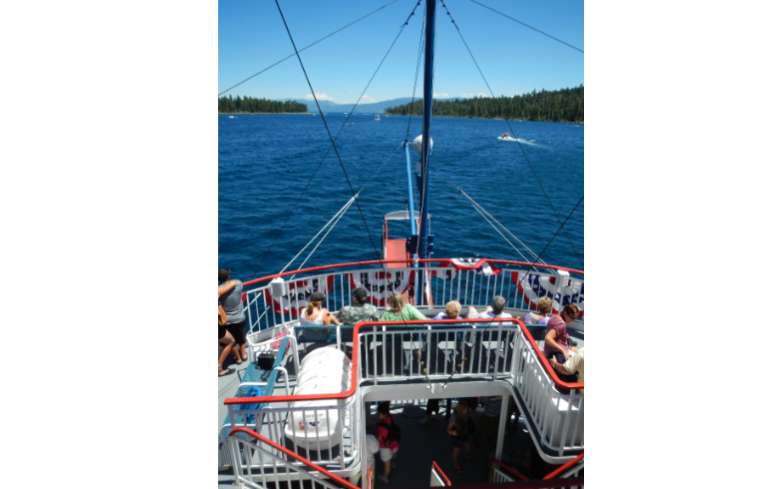
Heading out of Emerald Bay aboard the M.S. Dixie II. Photos/Kathryn Reed

Heading out of Emerald Bay aboard the M.S. Dixie II. Photos/Kathryn Reed

We had been up to the parking lot at Vikingsholm a couple days earlier to peer down at the bay and see it from land. Now was our opportunity to view it from the lake.

Far out on the lake we are able to see a tiny strip of white on the mountainside. It turns out to be Eagle Falls, which is right above Vikingsholm.

The highlight for many on these trips is seeing Vikingsholm as well as the teahouse on top of Fannette Island. (The castle is open during the summer for tours.)

Between “Mark Twain” (aka MacEvoy Lane) and the recorded information coming across the loud speakers, the history of Lake Tahoe starting with the Washoe people unfolds.

The problem, though, with sitting outside on the bow with the wind coming at us is that the voices are a bit muffled and we miss much of what is being said.

Still, we learn how the first road to Emerald Bay opened in 1913, that a glacier formed the bay, the scar to the left at the end of the bay is from a 1955 600-foot avalanche that closed the road for one year.

More recent, we are told 15 eagles wintered at the mouth of the bay – which is called Eagle Point – and they left three weeks ago.

It’s crowded on this holiday weekend. All the cruises were expected to sell-out during the long weekend. Arrive early because we had a hard time finding a seat outside. People had thought it a good idea to reserve their chair and then leave. Not so fast said some of the other passengers.

The Dixie has two interior floors, one of which has a small area where you can see through to the bottom of the lake. Food and beverages are available, and there is a small souvenir shop on board.

The other paddleboat Aramark runs on the South Shore is the Tahoe Queen. It is a true paddle-wheeler because the paddle is its sole power source. The Dixie has an engine. The difference also means the cruising times differ. The Dixie takes two hours for the Emerald Bay trip and the Queen 2½ hours.

The Dixie holds 525 people and is the largest cruising vessel on the lake, while the Queen can take on 380.

The Queen leaves from Ski Run Marina and the Dixie from Zephyr Cove.

The annual race between the boats is during Labor Day weekend.

ngg_shortcode_0_placeholder (Click on photos to enlarge.)


Trail workers needed on Daggett Summit

The Tahoe Rim Trail Association is looking for volunteers to work on the Daggett Summit project throughout the summer.

Workdays are every Tuesday and Saturday in South Lake Tahoe. To learn more and to sign-up click here.

This project has moved 3 miles of trail from city streets to forest. The project also adds 13 miles of new trail to the Tahoe Rim Trail system by building the Van Sickle Connector Trail and the Daggett North East Loop.

For any questions or concerns,  call (775) 298-0239