All-day workshop all about lavender

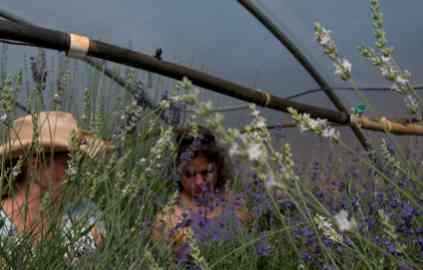
Students learn about lavender in a workshop at Campie's Lavender. Photo/Western Nevada College

Students learn about lavender in a workshop at Campie’s Lavender. Photo/Western Nevada College

The Western Nevada College Specialty Crop Institute is offering a value-added lavender workshop Aug. 19, 9am-4:30pm at the Carson City campus.

It will include a lavender farm tour. Cost is $35 for those registering by Aug. 12, $45 afterward. Lunch is included. Seating is limited, and registration is required.

The workshop will begin at Campie’s Lavender Patch in Stagecoach where owner Mike van Camp will demonstrate the distillation process for lavender essential oil and hydrosol. Following the farm tour, a classroom lecture at the WNC Carson City campus will focus on the benefits of developing value-added products and identifying the best varieties to grow.

Featured speakers include farmers van Camp and Elizabeth Inman of Purple Adobe Lavender Farm in New Mexico. Inman has grown lavender commercially for almost a decade.

For information/registration contact Ann Louhela at (775) 423.7565, ext. 2260 or ann.louhela@wnc.edu.


Mountain biking part of Heavenly’s epic plans

Heavenly wants its summer activities to rival what it offers guests in the winter.

Beyond what the South Shore ski resort is already embarking on, it has submitted plans to the U.S. Forest Service and Tahoe Regional Planning Agency to create Epic Discovery – the same type of summer adventure Vail Resorts has planned for Vail and Breckenridge in Colorado.

Epic Discovery is designed to connect kids and families with the national forests. “Learning through play” is the theme, much like the philosophy of the ski and snowboard learning centers.

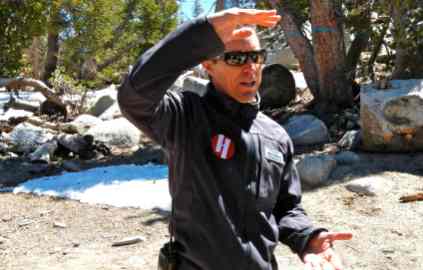
Heavenly's GM, Pete Sonntag, talks about changes coming to the resort for summer fun. Photo/LTN file

Heavenly’s GM, Pete Sonntag, talks about changes coming to the resort for summer fun. Photo/LTN file

Heavenly will contribute 1 percent of all summer lift ticket and activity revenue to the Nature Conservancy for forest and watershed restoration projects.

Below are some of the plans in the works and new proposals for Epic Discovery:

· Mid-Station Zipline Canopy Tour: An interpretive zipline canopy tour in the area between the gondola mid-station and the top station to the east of the gondola alignment.

· East Peak Zipline Canopy Tour: A multi-stage guided zipline canopy tour will begin near the top of Big Easy chairlift and end with a zip over East Peak Lake, near the base of Dipper Express chairlift.

· Sky Meadows Zipline Canopy Tour: It will begin near the top of Tamarack Express chairlift and end near the base of Sky Express chairlift.

· Sky Cycle Canopy Tour: Located in the area between the gondola top station and the Mid-Station Observation Deck, the Sky Cycle Canopy Tour will allow visitors to traverse the area by pedaling individual bicycle-like devices that are suspended from a cable in the air.

· Sky Meadows Ropes Course: A self-guided ropes course consisting of a series of platforms and rope walkway-bridges will be located between Sky Deck and the base of Sky Express chairlift.

· Forest Flyer: The Forest Flyer allows guests on individual sleds to descend on a raised track through the forest and natural rock formations. Located north and west of the existing tubing hill, the Forest Flyer will utilize gravity for the descent while giving riders full control of their speed.

· East Peak Lake Water Activities: Water-oriented activities on and around the existing East Peak reservoir will include kayaking, canoeing and fishing.

· Hiking Trails: New hiking trails will connect the top of Tamarack Express chairlift to the top of the gondola and Tamarack Lodge, continuing down to East Peak Lodge, approximately 3 miles.

· Ridge Run Lookout Tower and Observation Deck: A new observation tower will be developed near the existing Ridge Run Overlook. Resembling a historic Forest Service Fire Lookout Tower, it will offer views of High Meadows and Freel Peak, as well as Lake Tahoe. The existing picnic deck adjacent to the top of Sky Express chairlift will be rebuilt.

· Mountain Bike Park: Dipper Express, Comet Express and Tamarack Express will serve as access points to the Mountain Bike Park in the East Peak Basin area, offering eight to 10 total miles of trails ranging in difficulty from beginner through expert.

· Mountain Excursion Tour: A Mountain Excursion Tour will connect all three activity centers via motorized 4×4 vehicles, at the top of the Gondola, East Peak Lodge, and Sky Meadows, and will offer guided tours to various locations around the upper mountain.

· Interpretive Learning: Interpretive Discovery Zones will be integrated throughout the experience, sharing the area’s rich natural environment and cultural history with guests using fun and informative learning techniques.

— Lake Tahoe News staff report


Teens can learn to water ski or wakeboard

The STAR Teen Camp on Aug. 19-31 is Water Skiing & Wakeboarding.

Preregistration is required.

Campers will choose between water skiing and wakeboarding. This camp is taught by Lake Tahoe Water Skiing/Wakeboarding School.

Cost is $150.

For more info, contact Jen Menzel at jmenzel@cityofslt.us.


USFS working to create a stronger baseball bat

The U.S. Forest Service is intricately involved in the world of Major League Baseball.

The feds have been testing and analyzing thousands of shattered Major League bats, at the Forest Products Laboratory (FPL) to develop changes in manufacturing. It has resulted in decreasing the rate of shattered maple bats by more than 50 percent since 2008. While the popularity of maple bats is greater today than ever before, the number of shattered bats continues to decline.

The joint Safety and Health Advisory Committee of Major League Baseball and the Major League Baseball Players Association began working to address the frequency of bats breaking into multiple pieces five years ago. FPL wood experts looked at every broken Major League bat from July to September during the 2008 MLB season.

The research team found that inconsistency of wood quality, primarily the manufacturing detail “slope of grain,” for all species of wood used in Major League bat manufacture was the main cause of broken bats. Also, low-density maple bats were found to not only crack, but shatter into multiple pieces more often than ash bats or higher-density maple bats. Called multiple-piece failure, shattered bats can pose a danger on the field and in the stands.

Slope of grain refers to the straightness of the wood grain along the length of a bat. Straighter grain lengthwise means less likelihood for breakage.

With the help of TECO, a third-party wood inspection service, the FPL team established manufacturing changes that have proved remarkably successful over time. Limits to bat geometry dimensions, wood density restrictions, and wood drying recommendations have all contributed to the dramatic decrease in multiple-piece failures, even as maple’s popularity is on the upswing.

The Forest Service research team has been watching video and recording details of every bat breakage since 2009. The team will continue monitoring daily video and studying broken bats collected during two two-week periods this season, working to further reduce the use of low-density maple bats and the overall number of multiple-piece failures.


Odds favor previous Tahoe celeb golf winners

By Kathryn Reed

If the sportsbooks are right, there is going to be a repeat winner at this week’s American Century Championship golf tournament.

Dan Quinn, who has the won the tournament five times – including last year, is favored this year with the odds at 7:2. Seven-time winner Rick Rhoden is behind him with 4:1 odds. Three-time winner Billy Jo Tolliver has odds of 9:2 and two-time winner Jack Wagoner has 6:1 odds to win.

Sneaking in at fourth favored, though, is John Smoltz. He has yet to take home the trophy or $600,000 purse.

While there isn’t big action on the annual celebrity golf tournament, it can add another element of excitement to the event.

Odds makers say Dan Quinn. right, is favored to win the ACC tournament at Edgewood Tahoe. Photo/LTN file

Odds makers say Dan Quinn. right, is favored to win the ACC tournament at Edgewood Tahoe. Photo/LTN file

“A lot of celebrities will go in and bet,” John Packer, spokesman for Harveys-Harrah’s told Lake Tahoe News. And many are betting on themselves. Some joke about thinking the odds are not what they would have set for themselves.

“There are probably seven to 10 who could walk away with it any given year,” Packer said, which means special attention has to be paid to how the algorithms are used to configure the odds.

Those who follow the Lake Tahoe tournament that is now in its 24th year won’t be surprised to learn Charles Barkley is the least likely man to win. But at 500:1 odds, he is not alone. Trent Green, Jay Demarcus and Kevin Nealon have the same odds.

Packer says some people have joked that Barkley should be closer to 1 million to 1 odds to win.

But sometimes a rather long shot wins. Mario Lemieux was at 40:1 to win. He paid off big for some people in 1998 when he took home the title.

Phil Weidinger, who handles the public relations and a lot more for this tournament, put down $100 on Lemieux that year. He was watching from the pressroom as Lemieux was coming down the 18th green. That putt he sank put $4,000 in Weidinger’s pocket.

Weidinger isn’t revealing who he has money on this year.

Besides the straightforward bets, there is also one prop bet.

Quinn caddies for pro Ernie Els on occasion. While Quinn is in Tahoe, Els will be at the British Open. The odds they will both win July 21 are 85-1, while the odds that they will not are 1:105. The latter bet means for every $105 spent, the bettor could win $1.

The two won the respective tournaments in the same year in 2012 and 2002.

Like all betting odds, the numbers are subject to change before play begins.

—-

Notes:

• NBC will televise the 54-hole tournament live July 19-21. The sportsbook at Harveys will be airing it on multiple televisions.

• Wednesday is a practice round.

• Thursday is a celeb-am tournament.

• Tournament tickets (Fri-Sun) are $25; the other days are $15. Discount tickets available at Raley’s.

• More than 40,000 attended last year – which was a record.

• The tournament is played at Edgewood Tahoe in Stateline.

• For more info, go online.


Bike ride is mostly about the Truckee River

By Kathryn Reed

TAHOE CITY – It was a bit like being on sensory overload.

Endorphins are going with each rotation of the pedal. Sounds of the river rippling and people playing on it are inviting. The aroma of pines and other foliage make breathing deep desirable. The scenery – well, it’s breathtaking and challenges one to take pictures and ride at the same time.

Cycling the 8.03 miles from Tahoe City to Squaw Valley’s village is pretty easy – even for people who don’t often pedal. The most challenging part is avoiding all of the other people.

The four of us set out early to bypass the brunt of the heat on the last Saturday in June as well as the people. But this is a popular trail, so it’s impossible in the summer to have to the trail all to ourselves.

Besides the cyclists, some of whom were pulling children in trailers, people are jogging, walking (some with dogs), and others are on inline skates.

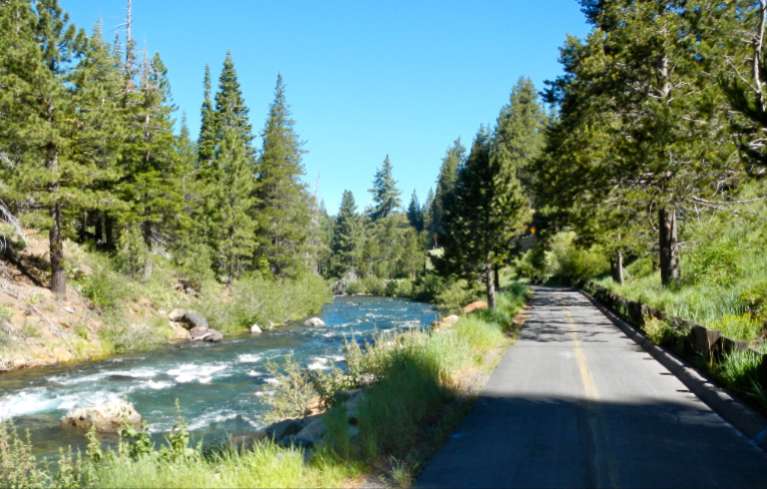
Much of the trail between Tahoe City and Squaw Valley is along the Truckee River. Photos/Kathryn Reed

Much of the trail between Tahoe City and Squaw Valley is along the Truckee River. Photos/Kathryn Reed

There are definite spots on the trail that are jarring, especially on a road bike with those skinny tires. And it’s obvious this is an old trail not built to current ASHTO standards that call for the trail to be 10-feet-wide with 2-foot shoulders. This one doesn’t seem much wider than 6-feet, if that. This plays into the congestion problem at times.

But most people are courteous and recognize this is a shared use trail.

Off to the side are interpretative signs that had we not been on bikes we probably would have stopped to read. There are also permanent maps that point out the various recreation amenities on this side of Lake Tahoe.

A few rafters are floating down the river on our way to Squaw. Coming back they seem to be everywhere. Some are part of a company that guides people and provides larger rafts, some brought their own for a group, while others are in individual blow-up devices. And some have floating coolers. One guy is on a stand up paddleboard going upstream.

Considering we are doing this ride on a weekend that has the temps well above normal, it’s great having so much shade.

We get to the junction of Highway 89 and Squaw Valley Road where a light has us crossing to go to the village. There’s something about staring at those Olympic rings, that flame – I never get tired of it.

The road up is wide, but the shade is gone. Beyond the Resort at Squaw Creek the bike trail is on the left.

That meadow with Squaw Creek and the Resort at Squaw Creek’s golf course just beyond are so lush. And Squaw – the mountain – in some ways I feel like I am back riding in Switzerland. While the Alps and Sierra are so different, Squaw is the one place in the Tahoe area that even comes close.

Stay on the “wrong” side of the road for a short jaunt and then follow the parallel blue lines that lead cyclists into the village. At that hour of day we all opted to get smoothies as a refresher, lounging in chairs in the village. Bike racks seem to be outside most of the businesses.

Then it was time to get back on the saddle to head out. We retrace our steps out of Squaw and along the river.

We cross our starting bridge and ride through the two roundabouts that are just for bikes or pedestrians, and wind up at the Bridgetender restaurant in Tahoe City. It’s a perfect spot next to the Truckee River to refuel for the rest of day’s activities.

—-

Getting there:

From South Lake Tahoe, go north on Highway 89. Just before the Fanny Bridge in Tahoe City is the transit center parking area on the left. Pull in and park.

The bike trail is on the north side. Cross the bridge, go left and keep pedaling.

The trail comes out at a light to cross Highway 89 to be able to ride up to the village at Squaw.

The transit center is also an area from which the Tahoe Rim Trail may be accessed as well as the Truckee River. Plus, it’s a place to park – for free – that provides walking access to Tahoe City.

ngg_shortcode_0_placeholder (Click on photos to enlarge.)


White ready to medal in new Olympic sport

By Scott Stump, Today News

When Shaun White straps on his snowboard for the 2014 Winter Olympics in Sochi, there will be less hair tucked under his helmet, and a different obstacle in his path.

The two-time Olympic gold medalist is best known for his aerial acrobatics in the half-pipe competition, but he will also compete in the new snowboard slopestyle event that has been added for the Sochi Olympics.

“What’s fun about the Olympics is that there’s a new discipline,’’ White, 26, said on Today Tuesday. “Every time you see me in the Olympics, it’s been in the half-pipe, but the new event is called slopestyle. It’s basically a series of jumps in one run and some rail features you slide on, and you make your way down and you basically do as many tricks as you can on those jumps.”

White, who trains at Northstar in Truckee, has dominated the half-pipe event, winning gold in the 2006 and 2010 Winter Olympics and becoming the first man to ever score a perfect 100 in the event at the Winter X Games in 2012. But slopestyle presents a new challenge.

“I’m all right at it,’’ he said. “I do like to compete in both events, though. It’s fun.”

White’s ability to innovate and master tricks that no one else has tried has kept him at the forefront of the sport.

“I recently was dreaming about snowboarding, and I thought of this new rotation to put on an existing trick that I already have, but it’s random,’’ he said. “You’re setting out to do something and by accident you create a new trick.”

White not only has a new discipline to tackle at the Olympics, he also has a new look. The long red hair that earned him the nickname “The Flying Tomato’’ has been shorn. In December 2012, he had his hair cut off for Locks of Love, a charity that gives wigs to underprivileged children who have lost their hair for medical reasons.

“It was a tough call, but it was a good cause,’’ White said. “It was 12 to 13 inches long, a lot of weight. I can go higher (on the half-pipe) now.”

While White has been involved in various charities and even had his band, Bad Things, signed by Warner Bros. Records last month, his attention is now completely on getting ready for Sochi.

“I’m really excited, it’s just one of those things where everything around my life right now is focused on the Olympics,” he said. “It’s a really good feeling that it’s coming up, and I think I’m prepared.”

He is the heavy favorite to make it three straight gold medals in the half-pipe competition.

“It’s something to strive for to live up to,’’ he said. “I like the pressure.”


Yosemite river plan delayed 5 months

By Alexei Koseff, Los Angeles Times

WASHINGTON — Facing flak for proposing to eliminate some popular tourist amenities in Yosemite National Park, the National Park Service said it needed five more months to finish a plan to “protect and enhance” the Merced River, which runs for 81 miles inside the park.

Kathleen Morse, the park’s chief of planning, said Tuesday that officials intended to complete the plan by the end of the year rather than this month.

The effort to restore the river corridor and habitat to their natural states has been overshadowed by controversy, she said. The proposals include removing or relocating popular tourist concessions that are too close to the riverbank — such as bike and raft rentals, two swimming pools, a snack stand, an ice skating rink and some hiking trails. The plan also would add new walk-in campgrounds and increase day-use parking.

“It’s unfortunate that there isn’t more discussion about the positive things coming out of the plan,” Morse said, such as easing the gridlock that often greets drivers in Yosemite, which draws 4 million visitors a year.

The park service is preparing the plan under a 1987 law that designated the Merced as a “wild and scenic” river, giving it a high level of federal protection. Local environmental groups had successfully challenged two previous plans in court as inadequate.

Local business groups and others have criticized the latest blueprint as harmful to commercial operations in and around Yosemite.

“The issue is public enjoyment of public lands,” Rep. Tom McClintock, a Republican who represents the district that includes Yosemite, said Tuesday at a hearing of the House subcommittee on public lands and environmental regulation.

The plan, he said, represents “a new elitist maxim: ‘Look, but don’t touch. Visit, but don’t enjoy.'”

Several witnesses argued that the changes would hurt nearby communities that are economically dependent on the park. They said officials preparing the plan had ignored their concerns.

“People don’t believe in the park service,” said Brian H. Ouzounian, representing the Yosemite Valley Campers Coalition, which promotes drive-in campgrounds and other family camping.

Jonathan B. Jarvis, director of the National Park Service, disputed that notion. He said two-thirds of the 30,000 comments submitted by the public supported the draft plan.

Jarvis said visitors would still be allowed to use rafts, bikes and horses inside the park, but they would need to bring their own rather than rent them.

McClintock produced a letter from retired congressman Tony Coelho, a Democrat who wrote the bill giving the Merced federal protection. Coelho, now a lobbyist, wrote that he “never intended” for the law to apply to the Merced River inside Yosemite, only to the river outside the park.

“Yosemite Valley has never been wilderness,” Coelho wrote.

Jarvis said Coelho’s intent did not matter.

“We have to go with the plain language of the statute,” he said. The law “covers the entire length of the river through Yosemite Valley.”


Youth state baseball tourney in South Tahoe

South Lake Tahoe is hosting the Babe Ruth 13–15 All-Star State Tournament July 12-15.

The local 13- to 15-year-old All-Star team will be competing against teams from Fallon, Sparks, and North Valley.

The tournament will be at the Babe Ruth field on Rufus Allen Boulevard. Game times on Friday and Saturday are 10am, 1pm, 4pm and 7pm. South Lake Tahoe team plays at 1pm and 4pm Friday and Saturday at 1pm and either 4pm or 7pm. Championship game will start at noon on Sunday.

It costs $10 to watch. All of the money goes to support South Lake Tahoe Babe Ruth. Snack shack will be open serving breakfast burritos, pulled-pork sandwiches and more.


Swimmer relives historic crossing of Lake Tahoe

By Kathryn Reed

While Erline Christopherson doesn’t remember every stroke, she does remember much of the 13 hours, 37 minutes she spent in Lake Tahoe.

Fifty-one years ago this month the then-16-year-old made history by becoming the first female to swim the length of Lake Tahoe.

This week the Lake Tahoe Museum in South Lake Tahoe debuts an exhibit about Christopherson. She was in town briefly Monday to view it. The 67-year-old now lives in Florida.

“I wanted to do something no one else had done,” Christopherson told Lake Tahoe News. It took her three tries, but she did it. The first was at age 15 when she came 3 miles shy of shore, the second time she was 1 mile short. All three swims entailed dealing with afternoon storms. The second and third attempts were three weeks apart.
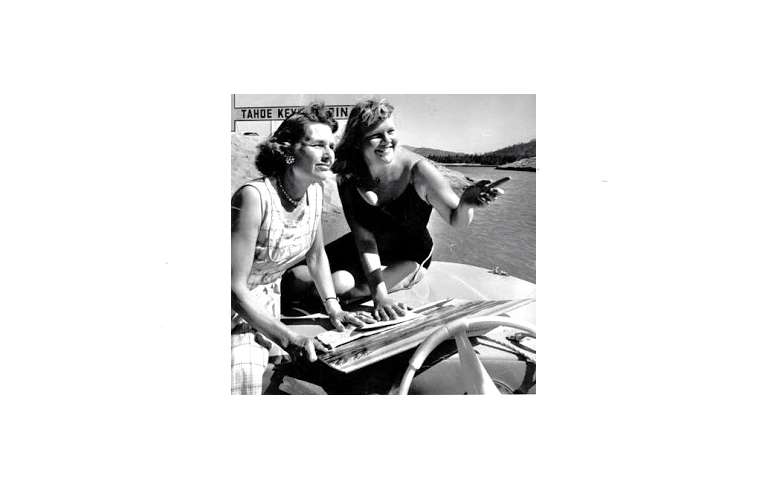
Erline Christopherson, right, with her mother, Elizabeth. Photo/Provided

Erline Christopherson, right, with her mother, Elizabeth. Photo/Provided

She swam from Cascade Properties to Dollar Point. It was so windy, the chaperone boat had to dock elsewhere.

Christopherson tried reading books about how best to prepare, but in 1962 that type of material didn’t exist. Her dad applied grease he used on the bailer to her body so it would not become water logged.

Her mom boiled beef and kept the water as protein water for her to consume during the swim. She also drank brown sugar water. Energy drinks as we know them today didn’t exist then.

Her sister sang to her to pass the hours.

Wes Stetson was in the air in his seaplane monitoring the progress. He landed and told Christopherson’s dad, who was in a boat, how to stay on course.

“All my dad had (as a point of reference) was a bald spot on the other side of the lake,” Christopherson said.
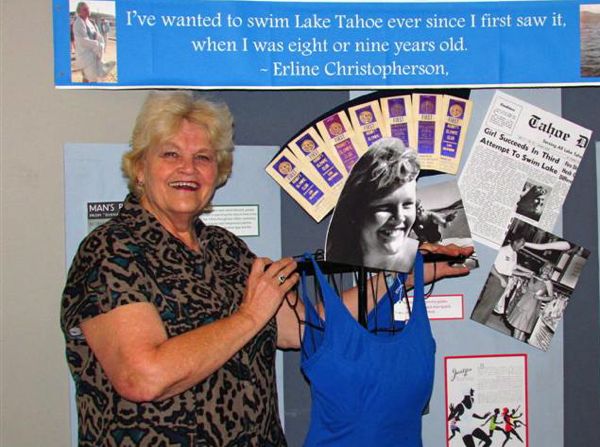
Erline Christopherson with the museum display. Photo/Denise Haerr

Erline Christopherson with the museum display, which includes the suit she wore. Photo/Denise Haerr

Christopherson was 7 or 8 when she first declared she was going to swim the 22 miles of Lake Tahoe.

“I did something that was my own. They can’t take that away from me,” Christopherson said.

She started swimming when she was 4, and was competing by age 10 in AAU meets. Her specialties were breaststroke and butterfly. At one point she was on the Junior Olympics.

Each attempt the family would come from their ranch in Lodi a few days early to acclimate to the Sierra. She swam the 15-mile width of the lake each of those three times as practice. Going from about Baldwin Beach to Emerald Bay, around Fannette Island and back were other training swims.

At home she would jump into the Mokelumne River and swim upstream against the current. Her swim coach allowed her train in one of the lanes.

She wore a blue one-piece swimsuit that is on display at the museum.

“A wetsuit gives you buoyancy. That is cheating,” Christopherson said.
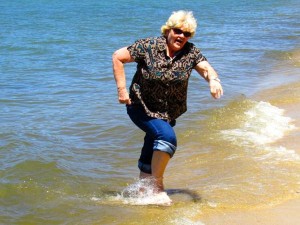
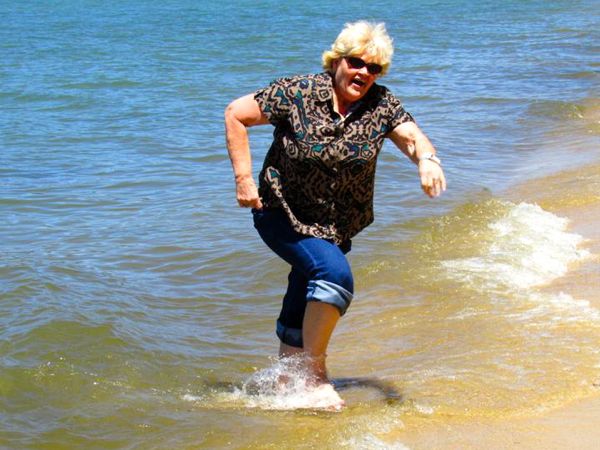
Remembering what it's like to be in Lake Tahoe -- Erline Christopherson. Photo/Denise Haerr

Remembering what it’s like to be in Lake Tahoe — Erline Christopherson. Photo/Denise Haerr

After she made history, the old Outdoorsman store allowed her to pick out any suit she wanted. What she wanted was not something she would compete in, but a bit more feminine. A poster of her was in the store as an advertising marquee.

Christopherson continues to swim. Four years ago, she won the series championship in an ocean race in Clearwater, Fla. – the only time she competed in it. She swims at least a mile when she gets in the pool; longer if she has the time.

“I love this lake. It’s the most beautiful lake in the world. I can’t come to California without coming up here,” Christopherson said. This time, though, there was no time for a swim.

—-

Notes: Museum volunteer Denise Haerr discovered a box full of memorabilia donated by Erline Christopherson. She started corresponding with the swimmer, which led to the visit on July 8. Haerr hopes Christopherson will give a talk about the July 25, 1962, feat and that a video would be created from old photographs and newspaper clippings.

The museum at 3058 Lake Tahoe Blvd., South Lake Tahoe is open Wednesday-Sunday from 11am-3pm. Donations are accepted.