Bear activity expected to spike in Tahoe basin

By Chris Healy

It is mid-August and the appetite of the Sierra Nevada black bear is about to take a dramatic swing upward. Motivated by signals from nature known as zeitgebers, the bears will spectacularly increase their daily caloric intake from 3,000 calories per day to upwards of 25,000 calories per day.

This physiological wonder is known as hyperphagia. Nature’s dinner bell is ringing.

“Hyperphagia is a period where bears eat as much as they possibly can so they can put on as much fat as possible to carry them through winter hibernation,” said biologist Carl Lackey. “Nothing much gets in the bear’s way when they are this hungry.”

Bears in Tahoe sometimes like to forage for people food. Photo/Janice Eastburn

Bears in Tahoe sometimes like to forage for people food. Photo/Janice Eastburn

Armed with that big appetite and motivated by zeitbegers like decreased daily sunlight and cooler morning temperatures, the bears will search far and wide in the hunt for food. Those 25,000 calories are the human equivalent of eating about 50 cheeseburgers per day over the next three months.

The moon will be full or nearly full for 10 days beginning this weekend (Aug. 17-24) just at the time that the bears begin to ratchet up their appetites.

“They will eat up to 20 hours per day during a full moon period as they pile on the fat,” stressed Lackey. “People living in bear country should not be tempting these already hungry bears with easy access to garbage, bird feeders, bowls of pet food or ripened fruit falling from trees.”

Areas most at risk of attracting bears by granting access to garbage and other attractants are the Lake Tahoe Basin (especially Incline Village), west Carson City and the foothill areas of Douglas and Washoe counties.

Nevada has had two dry winters in a row and the natural foods that the bears desire are not in abundance in the wild lands.

“Plants that create nuts and berries like manzanita, squirrel tail, snowbush, desert peach and rosehips are highly desired but not always abundant in dry years,” Lackey said. “It will be a busy next three months in bear country.”

People needing to report nuisance bear activity can call the NDOW’s Bear Hotline telephone number at (775) 688.2327. For information on living with bears, go online.

Chris Healy works for the Nevada Department of Wildlife.


Multiple running events at Kirkwood

Kirkwood Mountain Resort is the setting for the 33rd annual Kirkwood 5K/10K Adventure Trail Run on Aug. 31.

There will be 1.5 mile fun run for kids at 9am. The 5K and 10K will start after the fun run.

Run At A Higher Level is presented by the Tahoe Mountain Milers Running Club and the Kirkwood Volunteer Fire Department.

Race registration forms are available at: CV Sports in Carson City; Kahle Community Park in Stateline; South Lake Tahoe Recreation Center; Reno Running Company; or by calling (775) 588.2864.

Race day registration will be at the Kirkwood Main Lodge beginning at 8am.

Race day registration is $40 for the 5K/10K which includes a chance to win a ski pass. There is also a special Youth Club category for participants of cross country and track teams. The fee is $10 and does not include a T-shirt or a chance to win the ski pass. Kids Fun Run is $10 and does not include a T-shirt or a chance to win the ski pass.


Guidelines help keep high school athletes alive

By Deborah Franklin, NPR

For all the benefits of exercise and teamwork to the heart and head, high school athletes still lead the nation in athletics-related deaths. And it doesn’t have to be that way, sports medicine specialists say.

Many student deaths from head and neck injuries, heat stroke, sudden heart trouble and exertion-related sickle cell crises can be prevented, according to a scrum of leading sports doctors, athletic trainers, research physiologists and high school administrators who have endorsed a detailed set of guideline for keeping high school athletes safe.

“The idea was to create something that schools could almost use as a checklist,” says Douglas Casa, who helped shape the consensus guidelines published in the August issue of the Journal of Athletic Training. Casa, who led a similar effort to produce conditioning guidelines for college athletes in 2012, is a sports physiologist at the University of Connecticut in Storrs, and chief operating officer of UConn’s Korey Stringer Institute.

Read the whole story


N. America’s oldest petroglyphs found in Nev.

By Scott Sonner, AP

PYRAMID LAKE — Ancient rock etchings along a dried-up lake bed in Nevada have been confirmed to be the oldest recorded petroglyphs in North America, dating back at least 10,000 years.

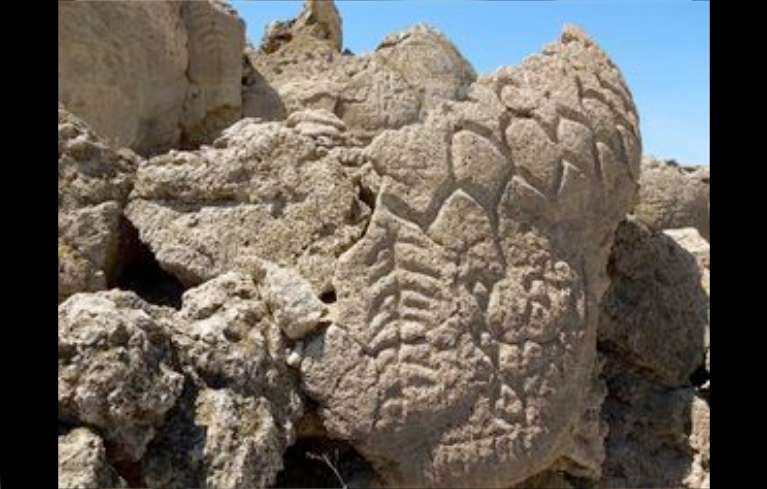
The petroglyphs found on limestone boulders near Pyramid Lake in northern Nevada’s high desert are similar in design to etchings found at a lake in Oregon that are believed to be at least 7,600 years old. Unlike later drawings that sometimes depict a spear or antelope, the carvings are abstract with tightly clustered geometric designs — some are diamond patterns, others have short parallel lines on top of a longer line.

 USGS, Larry Benson / AP Photo This May 2012 photo provided by the U.S. Geological Survey shows ancient carvings on limestone boulders in northern Nevada's high desert near Pyramid Lake. The carvings have been confirmed to be the oldest recorded petroglyphs in North America - at least 10,500 years old. The findings were published August 2013 in the Journal of Archaeological Science. This site was once the shoreline of the now dried up Winnemucca Lake. Read more here: http://www.sacbee.com/2013/08/14/5650997/nevada-petroglyphs-the-oldest.html?utm_source=dlvr.it&utm_medium=twitter#mi_rss=Latest%20News#storylink=cpy

Ancient carvings on limestone boulders near Pyramid Lake. Photo/Larry Benson/USGS/AP

Scientists can’t tell for sure who carved them, but they were found on the Pyramid Lake Paiute Tribe’s reservation land.

“We initially thought people 12,000 or 10,000 years ago were primitive, but their artistic expressions and technological expertise associated with these paints a much different picture,” said Eugene Hattori, the curator of anthropology at the Nevada State Museum in Carson City who co-wrote a paper on the findings earlier this month in the Journal of Archaeological Science.

The petroglyphs could be as much as 14,800 years old, said Larry Benson, a geochemist who used radiocarbon testing to date the etchings and was the lead author of the research paper.

Radiocarbon testing dated the carbonate layer underlying the petroglyphs to roughly 14,800 years ago. Geochemical data and sediment and rock samples from adjacent Pyramid Lake show they were exposed to air from 13,200 to 14,800 years ago, and again from 10,500 to 11,300 years ago.

“Whether they turn out to be as old as 14,800 years ago or as recent as 10,500 years ago, they are still the oldest petroglyphs that have been dated in North America,” said Benson, a former research scientist for the U.S. Geological Survey and current curator of anthropology at the University of Colorado Natural History Museum in Boulder.

Dennis Jenkins, an archaeologist with the University of Oregon’s Museum of Natural and Cultural History, called it a significant discovery. He led recent excavations of obsidian spear points near Paisley, Ore., that he dated back 13,200 years, and noted that the bigger challenge is identifying who created the petroglyphs.

“When you get back into this time period, if you speak with Native Americans they will tell you they were made (created) there and that is obviously their people and their artwork,” Jenkins said. “But approaching it from a scientific point of view — what we can prove — at this point, it is impossible to connect these to any tribal group.”

William Cannon, a longtime archaeologist for the U.S. Bureau of Land Management who discovered the petroglyphs at Long Lake in Oregon, brought the Nevada site to Hattori’s attention years ago. He said they bore similarities to petroglyphs at nearby Winnemucca Lake, and Hattori began connecting the dots after Benson spotted the carbonate coating on the rocks.

The etchings in Nevada and Oregon have relatively deep, carved lines dominated by linear, curved and circular geometrical designs. Some feature “tree-form designs” with a series of evenly spaced, vertically oriented ‘V’ shapes bisected by a vertical line.

Researchers have suggested the etchings represent various meteorological symbols, such as clouds and lightning, perhaps the Milky Way.

“But we really have nothing to go on for these particular petroglyphs that go back 10,000 or more years,” Hattori said Wednesday.

Benson has no idea what they mean.

“When I looked at it, I said, ‘These things are incredibly beautiful.’ We have so much beautiful, old Native American stuff in the United States, but this shows it didn’t necessarily get more interesting or more pretty with time,” he said.

Ben Aleck, a co-author of the study who is the collection manager at the Pyramid Lake Paiute Tribe’s Museum and Visitor Center in Nixon, said Wednesday he could not comment without permission from tribal leaders.


Landscaping, irrigation talk in Kings Beach

There will be a sustainable landscaping workshop on Aug. 20 from 6-8pm at the North Tahoe Event Center in Kings Beach.

The purpose of the event is to provide people with hints and tips to save water and thereby save money. Water saving technology and practices, water-wise landscaping techniques, turf removal techniques and re-landscaping ideas, yard fertility practices for healthier turf and clean water, and turf irrigation scheduling and seasonal maintenance will be talked about.

This event is free. It is sponsored by the North Tahoe Public Utility District, Tahoe Resource Conservation District and the University of California Extension Master Gardeners.


USFS thinning project to disturb recreationists

The U.S. Forest Service Lake Tahoe Basin Management Unit will begin forest thinning operations on National Forest System lands on the west side of Fallen Leaf Lake on Friday.

Operations will take place south of the dam and will move closer to the dam in a couple of weeks.

The Forest Service will issue a forest order to close a portion of the area from 7am until 6pm daily from Aug. 19-Oct. 11 for public safety due to heavy equipment operations and the felling of trees. Hazards may be present even when operations have ceased for the day and the closure is not in effect. Individuals disregarding the closure order may be cited, with subsequent fines or jail time.

The treatment method for this area will be cut-to-length thinning, in which trees are cut and processed on site by a harvester which removes the limbs and tops and cuts the tree into lengths for transport by a forwarder to a landing location. Also, there will be some roadway vegetation and tree clearing off of Cathedral Road to facilitate the access and safety needs for the road.

The forest thinning is part of the South Shore Fuel Reduction and Healthy Forest Restoration Project, which will treat approximately 10,000 acres between Cascade Lake and Stateline.


Learn about gardening in Tahoe soil

The Dirt on Your Garden Soil is talk that will focus on understanding your garden soil and how to improve it to make your garden more productive.

This is part of a series of talks and demonstrations on gardening in Tahoe presented by the Lake Tahoe Master Gardeners.

The free soil talk will be Aug. 19 at 5:30pm at the demonstration garden at Lake Tahoe Community College.


Learn about sustainable landscaping in Tahoe

There will be a sustainable landscaping workshop on Aug. 27 from 6-8pm.

Tahoe RCD, South Tahoe Public Utility District, and the Master Gardeners will teach people about water-wise landscaping techniques, turf removal and relandscaping ideas, water-saving technology, turf irrigation scheduling and maintenance, healthy yard fertility practices, and more.

The free workshop is at the STPUD office, 1275 Meadow Crest Drive, South Lake Tahoe.

For more info, email Jennifer Cressy at jcressy@tahoercd.org.


Aces deliver quality baseball in intimate setting

The Aces are in their fifth year playing in Reno. Photos/Kathryn Reed

The Aces are in their fifth year playing in Reno. Photos/Kathryn Reed

By Kathryn Reed

RENO – It felt a bit like being back at spring training – a warm night that never required long sleeves, grass beyond the outfield fence to sit in, beer prices that don’t break the bank and an intimate ballpark.

Now in their fifth season, the Reno Aces are developing players for the Arizona Diamondbacks.

But this year more parallels can be drawn between the Aces and San Francisco Giants than the Aces and Diamondbacks.

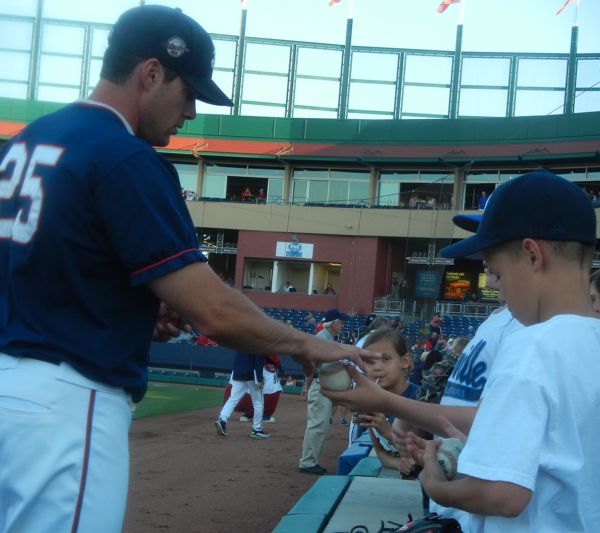
Aces rightfielder Brad Snyder signs autographs before the game.

Aces  outfielder Brad Snyder signs autographs.

The Aces and Giants both have impressive ballparks. (Walk around each one to take it all in.) Both have interesting food. (The veggie burger in Reno is homemade and yummy, while the mac ’n cheese bites need some work.) Both won their respective championships in 2012. Both are in last place in their divisions this year. (And that probably won’t change.)

Oh, and both can be a ton of fun to watch. The fact that the Aces won 14-3 on Tuesday helped with the fun factor.

But there are major differences as well. Prices are much less expensive at this triple-A ballpark. There is grass seating in Reno. Reno seats 9,100 and San Francisco more than 40,000. The announcer in SF is superb; the one in Reno needs to be replaced. The parks define jumbotron much differently.

While the team from Nashville was winning through the first three innings, the Aces took a commanding 8-3 lead after the sixth. But based on the fans, it would have been hard to know the Aces were winning. Or maybe they were Nashville fans.

(The announcer said there were more than 4,000 in attendance, but that was more likely the number of tickets sold because there were a ton of empty seats.)

It’s the announcer’s job to play fun music and get the crowd into the game if the players aren’t doing it. It didn’t work.

Still, if baseball is the main reason to be at the ballpark, then an Aces game is the place to be. There are future Major League players on the field and some who want a return trip to the Bigs. Eugenio Velez who used to race around the bases as a Giant was playing the other night — and still running fast — but for the Nashville Sound now.

Grass seating beyond the outfield.

Grass seating beyond the outfield.

The Aces’ season ends Sept. 2. There are six home games left, including tonight. And as the days tick away, more transactions are likely to occur. On Wednesday, pitcher Blayne Weller was transferred to Hillsboro, outfielder Tony Campana was recalled by Arizona, outfielder Ryan Stovall was transferred from Visalia and pitcher Tyler Skaggs was optioned to Reno.


Alpine County fish kill to begin this month

The U.S. Fish and Wildlife Service and state Department of Fish and Wildlife plan to begin a Paiute cutthroat trout restoration project later this month in Alpine County.

The project area is in a remote part of the Carson-Iceberg Wilderness in the Humboldt-Toiyabe National Forest.

The goal is to establish native Paiute cutthroat trout as the only trout species in Silver King Creek. This is a tributary of the East Fork of the Carson River. This is the only place in the world where this fish lives.

Rotenone – a chemical that will kill the fish officials don’t want to exist – will be added to 11 stream miles of the creek and its tributaries from Llewellyn Falls to Silver King Canyon. Tamarack Creek, Tamarack Lake Creek and Coyote Valley Creek will also be treated with Rotenone.

For more info, call the USFWS at (775) 861.6300.

— Lake Tahoe News staff report