Hairless bear from Placer County recovering

Eve lost her hair due to a severe case of mange. Photo/Fund for Animals Wildlife Center

By Barbara Harvey, Sacramento Bee

A young, hairless bear cub rescued in Placer County in December is recovering well after being transported to a wildlife rehabilitation center in Southern California.

The cub, who was found to be suffering from a severe case of mange, was rescued by good Samaritans before being turned over to the California Department of Fish and Wildlife. Members of the Department of Fish and Wildlife spent Christmas Eve transporting the cub hundreds of miles to the Fund For Animals Wildlife Center in Ramona, which is outside San Diego.

Read the whole story


Conglomerate that includes Squaw has a name — Alterra

The parent company of Squaw Valley, Alpine Meadows, Mammoth Mountain and nine other ski resorts finally has a name — Alterra Mountain Company.

This is the blending of affiliates of KSL Capital Partners and Henry Crown and Company.
 
Alterra is a fusion of the words altitude and terrain/terra.

In the coming months the company will announce season pass products that will provide access to all of its existing mountains, plus additional benefits.

Alterra Mountain Company is headquartered in Denver. The resorts it owns include: Squaw Valley, Alpine Meadows, Mammoth Mountain, June Mountain and Big Bear Mountain Resort in California; Steamboat and Winter Park in Colorado; Stratton in Vermont; Snowshoe in West Virginia; Tremblant in Quebec, Blue Mountain in Ontario; Deer Valley in Utah; and CMH Heli-Skiing & Summer Adventures in British Columbia.


Bowman qualifies for finals at Snowmass

By Courtney Harkins, U.S. Ski and Snowboard

Battling rough weather in the latter half of the day, the Toyota U.S. Grand Prix freeski halfpipe and snowboard slopestyle qualifiers went off at Aspen’s Snowmass Mountain in Colorado with 15 Americans qualifying for Friday’s finals.

The women’s freeski halfpipe went off without a hitch, with Olympic gold medalist Maddie Bowman (Meyers) celebrating her 24th birthday by leading the Americans in second place. Brita Sigourney (Carmel) was third and Olympic silver medalist Devin Logan (West Dover, Vt.) fourth. Carly Margulies (Mammoth Lakes) also made it into finals in eighth place with a solid second run.

But thick fog rolled in and heavy snow started during men’s training. After delays throughout run one and before run two, the Americans stacked six skiers into the 10 spots. Aaron Blunck (Crested Butte, Colo.) led the U.S. Freeski Team men with an enormous 93.66-point first run and local boy Alex Ferreira (Aspen, Colo.) won his heat. Both chose to not take a second run due to conditions and high first-run scores. Also taking spots in Friday’s finals were Olympic gold medalist David Wise (Reno), Birk Irving (Winter Park, Colo.), Taylor Seaton (Avon, Colo.) and Olympic silver medalist Gus Kenworthy (Telluride, Colo.).

The women were able to get their snowboard qualifiers off cleanly, with Jessika Jenson (Rigby, Idaho) snagging the top spot and Ty Walker (Stowe, Vt.) also making finals. Jules Marino (Westport, Conn.) and Hailey Langland (San Clemente, CA) did not qualify.

The men squeaked in their first run of slopestyle qualifiers, but the increasing darkness and snow stopped a second run from happening. Three U.S. men qualified: Red Gerard (Silverthorne, CO), Ryan Stassel (Anchorage) and Chandler Hunt (Park City, Utah).

Friday’s snowboard slopestyle and freeski halfpipe finals count as an Olympic qualifier. Bowman has met objective criteria for the U.S. Olympic Team with two podiums and would confirm her nomination with a first or second place at Snowmass. Already qualified for the U.S. Olympic snowboard slopestyle team are Jamie Anderson (Meyers) and Chris Corning (Silverthorne). Neither Anderson nor Corning are in attendance at Snowmass.


9-day outdoor festival returning to North Shore

The fifth winter Alpenglow Mountain Festival, presented by Outdoor Research and DPS Skis, will be Feb. 17-25.

The nine-day festival in North Lake Tahoe is a celebration of human-powered mountain sports, events, clinics, equipment demonstrations, critically-acclaimed film and more. It will showcase more than 75 individual events and is almost entirely free.

Geared toward beginner and intermediate winter recreation enthusiasts, the Alpenglow Mountain Festival includes backcountry skiing and splitboarding, cross-country skiing, snowshoeing, natural history, yoga, live music, educational workshops, social gatherings and more.

In addition to local guiding companies Alpenglow Expeditions, Backcountry Babes, Rich Meyer Alpine Guide, and North American Ski Training Center a litany of professional athletes will attend the event in order to lead tours and give presentations. They Adrian Ballinger, Kim Havell, Noah Howell, Barry Blanchard, Zach Griffin and more.

Other Mountain Festival highlights include:

  • The “Nachtspektakel” backcountry social with bonfire and three-course catered meal
  • Backcountry Essentials clinics for beginners
  • Backcountry Bartending with Adventure Dining Guide
  • Adventure Writing Workshop and Cast Iron Cooking clinics with Charlotte Austin.

Registration for the event opens on Jan. 12 at 10am. The majority of events are free, so space is limited and participants are encouraged to register online to secure spots. Registration for most events requires a deposit that is refunded upon participation.

A complete event schedule can be found online.


18 states may introduce sports betting bills in 2018

By Wayne Parry, AP

ATLANTIC CITY, N.J. — A new report predicts 18 states will introduce bills to regulate sports betting this year, with 11 having a good chance of passing legislation.

Eilers & Krejcik Gaming, which tracks gambling legislation nationwide, says that’s just the minimum; the firm predicts more than 30 states could introduce sports betting bills.

The U.S. Supreme Court this year will decide a case brought by New Jersey that seeks to overturn a ban on sports betting in all but four states: Delaware, Montana, Nevada and Oregon. A favorable ruling in that case could open the floodgates in terms of states adopting a new form of gambling.

Read the whole story


Sierra, Squaw turn Olympic dreams into reality

Squaw Valley racer Marco Sullivan competed in four Olympics. Photo/Eric Schramm Photography

By Susan Wood

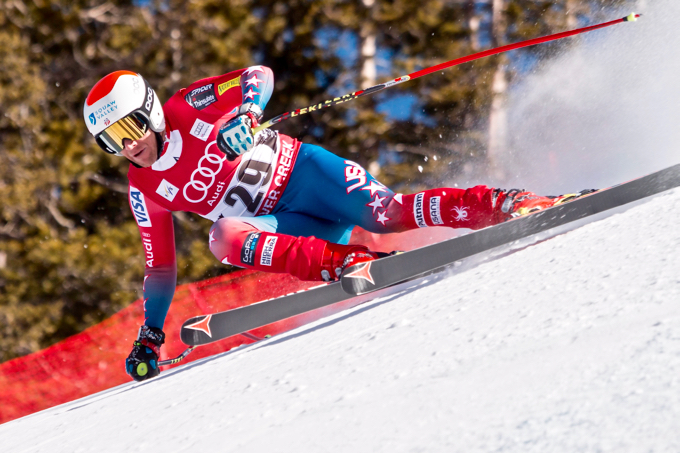
When the Winter Games in PyeongChang, South Korea, surge into our consciousness next month, retired alpine ski racer Marco Sullivan’s snow-filled mind is sure to drift to another mountain.

Sullivan, like many before and expectedly after him, grew up gracing the slopes of Squaw Valley.

Squaw, like its southern Lake Tahoe counterpart – Sierra-at-Tahoe, has an uncanny knack for cultivating Olympians. Combine Travis Ganong, Julia Mancuso, and Jonny Moseley on one shore with Jamie Anderson, Maddie Bowman, Hannah Teter and Travis Cabral on the other – and you’ve got a powerhouse assortment of Olympic medalists and contenders.  

“I’m really proud to say I’m from Squaw. Maybe it’s a similar vibe at Sierra,” Sullivan, a 37-year-old Truckee resident, told Lake Tahoe News. “There’s a long tradition of people in the valley, ex-ski team, who have established a vibe.”

To those associated with these athletes, there are various reasons why these no-holds-barred, homegrown resorts crank these top-of-their-field competitors out of the gate. Unique qualities ranging from the magnitude of the training program and the terrain to the abilities of the coaches and desires of the parents and resort management were cited from a host of people on the periphery. Plus, health care support like that found in Barton orthopedics is also commendable, U.S. Ski and Snowboard Chief of Sport Luke Bodensteiner outlined for LTN.

This year is no exception.

“I think we have the best team going,” Bodensteiner said boldly. There’s a whole crop of kids looking to carry on the tradition of excellence from the American team.
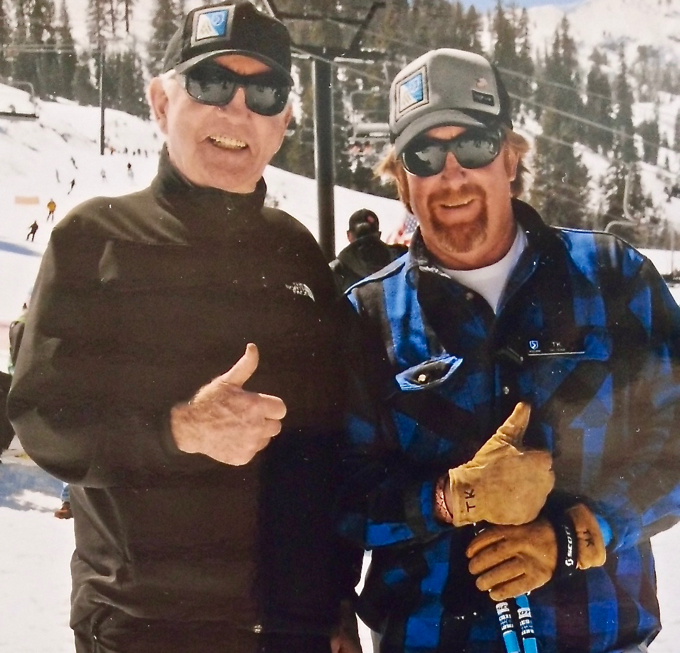
Tom and Todd Kelly are part of Squaw’s skiing heritage. Photo/Provided

And for Tahoe, it’s part of a history dating back as far as 1960.

For his part, Sullivan dreamed of competing in a World Cup race as early as age 5. The ski team member traded good grades and his traditional physical education class at North Tahoe High School for hours on the mountain in the afternoon. As the ski team head coach, his late uncle Mark “Sully” Sullivan saw something in Marco that groomed him for competition.

“The guy paved the way for me,” Sullivan said. “I never questioned going to the U.S. Ski Team. It was a given.”

The rest is history – a storied one filled with trials and tribulations. He competed for 15 seasons and made 105 World Cup starts – the most of any American racer. Podiums were hard to come by – four total. But the memories carved an indelible mark on his life, proving the journey is as important as the destination.

When he retired from racing, it was emotional.

“I ended a big part of my life. It’s not something that came easily,” he said. “I guess looking back I wished I would’ve won (a World Cup race). When you’re getting in 15th place, sometimes you forget you’re representing your country. I appreciate it all now.”

He now sees that fire in the eye of teenagers while running the American Downhill Ski Camp. The last large outing brought out 30 bright-eyed hopefuls between the ages of 12 and 19, along with a superstar staff including the most decorated downhill racer-turned-skiercross competitor Daron Rahlves, also from Truckee and retired. Sullivan also works as a NASTAR pacesetter on tour. Essentially, the job coaxes the competitors to meet and exceed the race-time threshold of a veteran.

As the Olympics go, he competed in four – Salt Lake City, Turin, Vancouver and Sochi.

He likes the chances of the women as well as his Squaw comrade Bryce Bennett this year.

When the teams are announced Jan. 20, it will mark almost six decades since Squaw Valley hosted the Games. That date comes only a month after the U.S. Ski and Snowboard Association announced a five-year agreement with the legendary North Lake Tahoe resort as an official training site of the U.S. Ski and Snowboard Team. While hosting the FIS World Cup Championships last year, Squaw joins the ranks with Mammoth Mountain, Deer Valley, Copper Mountain and Timberline.
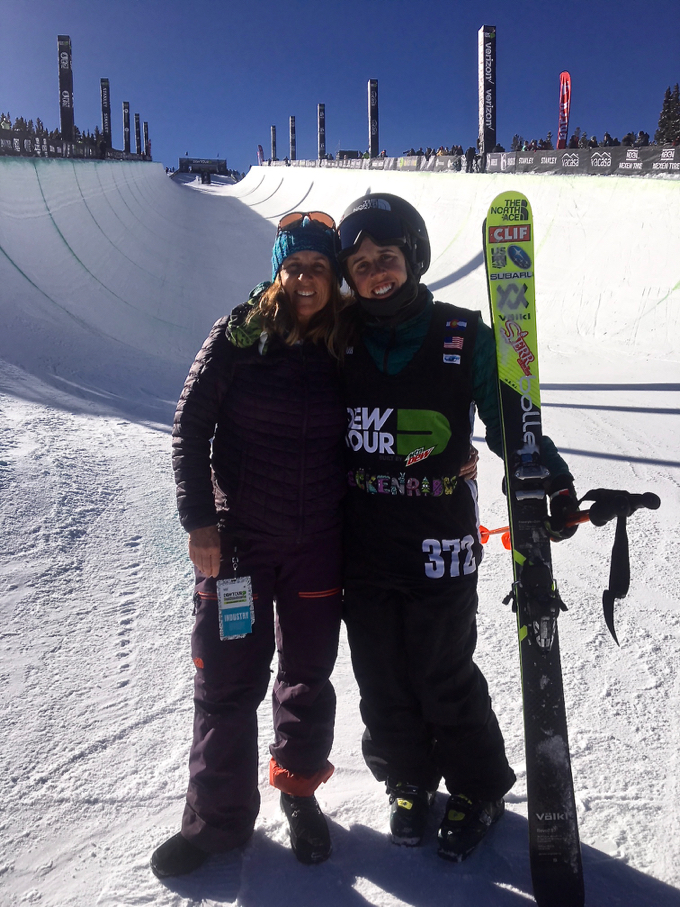
Sue and Maddie Bowman prove the power of family is strong at Sierra in so many ways. Photo/Provided

It takes a village — a familial one

An extraordinary ski team program is as crucial as the culture that created it, Squaw-Alpine Ski and Snowboard Team Director Todd Kelly insists.

Let’s face it, when you have kids who see the exhilaration and temptation for greatness as young as age 4, it’s tough to deny their shot. And Squaw sees many.  They learn early on who is Tamara McKinney, a four-time World Cup champion, and they see stars.

The program trains those who “bleed blue” (their uniform colors) in three disciplines — GS “giant slalom,” slalom and downhill. The development segment runs from ages 4 to 9.

“You can spot these kids here and there at age 5 to 7 – the ones that can ski great,” Kelly said.

Racing starts as early as age 7, and they grow into three age categories. From there, it takes a mature mental toughness.

“You definitely have to believe in yourself that you can win on that day,” Kelly told LTN.

He should know. Kelly, 48, went through the ranks and made the same declarations more than three decades ago – at this same mountain. He competed from 1986 to 1994 and was rated as the top U.S. super-G skier.

The village is indeed a family.

Marco’s uncle “Sully” was Kelly’s mentor before he died three years ago. So the connections run as deep as a healthy Sierra dumping in February.

The simplest argument is the culture breeds ski royalty from Truckee to Squaw Village.

“When you make a right or a left turn into the valley, there’s a culture for skiing and a passion that you learn at (age) 3 or 4,” Kelly said.

Of course, it helps when your father paves the way.

“Basically, it’s the mountain,” said Tom Kelly, a giant in his own right.

The two men provided a father-son perspective about Squaw with Lake Tahoe News. Their views were intertwined.

The elder Kelly, the resort’s 69-year-old building services manager, was a former Olympic and U.S. Ski Team coach.

He points out that even if the conditions vary, (take the unseasonably warm slush World Cup competitors navigated through last March at Squaw), the systematic support makes all the difference to a ski area bringing an athlete up to par.

“They need tremendous support from the people who run it,” he said with a nod to Squaw chief Andy Wirth.

Kelly and his son not only cite Wirth, the person at the helm of their resort, but Tom Kelly is quite familiar with the unbreakable reputation of John Rice at Sierra-at-Tahoe.

Jamie Anderson, Maddie Bowman and Hannah Teter celebrating in 2014 at Sierra. Photo/LTN file

The power of place of Sierra

After the last Winter Games, Sierra-at-Tahoe hosted a huge community party to honor three women who have all won gold medals for Lake Tahoe.

Snowboarder Teter, who earned hers in an earlier Olympics, with snowboarder Anderson and free skier Bowman having achieved theirs from 2014 — all say the same thing when asked where they honed their exceptional skills on snow. Sierra-at-Tahoe, a smaller resort than other properties owned by a conglomerate, is their home resort.

They let that be known in various ways.

Teter, who hailed from Vermont, released her version of maple syrup in an event at the Sierra Pub.

Anderson speaks often of freeing her in-demand mind by cutting loose in the stashes of Sierra.

Bowman, well, she’s rather engrained in the culture – as her mom knows so well.

How many teenagers do you know would take the time to deliver homemade fudge to the employees spread out all over a ski resort during the holidays?

Maddie’s mother, Sue, a volunteer coach who is celebrating her 52nd year skiing, makes 16 pounds of it. The mother-daughter duo thinks nothing of stuffing the secret recipe into their packs and making the rounds. It’s gotten to the point in which the staff counts on it, waiting for the days when the younger celebrity takes time out of her busy schedule to come home.

The tricks Bowman performs on skis are only matched by her humility.  That’s because she knows where she comes from and lives by those died-in-the-wool, mountain-community ethics that make Sierra-at-Tahoe something other resorts may not get.

For one thing, the resort groomers and terrain park builders are known to move heaven and earth to create a masterpiece challenging enough for Olympians to be interested.

For another, General Manager Rice implemented a program at Sierra-at-Tahoe years ago that provides free ski passes for students at Lake Tahoe Unified School District making a 4.0 grade point average. Hundreds of passes have been doled out, students have excelled, and Rice set a benchmark for teens like Bowman to become the role model she is today. Bowman attributes part of her success to that program.

Then there’s the attitude that starts from the top down. Sue Perpall told LTN she’ll never forget when her daughter was about to make her debut on a Dew Tour in her “tore-up” ski pants. Rice took her to one of the resort’s retail shops and bought her a “presentable” pair.

“When someone helps you out like that, it boosts your confidence,” Perpall said.

Perpall has tried to put things into perspective because it’s common for parents “to think their kids are superstars.” Maddie was proving it on the Buddy Werner team among others, and Rice saw it.

“It never occurred to me (she would be a contender). But John skied up to me one day and said: ‘I want to back her,’” she said. “How many general managers can ski up to somebody, first find their mom, then know when someone has promise?”

Bowman just thought she wanted to hang with the boys as sometimes the only girl in a daredevil group destined for greatness. They’d challenge her, and she delivered.

“She was always a tomboy from Day 1. When she’s on top of the halfpipe, she brings it,” Perpall said.  “And Sierra bends over backward to build its halfpipe when it can. It’s been amazing what they’ve been able to do.”

Perpall emphasized the lack of dedication from other resorts.

That commitment is also noticed by the industry.

“Sierra is different. With Sierra, it may well be the culture for Hannah, Maddie and Jamie. I think the stuff they do when it comes to the Olympics fits with Sierra – that laid-back style,” California Ski Industry Association President Mike Reitzell said.

Then, there’s the obvious.

“I think Squaw is a no brainer. When you host the Olympics, you’re forever entrenched as the place that’s going to attract the Olympians. And Squaw totally embraces its Olympic heritage,” Reitzell told Lake Tahoe News. “It’s evident when you first see those Olympic rings off Highway 89.”

The Winter Games start Feb. 9.


Controlled burns resuming in Tahoe basin

The Tahoe Fire and Fuels Team, which includes local, state and federal agencies, may continue prescribed fire operations this week in multiple locations around Lake Tahoe, weather permitting. 

Winter typically brings cooler temperatures and precipitation, which favor prescribed burning. Each prescribed fire operation follows a specialized prescribed fire burn plan that considers temperature, humidity, wind, moisture of the vegetation, and conditions for the dispersal of smoke. This information is used to decide when and where to burn.

Smoke from prescribed fire operations is normal and may continue for several days after an ignition depending on the project size and environmental conditions. 

The TFFT gives as much advance notice as possible before burning, but some operations may be conducted on short notice. 


$125,000 snow machine latest toy of the superrich

By Kyle Stock, Bloomberg

Way back in the snow-choked mountains, miles from any road, curb appeal is still a thing.

Consider the Tucker Sno-Cat. It sits on four treads, seemingly designed for a tank, that nevertheless appear to float atop fluffy snow that’s swimming pools-deep. The cab is painted an industrial orange that contrasts cartoonishly against the cottony landscape. A Tucker, like all great vehicles, is a cross between a serious machine—purpose-built for a job—and a child’s toy.

Demand for Tucker Sno-Cats—both new and used—is peaking, thanks to affluent landowners, classic collectors, and gearheads with a love of snow.

This year, Tucker drew almost $600,000 in government contracts, including an order to service seven of its machines at the U.S. Marine Corps Mountain Warfare Training Center in California’s Sierra Nevada.

A few months ago, a customer with a spread near Lake Tahoe ordered a Tucker in Ferrari red. 

Read the whole story


Adaptive ski festival on North Shore

Achieve Tahoe, a leading provider of winter and summer adaptive sports instruction for adults and children with disabilities, will host the Ability Celebration & Winter Ski Festival, its annual military sports camp for injured veterans and their family members, Jan. 16-19 in North Lake Tahoe.

The program will provide 34 participants with complimentary ski and snowboard lessons, overnight accommodations in the Village at Squaw Valley, meals and transportation.

Participants will travel to North Lake Tahoe from all over the country to participate in specialized private ski and snowboard instruction that will be provided to them free of charge. Each person will receive lessons specifically designed to support their physical therapy, boost their emotional well-being, build their confidence and ultimately help their re-integration into their communities. The veterans in attendance are also invited to bring a guest to share in their experience, and to provide them with support and encouragement.

The Warfighter Sports program was designed to offer sports rehabilitation for severely wounded warriors in military hospitals and communities across the U.S. through a nationwide network of over 120 community-based chapters of Disabled Sports USA. The program helps to rebuild lives through sports by improving self-confidence, promoting independence and uniting families through shared healthy activities.

Contributions cover all expenses for participation of the warrior and a family member, including individualized adaptive instruction, adaptive sports equipment, transportation, lodging and meals. Since 2003, more than 12,000 of the most severely wounded and their families have been served, including those with amputations, traumatic brain injury, spinal cord injury, visual impairments, and significant nerve and muscle damage.


Bald eagle count participants sought

Tahoe Institute for Natural Science will host the 37th annual mid-winter bald eagle count on Jan 12 from 9am-noon.

Participants must commit to arriving 15 minutes early, and staying for the full three hours of the survey. 

The results of the count will be combined with those from across the nation to generate an index of bald eagle populations wintering in the United States. The count is part of the National Midwinter Bald Eagle Survey that was initiated by the National Wildlife Federation in 1979. Over the years, the coordination of the national effort has changed, and is currently managed by the United States Army Corps of Engineers. 

To register, go online.