Hike benefits two South Shore housing groups

The annual Hike for Housing fundraiser to support South Lake Tahoe Habitat for Housing and Saint Joseph Community Land Trust is Sept. 21 from 9am-1pm at the Lam Watah Trail.

Meet at 1 Elks Point Road in Round Hill.

Registration is $25 per family or $15 for an individual. Register and park for free at Our Lady of Tahoe Catholic Church off Elks Point Road.

Raffle tickets will be available for purchase at the registration site.

This is a paved two-mile trail with several side trails for those who wish to extend the mileage. The trail is dog and bike friendly.

For more information, call (530) 541.4654 or (530) 541.8930.


Rahlves’ Banzai Tour sets 2014 dates

The 2014 Rahlves’ Banzai Tour will stop at four Lake Tahoe resorts this winter.

From Feb. 8 through March 16 the tour will be at Kirkwood Mountain Resort, Squaw Valley, Alpine Meadows, and finishing with the finals and super final at Sugar Bowl Resort.

“There is no other race like this in the world,” Daron Rahlves, former World Champion, X-Games Champ, four-time Olympian, Sugar Bowl Resort ambassador, and tour founder said in a statement. “What’s so unique about the Banzai is that everyday rippers line up against pro-level athletes to find out what they’re made of, battle for Rahlves’ Banzai titles, and an $80,000 purse. When the gate drops, it’s on as four competitors go head-to-head in a top to bottom race over natural terrain.”

Last year’s champs Johnny Bochenek, Shannon Rahlves, Casey Lucas, and Kyle Coxon will have tough competition in defending their titles. From everyday rippers representing their home resorts, to skiers/boarders of all levels coming out for a fun and competitive experience, to competitors making a name for themselves on other tours in racing, ski cross and big mountain—all will converge for the high-speed action at each 2014 RBT stop.

The dates are:

Kirkwood Mountain — Feb. 8-9

Squaw Valley — Feb. 15-16

Alpine Meadows — March 8-9

Sugar Bowl — March 15-19.


Triathlon creator to give talk in Tahoe City

One of the four men who came up with the concept of the modern triathlon will be speaking Thursday night in Tahoe City.

Dan Hendrickson will be talking Sept. 19 at 6:30pm at the Gatekeeper’s Museum. A former Navy Seal, Hendrickson was one of four friends who originally came up with the idea of the triathlon. The concept was created with the intention of proving which athletes were more fit: swimmers or runners? The first triathlon was in San Diego in September 1974.

This Third Thursday Speaker Series event is free for North Lake Tahoe Historical Society members. A $10 donation is suggested for non-members.

Doors open at 6pm with a no-host bar.

For more information, call (530) 583.1762.


Series of holiday runs on South Shore for all ages

Tahoe Tri Club has teamed with South Lake Tahoe to host three family races in a series called Run Through the Holidays.

The three races will be themed to match each of the holidays coming up this fall. The events will infuse fitness and fun into what can often be a stressful time of year.

The focus is more about the themes, costumes, and having fun while improving health. A 1k (0.6 miles) kids distance is included at each event to provide an opportunity for confidence-building in young participants by being able to finish a first race.

The first run, called Tahoe’s Freakin’ Fun Run, will be Oct. 13 at the Lake Tahoe Community College playfields, and will be centered around Halloween festivities. Participants are encouraged to dress up in Halloween costumes and run for their lives from zombies, ghosts and goblins. Registration begins at 8am, with the official event starting at 10am.

The second run will be Nov. 17. Named the South Tahoe Turkey Trot, this event is themed around Thanksgiving. This event will be at Bijou Community Park kicking off at 10am, with registration beginning at 8am.

The series will wrap up with the Jingle Jog Hot Chocolate Run where participants show their holiday spirit and receive a piping hot commemorative mug of cocoa as they cross the finish line. Hot cocoa will also be available on the run course to help fuel all the Santas, elves and reindeer as they race along. This event will be at Lakeview Commons on Dec. 15 beginning at 10am, with registration starting at 8am.

All three events will offer a 1k (0.6 mi) fun run for kids ages 3-13, a 5K and a 10K run for all ages and ability levels. Prizes will be awarded for Best Costume and Most Challenging To Run In along with other fun awards like the Hydra category where three or more participants have to be physically connected for the entire race. Additionally, the fastest runners in each age group and category will receive accolades.

Proceeds will help support the Tahoe Kids Triathlon Team and the Development Team of the Tahoe Tri Club. For more information, call (530) 307.3316.


Restoration brings out charm of Ward Creek Park

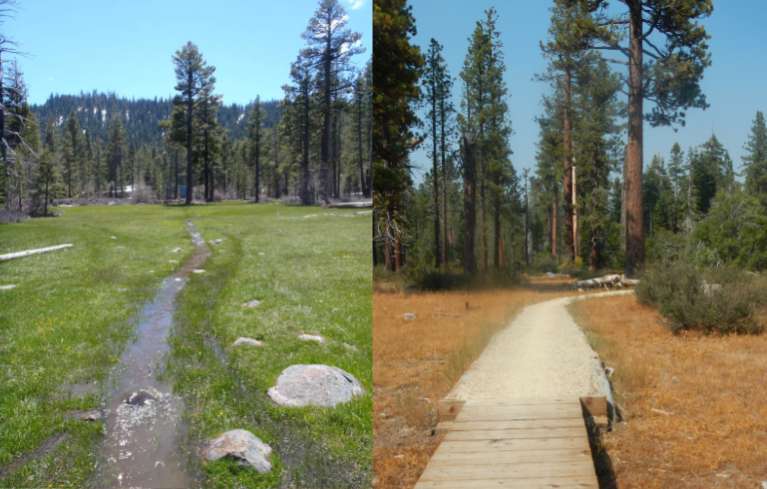
The trail through the meadow, left, before restoration; and after work was completed. Photos/Stat Parks and LTN

The trail through the meadow, left, before restoration; and after work was completed. Photos/State Parks and LTN

By Kathryn Reed

TAHOE CITY – A thick overgrown forest with logging roads that became gullies during the wet season that would then carry sediment into Ward Creek and Lake Tahoe.

That was what these 179 acres near Tahoe City were like in the early 1980s when the McClatchy family deeded the property to California State Parks.

Today, Ward Creek Park is probably the least used state park in the Lake Tahoe Basin. Restoration began in 2009, with the network of trails completed in 2012. Still to come this fall are interpretive signs.
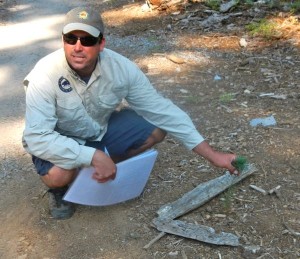
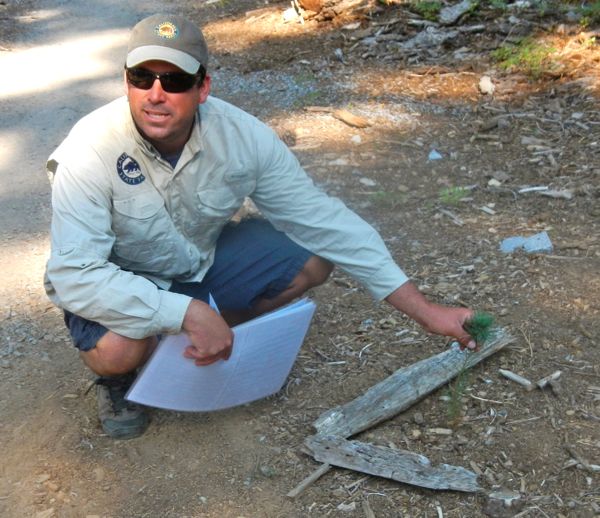
Nathan Shasha points out a newly planted sugar pine. Photo/Kathryn Reed

Nathan Shasha points out a newly planted sugar pine. Photo/Kathryn Reed

Part of the restrictions with the land is no pavement can be put in and a campground cannot be developed.

It was the Angora Fire of 2007 on the South Shore that freed up money for this project. Reducing hazardous fuels has been the mantra in the basin since then. And that is what enabled State Parks to turn this plot of land into something officials want to promote and no longer worry about being a fire hazard.

“We tried to keep the larger trees,” Cyndie Walck with State Parks explained. “There was massive thinning to decrease the fire hazard.”

This area was commercially logged in the 1930s and 1960s, so many of the large trees were already long gone.

The 12- to 15-foot-wide roads went straight up. This is just the opposite of how trails are designed, so they have been rehabbed. This will prevent erosion. And in a few years the shrubs will grow in and the rocks and logs used to make the roads impassible will not be noticeable. Much of the infill needed came from the neighboring California Tahoe Conservancy project at Blackwood Canyon. The roads in places were 2 feet below grade.

Two stands of more dense trees were left.
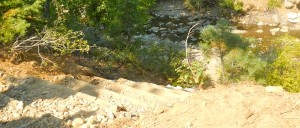
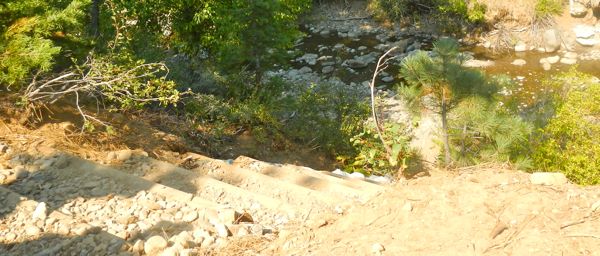
Stairs now allow access to Ward Creek. Photo/Kathryn Reed

Stairs now allow access to Ward Creek. Photo/Kathryn Reed

“The best thing for habitat is variability in age and density instead of treating the park all the same,” Walck said.

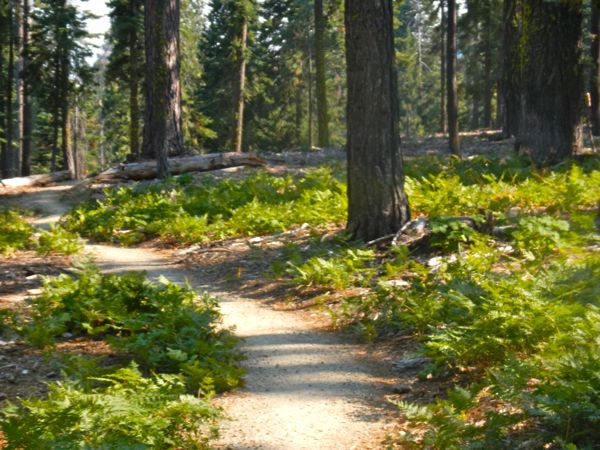
The Sugar Pine Foundation has planted thousands of trees in Ward Creek Park. And the grove of ferns adds to the diversity.

A network of about 3 miles of trails meanders through this once secret gem. While some of the user-created trails are gone, the things people like most are still there. This includes access from the bike trail along Highway 89 to the park, two locations to get to Ward Creek, and trails that connect to the U.S. Forest Service trails that lead to Stanford Rock, and a connection to the Tahoe Rim Trail. The upper part of the watershed is where the Sherwood chairlift at Alpine Meadows is.

“It’s a complete watershed with recreation,” Walck told Lake Tahoe News.

California Conservation Corps members did much of the work.
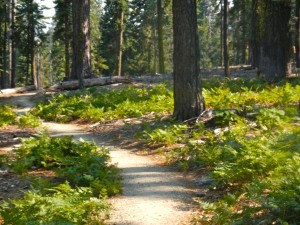
Ferns create a diverse landscape. Photo/Kathryn Reed

Ferns create a diverse landscape. Photo/Kathryn Reed

“We maintained all the major access points to the park,” Nathan Shasha with State Parks said while walking along some of the trails. He oversaw the construction.

While there is a larger loop, it’s not just one trail. Several offshoots are part of the network.

One spot leading to Ward Creek now has stairs to help with ease of access and to prevent erosion. Before people scrambled up and down a steep embankment.

The first part of the trail from the Rideout Community Center is designed to comply with American with Disabilities Act requirements.

Different types of material were used to get people across the meadow. Part is boardwalk. This elevated path allows water to freely flow under it in the spring or other wet times.

The boardwalk then becomes a turnpike that has logs on the sides and a coarse trail.

The goal was to be able to experience the meadow without impacting it.

Sod plugs have been put in to help restore the meadow.

Walck and Shasha have pictures of what the meadow looked like before the work. At times it was impassable because of the amount of water. People would ride bikes and make grooves. Water would pond.

Restoration work was designed so the water will flow more evenly, this in turn should restore the water table. And with an elevated trail it keeps people from harming the ecosystem.

—-

Notes:

• Getting there: From South Lake Tahoe, take Highway 89 north. Turn left on Timberland Lane. Turn right at the Rideout Community Center. Park. Trail starts in the right rear of the center. There is also access a bit farther up off Timberland; with a gate on the right.

• Parking is free.

• Mountain bikes OK.

• Dogs on leash OK.


Fitness retreats have nothing to do with indoor gyms

By Tyler Graham, Bloomberg

Instead of going to a gym, Erwan Le Corre climbs trees and shoulders heavy logs. And on your next vacation, he wants you to join him.

Le Corre’s Santa Fe, N.N.–based MovNat is one of a handful of fitness outfitters offering getaways centered on the notion that our Stone Age genes are a mismatch for our Google-age environment. Unlike spa-centric wellness retreats from the likes of Canyon Ranch, these strenuous multiday excursions in places such as California, Kenya and Thailand aim to reconnect the office-bound, white-collar set with the motions our bodies were intended to make in the natural world.

At MovNat’s outposts in Costa Rica, Mexico and Spain, for instance, days are spent mastering what Le Corre classifies as the basics of human movement: climbing, crawling, jumping, running, swimming and lifting. Le Corre says his approach helps reverse the damage done by our sedentary lives.

The day might begin with a group outing into the forest, where a MovNat-certified instructor teaches participants how to properly crawl through the underbrush or vault over a branch blocking a trail; later, you might find yourself lifting 50-pound logs or scaling a tree, branch by branch.

Each movement Le Corre champions engages the entire body, he says, rather than targeting a specific muscle group like most gym workouts. If a client is unable to perform a given activity, trainers will modify the task accordingly.

The 150 spots at this year’s PrimalCon, as the event is known, sold out almost immediately, spurring him to add dates in South Lake Tahoe and Austin.

Read the whole story


Walkabouts slow to catch on in United States

By Sam McManis, Sacramento Bee

Atop Wolf Ridge on a clear day in the Marin Headlands several years ago, Tom Courtney paused to take in the view. Hikers always stop there, mostly to gawk at the Pacific Ocean to the west and Mount Tamalpais to the north, but also to catch their breath after a steep climb.

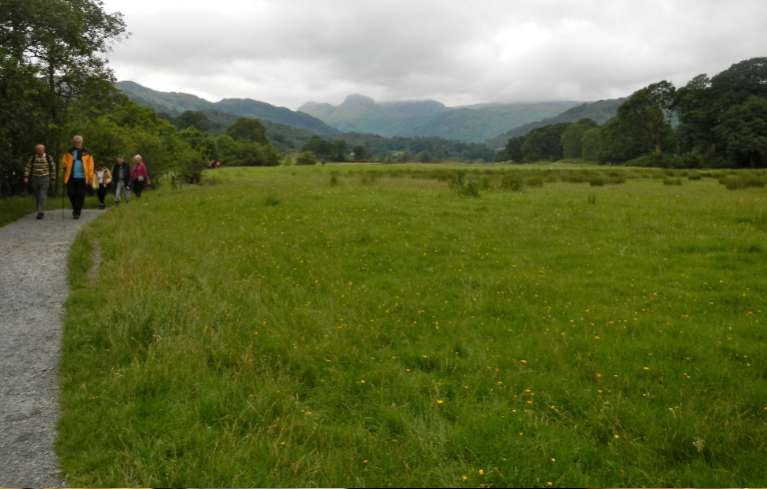
Going on walkabouts in England is common. Photo/LTN file

Going on walkabouts in England is common. Photo/LTN file

But Courtney had other reasons for peering pensively into the distance that day. Once, years before, he had completed a multiday hike in the Cotswolds in west-central England, hoofing it from inn to inn as part of a pastime Europeans call “walkabouts.”

So, as he gazed beyond verdant Tennessee Valley and over Mount Tam’s foothills, he wondered whether it was possible — logistically, not athletically — to string together a “walkabout” from Rodeo Beach to Point Reyes without resorting to pitching a tent and camping. Nothing wrong with roughing it, of course, but occasionally a guy likes to soak his weary feet in a hot tub, sip a fine Merlot alongside a juicy steak, and sleep in high-thread-count sheets along the way.

Read the whole story


USFS, Coke agree to watershed protection deal

By Tammy Webber, AP

CHICAGO — The U.S. Department of Agriculture and Coca-Cola signed a five-year agreement Friday to restore watersheds that have been damaged or altered by development, wildfires and agriculture as part of an initiative to slow runoff and replenish groundwater on federal lands.

Such efforts are increasingly important to corporations and farmers who rely on water and to tens of millions of people whose drinking water originates in the national forest system, Agriculture Secretary Tom Vilsack said. But federal budget cuts and the wide scope of the problem have the USDA turning to partnerships with nonprofit groups and corporations for help.

“We need to look creatively at ways to leverage our resources or attract outside resources,” said Vilsack, who along with Coca-Cola Americas President Steve Cahillane will announce the partnership at the Midewin National Tallgrass Prairie outside of Chicago. A wetland at the 18,000-acre site is being restored by removing old agricultural drain tiles that divert almost 14 million gallons per year into waterways — and eventually down the Mississippi River — rather than allowing it to soak back into the ground.

It’s one of six projects that Coca-Cola has helped fund through a pilot program with the USDA’s U.S. Forest Service over the past two years, said Chris Savage, assistant director of the agency’s Watershed, Fisheries and Wildlife office. Others included restoring a wetland in the Sierra Nevada Mountains that helps supply water to San Francisco and restoring the landscape along Colorado’s South Platte River that was devastated by fire a decade ago.

Under the new agreement, the company and the Forest Service will work with two nonprofit foundations — the National Forest Foundation and the National Fish and Wildlife Foundation — to identify projects on federal lands. Corporate funding will go through the foundations, which also contribute money to the projects, officials said. There is no specific amount committed to the projects, but Vilsack said he expects “millions” will be spent.

Coca-Cola will emphasize projects that can be done fairly easily and improve resources in areas where the company withdraws water for production, said Bruce Karas, the company’s vice president of environment and sustainability for North America.

“Water stewardship is a key focus because … it’s in every product,” Karas said, adding that the company has pledged by 2020 to replenish as much water as it uses. The company has worked with universities and other organizations in the past, but partnering with the USDA could help it get the most from its investment because national forest lands often are the headwaters for important watersheds, Karas said.

The importance of restoring watersheds can’t be overstated, especially with climate change leading to weather extremes such as flooding and drought — and potentially more frequent and larger fires — at the same time manufacturers, residents and farmers increasingly compete for water, Vilsack said.

That’s particularly true in the West, he said, where wildfires have stripped the land of trees and other vegetation that once helped absorb water. The land, he said, “hardens like cement so rain runs off in a torrent” with ash, sludge and debris that makes its way into rivers and reservoirs. What’s more, the drinking water for about 60 million Americans originates in the national forest system.

“It’s about the quantity of water and availability,” he said.


National parks try to attract more diverse visitors

By Kirk Johnson, New York Times

LA PUSH, Wash. — Thrusting out into the Pacific Ocean, Olympic National Park can feel like a lost world, with its verdant forests, violent surf and cloud-shrouded peaks.

But to the four women who hiked down to the sand one recent afternoon, there was an added element of strangeness: race.

“We’ve been here for two days, walking around, and I can’t think of any brown person that I’ve seen,” said Carol Cain, 42, a New Jersey resident of Dominican and Puerto Rican roots, who was zipped up tight in her hooded, dripping rain jacket.

The National Park Service knows all too well what Cain is talking about. In a soul-searching, head-scratching journey of its own, the agency that manages some of the most awe-inspiring public places is scrambling to rethink and redefine itself to the growing number of Americans who do not use the parks in the way previous — mostly white — generations did.

Only about 1 in 5 visitors to a national park site is nonwhite, according to a 2011 University of Wyoming report commissioned by the Park Service, and only about 1 in 10 is Hispanic — a particularly lackluster embrace by the nation’s fastest-growing demographic group.

Read the whole story


Nevada bear hunting season to begin

Bear hunting season in Nevada begins Sunday and goes through Dec. 31.

Twenty bears can be killed in that time period per state regulations.

This is the third year Nevada has allowed bear hunting. When the season is over the Nevada Wildlife Commission plans to analyze how the hunts have gone.

Fourteen bears were killed in 2011 and 11 in 2012.

California and other Western states have allowed bear hunting for years.