Bear activity increasing; fruit trees an issue

Bear activity has taken a sharp increase in recent days as hungry black bears expand their search for food, according to the Nevada Department of Wildlife.

Areas near Yerington in Lyon County, the Topaz Ranch Estates and the Minden-Gardnerville area of Douglas County and the foothills of Reno have all seen bears Monday, Tuesday and Wednesday.

“We have four traps and they are all out and set,” said warden Lt. Mike McCusker of NDoW. “The goal is to trap these bears, perform aversive conditioning and release the bears, unharmed but chastened, back into the wild.”

The bears are targeting garbage, but ripened fruit from area trees is also a strong attractant this time of the year. Fruit on the ground should be picked up as soon as possible.


Law mandates vehicles give cyclists more room

By David Siders, Sacramento Bee

Gov. Jerry Brown has signed legislation requiring motorists to give bicyclists at least 3 feet of space when passing on a California roadway, after vetoing similar legislation during the last two years.

Assembly Bill 1371, by Assemblyman Steven Bradford, D-Gardena, requires motorists to slow down if they can’t give room and makes failing to comply an infraction punishable by a base fine of $35.

The new bill will take effect in September 2014.

Read the whole story


Regional sports hall of fame to add 4 members

The Reno Tahoe Winter Games Coalition will honor premier sports figures and their endeavors at the third annual Reno Tahoe International Sports Hall of Fame dinner gala on Nov. 23 at the Atlantis in Reno.

The four inductees are:

· Pam Buckner: Born and raised in Northern California, Buckner moved to Reno in the early 1980s during the prime years of her career on the women’s pro bowling tour. By then her legend on tour had already been cemented.On Aug. 26, 1979, during a national tournament in suburban Detroit, Buckner became the first woman in competitive bowling history to roll back-to-back perfect 300 games. The lefthander captured numerous titles while also representing Ebonite as a national bowling equipment sales manager. She has coached hundreds of kids to bowl in Reno since moving here in 1981 and still does so at the High Sierra Lanes, which also hosts the annual Pam Buckner Open.

· Rusty Crook: Crook’s athletic endeavors started early. While attending Reno High School he became a state diving and pole vault champion. He was a member of the University of Denver NCAA championship ski team before returning to the University of Nevada where he competed in gymnastics and skiing. Crook is a retired Washoe County School District physical education teacher and also coached a variety of sports during his 30-year tenure. He is the founder and former director of the Mt. Rose Falcon Ski Team and former technical director of the junior ski program. Crook has earned several state and national distinctions for his skiing and track and field instruction.

· Frank Hawkins: Born and raised in Las Vegas, Hawkins earned a full football athletic scholarship to the University of Nevada in 1977 after his graduation from Western High School in Las Vegas. Hawkins became the first of a long line of “Nevada Backs” in Chris Ault’s high-octane offense. A four-year starter, “The Hawk” amassed 5,333 rushing yards, the fourth highest total in college football history. A three-time All-American, Hawkins was drafted by the Oakland Raiders in 1981 and played for the team during his entire seven-year football career, highlighted by his role as the starting fullback for the 1983 Super Bowl champion Raiders after their move to Los Angeles. Upon retirement, Hawkins returned to his native Las Vegas and was elected to the City Council. He owns a company that builds affordable housing in low-income neighborhoods and is the president of the Las Vegas NAACP.

· Bob Tallman: Born in Winnemucca, Tallman learned the cowboy way. Realizing his future wasn’t in athletics but rather in talking about them, Tallman found his way to becoming an announcer on the rodeo circuit. Tallman announced his first event, an amateur rodeo, in his native Winnemucca in 1970 and within five years was on the microphone at the National Finals Rodeo. He revolutionized rodeo announcing by painting a picture for fans rather than just blurting out a name and a result. Tallman has been enshrined in numerous regional and national rodeo Hall of Fames and has recently cut back his schedule to allow for other endeavors including spending time tending the family ranch in Poolville, Texas, his online meat seasonings business and The Bob Tallman Charities Foundation that raises funds for a Houston area pediatric hospital and a cowboy crisis fund.

· Scholastic Achievement Awards: This honor, created in 2012, is awarded to deserving athletes, teams or schools recognized for their accomplishments in the field of play and/or the classroom and the community. Receiving the honor this year is:

Jack Rovetti and Drew Rippingham: These two young athletes became fast friends as teammates on the Swope Middle School track and field team. Both eighth-graders during last school season, Rovetti, who has Down’s syndrome, was befriended by Rippingham at the beginning of the season but it was the final race of their season that cemented both in the hearts and minds of all those who love sport for its purest of reasons – camaraderie and sportsmanship.

· Special Recognition: Leland Hernandez: This longtime Reno resident has devoted decades of time, talent and “treasure” to promote and enhance sports in Reno-Tahoe. Hernandez was a longtime co-owner of the Class-A Reno Silver Sox minor league baseball team that called Moana Stadium home. Since the early 1990s he has been a staunch supporter of the region’s efforts to bring the Olympic Winter Games back to Reno-Tahoe. Hernandez remains an honorary member of the highest order to the Reno Tahoe Winter Games Coalition.

The event begins at 5:30pm. Reserve tickets by calling (775) 622.1889.


Snowmaking may not save ski resorts

By Jakob Schiller, Powder

The first time I went to my local ski area last year — Sipapu Ski and Summer Resort in northern New Mexico — there was one run open and almost all the snow was man-made. To any bird flying over it must have been quite a scene: a mostly brown hill with a thin, continuous patch of white running from top to bottom.

But there I was, season pass in hand, anxious to put skis to snow. I’d waited all summer to strap on my boards and it seemed more important to finally be making turns than to worry about what it all meant. I was hungry. Still, the question lingered in the back of my head: What was the cost of this absurdity?

Porter Fox, whose book “Deep” was excerpted in the September issue of Powder, says the snowpack in the Cascades is down 20-40 percent because of climate change. Here in the Rockies, the spring snowpack is down 20 percent. Climatologists estimate that two-thirds of ski resorts in Europe might have to close by 2100 and only four of the 14 major resorts on the East Coast might be afloat at that same time.

According to a report cited in a study released by Protect Our Winters and the Natural Resources Defense Council, “Park City, Utah will lose all mountain snow pack by the end the century while Aspen Mountain, Colorado snowpack will be confined to the top quarter of the mountain under a higher emissions scenario.”

To compensate for a lack of snowfall that has already dramatically declined, 88 percent of North American ski areas make snow, although according to an article in High Country News, some resorts are trying to mitigate the impacts as best they can. Heavenly Mountain Resort uses computers to run its snowmaking operation, which helps make it more efficient. And Loveland Ski Area in Colorado has found a way to capture the runoff from its manmade snow and store the water so it can be reused. Both strategies are creative, but no amount of computerization or runoff capture will offset the amount of snow these large areas will need to make and the battles that will be fought over the water to make it.

Snowmaking is already a contentious issue in the West and several recent cases point to the kinds of problems that will undoubtedly crop up as other resorts turn to snow cannons to make sure they have enough snow on the slopes for opening day.

Read the whole story


Fire restrictions lifted in Lake Tahoe Basin

The U.S. Forest Service Lake Tahoe Basin Management Unit lifted fire restrictions on national forest lands today.

“The arrival of cooler, wetter weather brings safer conditions and has allowed us to lift restrictions on Forest Service managed lands,” Forest Service Fire Chief Kit Bailey said in a press release. “Even though restrictions will be lifted, we still need hikers and campers to use caution with campfires, stoves, barbecue grills and cigarette smoking.”

While fire restrictions imposed in the summer will be lifted, the Lake Tahoe Basin Management Unit adopted a set of fire regulations in 2004 that restrict where campfires are allowed year-round. Most of the Lake Tahoe backcountry is “stove only” with a valid campfire permit. This regulation applies within the Desolation Wilderness, where a stove only regulation has been in place for more than 10 years.


Safety concerns remain at American Fire site

The snow and rain that fell on the American Fire area over the weekend did not put the fire out. Smoke is still evident, especially in the northeast corner of the fire near Cavanah Ridge and Robinson Flat.

The area near Foresthill is still hazardous, and consequently the closure order is still in place. Officials are citing multiple violators daily and escorting them from the fire area.

Private landowners are being issued day passes on a case-by-case basis based on current fire activity and location.

Crews are extinguishing hot spots near containment lines and patrolling the perimeter. The first stage of suppression repair work is finished. The initial Burned Area Emergency Response (BAER) emergency stabilization measures within the fire area will begin as soon as possible.

Smoky conditions will fluctuate with weather changes. People traveling on open roads near the fire area for recreation or other purposes may also experience extra traffic and intermittent smoke.


Petanque growing in popularity in S. Tahoe

Tony Lyle won Lake Tahoe Petanque Club’s inaugural competition.

After a tightly fought game, Lyle beat Steve Heslop in the finals of the adult singles class.

In an ironic coincidence Scott Heslop (son of Steve Heslop) defeated Noah Lyle (son of Tony Lyle) to be crowned champion in the junior class. The competition was Sept. 22.

Jessica Williams plays a round of petanque. Photo/Provided

Jessica Williams plays a round of petanque. Photo/Provided

Petanque takes about 20 minutes to learn, is not too physically demanding and can be played on a range of surfaces, except grass, concrete or asphalt. Petanque or boules, as the game is also known, are not the same as bocce ball, but similar. Bocce is of Italian descent and is more of a bowling game. The French game of petanque is more of a tossing game. Bocce balls are rolled palm up whereas petanque balls or boules are thrown palm down to get a backspin. Petanque boules are about the size of an orange.

The club has been meeting weekly during the summer at members’ private homes. The goal is to create a public location for the club to meet and play.

The club is affiliated with the Federation of Petanque USA and the International Federation of Petanque and Jeu Provencal (FIPJP). The Lake Tahoe Petanque Club is an informal, casual club and welcomes players of all abilities, ages and nationalities. For more information visit the club website.


Kids fun runs part of annual marathon events

As part of the Lake Tahoe Marathon, the Optimist Club is putting on a free set of Kids Fun Runs at Pope Beach on Sept. 28 starting at 2pm.

The kids start at the finish line gantry of the regular finish line of the Sunday marathon races.

Age divisions are 1 to 13. Distances are from 30 yards for the toddlers to one mile for 13 year olds. Boys and girls have separate divisions.

Sign up at Pope Beach starting at 1pm. Races start at 2pm with the toddlers.

Optimists will supply finishers medal to all kids, hot dogs and drinks. All of this is free.

There is limited parking inside Pope Beach for this event.

Most will have to park outside and walk in or bike in.


Ironman veterans win inaugural Lake Tahoe event

An Australian and a Swede won the inaugural Ironman Lake Tahoe on Sunday.

Chris McDonald earned his sixth Ironman crown with a finish time of 8:55:14, while Asa Lundstrom earned her second title with a time of 9:58:53. Both the men’s and women’s pro races were not determined until late in the race.

While the day started in the dark and finished in the dark for some, it wasn’t snowing or raining like the day before. The route did impact motorists, with it taking some people three hours to get from Zephyr Cove to Truckee because of road closures and congestion.
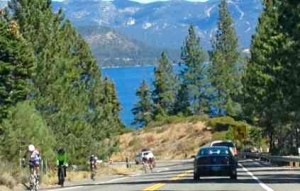
Cyclists pedal hard during the inaugural Lake Tahoe Ironman on Sept. 22. Photo/Kathryn Reed

Cyclists pedal hard during the inaugural Lake Tahoe Ironman on Sept. 22. Photo/Kathryn Reed

In the men’s race, emerging out of the settled mist on Lake Tahoe, Romain Guillaume (FRA), Joe Gambles (AUS), Paul Ambrose (AUS), Maik Twelsiek (GER) and Matt Lieto (USA) came out of the water within 13 seconds of each other.

On the bike, Twelsiek took control of the men’s race as he forged his way to the lead late in the first half of the bike. Gambles appeared content to shadow Twelsiek until McDonald (AUS) and Guillaume forced the pace. Coming into transition, Twelsiek carried a tentative 1:30 advantage over McDonald, while Gambles slipped to well over six minutes off the leaders pace over the late miles of the bike.

Hitting the run, Twelsiek looked strong and held the lead throughout the first 13 miles, however the German succumbed to McDonald’s relentless pressure from behind just before mile 14. Twelsiek hung on to second with his 8:57:53 clocking, while Gambles finished third with his 9:02:55 clocking.

In the women’s race, veteran Dede Griesbauer (USA) celebrated her 42nd birthday by dominating the swim and carried a 4:50 advantage over Catriona Morrison (GBR) and over six minutes on Angela Naeth (CAN), Jeanne Collonge (FRA), and Lundstrom (SWE).

Griesbauer relinquished the lead to Lundstrom after 25 miles, with Morrison, Naeth and Collonge biking strong and closing the gap to the front of the race. The field jockeyed for position behind Lundstrom throughout the remainder of the race but it was Lundstrom who dismounted her bike first, with Collonge following her into T2 a half minute back, while Naeth found herself coming off the bike in third in her first Ironman, 4:12 off the leaders pace.

Lundstrom initially built up over a two minute advantage over Collonge in this first three miles but the lead didn’t last long as Collonge ran her way into the lead at five miles. The battle between the two waged on for the remainder of the run that saw Collonge’s lead expand at one point to over two minutes. Lundstrom’s perseverance proved to be her asset as she clawed her way back to the front of the race, and had eliminated all but 20 seconds as the women’s race reached 24 miles. Collonge surrendered the lead to Lundstrom in the final mile of the run, and went on to claim the victory. Coming into the finish line chute in second, Collonge finished with a 9:59:43 time, just 51 seconds short of the win. Closing the podium was Morrison with her 10:03:38 finish time.

The race included a two-loop, 2.4-mile swim in Lake Tahoe at King’s Beach. Athletes went through a lakeside transition before starting a two-loop 112-mile bike course that traveled along the lake into Tahoe City before following the Truckee River past Squaw Valley and into the town of Truckee. From there, the course turned south back toward Lake Tahoe, had a short loop in Martis Camp, continued past Northstar and climbed to Brockway Summit. After a descent back down to Kings Beach, athletes completed a second loop, and then a final, flat 17 miles to finish the bike course at Squaw Valley. With a transition at Squaw, runners proceeded along the Truckee River bike path into Tahoe City, and continued south along the shores of Lake Tahoe to a turnaround in Homewood and finishing at the Village at Squaw Valley.

The event offered a total professional prize purse of $75,000 and 50 coveted slots to the 2014 Ironman World Championship, taking place on Oct. 11 in Hawaii.

— Lake Tahoe News staff report


More logging in national forests approved by House

By Richard Simon, Los Angeles Times

WASHINGTON — In response to fires that have ravaged the West this year, the House on Friday approved a bill that would expand logging in national forests despite a White House veto threat.

The measure, which would impose limits on environmental reviews to speed timber-cutting projects, was approved by the Republican-controlled House, 244-173, on a largely party-line vote.

The bill would more than double timber harvest levels nationwide to roughly 6 billion board feet of timber for sale each year, up from the average of 2.5 billion board feet sold annually in recent years.

It would significantly affect California with its 18 national forests that take in more than 20 million acres. About 5 million acres of California forest are suitable for harvest. Currently, about 22,000 acres are logged in the state, a number that would likely increase if the measure became law.

Read the whole story