Time to plant sugar pines in Tahoe

The Sugar Pine Foundation has a series of community plantings and student plantings planted for the fall.

Volunteers are needed to help plant. The group provides seedlings, tools and gloves for all plantings.

Here are the dates:

  • Oct. 19, 10am-noon, Tahoe City: Community planting at Beverly Drive and Clayton Way. Tahoe City Rotarians are sponsoring the planting.
  • Oct. 20, 10:30am-1pm, Truckee: Truckee River Day planting at Waddle Ranch. Meet at the airport parking lot and carpool. This is sponsored by the Truckee Tahoe Airport and Northstar Properties.
  • Oct. 21, 1-3:30pm, South Lake Tahoe: Environmental science and ecology students will plant at the Lake Tahoe Community College campus. Sponsored by photographers Josh Marianelli and Corey Rich.
  • Oct. 22, 9am-1pm, North Tahoe Middle School. One hundred sixth-graders will participate in a field day of planting, and learning about seed dispersal and erosion control.
  • Oct. 22, 1:30-4pm, Incline Village: Sierra Nevada College environmental science class planting.
  • Oct. 24, 10am-2pm, Incline Village: Lake Tahoe School Planting at Sand Harbor. Thirty fourth- and fifth-graders will be planting and learning junior botany.
  • Oct. 26, 10am-noon, Stateline: South Shore community planting near the old Kingsbury Middle School. Plant alongside Starbucks employees. Sponsored by Plant Trees 4 Life.
  • Oct. 27, 9:30am-noon, South Lake Tahoe: Join city volunteers in planting trees near Lake Tahoe Airport. A shuttle bus will take volunteers from the airport to the planting site.
  • Oct. 28, 10am-noon, Zephyr Cove: Thirty-five Whittell High science students will take part in a planting at Zephyr Cove Park.
  • Oct. 31, 10am-1pm, El Dorado County: Fifty South Lake Tahoe sixth-graders will plant and learn junior botany near Golden Bear Drive.
  • Nov. 1, 10am-1pm, El Dorado County: Fifty more South Lake Tahoe sixth-graders will plant and learn junior botany near Golden Bear Drive.


Tips for having fun outdoors with dogs

By Peter Dickson

You and your dog want to get out in the woods and go camping. You’ve decided you want to bypass the boring campsites offered at the usual places and head off the beaten path. The backcountry, the hinterlands — call it what you want, but you’ll need a few tips to make sure that you and your dog will have a memorable outdoors experience so far from home.

Leash or not?

Leashing your dog depends on his or her temperament and training. If your dog will stick close to you and come when you call, it might be all right to go without. But if your dog has a tendency to take off on its own, then obviously you’d better have it on a leash — one that’s heavy duty enough to handle the rigors of navigating the terrain. Alternatively, you could try one of the newer models of electronic dog training collars. They’re not intended to train a dog to perform a command that they don’t already know, but rather to enforce ones already learned, enabling you to keep your dog close and under control.

Water: Do you have enough?

Water is heavy, weighing in at a little over eight pounds per gallon. You’re going to need a lot of it yourself, and your dog — after running around the whole forest chasing chipmunks — is going to be thirsty. You might be leery about letting your dog drink out of the creek or that stagnant puddle, but really, they were made to do that kind of stuff. If you don’t like the idea of letting your dog do that, haul in a few gallons. Bring some iodine tablets or a filter to purify the water.

Make sure shots are up to date

During the camping trip, your dog will be exposed to wild animals and animal feces which can carry parasites. It could be a squirrel, raccoon, possum or just a tick. Talk to your vet and make sure your pup is protected.

Make him carry his load

Hey, the dog can carry stuff too. They actually make load-carrying outfits for dogs. And why not? Some breeds haul sleds through the frozen north, so you can at least make them carry their own food and water. They’ll understand.

Pack out poop

Some environmentally minded outdoors enthusiasts advocate carrying a pooper-scooper to pick up your dog’s waste, so as not to contaminate the environment. This makes good sense if you’re in an area frequented by other people, but if you’re roughing it off the beaten path, isn’t dog poop kind of environmentally friendly?

Above all, you know what’s best for your dog. Use some common sense, and have fun.

Peter Dickson is a hunter and outdoorsman who travels as a consultant for sustainable game reserves. When he is not working, he enjoys writing about nature and the outdoors.


No need for ski lodging with tricked out van

By Kade Krichko, Outside

Lars Chickering-Ayers, the runner-up of the 2011 Subaru Freeskiing World Tour and winner of 2013’s Kirkwood stop of the Freeride World Tour is a van life vet.

For years he and his brother, Silas, have traveled around North America to FWT stops in a souped-up 1993 Ford E350 dubbed “The General.”

“We designed [the General] to travel around the World Tour because we wanted to get ourselves and our gear pretty much anywhere,” he says. “Basically it’s fun and it’s convenient.”

Chickering-Ayers represents a growing number of skiers and snowboarders using vans to carve out prime slope access. What their vehicles lack in indoor plumbing and kitchen convenience, they make up for mobility, making them an ideal option for those that live life one winter storm at a time.

Some resorts like Squaw Valley offer free overnight parking for 72 hours (except on storm days).

Read the whole story


Bears making themselves known in Western Nevada

Bear sightings have been heavy this weekend throughout much of western Nevada.

West Reno has two bear traps set in the Caughlin Ranch-Mayberry-Juniper area. Residents on the west side of Carson City have called Nevada Department of Wildlife officials on Saturday and Sunday mornings with reports of a black bear visiting backyards. In Gardnerville, a bear up a tree in a rural area near town was harassed by Karelian bear dogs and chased back into more traditional bear habitat.

In Yerington, a bear was trapped on Saturday and was to be released into the Pine Grove Mountains southeast of Yerington. The 6-year-old female had never been handled before by NDOW.

“She will be fitted with an ear tag and more importantly, a satellite collar and she will become part of our long-term research project studying the population of black bears in Nevada,” NDOW biologist Carl Lackey said in a statement.

The satellite collars send a GPS signal periodically to researchers who can follow the movements of the bears fitted with such collars.

“These movements tell us what habitats the bears utilize, where the females give birth to their cubs and a myriad other details on the bear’s lives that we could only wish to know just a few years ago,” Lackey said.

Bear activity in western Nevada is expected to be “busy and active” for at least the next month. Sierra Nevada black bears usually go into hibernation in between Thanksgiving and Christmas as food sources become harder to find.


Tahoe women set to summit, ski Mount Kenya

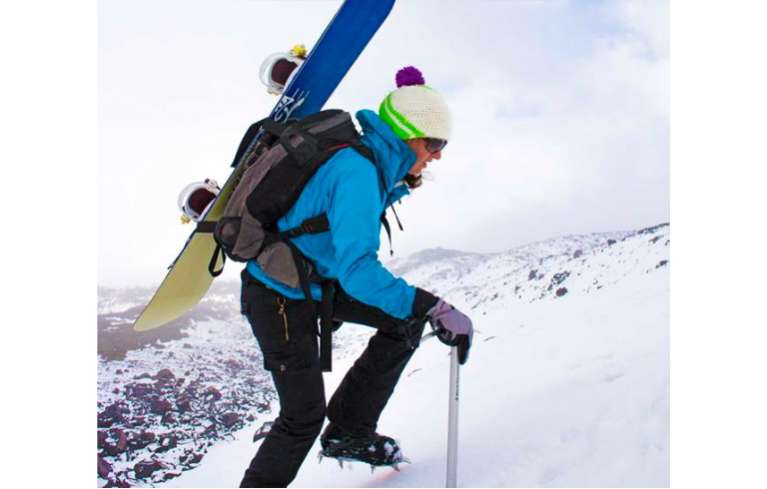
When most people think about Africa, they don’t think of snow. Two Lake Tahoe women will change that as they attempt to summit and ski Mount Kenya in November.

They are climbing to make a statement about climate change and raise funds for micro-loans in an expedition they call Summit for our Sisters.

Mount Kenya is home to the first and only skiing competition in the country, which was in 1936. Africa’s second highest mountain after Kilimanjaro, it rises above the country’s highlands to 16,355 feet. Due to recent global warming trends, only a handful of mountain enthusiasts have accomplished this trek on Lewis Glacier, one of the last permanent snowfields in Africa. Studies show the snow and ice on the volcanic peak of Mount Kenya are melting away so fast scientists estimate they will disappear in the next two or three decades.

Jen Gurecki trains for her Africa expedition. Photo/Provided

Jen Gurecki trains for her Africa expedition. Photo/Provided

Given this trend, Jen Gurecki and Meghan Kelly are following their passion and jumping on the opportunity to become part of the select few to accomplish such a large feat. The expedition, sponsored by Coalition Snow, an emerging ski and snowboard company for women, and will benefit Zawadisha.

The Zawadisha Fund is a micro-credit organization started in Lake Tahoe, whose mission is to empower, entrust, and expand opportunities for women in Kenya.

“The women I work with in Kenya are incredibly impacted by climate change. Many of them are farmers and other sell food staples at the local market. Drought, caused by climate change, leads to less productive crops, decreasing daily incomes and increasing food costs. While I sit and contemplate the effects of climate change, these women are living it day in and day out,” Gurecki said in a statement. “At Zawadisha, we are actively developing strategies on how we can support our members in adapting to climate change. Through this expedition we are hope to raise awareness about the issue, while also raising funds for the small business loans Zawadisha provides to women living in poverty.”

Kelly added, “At Coalition Snow, we’re passionate about three things: snowsports, women’s empowerment, and the environment. The expedition to Mt. Kenya combines all three and really shows the world what we’re all about. While we partner with Zawadisha, we hope to share our experiences in entrepreneurship with the micro-loan recipients and learn from their experiences. We’re environmentally and socially conscious, but we’re also unique in the snowsports industry — we’re launching a skiing and snowboarding company in Africa.”

The two adventurers have been passionate about playing in snow since moving to the Sierra Nevada nearly a decade ago. They also have been equally passionate about empowering women, both locally and internationally.

Note: Summit for Our Sisters fundraising campaign begins Oct. 14. More information is online.


History in the middle of an alpine meadow

Meiss Meadow with the old house and barn in the distance. Photos/Kathryn Reed

Meiss Meadow with the old house and barn in the distance. Photos/Kathryn Reed

By Kathryn Reed

A golden meadow stretches for what looks like miles. It’s barren and beautiful at the same time. Stevens Peak (10,059 feet) and Red Lake Peak (10,063) are nearby.

A cabin and barn are remnants of civilization from an era long gone.

Meiss Meadow.

Besides being the starting point of the Upper Truckee River, this section of Alpine County was once bustling with cattle.

A couple women on horseback offer a glimpse of what this area might have been like a century ago. Hitching posts are still out front.

Water flowing in the river behind the house is good for the dogs that have come along with their people.

The buildings were constructed by Louis Meiss (pronounced mice) who emigrated from Germany in the 1800s with his parents. Meiss bought 1,000 acres – which included what is now known as Meiss Meadow – in 1878. It was all about cattle crazing at that time.

In 1936 the land was sold to another family. In 1965 the U.S. Forest Service acquired the property. The structures are of historical significance.

Today is it a hikers paradise. There are a few ways to get to Meiss Meadow – after all it is an intersection of the Pacific Crest and Tahoe Rim trails. For those on the PCT, they have 1,000 miles to get to Mexico or 1,400 more miles and they’ll be in Canada.

We started on a recent Sunday from Big Meadows trailhead off Highway 89. Signs of fall are evident from the start as aspens and other flora are turning shades of yellow.

Big Meadows never disappoints. It’s like being in a bowl of beauty with 360-degree views of Sierra serenity.

But the trail in front of us is a bit congested even though it’s the off-season. Mountain bikers and horses share this trail with those on two legs. Numerous backpackers are headed home, most having stayed overnight at Dardanelles Lake. Once we get beyond the turn off for that lake we see very few people. We are headed toward Round Lake.

We don’t fish, but reports are those with poles can find Lahontan cutthroat trout at Round Lake.

We stop briefly for a bite to eat and to let AJ have a swim. The chill in the air and slight breeze have us moving on soon.

The terrain after Round Lake changes from typical Tahoe pines to a more expansive, openness with varied foliage. It feels a bit more like the Alps with the meadows at this elevation. Though at the same time thoughts of “Little House on the Prairie” come to mind.

We stop again at Meiss Meadow; by the barn to enjoy the scenery. Then we walk a short ways toward Carson Pass to see the golden grasses in that section of the meadow. It’s almost like there is too much to see, that you want to stay a little longer to make sure you capture it all in your mind. It’s both peaceful and rugged.

—-

Notes:

• It is 2.7 miles from Big Meadows trailhead to Round Lake, 2 miles from Round Lake to Meiss Meadow. And it’s another 2 miles to Showers Lake from the meadow.

• To get there from South Lake Tahoe, take Highway 50 west, turn left onto Highway 89 toward Hope Valley. The Big Meadows trailhead parking is about 4 miles from the intersection of highways 50 and 89. The trailhead is back down Highway 89 on the other side of the road. There are a few wide spots to park on the highway.

ngg_shortcode_0_placeholder (Click on photos to enlarge.)


Old South Shore campground being rehabbed

By Kathryn Reed

TAHOE CITY – While work has been going on at the 8.117-acre former Tahoe Pines Campground since the California Tahoe Conservancy purchased it for $4.018 million in 2008, more substantive improvements could come late next summer.

The CTC board at its September meeting was given an overview of what staff is contemplating to do to this area long the Upper Truckee River in Meyers. Definitive plans will be forthcoming at the March or June meeting at which time funding will be sought.

The former Tahoe Pines Campground includes 915 linear feet along the Upper Truckee River. Photos/Kathryn Reed

The former Tahoe Pines Campground includes 915 linear feet along the Upper Truckee River. Photos/Kathryn Reed

Peter Eicher, who is spearheading the project for the CTC, said a guesstimate at this time is about $400,000 will be needed.

“There will be a lot of ripping out of old pavement, and (adding) new pavement and a new bridge,” Eicher told the board at the quarterly meeting. It’s likely the bridge will not be built for vehicle use.

The goal is to provide river access for the public. While people could put in there to kayak or canoe along the Upper Truckee River, that isn’t going to be encouraged. This is because this section to Elks Club is more difficult to navigate, includes snags across the river and the need to potentially dodge golf balls.

A trail to the river is planned, along with casual spots to sit. No restroom facilities will be installed. A gate will prevent access during the winter – at least to vehicles. About 12 parking spaces are planned.

Eicher said his crew is trying to strike a balance of providing access, but not needing to provide daily maintenance to the area because the Conservancy doesn’t do that sort of thing. It is considered a low-level use site.

Making the land function better is a primary goal.

In 1932 Alma Mater started the campground. From 1983 until when the CTC bought the land the Poulen family ran it. Little evidence of the 59 campsites remains.

When the Conservancy board was given a tour of the area in 2008, Greg Poulen told many stories about the flood of 1996. A loud clang would echo through the campground. Another barbecue pit had been dislodged and was banging along the rocks in the raging river.

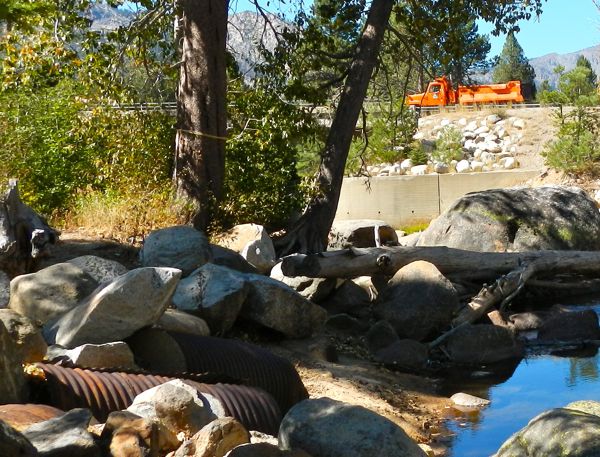
A cement filled culvert, foreground, is near the river. And vehicles on Highway 50 roar by the property.

A cement filled culvert, foreground, is near the river. And vehicles on Highway 50 roar by the property.

What is left today is compacted and disturbed land, a bridge that is sketchy at best, concrete filled culverts, and boulders in the river.

The Conservancy has put up some fencing, has taken down trees and is already seeing vegetation start to naturally re-establish in some locations.

“This area is prone to flooding. Our designers are looking at that,” Eicher said. The floodplain will be worked on so the groundwater table rises and the ecosystem works in a way that would be reminiscent to before the campground was put in.


Hikers retrace portions of Donner Party’s trail

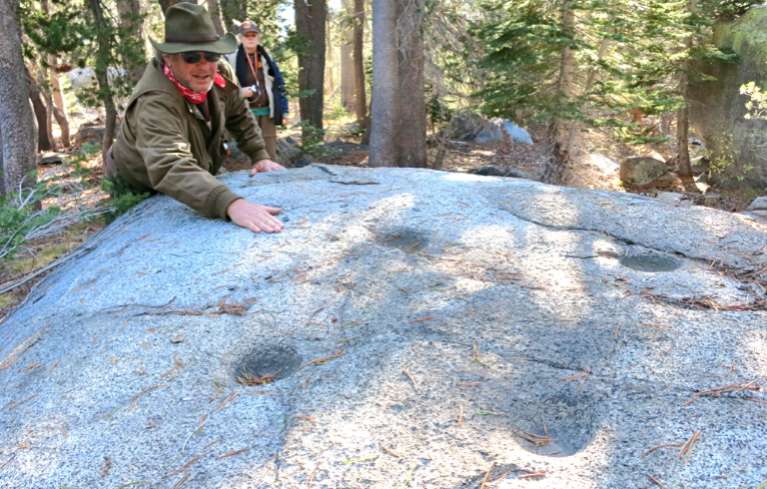
Guide Greg Zirbel points out the mortars on a granite boulder. Photos/Jessie Marchesseau

Guide Greg Zirbel points out the mortars on a granite boulder. Photos/Jessie Marchesseau

By Jessie Marchesseau

TRUCKEE — The thermometer read 32 degrees when I pulled into the Sugar Bowl parking lot. It was 8am on the first Saturday in October, and summer was obviously over.

Sugar Bowl’s Mt. Judah lodge was the launching point for the 21st annual Donner Party Hike. The yearly event offers a variety of guided interpretive hikes giving participants a chance to explore Truckee’s abundant mountain trails while getting in a history lesson at the same time.

Included in the weekend event is an afternoon speaker. This year it was Ethan Rarick, author of “Desperate Passage – the Donner Party’s Perilous Journey West”. Sunday’s activities included a walking tour focused specifically on the Donner Party and entrance to the Emigrant Trail Museum.

The seven hikes available on Saturday provided hikers with options ranging from 3.5 to 6 miles in a variety of skill levels.

I chose the four-mile Summit Meadows hike. New to the roster this year, the route explores the Summit Valley, also known as Lake Van Norden. The area is part of a 2,900-acre parcel of land acquired this year by the Truckee Donner Land Trust.

Kathy Hess, Donner Party Hike event coordinator, said they add, subtract and change hikes frequently to keep things fresh for the hikers who return year after year. Of this year’s 200 hikers, Hess said about 90 percent are from out of town. A little nip in the air was not going to keep them away, in past years they have seen snow.

From the lodge, some groups were shipped off to their trailheads by bus. Since the starting point for Summit Meadows was fairly close, our group carpooled. A short drive down Highway 40 brought us to Soda Springs and the Van Norden Dam where we parked our vehicles.

Built in 1890, the dam was breached in 1976, and what had been Lake Van Norden became a vast meadow surrounded by emigrant and Native American history. Though no longer full of water, the concrete walls of the dam still stand tall.

Sporting hats, mittens, beanies and jackets to ward off the crisp autumn air, we set out, passing through the parking lot, over a metal bridge, and climbing down into the spillway. Our guides for the day, Greg Zirbel and Penelope Curtis, led the way.

With 11 hikers and two guides, we must have been one of the smaller groups. Two men from San Francisco were participating in the event for the ninth time, another for his fifth time. A few of the hikers were from Reno, a few from Chico. My friend Megan and I were the only ones from Truckee-Tahoe.

Meandering through the forest as a group, our first historical stop was at a large granite boulder. We gathered round while Zirbel explained how and why the Native Americans who once inhabited this place carved the bowl-like indentations called mortars into the granite. Each of us had a chance to see and touch the mortars that are hundreds, possibly thousands of years old. Zirbel passed around laminated black and white photographs of what the place looked like a century ago, something he did periodically throughout our journey.

We tromped along, branches and pine needles crunching beneath our feet.

“Aren’t you glad you’re not trying to find all this on your own,” Zirbel laughed. “It’s not really a well-marked trail.”

In fact, it’s not a trail at all. Having just been opened to the public this year, the meadow is practically devoid of trails. There are, however, several signs posted high up on trees for visitors to the Royal Gorge Cross Country Ski Resort which offered trails through this area last winter. Luckily, Zirbel had done the hike half a dozen times this season and was able to locate all the highlights along the way.

We passed by several boulders with mortars and metates, flat grinding surfaces, often with sweeping views of the valley for the women to admire while they worked. We walked down the wide indentation left from an old wagon road, stood at the site of an all-but-forgotten cabin and peered through the window frames of the old sheepherders’ shack.

The last portion of the expedition was along a dirt road allowing for relaxed walking, chatting and reading of informational plaques along the way.

Many in the group had been on Donner Party Hikes in the past.

“It’s always interesting because you live around here, but you don’t see everything,” said Jeanne Wendel of Reno who was on her third Donner Party Hike.

Geoffrey Caldwell, an English teacher from San Francisco, said it is becoming a tradition for him and his wife who were on their fifth year at the event.

We reached our cars about three hours after we set out and just in time for a complimentary hamburger/veggie burger lunch.

On the deck of the Mt. Judah lodge, the sun was shining while nearly all of the 200 hikers milled about discussing their morning adventures and the wildlife they saw along the way.

Before long, Ethan Rarick took the stage to offer another history lesson, though this one did not involve any hiking. As author of “Desperate Passage – the Donner Party’s Perilous Journey West”, Rarick has a wealth of knowledge about the Donner Party and its individual members. He offered a short Donner Party narrative before opening the floor to questions of which there were plenty. He had answers for nearly every inquiry and dispelled a few myths as well.

Pulling out of the Sugar Bowl parking lot later that afternoon, I felt a little tired, a little smarter and a lot warmer.

ngg_shortcode_1_placeholder (Click on photos to enlarge.)


Squaw’s Sullivan eager for Olympic year

By Marco Sullivan

Last week I attended the Team USA Media Summit with over 100 other 2014 Olympic and Paralympic hopefuls. The summit is an event that the U.S. Olympic Committee has been hosting since the 1988 Olympic Games and it provides a convenient venue for the media to gain access to the athletes.

This year there were roughly 350 media outlets attending the summit. Teams and their respective athletes were shuttled through over the course of three days.

Marco Sullivan

Marco Sullivan

The summit is cool because it allows any credentialed media outlets to conduct interviews. Many of the questions are the same, but there were also some very unique stops. Throughout the day I posed in my speed suit, was interviewed by a Russian TV station that had just arrived in the country, filmed part of a music video and held a press conference with my team.

The press conference included the return of my teammate Bode Miller and of course he drew much of the spotlight. In my opinion, Bode is a master of portraying his feelings and explaining the way he approaches the sport. He does not talk to the media often, but when he does there is a reason that people love to listen. It was nice to hear that he will keep skiing until his body no longer allows him to and that he is recovering well from his knee surgery last season.

Ted Ligety was also in on the conference and he reiterated his disdain for the FIS regulation of GS skis. I think he has strong evidence to support his statements and as the best GS skier in the world it definitely means something.

After finishing the day I pulled out my phone and checked up on my social media accounts. To my surprise all over the feed were quotes that my team had been saying to reporters throughout the day. It was great to see that ESPN, the New York Times and USA Today among others all considered our opinions newsworthy.

I have sometimes been accused of having too modest a view of what we do on the U.S. Ski Team. I love skiing and racing and I think the great thing about an Olympic year is that people actually tune in to our sport and are interested.

Walking around the Media Summit I saw athletes who I know have amazing skills. From the tiny figure skaters to the burly bobsledders, all of these folks have worked like crazy to achieve Olympian status. This is also the group that is inspiring kids to follow their dreams and be better because of sport in their lives.

There was another more subtle but just as real effect that the summit had upon athletes and reporters alike. The more we talked about the Olympics and the upcoming winter the more excitement and expectation was created. It is an Olympic year and things are going to get real. From the starting gun this season I think we will see some amazing performances from kids who are fighting to gain their own spot at the Olympics. I am excited, and I hope you are too.

Marco Sullivan grew up in Squaw Valley. Follow his journey on Twitter: @MarcOsullivan.


NIAA creating policy for transgender athletes

By Catherine Van, KOLO-TV

Should transgender high school athletes be able to decide for themselves whether to play on the boys team or girls team? Nevada Interscholastic Activities Association is considering granting transgender students the ability to choose.

High school sports can be gender exclusive but for those athletes who identify with the opposite sex, those eligibility lines can be blurry. More than half a dozen states including Washington and California have adopted the policies to allow transgender students to compete on teams of their choosing and Nevada could be next.

“Issues with respect to high school athletics has become somewhat of a larger and open issue on a national basis,” Paul Anderson, NIAA legal counsel said.

Transgender students are a small but growing group across the nation and Nevada plans to stay ahead of the curve.

The NIAA includes high schools in the Lake Tahoe Basin that are in California as well as Truckee.

Read the whole story